
Why Digital Asset Disclosures Matter for Compliance

Digital asset disclosures are formal reports detailing a company’s holdings, valuations, risks, and governance practices related to digital assets, and they are required by regulators including the SEC and FASB to maintain market integrity. Understanding why digital asset disclosures matter is no longer optional for finance and compliance professionals. The CAQ found that only about 9% of S&P 500 companies disclosed digital asset information in their most recent Form 10-K filings. That gap signals a widespread governance failure, not a technicality.
Why digital asset disclosures matter for regulatory compliance
Digital asset disclosure obligations sit at the intersection of SEC guidance, FASB accounting standards, and IRS enforcement. Each framework imposes distinct requirements, and failing to satisfy any one of them creates material legal exposure. Compliance professionals who treat disclosures as a checkbox exercise misread the regulatory environment entirely.
The SEC requires companies to disclose digital asset risk factors and technology-related uncertainties in their annual filings. These disclosures must reflect the actual nature of holdings, including whether assets are classified as commodities or securities. Classification affects compliance obligations and client reporting methods, which means a misclassification in a filing is not a minor error. It is a material misstatement.

FASB has moved aggressively to close accounting gaps. ASU 2023-08 requires entities to measure crypto assets at fair value each reporting period under ASC 820 fair value measurement rules. In april 2026, FASB tentatively agreed to expand cash equivalent disclosure requirements to cover stablecoins, requiring annual breakdowns by significant asset class. That decision aligns FASB with IAS 7 and applies to all entities holding stablecoins. The practical effect is that disclosure scope is widening, not narrowing.
Key regulatory requirements finance teams must track include:
- SEC risk factor disclosures: Must describe digital asset exposure, custody arrangements, and technology risks in Form 10-K filings.
- FASB ASU 2023-08: Mandates fair value measurement of crypto assets with Level 1, 2, or 3 classification under ASC 820.
- Stablecoin guidance (post-april 2026): Requires breakdowns by significant class for entities holding stablecoins as cash equivalents.
- IRS audit requirements: Taxpayers with digital assets must provide life-to-date attestation of all wallets and exchanges, with false claims potentially leading to felony charges.
- GAAP alignment: Digital asset accounting must conform to GAAP, with digital asset accounting standards evolving rapidly alongside new asset categories.
Pro Tip: Review your Form 10-K risk factor section against the SEC’s current digital asset guidance at least 90 days before your filing deadline. Waiting until the final review cycle leaves no time to address classification or valuation inconsistencies.
What risks make thorough digital asset disclosures essential?
Digital asset disclosures are not primarily a reporting formality. They are a risk management instrument. Four distinct risk categories make thorough disclosure non-negotiable for any organization with material digital asset exposure.
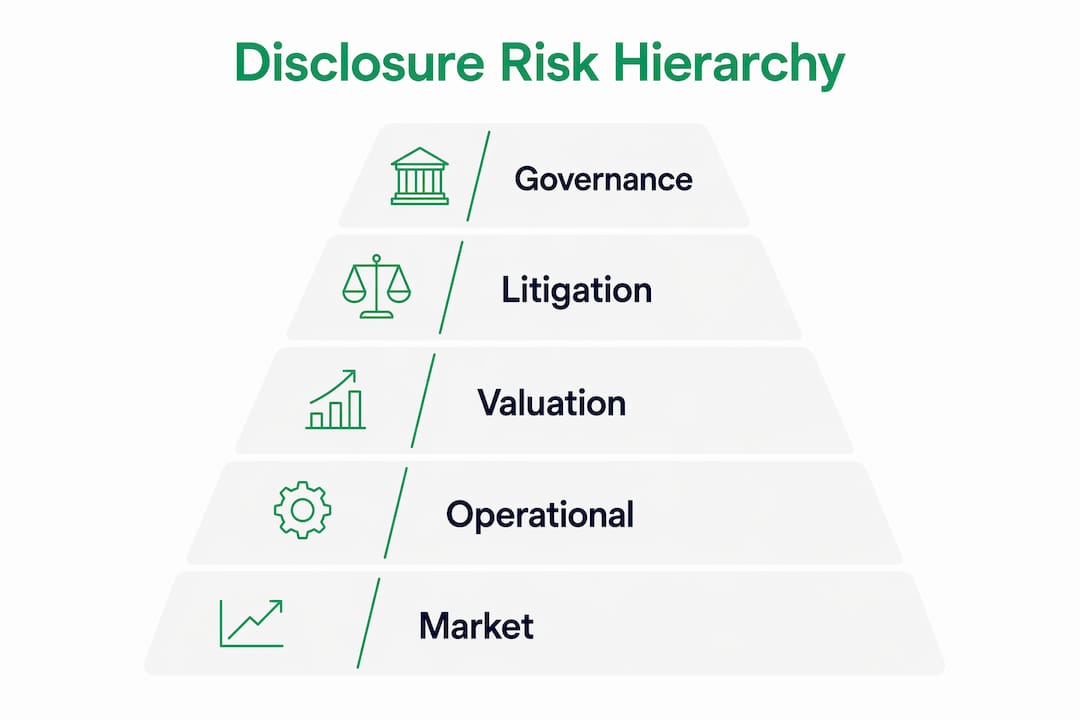
Price volatility and valuation risk top the list. Digital asset markets can move 20% or more in a single trading session. Under ASC 820, entities must discount fair value for illiquid assets affected by lockups, low trading volumes, or transfer constraints. Valuation risk from illiquid markets requires valuation specialists for Level 3 inputs, adding cost and complexity to every reporting cycle.
Cybersecurity and custody risk require explicit disclosure. Auditors and regulators now scrutinize custody methods and private key management practices as part of operational risk assessments. A company that holds digital assets through a third-party custodian faces different risks than one using self-custody. Both scenarios require distinct disclosures.
“Transparent digital asset reporting is a crucial defense against shareholder derivative lawsuits, activist investor scrutiny, and regulatory investigations related to governance failures.” — Board considerations for public companies engaging with digital assets
Governance and litigation risk complete the picture. Disclosure gaps can be used as evidence of mismanagement or breach of fiduciary duties in shareholder derivative suits. Activist investors specifically target companies where business section disclosures conflict with audited financial statements. The importance of digital asset transparency is therefore as much a legal defense strategy as it is a reporting obligation.
How do digital asset disclosures fit into financial reporting and audits?
Placement within corporate filings determines how much scrutiny a disclosure receives. Most digital asset disclosures currently appear in the Risk Factors or Business sections of Form 10-K filings. Those sections sit outside the audited financial statements. That location matters enormously.
Disclosures outside audited areas bypass rigorous verification requirements. A company can describe its digital asset strategy in the Business section without that description being subject to the same audit procedures applied to its balance sheet. When those two sections conflict, the company faces both regulatory inquiry and litigation exposure. Compliance teams must treat consistency between sections as a hard requirement, not a best practice.
The fair value hierarchy under ASC 820 directly shapes audit intensity. The table below shows how asset classification affects the level of audit scrutiny applied.
| Fair value level | Input type | Audit scrutiny |
|---|---|---|
| Level 1 | Quoted prices in active markets | Standard verification |
| Level 2 | Observable inputs, inactive markets | Moderate additional procedures |
| Level 3 | Unobservable inputs, illiquid assets | Valuation specialist required |
Operational disclosures extend beyond financial statements. Auditors now expect companies to document custody arrangements, internal controls over private key management, and access control policies. Finance professionals who treat digital asset financial controls as a back-office concern will find auditors pushing back during fieldwork. The disclosure obligation covers the full operational picture.
Pro Tip: Map every digital asset disclosure in your Form 10-K against its counterpart in the audited financial statements before filing. Any inconsistency between the two will surface during audit review or, worse, during regulatory examination.
What steps improve digital asset disclosure quality?
Improving disclosure quality requires a structured approach, not ad hoc fixes. Finance and compliance professionals should treat disclosure readiness as a continuous program with defined milestones.
-
Conduct a classification audit. Identify every digital asset the organization holds and determine whether each qualifies as a commodity, security, or cash equivalent under current FASB and SEC guidance. Classification drives disclosure form, measurement method, and regulatory reporting path.
-
Review policy gaps against current standards. Compare existing disclosure policies against ASU 2023-08, the SEC’s current risk factor guidance, and post-april 2026 FASB stablecoin decisions. Document every gap and assign remediation ownership with a deadline.
-
Implement internal controls for valuation and custody. Establish documented procedures for fair value measurement, including the criteria used to assign Level 1, 2, or 3 classification. Separately document custody arrangements and private key management protocols. A digital asset operational risk framework provides a practical structure for this work.
-
Train teams handling digital asset disclosures. Finance, legal, and treasury staff need current knowledge of FASB, SEC, and IRS requirements. Training is not a one-time event. Annual renewal is necessary because the regulatory environment changes each year.
-
Establish board-level oversight with regular reporting. The board must receive periodic updates on digital asset exposure, valuation changes, and disclosure status. A board oversight checklist for 2026 gives directors a structured framework for fulfilling their fiduciary duties. Boards that cannot demonstrate active oversight face heightened litigation risk when disclosures are challenged.
-
Conduct a governance gap assessment. Before each annual filing cycle, run a formal governance gap assessment to identify disclosure weaknesses. This process surfaces inconsistencies between operational practices and reported disclosures before auditors or regulators find them.
Key Takeaways
Digital asset disclosures are a legal, financial, and governance obligation that finance and compliance professionals must treat as a core part of their annual reporting program.
| Point | Details |
|---|---|
| Regulatory scope is widening | FASB, SEC, and IRS requirements now cover fair value, classification, custody, and stablecoin reporting. |
| Most companies are underreporting | Only about 9% of S&P 500 companies disclosed digital asset information in their Form 10-K filings. |
| Placement determines audit exposure | Disclosures outside audited financial statements bypass verification and create litigation risk. |
| Operational disclosures are mandatory | Custody methods, private key management, and access controls must be documented and disclosed. |
| Board oversight is a legal defense | Active board-level reporting on digital assets reduces fiduciary liability in shareholder disputes. |
The disclosure gap is a governance crisis in slow motion
I have reviewed disclosure frameworks across a range of enterprise organizations, and the pattern is consistent. Companies acknowledge digital asset exposure in their risk factor sections, then fail to carry that acknowledgment through to their audited financial statements. That disconnect is not a drafting oversight. It reflects a deeper organizational failure to integrate digital asset governance into the core compliance function.
The firms that handle this well share one trait. They treat disclosure as an output of a governance process, not as a standalone filing task. When custody arrangements, valuation methodologies, and internal controls are documented and reviewed on a regular cycle, the disclosure almost writes itself. When those processes do not exist, the disclosure becomes a liability.
The regulatory direction is clear. FASB is expanding its guidance. The SEC is increasing scrutiny. The IRS has a specialized audit document for digital assets. Organizations that wait for a formal enforcement action before building disclosure discipline will pay a far higher price than those that act now. The regulatory risk in digital assets is not theoretical. It is already materializing in audit findings and shareholder challenges.
Standardized disclosures also serve a broader purpose. They connect blockchain-native transparency with the verification standards that traditional financial markets require. That connection is what gives institutional investors the confidence to engage with digital assets at scale. Without it, the asset class remains structurally isolated from mainstream capital allocation.
— Gregg
Wush DARE: built for disclosure readiness
Finance and compliance teams that want a structured path to disclosure readiness have a clear starting point with Wush.
The DARE certification program from Wush provides modular assessments covering custody, valuation, regulatory compliance, and operational controls. Each module maps directly to the disclosure categories that auditors and regulators examine. Teams that complete the program hold credentials that demonstrate active governance, not just intent. For organizations managing digital asset readiness across treasury, legal, and finance functions, DARE provides the framework to close governance gaps before they become filing liabilities. Annual renewal keeps credentials current as FASB, SEC, and IRS requirements evolve.
FAQ
What is a digital asset disclosure obligation?
A digital asset disclosure obligation is a regulatory requirement for companies to report their digital asset holdings, valuations, risks, and governance practices in formal filings such as Form 10-K. The SEC, FASB, and IRS each impose distinct disclosure requirements that apply to different aspects of digital asset ownership and management.
Why do digital asset disclosures matter for audit quality?
Disclosures placed outside audited financial statements bypass verification procedures, creating inconsistency risk. Auditors now examine operational disclosures including custody arrangements and private key management as part of their standard procedures.
What is the fair value hierarchy and why does it affect disclosures?
The fair value hierarchy under ASC 820 classifies digital assets into three levels based on market observability. Level 3 assets in illiquid markets require valuation specialists, which increases audit scrutiny and disclosure complexity.
How do disclosure gaps create litigation risk?
Gaps between business section disclosures and audited financial statements can be used as evidence of mismanagement in shareholder derivative suits. Activist investors specifically target these inconsistencies to challenge board diligence.
What should compliance teams prioritize first to improve disclosures?
Conduct a classification audit to identify every digital asset held and determine its regulatory category under current FASB and SEC guidance. Classification determines the measurement method, disclosure form, and reporting path for each asset.