
Digital Asset Operational Accountability Explained

Digital asset operational accountability is the structured governance and control framework that finance and risk professionals use to identify, manage, and mitigate operational risks across every stage of digital asset management. Unlike traditional financial controls, this framework must account for 24/7 irreversible blockchain transactions, programmable smart contracts, and a regulatory environment that spans the FCA, DORA, and IRS reporting mandates. The industry standard term for this discipline draws from the COSO Internal Control Framework and the Three Lines of Defense model, both adapted specifically for digital asset environments. Getting this right is not optional. A single misdirected withdrawal or infrastructure failure during market stress can produce losses that no reconciliation process can reverse.
What is digital asset operational accountability?
Operational risk in digital asset operations includes transaction errors, system failures, and unauthorized access events that require a control framework aligned with COSO to manage effectively. This means documented policies, qualified personnel, ethical standards, and a clear assignment of ownership for every control activity. The COSO framework provides the structural backbone. The Three Lines of Defense model provides the organizational logic.
The Three Lines of Defense, adapted for digital assets, assigns distinct accountability to three groups. Operational management in the first line owns risks directly through daily control activities: transaction authorization, reconciliation, and change management. The second line, typically risk and compliance functions, monitors whether those controls are working. The third line, internal audit, provides independent assurance that the entire system functions as designed. All three lines require digital asset expertise to avoid oversight becoming ceremonial rather than substantive.

The control environment in digital asset operations extends well beyond policy documents. Custody frameworks require operational controls over private key management, transaction authorization, reconciliation cycles, and disaster recovery procedures. Staffing adequacy for 24/7 market coverage is a control requirement, not a resourcing preference. Firms that treat weekend and overnight coverage as optional discover this during the first major incident.
Pro Tip: Build your control environment documentation to answer one question: if a regulator asked for evidence of who authorized each transaction and why, could you produce it within 24 hours? If not, your accountability framework has a gap.
The practical implementation of digital asset operational accountability requires four numbered control layers:
- Transaction controls covering authorization limits, multi-party approval workflows, and real-time monitoring of transaction status.
- Reconciliation controls matching on-chain records to internal ledgers on a defined cycle, with named owners for exception resolution.
- Change management controls governing updates to wallet configurations, smart contract parameters, and infrastructure components.
- Disaster recovery controls with tested procedures for key recovery, system failover, and operational continuity during infrastructure stress.
Each layer must have a named owner, a documented procedure, and an evidence trail that survives an audit.
What role does segregation of duties play in digital asset accountability?
Segregation of duties in digital asset environments separates transaction initiation, approval, execution, and reconciliation across distinct roles and system architectures. The traditional four-eyes principle assumes human review at each stage. Programmable environments challenge this assumption because smart contracts can execute transactions automatically, collapsing the gap between approval and execution to milliseconds.
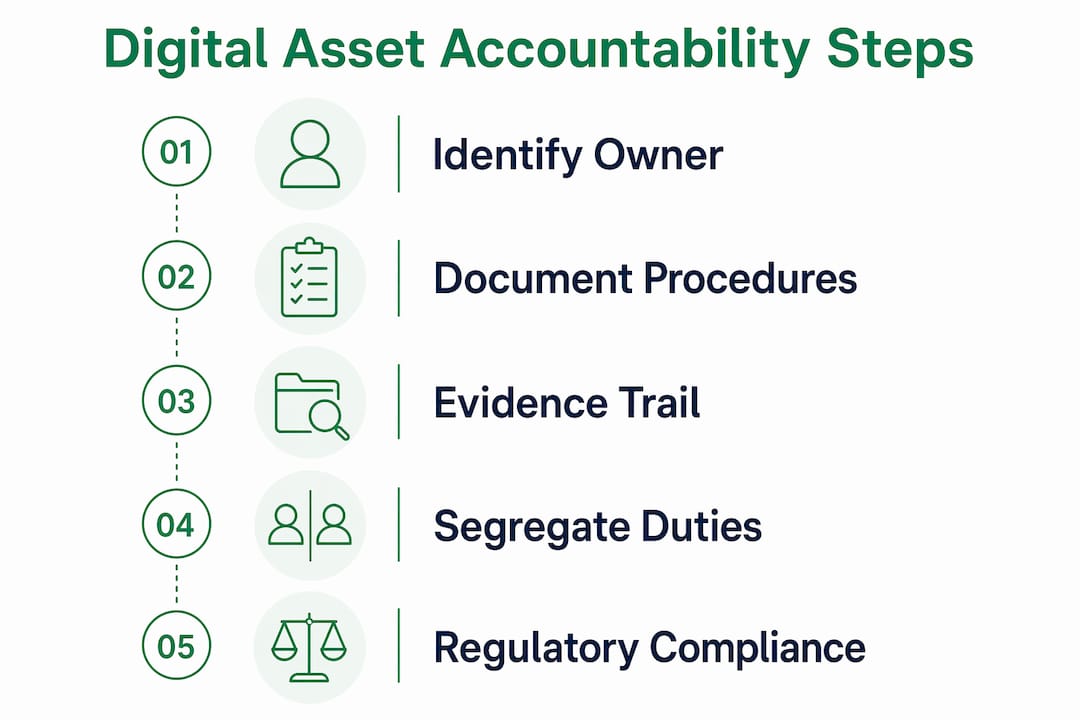
The risks of collapsed controls are concrete. When one person or one automated process can initiate, approve, and execute a transaction without independent review, operational concentration risk becomes severe. A single compromised credential or misconfigured smart contract parameter can drain a wallet before any monitoring alert fires. Programmable environments blur role boundaries in ways that purely human-role segregation cannot address.
Effective segregation in digital asset operations requires both human-role separation and system-architecture controls:
- Wallet permission architecture that enforces role boundaries at the infrastructure level, not just in policy documents.
- Independent monitoring tools with read-only access that cannot be modified by the same personnel who execute transactions.
- Policy layering that requires multi-party approval for transactions above defined thresholds, with audit logs that capture every approval step.
- Smart contract governance that separates the team deploying contract updates from the team authorizing transaction execution.
- Reconciliation independence where the function matching on-chain records to internal ledgers has no authority to initiate or approve transactions.
Pro Tip: In multi-sig environments, signature count alone does not enforce policy. A three-of-five multi-sig arrangement where three signers sit in the same team, report to the same manager, and share access to the same systems provides far less protection than the signature count implies. Design segregation around organizational independence, not just technical thresholds.
Maintaining a comprehensive wallet address register tied to legal entity ownership is the foundation of audit evidence completeness. Without it, reconciliation controls have no reliable baseline, and segregation of duties becomes impossible to verify.
What regulatory frameworks drive digital asset operational resilience?
Three regulatory regimes currently define the minimum standard for operational accountability in digital asset management. Understanding each one is necessary for any finance or risk professional operating in this space.
The FCA operational resilience regime requires boards to review self-assessments that document the firm’s approach to operational resilience, including impact tolerances, scenario test results, and remediation plans with named owners. FCA supervisory observations show that boards must actively challenge remediation plans based on clear evidence, not simply approve high-level summaries. Firms where second and third line input is absent from resilience governance consistently produce weaker outcomes under stress. The FCA expects named remediation owners and clear target dates, not aspirational commitments.
The EU Digital Operational Resilience Act places management body accountability at the center of ICT risk governance. Under DORA, management bodies must define, approve, and actively oversee ICT risk frameworks, maintain adequate knowledge of digital operational risks, and allocate appropriate budgets for resilience. This is not a delegation to the technology team. DORA explicitly assigns responsibility to the management body for risk tolerance decisions, business continuity arrangements, and staff training on digital operational resilience. Firms that treat DORA as an IT compliance exercise will fail supervisory scrutiny.
In the United States, the IRS requires brokers to report digital asset transactions on Form 1099-DA starting in 2025, with phased cost basis reporting beginning in 2026. Reporting applies even when no taxable gain results from a transaction. This drives a direct operational requirement: auditable data pipelines with completeness controls that capture every transaction, every counterparty, and every cost basis record. Firms without those controls face both regulatory exposure and the practical impossibility of reconstructing accurate records after the fact.
| Regulatory framework | Accountability requirement | Key operational implication |
|---|---|---|
| FCA operational resilience | Board review of self-assessments with named remediation owners | Second and third line must provide independent input to resilience governance |
| EU DORA | Management body defines and oversees ICT risk framework | Budget allocation and training are board-level responsibilities |
| IRS Form 1099-DA | Broker reporting of all digital asset transactions from 2025 | Auditable data pipelines with completeness controls are mandatory |
For firms operating across jurisdictions, the enterprise crypto risk oversight challenge compounds. Each regime has distinct documentation requirements, and the evidence standard for each is higher than most firms currently meet.
How does programmability change operational accountability frameworks?
Smart contracts and automated transaction execution create accountability gaps that traditional control frameworks were not designed to close. Automated rules engines are necessary because multi-sig alone does not guarantee policy enforcement. A transaction that meets the signature threshold but violates a counterparty restriction or exceeds a risk limit will still execute unless a policy engine intercepts it before broadcast.
The practical implications for accountability frameworks are significant:
- Policy enforcement engines must be integrated directly into the transaction infrastructure, not applied as a post-execution review layer.
- Automated reconciliation that sweeps position data into ERP systems reduces manual error risk and creates a continuous audit trail rather than a periodic snapshot.
- Real-time monitoring with alerts tied to named escalation owners closes the gap between automated execution and human oversight.
- Smart contract change governance requires the same rigor as production code deployment in regulated financial systems, including independent review and documented approval.
Legal control analysis ties operational accountability directly to factual control mechanisms: private key possession and smart contract authorization paths determine who actually controls a digital asset, regardless of what the policy document says. Accountability frameworks must map to those actual control paths, not to organizational charts.
Automation reduces manual error risk and improves accountability by enforcing rules within transaction layers and automating reporting. The benefit is real, but automation without clear ownership creates a different problem. When an automated process fails or produces an unexpected result, the accountability question shifts from “who approved this transaction” to “who owns this system and its outputs.” That question must have a documented answer before the system goes live, not after the first incident.
For finance teams building digital asset business continuity procedures, the programmability dimension adds a specific requirement: recovery procedures must account for smart contract state, not just system availability.
Key takeaways
Operational accountability for digital assets requires governance that maps to actual control paths, not organizational assumptions, and must satisfy FCA, DORA, and IRS standards simultaneously.
| Point | Details |
|---|---|
| COSO and Three Lines of Defense | Apply both frameworks with digital asset expertise at every line to prevent ceremonial oversight. |
| Segregation beyond multi-sig | Design role and architecture separation based on organizational independence, not signature counts alone. |
| Regulatory accountability is board-level | FCA, DORA, and IRS each assign accountability to management bodies, not just compliance teams. |
| Programmability demands policy engines | Integrate automated rules enforcement into transaction infrastructure before execution, not as a post-trade review. |
| Audit evidence completeness | Maintain a comprehensive wallet register tied to legal entities as the foundation for all reconciliation and audit work. |
Why governance depth matters more than governance breadth
The most common failure pattern I see in digital asset governance is not the absence of controls. It is the presence of controls that look complete on paper but have no operational depth. A firm can have a Three Lines of Defense policy, a multi-sig wallet setup, and a DORA compliance project running simultaneously, and still have a governance framework that will collapse under the first serious incident.
The reason is almost always the same: second and third line functions are involved at the design stage and then disappear from day-to-day operations. Remediation plans have owners on a spreadsheet but no one with authority to escalate when a deadline slips. The digital asset governance gap is not a missing policy. It is a missing habit of continuous challenge.
What actually works is embedding accountability into operational rhythms. That means named owners reviewing exception reports weekly, not quarterly. It means internal audit with genuine digital asset expertise, not a team that reads the policy and checks the box. It means boards that ask hard questions about remediation evidence, not boards that receive a summary and move on.
The accountability frameworks discussed in this article are not complicated in concept. They are difficult in practice because they require sustained organizational commitment, not a one-time implementation project. Firms that treat operational accountability as a certification exercise will pass the assessment and fail the incident.
— Gregg
Strengthen your digital asset accountability framework with DARE
Wush built the Digital Asset Readiness Evaluation specifically for finance and risk professionals who need more than a policy checklist. DARE provides a structured certification framework that maps directly to the governance requirements covered in this article, including Three Lines of Defense implementation, segregation of duties design, and regulatory alignment with FCA, DORA, and IRS standards. The modular assessment process identifies specific gaps in your current operational controls and produces credentials backed by blockchain verification. If your organization is building or stress-testing its digital asset accountability framework, the DARE platform provides the independent evaluation standard that regulators and boards increasingly expect to see.
FAQ
What is operational accountability in digital asset management?
Operational accountability in digital asset management is the assignment of clear ownership, documented controls, and audit evidence across every stage of digital asset operations, from transaction authorization to reconciliation and disaster recovery. It draws on the COSO framework and the Three Lines of Defense model adapted for blockchain and programmable asset environments.
How does DORA affect digital asset operational accountability?
DORA requires management bodies to define, approve, and actively oversee ICT risk frameworks, including budget allocation and staff training on digital operational resilience. This places accountability at board level, not just within technology or compliance teams.
Why is multi-sig insufficient for segregation of duties?
Multi-sig enforces a signature count but does not enforce policy rules such as counterparty restrictions or transaction limits. Automated policy enforcement engines integrated into the transaction infrastructure are required to close that gap.
What does the IRS Form 1099-DA require from operations teams?
Brokers must report all digital asset transactions starting in 2025, with cost basis reporting phased in from 2026, regardless of whether a taxable gain occurred. This requires auditable data pipelines with completeness controls that capture every transaction and cost basis record.
How do you build a complete audit trail for digital assets?
Maintaining a comprehensive register of all wallet addresses tied to legal entity ownership is the foundation. Pair that with automated reconciliation cycles, named exception owners, and real-time monitoring to produce an audit trail that survives regulatory scrutiny.