
How to Build Enterprise Crypto Risk Oversight

Most executives assume crypto risk oversight means watching token prices and running IT security scans. That assumption is expensive. Enterprise crypto risk oversight is the governance process that defines who is accountable for crypto-related risks and how those risks are identified, assessed, controlled, monitored, tested, and reported so that activities remain compliant and operationally secure. The scope is far broader than a market dashboard or a firewall. This guide walks you through what genuine oversight looks like, why the gaps are so costly, and how to build a framework your board and regulators can actually examine.
Table of Contents
-
Metrics that matter: Beyond price risk to regime-aware oversight
-
What most organizations get wrong about crypto risk oversight
Key Takeaways
| Point | Details |
|---|---|
| Oversight goes beyond price risk | Effective frameworks address operational, cyber, and regulatory risks, not just market movements. |
| Pillars shape resilient oversight | Policy, controls, testing, compliance, and scenario planning are essential for enterprise readiness. |
| Regulatory programs are risk-based | Current guidance focuses on adapting proven risk control principles to crypto’s unique challenges. |
| Metrics must fit crypto regimes | Go beyond volatility and use stress tests and dynamic dashboards for ongoing monitoring. |
Defining enterprise crypto risk oversight
Having established why crypto oversight is so often misunderstood, we need a solid working definition before going further. The term “oversight” gets used loosely, but in an enterprise context it means something specific and demanding.
Enterprise crypto risk oversight is the governance process that defines accountability, risk identification, control, monitoring, and reporting across every function that touches digital assets. That includes treasury, legal, compliance, information security, and operations, not just the trading desk or the IT department. If any one of those functions operates in isolation, the oversight framework has a gap.
Board-level visibility is not optional. Regulators and auditors expect to see regular reporting that goes beyond price exposure. Scenario planning, stress test results, and audit-ready evidence of controls should reach senior leadership on a scheduled cadence. The board does not need to understand every technical detail, but it does need to understand what could go wrong, how likely that is, and what the organization is doing about it.
The risks that matter most in enterprise crypto are broader than most teams initially expect:
-
Custody failures: Loss of private keys, insolvency of a third-party custodian, or unauthorized access to wallets
-
Operational breakdowns: Smart contract bugs, node outages, or failed transaction settlements
-
Legal and regulatory exposure: Operating outside licensing requirements, inadequate AML controls, or misclassification of assets
-
Counterparty risk: Exchange insolvency, liquidity crises, or undisclosed leverage at partner firms
-
Reputational risk: Association with sanctioned entities or public incidents tied to poor governance
Pro Tip: Avoid the trap of assigning crypto oversight exclusively to IT security or to a single compliance officer. Effective oversight requires a cross-functional team with clear ownership at each layer of the risk stack. Assign named accountable owners to each risk category and build escalation paths before you need them.
“Oversight is only as strong as the reporting lines that connect operational teams to board-level decision-makers. Without that connection, controls exist on paper but not in practice.”
Building your enterprise crypto risk readiness starts with this definition and these accountability structures. Everything else builds on top.
Key pillars and practical framework
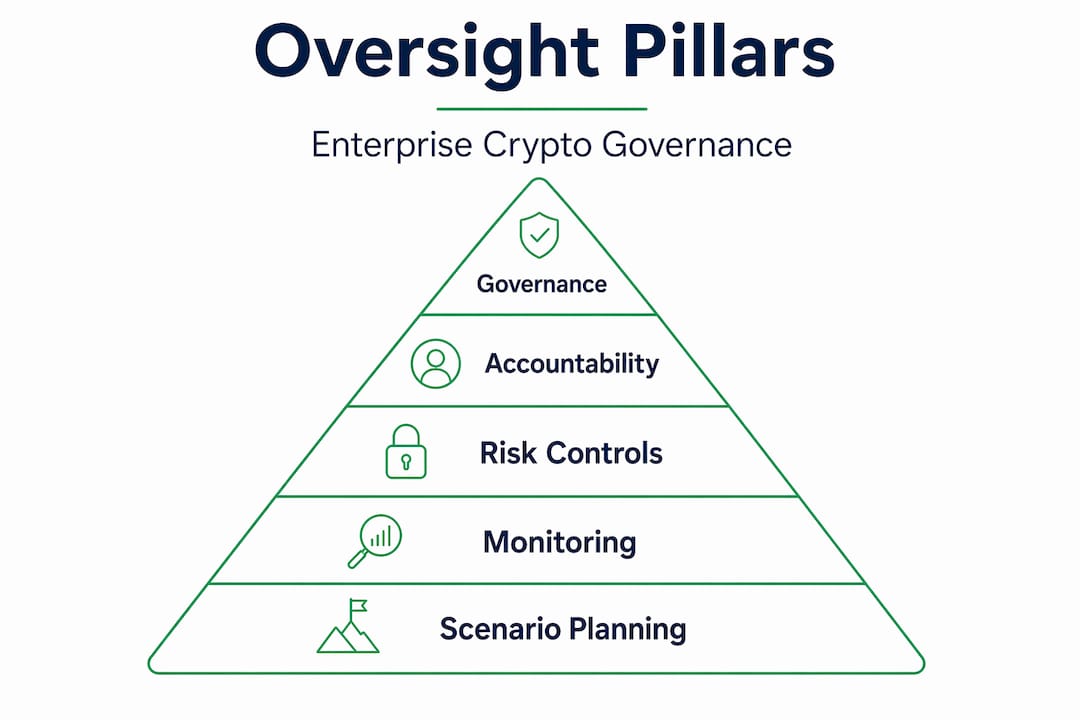
With a definition in place, let’s break down the architecture of an effective oversight framework for digital assets. A practical enterprise oversight methodology operationalizes risk through policies, controls, stress testing, compliance, and incident preparedness. These five pillars interlock, and weakness in any one of them undermines the others.
The five pillars of enterprise crypto risk oversight:
-
Policies and ownership: Written policies that name specific owners for each risk domain. These are not generic IT policies repurposed for crypto. They address key management, asset classification, transaction authorization thresholds, and vendor due diligence for custodians and exchanges.
-
Custody and operational controls: Multi-signature wallet requirements, cold storage thresholds, reconciliation procedures, and segregation of duties for transaction approval. These controls prevent both internal fraud and external theft.
-
Risk limits and stress testing: Defined exposure limits by asset, counterparty, and concentration. Stress tests should model not just price drops but also liquidity crises, custodian failures, and regulatory freezes. Run these at least quarterly.
-
Compliance controls and evidence: Documented AML/CFT procedures, transaction monitoring, sanctions screening, and audit trails. Evidence must be retrievable on short notice for regulatory examination.
-
Incident and cyber resilience: Incident response playbooks specific to crypto failure modes, tested recovery procedures, and defined communication protocols for regulators, counterparties, and the board.
The table below shows how crypto-specific requirements differ from traditional financial oversight:
| Oversight area | Traditional finance | Crypto-specific requirement |
|---|---|---|
| Asset custody | Bank or broker holds assets | Private key management, multi-sig wallets, cold storage |
| Settlement finality | T+2 with reversibility | On-chain, near-instant, largely irreversible |
| Counterparty vetting | Credit ratings, ISDA agreements | Exchange solvency, proof of reserves, on-chain audit |
| Regulatory reporting | Standardized forms, known timelines | Evolving requirements, jurisdiction-specific rules |
| Incident recovery | FDIC insurance, wire recalls | No insurance backstop, key recovery procedures |
| Stress testing | Historical market data | Regime-aware models, tail-risk scenarios |
Operationalizing each pillar requires assigning a named owner, defining a reporting cadence, and establishing a test schedule. The digital assets oversight framework you build should be documented well enough that a new compliance officer or external auditor can follow it without a guided tour.
Cyber threats, technical risks, and scenario planning
Building on the framework, let’s examine the evolving frontier of cyber and technical risks distinct to crypto operations. Generic IT risk checklists were not designed with blockchain infrastructure in mind. They miss the attack surfaces that are unique to digital asset management.

Crypto risk oversight for cyber adversary threats benefits from threat-model taxonomies that map real-world attacker behavior to digital asset management systems. MITRE’s AADAPT framework, for example, catalogs how adversaries target wallets, signing ceremonies, node infrastructure, and oracle feeds. This is a more precise starting point than a generic cybersecurity framework applied to crypto by analogy.
The most common crypto-specific incident types your scenario planning must address include:
-
Custodian insolvency: A third-party custodian files for bankruptcy or freezes withdrawals. Your response plan must include asset recovery procedures, legal escalation steps, and a communication plan for stakeholders.
-
Blockchain network outages: A major chain experiences a halt or reorganization. Transactions may be delayed or reversed. Your operational playbook must define how to pause activity and communicate with counterparties.
-
Oracle failures: Price feeds used by DeFi protocols or internal valuation systems report incorrect data. This can trigger incorrect liquidations or mispriced hedges.
-
Smart contract exploits: Vulnerabilities in on-chain code are exploited to drain funds. Your controls must include pre-deployment audits and exposure limits on any single protocol.
-
Insider threats: Employees with signing authority collude or act unilaterally. Multi-signature requirements and separation of duties are the primary controls here.
Pro Tip: Update your incident playbooks at least once a year. The crypto threat landscape changes faster than most enterprise risk calendars. A playbook written in 2024 may not account for the specific failure modes that emerged in 2025 or 2026. Schedule an annual review that includes both your IT security team and your compliance function.
Scenario planning must also account for regulatory change. A jurisdiction where your custodian operates may introduce new licensing requirements, asset restrictions, or reporting mandates on short notice. Build regulatory change scenarios into your annual stress testing cycle, not just market and technical scenarios.
Complying with regulations and programmatic controls
With technical risks mapped, regulatory obligations come next, and they drive much of what must be covered in oversight efforts. The compliance layer is where many enterprises underinvest until a regulator or an incident forces the issue.
Crypto oversight includes compliance program design, requiring written AML/CFT programs, a U.S.-based compliance officer, tailored training, and mandatory testing. These are not suggestions. Under the GENIUS Act’s proposed rules and existing Bank Secrecy Act obligations, these elements are minimum requirements for regulated businesses handling digital assets.
Here is a practical sequence for establishing compliant crypto oversight:
-
Appoint a qualified compliance officer. This person must be based in the United States, have authority to act independently, and report directly to senior leadership or the board.
-
Draft a written AML/CFT program. The program must be tailored to your specific business model, not copied from a generic template. It should address customer due diligence, transaction monitoring thresholds, and suspicious activity reporting.
-
Implement transaction monitoring. Automated monitoring tools should flag unusual patterns, large transactions, and activity involving high-risk jurisdictions or counterparties.
-
Conduct sanctions screening. Every counterparty, wallet address, and transaction must be screened against OFAC and other relevant sanctions lists before execution.
-
Train staff on a scheduled basis. Training must be tailored to the roles that interact with digital assets. A treasury analyst and a software engineer have different risk exposures and need different training content.
-
Test the program regularly. Independent testing, either by an internal audit function or an external reviewer, must occur on a defined schedule. Document the results and remediate findings promptly.
“US agencies frame oversight around existing risk principles; no entirely new supervisory expectations are created. The expectation is that you apply rigorous, evidence-driven risk management to digital assets the same way you would to any other material business activity.”
This is actually good news for compliance teams. You are not starting from scratch. You are extending proven frameworks to a new asset class, with some important modifications for crypto-specific risks.
Metrics that matter: Beyond price risk to regime-aware oversight
To round out the framework, let’s zero in on which metrics really drive resilient enterprise oversight in volatile and shifting markets. Price volatility is the metric most boards ask about first. It is also the least sufficient metric for genuine risk oversight.
Crypto risk is not just price volatility. Tail-risk and drawdown dynamics can worsen or remain asymmetric across different market regimes. In other words, a standard value-at-risk model calibrated on calm market data will systematically underestimate losses during stress periods. Bitcoin’s maximum drawdown in high-uncertainty regimes has historically exceeded 70%, a figure that a simple volatility metric would not predict or capture.
The metrics that belong in a mature crypto risk dashboard include:
-
Maximum drawdown by asset and regime: Track the worst-case loss from peak to trough, segmented by market condition. This gives the board a realistic picture of tail exposure.
-
Concentration metrics: What percentage of total digital asset exposure sits in a single asset, custodian, or protocol? Concentration limits should trigger automatic review.
-
Liquidity coverage ratio for digital assets: How quickly can holdings be converted to fiat without significant market impact? This matters most during stress events.
-
Counterparty health indicators: Proof-of-reserves data, credit signals, and operational status updates for every custodian and exchange you use.
-
Regulatory change index: A simple tracker of pending regulatory actions in every jurisdiction where you operate. This feeds directly into scenario planning.
Dynamic reporting means your risk dashboard updates as conditions change, not just on a monthly schedule. Build alert thresholds that trigger escalation when any metric crosses a defined boundary. This is how oversight becomes proactive rather than reactive.
What most organizations get wrong about crypto risk oversight
After outlining the procedural “what” and “how,” here is where most organizations veer off course, and what you can do differently.
The most common mistake is treating crypto risk oversight as either a market risk problem or an IT security problem. Executives assign it to the trading desk or the CISO and consider it handled. Then a regulatory examination or an operational incident reveals that compliance, legal, and operations were never integrated into the oversight structure. The controls existed in silos, and the gaps between them were where the real risk lived.
Mature approaches treat crypto risk oversight as a cross-functional governance and control environment that regulators can examine end-to-end. That phrase “end-to-end” is the key. Regulators do not examine one function in isolation. They trace a transaction or a decision from initiation through approval, execution, settlement, reporting, and audit. If any link in that chain is weak or undocumented, the examination will find it.
The second mistake is building controls that are static. The crypto risk landscape evolves faster than annual policy review cycles. Regulatory guidance changes. New attack vectors emerge. Custodians fail. The organizations that manage this well build processes designed to flex, not just frameworks designed to document. That means scheduled reviews triggered by external events, not just the calendar.
The third mistake is underestimating board-level engagement. Boards that receive a quarterly price chart and a brief compliance update are not exercising genuine oversight. They need scenario results, control test outcomes, and clear escalation paths. Executive insights on crypto oversight consistently show that organizations with strong board engagement respond faster and more effectively to both regulatory inquiries and operational incidents.
Don’t chase controls. Build the governance process that generates, tests, and evolves controls continuously. That is the difference between compliance theater and genuine risk management.
Ready to assess your crypto risk oversight maturity?
If this guide has surfaced gaps in your current oversight approach, the next step is a structured assessment that gives you a clear picture of where you stand and what to address first.

The Digital Asset Readiness Evaluation (DARE) from dare.wush.co is built specifically for this moment. It provides a modular, board-ready assessment of your organization’s crypto governance maturity across custody, compliance, risk management, legal controls, and operational security. The DARE certification gives your team a credentialed, independently verified baseline that regulators and auditors recognize. Annual renewal ensures your oversight posture stays current as the regulatory and threat landscape shifts. If your organization is serious about digital assets oversight evaluation, this is where structured progress begins.
Frequently asked questions
What risks does enterprise crypto oversight cover beyond price volatility?
Oversight frameworks cover operational, technical, regulatory, and custody risks, not just market movements. Governance and accountability procedures for identifying and managing these risks are the foundation of any compliant enterprise program.
Is new crypto risk oversight required for banks under US regulations?
US agencies expect banks to use established risk-management principles for crypto without creating entirely new supervisory requirements. Existing risk principles apply, but they must be adapted rigorously to the specific characteristics of digital assets.
How do companies plan for unique crypto failures like custodian insolvency?
Companies must scenario-plan for crypto-specific failures and integrate these risks directly into oversight playbooks. Operational failure modes unique to crypto supply chains, including custodian insolvency and regulatory change, must be built into annual stress testing cycles.
What are the minimum controls for a compliant crypto oversight program?
Enterprises need written AML/CFT programs, a qualified compliance officer, employee training, and mandatory testing based on risk. These program requirements are codified under proposed GENIUS Act rules and existing Bank Secrecy Act obligations for regulated businesses handling digital assets.