
What Digital Asset Compliance Signals to Investors

Digital asset compliance is the demonstration that a firm adheres to all relevant financial, regulatory, and governance standards specific to cryptocurrencies and tokens, signaling credibility and operational reliability to investors. What does digital asset compliance signal investors? At its core, it signals management quality, risk discipline, and the capacity to survive regulatory scrutiny. Crypto-related enforcement actions resulted in over $4.7 billion in global fines and penalties in 2025. That number tells investors exactly what non-compliance costs. With the EU’s MiCA framework and the U.S. GENIUS Act reshaping the rules in 2026, compliance has moved from a legal checkbox to a primary investment signal.
What does digital asset compliance signal investors about firm quality?
Compliance signals investor confidence by revealing how well a firm manages risk, governs its operations, and prepares for regulatory change. Investors treat compliance not as a legal formality but as a proxy for management discipline. A firm that maintains clean AML and KYC frameworks, holds proper licenses, and documents its governance structure is telling investors it can be trusted with capital.
The specific compliance areas investors examine fall into five categories. Each one carries a distinct signal.

| Compliance area | What investors look for |
|---|---|
| Licensing and registration | Active licenses in all operating jurisdictions, no gaps or lapses |
| AML/KYC frameworks | Documented procedures, trained staff, and regular audits |
| Governance structure | Defined roles including MLRO, clear reporting lines, board oversight |
| Regulatory track record | History of incident handling, timely resolution, and regulator communication |
| Scalability of compliance systems | Capacity to handle growth from thousands to hundreds of thousands of customers |
A compliance framework scalable from thousands to hundreds of thousands of customers is a direct valuation differentiator. Investors know that a system effective at small scale but inadequate at large scale creates operational failure risk. That risk shows up as a discount on the deal.
Pro Tip: When preparing for investor due diligence, map your compliance controls against each of these five areas and document gaps before investors find them. Self-identified gaps with remediation plans read as governance maturity, not weakness.
How do investors interpret compliance signals in due diligence?
Compliance is the hidden dealbreaker in institutional due diligence. Investors use it as a proxy for management quality and operational discipline. A firm with clean compliance documentation signals that its leadership understands risk and builds systems that last.
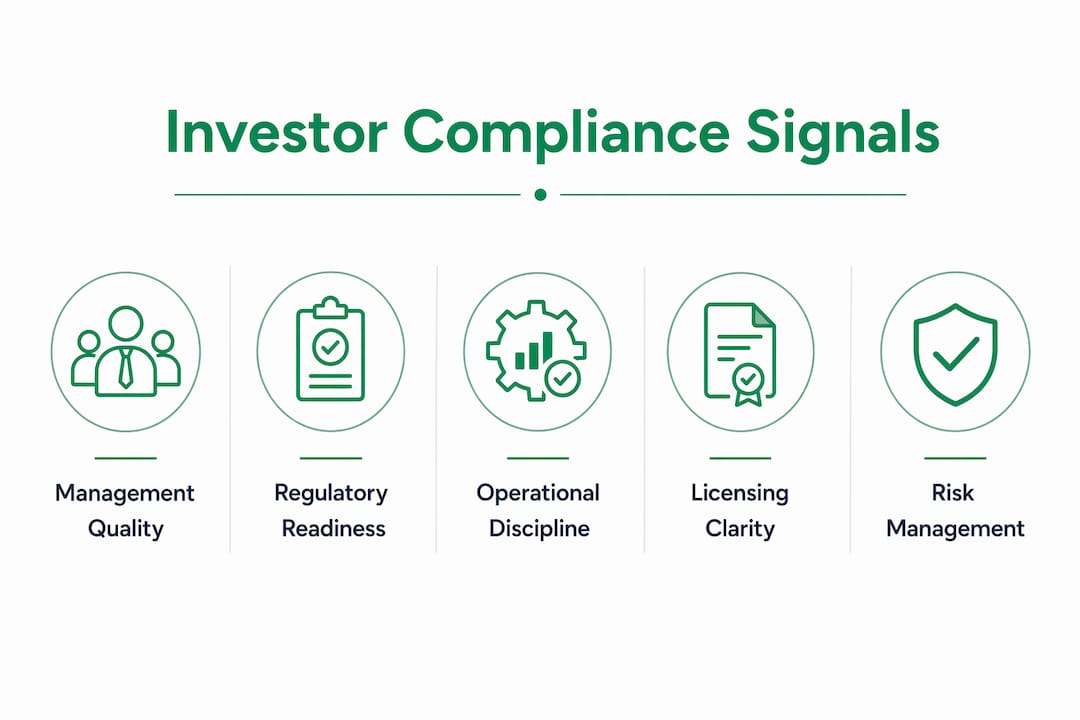
The impact of poor compliance on deal outcomes is direct and measurable. Weak or inconsistent compliance leads investors to apply risk discounts on valuation multiples, resulting in reduced offers or deal terminations. That means a firm with a strong product but poor compliance controls will receive a lower valuation than a less innovative firm with clean governance.
Investors follow a specific sequence in their compliance review:
- Initial screening. Investors check licensing status and jurisdiction coverage before any deeper engagement. Missing licenses in key markets end conversations early.
- Documentation review. AML/KYC policies, governance charters, and incident logs are requested and reviewed for completeness and consistency.
- Management interviews. Investors probe the MLRO and senior leadership on how compliance decisions are made and escalated.
- Scalability assessment. Investors test whether compliance systems can handle the growth trajectory the firm is projecting.
- Track record verification. Any past regulatory actions, fines, or enforcement notices are examined for how the firm responded and resolved them.
Investors conduct compliance due diligence 6–12 months before funding events. Last-minute remediation attempts during term sheet negotiation are read as governance red flags, causing valuation downgrades or lost deals entirely.
Pro Tip: Start your compliance audit 12 months before your target funding date. Investors notice the difference between firms that built compliance into their operations and firms that patched it together under pressure.
Investors also carry personal liability concerns. Post-investment, they assume professional responsibility for the firms they back. Regulatory failure becomes a reputational and liability risk for the investor, not just the firm. That reality makes compliance sensitivity a self-protective behavior, not just a preference.
What are the 2026 regulatory frameworks investors are watching?
The regulatory environment in 2026 has set concrete compliance benchmarks that investors now use as minimum standards. Two frameworks dominate investor attention.
The EU’s MiCA regulation became enforceable on july 1, 2026. MiCA requires crypto asset service providers to hold standardized licenses, maintain capital reserves, and meet consumer protection standards across all EU member states. For investors, MiCA compliance signals that a firm can operate in the world’s largest regulated digital asset market.
The U.S. GENIUS Act, signed in july 2025, targets stablecoins specifically. It requires 1:1 reserve backing and imposes standardized licensing for stablecoin issuers. Investors evaluating stablecoin projects now treat GENIUS Act compliance as a baseline, not a differentiator.
| Regulation | Jurisdiction | Key investor-focused requirement |
|---|---|---|
| MiCA | European Union | Standardized licensing, capital reserves, consumer protection |
| GENIUS Act | United States | 1:1 stablecoin reserve backing, issuer licensing |
| APAC frameworks | Singapore, Hong Kong, Japan | Operational maturity, custody standards, AML enforcement |
APAC jurisdictions add a third dimension. Institutions in Singapore, Hong Kong, and Japan emphasize operational maturity and smooth compliance execution beyond merely obtaining licenses. That shift shapes competitive positioning. A firm licensed in Singapore that cannot demonstrate clean operational compliance will still lose deals to a competitor that can.
Evolving regulation increases investor sensitivity to compliance risk because the cost of being wrong keeps rising. Firms that track regulatory developments and update their controls proactively signal to investors that they will not be caught off guard by the next rule change. Understanding regulatory risk in digital assets is now a core competency investors expect from management teams.
How can firms operationalize compliance to attract investors?
Compliance that attracts investors is not a policy document. It is a functioning system embedded in daily operations. The era of “innovation first” is over. Compliance now forms part of the essential technology stack that investors value.
Firms that want to signal credibility to investors should build compliance into their operations across these dimensions:
- Automate where possible. Programmable compliance embedded into smart contracts and blockchain analytics automates regulatory adherence, provides auditability, and reduces human error. Sophisticated investors prefer automated programmable compliance over manual siloed reporting.
- Document everything. Governance decisions, compliance reviews, incident responses, and audit trails must be recorded and retrievable. Investors will ask for them.
- Assign clear ownership. Every compliance function needs a named owner. The MLRO role is the most visible, but custody controls, data protection, and operational risk each need accountable individuals.
- Test scalability. Run stress scenarios against your compliance systems at 10x your current transaction volume. If the system breaks, fix it before investors find out.
- Prepare a compliance data room. Organize licenses, policies, audit reports, and incident logs into a structured format. Investors conducting digital asset compliance readiness reviews expect this material to be ready on request.
Good compliance also improves financing speed. Poor compliance delays financing rounds, increases capital costs, triggers penalties, and consumes management time. The inverse is equally true. Firms with clean compliance records close rounds faster and on better terms.
Operational smoothness and engineering capability beyond licensing are the new areas of institutional competition in digital asset compliance. Firms that treat compliance as a competitive capability, not a cost center, attract better investors and retain them longer.
Key Takeaways
Digital asset compliance signals investor confidence by demonstrating management quality, regulatory readiness, and the operational discipline required to scale safely.
| Point | Details |
|---|---|
| Compliance signals management quality | Investors treat AML, KYC, and governance controls as proxies for leadership discipline. |
| Timing matters in due diligence | Investors review compliance 6–12 months before funding; last-minute fixes destroy deal terms. |
| 2026 regulations set new baselines | MiCA and the GENIUS Act define minimum compliance standards investors now expect globally. |
| Scalability is a valuation driver | Compliance systems that cannot handle growth create risk discounts on deal valuations. |
| Automation earns investor trust | Programmable, auditable compliance built into technology stacks outperforms manual reporting. |
Compliance is the dealbreaker nobody talks about
I have watched institutional investors walk away from genuinely impressive digital asset firms because the compliance room was a mess. Not because the product failed. Not because the market was wrong. Because the MLRO could not produce a clean incident log, or the AML policy had not been updated since the firm was half its current size.
The conventional wisdom says investors back great teams and great ideas. That is true, but it misses the filter that comes before the pitch deck gets read twice. Compliance is that filter. Investors assume professional responsibility the moment they wire funds. They are not going to put their own reputation at risk for a firm that cannot demonstrate it takes regulatory obligations seriously.
What I find most telling is the shift in investor language over the past two years. Institutional allocators are no longer asking “are you compliant?” They are asking “show me how your compliance scales.” That is a fundamentally different question. It moves compliance from a legal checkbox to an operational capability assessment. Firms that understand this distinction prepare differently. They build compliance into their technology stack, assign real ownership, and document their controls as if an investor is always watching. Because one is.
The firms that close the best rounds in 2026 are not the most innovative. They are the most operationally mature. Early compliance investment pays off in faster closes, lower capital costs, and investors who stay through the hard parts. That is the real return on compliance.
— Gregg
How DARE certification supports investor-ready compliance
Firms preparing for investor scrutiny need more than internal policies. They need a verified, independent signal that their compliance controls meet recognized standards.
Wush offers the DARE certification (Digital Assets Readiness Evaluation), an independent assessment that covers custody, regulatory compliance, risk management, legal controls, and operational governance. DARE gives firms a structured framework to identify gaps, remediate them, and earn a credential that investors can verify. For investors, a DARE-certified firm signals that its compliance posture has been independently tested, not self-reported. For firms, DARE accelerates due diligence by organizing compliance evidence into a format investors already trust. Explore the full DARE platform to see how certification maps to investor expectations in 2026.
FAQ
What does digital asset compliance signal to investors?
Digital asset compliance signals management quality, regulatory readiness, and operational discipline. Investors treat it as a proxy for how well a firm manages risk and governs its operations.
How does poor compliance affect investment valuations?
Weak compliance leads investors to apply risk discounts on valuation multiples, resulting in lower offers or deal terminations. Poor compliance also delays financing rounds and increases the cost of capital.
When do investors review compliance during due diligence?
Investors conduct compliance due diligence 6–12 months before funding events. Last-minute remediation attempts are treated as governance red flags that reduce valuations or end deals.
What compliance areas matter most to digital asset investors?
Investors focus on licensing clarity, AML/KYC frameworks, governance structure, regulatory track record, and the scalability of compliance systems to handle customer growth.
How do MiCA and the GENIUS Act affect investor expectations?
MiCA requires standardized licensing and capital reserves across the EU, while the GENIUS Act mandates 1:1 reserve backing for stablecoins in the U.S. Both frameworks set the minimum compliance benchmarks investors now expect from any serious digital asset firm.