
Digital Asset Operational Risk Framework for Finance Pros

Most risk managers assume that blockchain’s technical security is the main line of defense against losses in digital asset operations. That assumption is wrong. Operational weaknesses cause the majority of institutional losses in digital assets, not blockchain consensus failures. A well-designed digital asset operational risk framework addresses the real vulnerabilities: process gaps, custody failures, vendor dependencies, and human error. This article breaks down the categories, governance structures, regulatory requirements, and practical implementation steps that risk managers and compliance officers need to build frameworks that actually hold up.
Table of Contents
- Key takeaways
- Defining operational risk in digital assets
- Framework structure and governance models
- When operational risk becomes a real incident
- Regulatory expectations for operational risk
- Implementing a framework in practice
- My perspective on where most frameworks fall short
- Strengthen your operational risk posture with DARE
- FAQ
Key takeaways
| Point | Details |
|---|---|
| Operational risk dominates losses | Most institutional losses stem from process and management failures, not blockchain technical errors. |
| Framework structure matters | A COSO and Three Lines of Defense model adapted for digital assets provides the foundation for sound governance. |
| Regulatory mandates are tightening | Jurisdictions like the UK and UAE now require documented impact tolerance and biannual operational risk reassessments. |
| Automated controls are critical | Incident response in DeFi environments depends on automated governance modules, not manual intervention. |
| Continuous monitoring is non-negotiable | Key Risk Indicators and typology-driven on-chain analysis must replace static, list-based compliance screening. |
Defining operational risk in digital assets
In traditional finance, operational risk covers losses from failed internal processes, people, systems, or external events. That definition carries over to digital assets, but the characteristics of crypto markets amplify every category. Transactions are irreversible. Markets run 24 hours a day, seven days a week. The technical complexity of smart contracts, multi-chain infrastructure, and self-custody arrangements introduces failure modes that simply do not exist in conventional banking.
The digital asset operational risk categories that matter most to institutions are:
- Technology risk: Smart contract vulnerabilities, wallet misconfigurations, API failures, and infrastructure outages.
- People risk: Key person dependency on private key holders, inadequate training on protocol-specific controls, and insider threat exposure.
- Process risk: Transaction authorization gaps, reconciliation failures across chains, and inadequate change management for protocol upgrades.
- External event risk: Regulatory changes that immediately affect asset classifications, third-party custodian failures, and exploit activity on connected protocols.
Cybercrime alone caused $2.94 billion in losses across 200 security incidents in 2025. That figure reflects technology and process failures more than it reflects any flaw in the underlying blockchain consensus mechanism. The distinction matters because it directs where you spend your control budget.
The other critical differentiator from traditional finance is the absence of intermediaries with discretionary override capability. In conventional banking, a wire transfer error can be recalled. In digital assets, a misaddressed transaction is final. That irreversibility means the cost of a control failure is structurally higher, and it demands a risk assessment for digital assets that accounts for zero-recourse scenarios.
Pro Tip: When scoping your digital asset operational risk categories, map each risk type to the specific asset class and custody model your institution uses. A self-custody arrangement carries entirely different people and process risks than a third-party custodian model.
Framework structure and governance models
The architecture of a sound digital asset operational risk framework draws from two established models: the COSO Internal Control framework and the Three Lines of Defense. Three Lines of Defense remains the gold standard for digital asset governance, though it requires meaningful adaptation for crypto-specific risks.

Here is how the two models align when applied to digital asset operations:
| Framework Component | Traditional Application | Digital Asset Adaptation |
|---|---|---|
| COSO Control Environment | Tone from the top, ethics policies | Digital asset governance policy, custody authority matrix |
| COSO Risk Assessment | Risk identification and scoring | On-chain risk scoring, smart contract audit results |
| COSO Control Activities | Authorization, reconciliations | Multi-signature controls, wallet address whitelisting |
| COSO Information and Communication | Management reporting | Real-time blockchain monitoring dashboards |
| COSO Monitoring | Internal audit, control testing | Continuous automated surveillance, KRI tracking |
| Three Lines: First Line | Business unit risk ownership | Trading desks and treasury teams managing daily controls |
| Three Lines: Second Line | Risk and compliance oversight | Crypto-specific risk function reviewing KRIs and policy |
| Three Lines: Third Line | Internal audit | Independent testing of smart contract controls and custody procedures |
The first line of defense owns the daily controls: transaction approvals, wallet management, and reconciliations. The second line sets policy, defines Key Risk Indicators, and monitors exception reporting. The third line independently tests whether those controls are actually working. In digital asset environments, the second line needs personnel who understand permissionless DLT architectures, because you cannot assess a risk you cannot describe technically.
Key Risk Indicators for digital asset operations go beyond standard finance KRIs. Relevant metrics include: failed transaction rates by protocol, time to detect unauthorized wallet activity, percentage of third-party vendor contracts with documented exit strategies, and frequency of smart contract code changes without formal review.
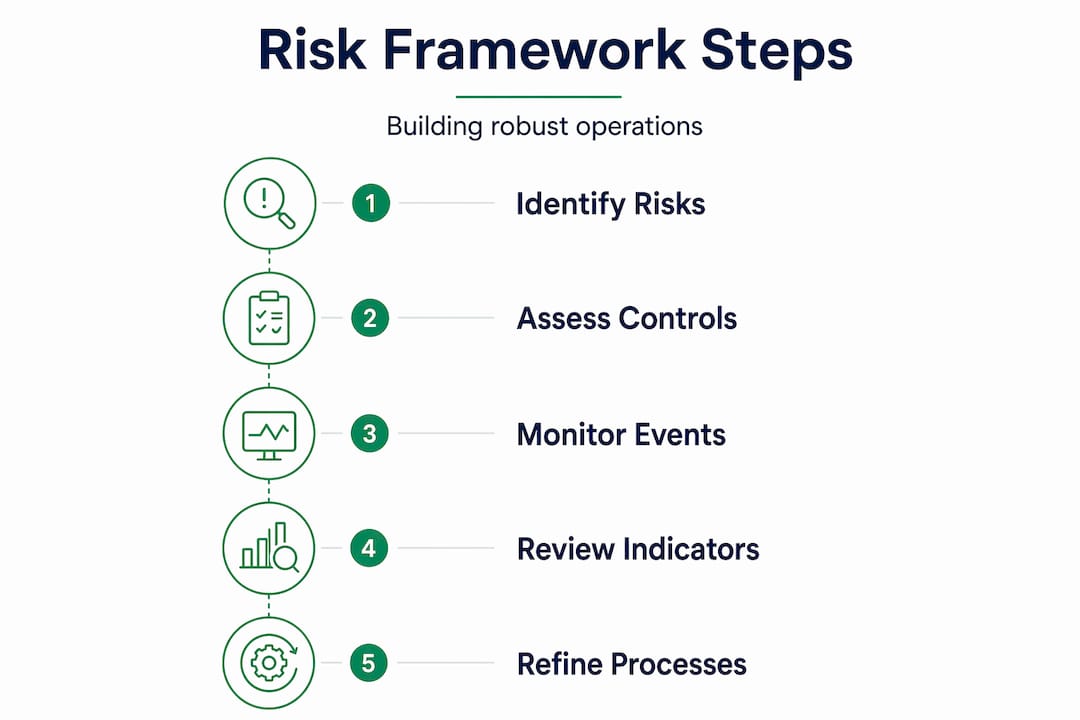
Pro Tip: Do not wait for your annual audit cycle to test digital asset controls. Protocols update frequently, and a control that worked last quarter may be completely bypassed by a new contract version. Build quarterly control testing into your digital asset management framework by default.
When operational risk becomes a real incident
The THORChain exploit in May 2026 illustrates what operational risk looks like in practice, and what good incident response requires. Automated protocol governance modules froze operations for 13 hours after $10.8 million was drained from the cross-chain liquidity protocol. The freeze was not a human decision. It was an automated “pause” command embedded in the smart contract governance layer.
That response structure holds four important lessons for institutional operational resilience:
- Automated controls outperform manual response in speed. By the time a human reviews an alert and escalates through approval chains, losses compound. DeFi incident response protocols that rely on automated governance controls can freeze operations in seconds, not hours.
- Third-party protocol risk requires explicit assessment. THORChain was an external dependency for institutions using cross-chain settlement. If your framework does not map third-party protocol exposures, you will not know your blast radius until it is too late.
- Regulatory and law enforcement coordination must be pre-planned. Post-exploit coordination with forensic teams and regulators takes time institutions rarely budget for in their incident response plans.
- Communication protocols need separate owners. During active incidents, the team managing technical containment cannot simultaneously manage stakeholder communications. Separate those responsibilities explicitly in your runbook.
“Operational resilience is not the same as uptime. A system that stays online while losing funds is not resilient. True resilience means the ability to contain a failure before it becomes a catastrophe.”
That framing from the THORChain incident should reshape how you define success in your business continuity planning for digital assets. Recovery time objectives matter. So does recovery scope.
Regulatory expectations for operational risk
The regulatory picture for operational risk in digital assets is moving fast, and in a consistent direction: greater specificity, more frequent assessment, and explicit documentation requirements.
Key regulatory developments shaping compliance expectations right now include:
- FCA operational resilience rules: The UK’s Financial Conduct Authority now requires cryptoasset firms to define impact tolerance per business service, meaning the maximum disruption each service can absorb before causing consumer or market harm. This is not a generic uptime target. It is a service-specific, quantified threshold backed by scenario testing.
- UAE biannual reassessment: UAE regulations require reassessment of digital asset suitability every six months, including operational risk and financial crime risk evaluations. For institutions operating across jurisdictions, that cycle needs to be built into your risk calendar.
- Transaction monitoring depth: OFAC list screening alone is insufficient to detect indirect exposure to sanctioned entities. Regulators and enforcement bodies increasingly expect typology-driven on-chain analysis that traces transaction patterns across wallet clusters and protocol layers.
Here is a summary of how these regulatory requirements map to framework controls:
| Regulatory Requirement | Jurisdiction | Framework Control Implication |
|---|---|---|
| Impact tolerance documentation | UK (FCA SYSC 15A) | Define tolerances per important business service, backed by testing |
| Biannual operational risk reassessment | UAE | Schedule formal risk reviews into governance calendar twice annually |
| Typology-based on-chain monitoring | US (FinCEN guidance) | Replace or supplement list screening with behavioral chain analysis |
| Third-party provider risk governance | Multiple | Map dependencies, assess exit strategies, require contractual risk disclosures |
The best practices for digital risk compliance increasingly require firms to treat regulatory monitoring as a real-time function, not a periodic review. Embedding compliance requirements directly into your KRI reporting structure is the most efficient way to stay ahead of enforcement gaps.
Implementing a framework in practice
Building a digital asset operational risk framework is not a documentation exercise. It requires operational integration across technology, legal, compliance, and treasury functions.
The practical implementation process follows this structure:
- Map important business services first. Identify which digital asset activities are material to your institution: custody operations, settlement processes, staking, or trading desk functions. Each service requires its own risk inventory and control set.
- Apply risk scoring adapted to digital assets. Standard likelihood-impact matrices need adjustment. Add an irreversibility factor that increases residual risk scores for controls where failure has no recovery path.
- Build control activities around the specific asset type. Multi-signature authorization requirements differ between hot wallet operations and cold custody. Change management controls for smart contract upgrades are fundamentally different from software change controls in traditional systems.
- Run scenario tests, not just tabletop exercises. Simulate an unauthorized transaction, a custodian failure, and a regulatory change that reclassifies your held assets. Measure actual response time against your documented tolerances.
- Track KRIs continuously, not quarterly. The 24/7 nature of digital asset markets makes periodic reporting a structural lag. Automate KRI feeds where possible and build escalation triggers into your monitoring infrastructure.
Understanding how to monitor digital asset market risk complements your operational risk monitoring by surfacing price and liquidity signals that often precede operational stress events.
Pro Tip: When addressing permissionless DLT exposures, maintain a current protocol dependency register that lists every external smart contract or blockchain your operations interact with, even indirectly. Update it after every protocol upgrade or new product launch.
Financial institutions managing digital assets at scale are discovering that governance gaps appear fastest at the intersection of new product launches and unchanged operational controls. Build a formal review trigger for any new digital asset activity, not just an annual framework refresh.
My perspective on where most frameworks fall short
I’ve reviewed operational risk frameworks across financial institutions at various stages of their digital asset journey, and the most consistent failure is the same: teams build a framework that looks good on paper and then treat blockchain security as a substitute for operational controls. It is not.
In my experience, the institutions that manage digital asset operational risk well share one habit. They treat every new protocol interaction as a new product launch, with a formal risk assessment and control sign-off before any operational activity starts. That sounds bureaucratic until you realize that quantum computing is actively being incorporated into long-term cyber governance planning at major institutions. The threat surface is not static. Your framework cannot be static either.
What I’ve found actually works is embedding operational resilience into how you define success, not just how you recover from failure. Impact tolerance definitions force that conversation. If your institution cannot articulate exactly how much disruption each digital asset service can absorb before causing harm, you do not have an operational risk framework. You have a risk register dressed up as one.
The governance gap in digital asset operations is real, and it is wider than most compliance officers realize until something goes wrong. Proactive risk culture means closing that gap before the incident, not explaining it afterward.
— Gregg
Strengthen your operational risk posture with DARE
Knowing your framework has gaps and knowing exactly where those gaps are are two different problems. Wush built the Digital Asset Readiness Evaluation (DARE) to close the distance between them. DARE provides a structured certification pathway that maps directly to the governance and control requirements regulators are enforcing right now, covering custody, compliance, legal risk, and operational controls in a single modular program.
For risk managers and compliance officers, DARE certification delivers two concrete advantages: a documented, independently verified framework assessment that satisfies regulatory scrutiny, and an annual renewal process that keeps your controls current as the regulatory environment evolves. If your institution is building or maturing its digital asset operational risk framework, explore your readiness evaluation to find out exactly where you stand.
FAQ
What is a digital asset operational risk framework?
A digital asset operational risk framework is a structured set of governance policies, controls, and monitoring processes designed to identify, assess, and mitigate operational risks specific to digital asset activities. It typically integrates models like COSO and Three Lines of Defense, adapted for the technical characteristics of blockchain-based assets.
What are the main digital asset operational risk categories?
The four primary categories are technology risk (smart contract failures, wallet misconfigurations), people risk (key person dependencies, insider threats), process risk (authorization gaps, reconciliation failures), and external event risk (regulatory changes, third-party custodian failures, and protocol exploits).
How do regulators expect firms to manage operational resilience in digital assets?
Regulators including the FCA now require firms to define impact tolerance for each important business service, documenting the maximum acceptable disruption level before consumer or market harm occurs. The UAE mandates biannual operational risk reassessments, and US guidance calls for typology-based on-chain transaction monitoring beyond standard OFAC screening.
Why is automated governance critical for digital asset incident response?
Because digital asset transactions are irreversible and markets operate continuously, manual escalation chains are too slow to contain losses effectively. Automated governance controls, such as smart contract pause functions, can freeze operations in seconds and are now considered a baseline requirement for DeFi-adjacent operational resilience planning.
How does the Three Lines of Defense model apply to digital asset governance?
The Three Lines of Defense model is adapted so the first line owns daily digital asset controls like transaction approvals and wallet management, the second line sets crypto-specific policy and monitors KRIs, and the third line independently tests whether those controls are effective against current protocol and custody configurations.