
Legal risk management for digital assets: A compliance guide

Most legal teams assume digital asset compliance lives in one regulatory home. It doesn’t. In the U.S., the role of legal in digital asset risk management spans at least four federal agencies, a patchwork of state licensing regimes, and a set of laws that were written long before blockchain existed. The SEC, CFTC, FinCEN, and OCC each claim authority over different slices of the same transaction. Miss one, and the consequences range from substantial fines to criminal exposure. This guide walks compliance executives through the regulatory terrain, the specific obligations legal must own, and the practical strategies that turn complexity into controlled, defensible governance.
Table of Contents
-
Integrating legal risk management within digital asset operations
-
Practical steps for legal teams to lead digital asset risk management
-
Why legal leadership is the competitive advantage in digital asset risk management
-
Explore how DARE supports legal risk management in digital assets
Key Takeaways
| Point | Details |
|---|---|
| Complex regulatory environment | Multiple U.S. agencies regulate digital assets with overlapping laws creating a challenging legal landscape. |
| Critical compliance deadlines | MSBs must meet registration, renewal, and reporting deadlines to avoid penalties. |
| Cross-functional integration | Legal teams must work closely with product, compliance, and risk functions to manage all facets of digital asset risk. |
| Emerging regulatory trends | Novel issues like asset blacklisting and stablecoin rules require proactive legal strategies. |
| Legal as strategic advantage | Proactive legal leadership can transform risk management into competitive differentiation. |
Understanding the regulatory landscape for digital assets
The first thing to accept is that no single agency governs digital assets in the U.S. That reality is the foundation of every legal challenge in digital asset management. FinCEN treats digital asset businesses as Money Services Businesses (MSBs) subject to the Bank Secrecy Act. The SEC asserts jurisdiction over tokens it classifies as securities. The CFTC claims authority over digital commodities. The OCC has issued guidance permitting national banks to provide digital asset custody. Each framework carries its own registration, reporting, and enforcement teeth.
The Bank Secrecy Act requires MSBs to file Suspicious Activity Reports (SARs) and Currency Transaction Reports (CTRs) for digital asset transactions over $10,000 as of May 2026. That obligation alone demands a functioning AML program, trained personnel, and documented procedures before your first transaction clears. State law adds another layer. New York’s BitLicense, for example, requires a separate state-level license that takes months to obtain and imposes its own capital and cybersecurity requirements. Many organizations focus on federal obligations and then get caught off guard by state-level licensing timelines.
In 2026, the SEC and CFTC published joint guidance establishing the first formal token taxonomy with five categories, ranging from commodities to securities to hybrid instruments. That taxonomy directly determines which registration and disclosure obligations apply to your organization’s digital asset activity. Legal teams that have not yet mapped their product portfolio against these five categories are carrying unquantified exposure.
Key agencies and their primary jurisdiction:
-
FinCEN: AML/BSA compliance, MSB registration, SAR and CTR filing
-
SEC: Securities classification, disclosure, and broker-dealer registration for digital asset securities
-
CFTC: Commodity classification, derivatives oversight, and anti-fraud enforcement
-
OCC: National bank custody authority and digital asset-related guidance
-
State regulators: Licensing (e.g., BitLicense in New York), money transmission laws, and consumer protection
| Regulatory body | Primary law | Key obligation |
|---|---|---|
| FinCEN | Bank Secrecy Act | MSB registration, AML program, SARs/CTRs |
| SEC | Securities Act of 1933 | Registration or exemption for security tokens |
| CFTC | Commodity Exchange Act | Reporting and registration for commodity tokens |
| OCC | National Bank Act | Guidance on custody and permissible activities |
| State regulators | Varies by state | Licensing, surety bonds, consumer disclosures |
Completing a digital asset readiness evaluation before expanding into new asset classes or jurisdictions gives legal teams a structured baseline for identifying which of these obligations apply and where gaps exist.
Legal compliance obligations and operational deadlines
After understanding the overarching regulatory landscape, it is crucial to focus on the specific compliance tasks and deadlines legal teams manage daily. These are not theoretical obligations. They carry hard dates, and missing them is not a compliance gap you can quietly correct.
Here are the core registration and reporting requirements legal must own:
-
Register with FinCEN as an MSB within 180 days of commencing operations. MSBs must register within this window and renew every two years.
-
File SARs for suspicious transactions within 30 days of detection, or 60 days when no suspect is identified.
-
File CTRs within 15 days for digital asset transactions exceeding $10,000.
-
Comply with the FinCEN Travel Rule, which requires transmitting sender and recipient information for transactions above $3,000.
-
Maintain an AML program that includes written policies, a designated compliance officer, independent testing, and ongoing employee training.
-
Track state licensing renewal dates separately from federal obligations, since deadlines and required documentation vary significantly by state.
Organizations frequently miss deadlines by concentrating on product development and treating compliance as a later-stage concern. By the time they build their compliance calendar, they are already operating in violation. Legal must be in the room before launch, not after.
Pro Tip: Build a rolling 24-month compliance calendar that maps every registration renewal, reporting deadline, and regulatory comment period for proposed rules. Assign owners for each item and review the calendar quarterly. This single practice eliminates the most common and most preventable compliance failures in digital asset operations.
The AML program requirement deserves particular attention. It is not a policy document. Regulators expect evidence of actual implementation: training records, testing results, and documented reviews of transaction monitoring alerts. Legal teams that treat AML as a checkbox rather than a living program find themselves unable to produce the evidence that enforcement actions demand.

Legal compliance management in digital assets requires building institutional muscle, not just institutional knowledge. The difference is whether your team can execute under pressure or only advise in calm conditions.
Integrating legal risk management within digital asset operations
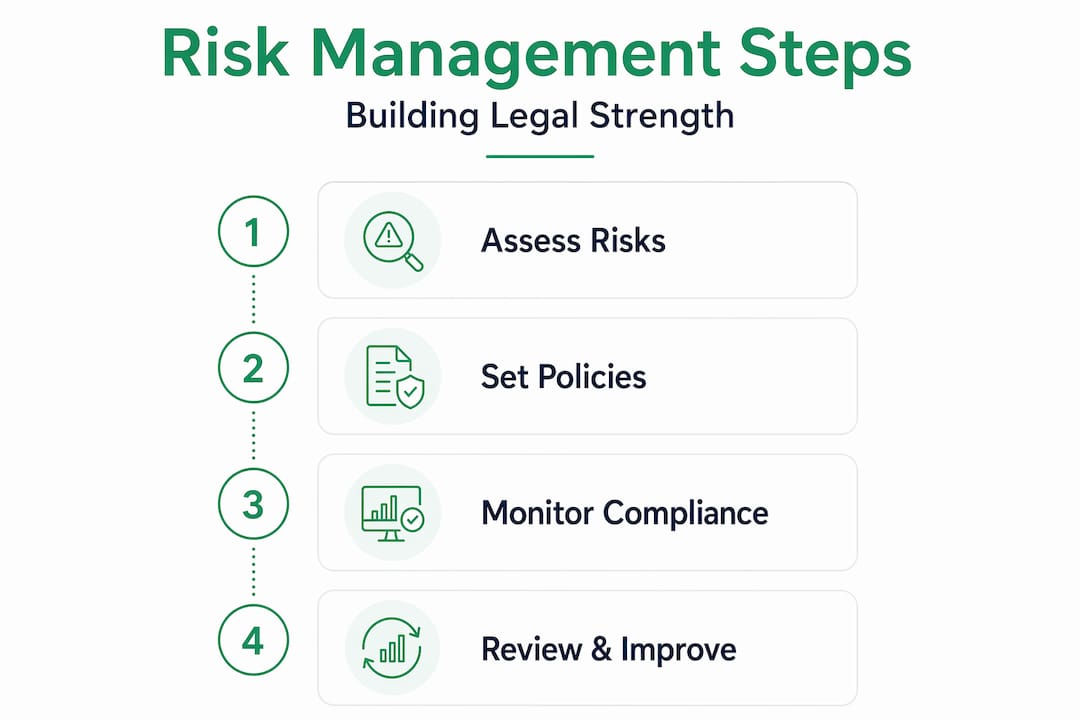
With critical compliance elements in place, integrating legal risk management into daily operations ensures these obligations are met effectively across the organization. This is where many firms fall short. Legal sets policy, compliance checks the boxes, and the product team ships without fully understanding the implications.
As industry expert Ben Hailey put it:
“Successful digital asset risk management requires focusing on both the product, meaning what you are offering, and the third-party partners, meaning who you are working with. Neglecting either dimension creates blind spots that regulators and counterparties will eventually expose.”
Effective risk management requires dual focus on the digital asset product itself and the reliability of the partners involved in its custody, transaction, and settlement. Legal must conduct structured assessments of both dimensions before any new product launch or partnership is approved.
What that looks like in practice:
-
Product assessment: Classify the asset against the SEC/CFTC five-category taxonomy. Determine whether it constitutes a security, commodity, or stablecoin. Map the applicable reporting and registration obligations before any customer-facing activity begins.
-
Third-party due diligence: Confirm that every custodian, exchange, wallet provider, and technology vendor holds current licenses. Review their AML programs, financial stability, and incident response procedures.
-
Contract review: Every digital asset agreement should explicitly address custody arrangements, security standards, breach notification timelines, dispute resolution mechanisms, and regulatory compliance representations.
-
Cross-functional governance: Establish a working group that includes legal, compliance, treasury, IT, risk, and product. Meet at least monthly. Document decisions and assign accountability.
Pro Tip: Avoid treating digital asset risk as solely a technology or compliance problem. Legal must be the function that pulls every discipline together. When legal owns the coordination role, accountability gaps close faster.
Risk management integration is not a project with a completion date. It is an operating discipline. The organizations that get this right treat legal not as a gatekeeper but as a connector, the function that keeps every team aligned to the same regulatory reality.
Addressing emerging legal challenges and regulatory trends
Beyond established compliance, legal must stay ahead of evolving and complex challenges that digital asset governance creates. The landscape is not static. Three areas in particular are generating new legal risk that few teams have fully priced in.
Digital asset blacklisting is the most underappreciated legal risk in this space. When stablecoin issuers or blockchain protocols voluntarily freeze or blacklist addresses, they are bypassing traditional seizure protections without a court order. This creates significant legal exposure for the organizations whose assets are frozen, who may have no clear legal avenue to contest the freeze or prove legitimacy. Legal teams need pre-built documentation frameworks that establish proof of transaction legitimacy before a freeze event occurs, not after.
Stablecoin regulation is accelerating. FDIC and FinCEN have proposed frameworks that would treat permitted payment stablecoin issuers as financial institutions under the Bank Secrecy Act, triggering the full suite of AML obligations. Organizations that hold or transact in stablecoins must assess whether their current controls are adequate under a financial institution standard, which is materially more demanding than an MSB standard.
Cybersecurity obligations are expanding through regulatory mandates, not just best practice recommendations. Service provider contracts must now include specific incident reporting timelines, security audit rights, and breach remediation obligations to satisfy both federal and state cybersecurity rules.
| Factor | Traditional asset seizure | Digital asset blacklisting |
|---|---|---|
| Legal process required | Yes, court order | No, voluntary action by issuer |
| Due process protections | Established | Limited or unclear |
| Asset holder’s recourse | Defined legal remedies | Undeveloped legal framework |
| Documentation burden | On seizing authority | On asset holder to prove legitimacy |
| Speed of action | Days to weeks | Near-instant |
Emerging regulatory trends legal must track:
-
Proposed stablecoin legislation that would clarify federal versus state jurisdiction
-
SEC enforcement actions defining which DeFi protocols constitute unregistered securities exchanges
-
FinCEN Travel Rule expansion to lower transaction thresholds
-
State-level cybersecurity mandates for digital asset businesses
Handling emerging risks proactively, before they become enforcement actions, is what separates reactive legal teams from genuinely effective ones.
Practical steps for legal teams to lead digital asset risk management
Equipping legal functions with concrete strategies translates knowledge and risks into effective governance leadership. Legal must lead in developing policies, educating boards, and coordinating cross-functional teams for digital asset strategy. That is not aspirational guidance. It is a description of what effective Chief Legal Officers and General Counsels are doing right now.
-
Educate your board and executive team quarterly. Digital asset regulation changes faster than most board members realize. Brief them on material regulatory developments, pending enforcement actions in your sector, and the implications for your organization’s exposure.
-
Build written policies covering asset selection criteria, approved custody arrangements, transaction authorization thresholds, and incident response procedures. These documents are your first line of defense in an examination.
-
Form a cross-functional digital asset task force with standing representation from legal, compliance, treasury, IT, and risk. Assign a legal team member as chair.
-
Verify the regulatory status of every counterparty. This means confirming current FinCEN registration, applicable state licenses, and any public enforcement history before onboarding.
-
Implement custody controls that include multi-signature wallet requirements, cold storage policies, and insurance coverage specifically designed for digital asset custody risk.
-
Conduct annual policy reviews that incorporate new regulatory guidance, enforcement trends, and operational lessons learned.
Pro Tip: Regularly review and update your digital asset policies. Regulators do not grade on a curve for outdated controls. A policy written in 2024 that has not been updated for 2026 regulatory guidance signals to examiners that your governance program is not keeping pace.
Leading digital asset governance requires legal to own the full cycle: policy creation, implementation, monitoring, and board reporting. Organizations where legal plays a reactive role in digital asset strategy are consistently the ones that face the most costly compliance failures.
Why legal leadership is the competitive advantage in digital asset risk management
Here is the perspective that most articles miss: legal involvement in digital asset risk is not just about avoiding penalties. It is about moving faster than your competition with confidence.
The conventional view frames legal as a cost center that slows things down. In digital assets, that framing is backward. Organizations with mature legal governance frameworks can enter new asset classes more quickly because they have already done the classification work. They can close partnerships faster because their due diligence process is standardized. They can respond to regulatory inquiries without panic because their documentation is current.
As Ansgar Schott observed in Baker McKenzie’s 2026 analysis: financial institutions that integrate technological innovation with sound legal governance transform regulatory challenges into competitive differentiation. The firms that will lead in digital assets over the next decade are not the ones that avoid legal complexity. They are the ones that have built legal functions capable of navigating it without losing momentum.
The fragmented regulatory landscape is not going to simplify. New asset classes will emerge. New agencies will assert jurisdiction. New enforcement priorities will shift the risk calculus. The organizations that have invested in adaptive legal governance frameworks will be positioned to anticipate these changes and respond before their competitors do.
Legal governance advantage is not a future state. It is available right now to any organization willing to treat its legal function as a strategic driver rather than a defensive cost.
Explore how DARE supports legal risk management in digital assets
Legal and compliance executives navigating the demands described in this article need more than policy documents. They need a structured framework for assessing where their organization actually stands.
The DARE digital asset readiness evaluation gives legal teams a modular, evidence-based assessment across the exact areas that matter most: regulatory compliance, custody controls, AML program quality, third-party risk, and operational governance. The platform supports ongoing monitoring as regulations evolve, so your compliance posture does not degrade between annual reviews. Legal and compliance executives use DARE results to guide board reporting, prioritize remediation efforts, and demonstrate to regulators that governance is active rather than performative. It is the structured foundation that turns the strategies in this guide into measurable, defensible outcomes.
Frequently asked questions
What are the key legal risks for digital asset managers?
Key risks include regulatory noncompliance across multiple agencies, inadequate AML controls, custody vulnerabilities, and exposure from evolving asset classification rules and sanctions. Legal must manage layered obligations enforced by different agencies simultaneously.
How often must Money Services Businesses renew their FinCEN registration?
MSBs must renew their FinCEN registration every two years to maintain compliance with the Bank Secrecy Act. Registration and renewal within 180 days of starting operations is also required.
What role does legal play in managing third-party risks for digital assets?
Legal assesses third-party service providers’ licensing, contracts, compliance programs, and financial stability to mitigate risks related to custody, transactions, and reputational exposure. The focus should be on both the product and the partners involved.
How should legal teams prepare for emerging stablecoin regulations?
Legal should monitor proposed rules, assess whether existing AML controls meet a financial institution standard, and advise on operational impacts. Proposed rules treat stablecoin issuers as financial institutions under the Bank Secrecy Act, which raises the compliance bar materially.
What strategies help legal teams lead digital asset governance effectively?
Key strategies include educating boards regularly, developing written policies on asset selection and custody, forming cross-functional task forces, and reviewing controls annually. Legal must lead policy development, education, and cross-functional coordination for digital asset strategy.