
Digital Asset Financial Controls Overview for Finance Executives

A digital asset financial controls overview is a risk-based framework that applies the COSO Internal Control Framework’s five components to secure, monitor, and report on digital assets within corporate finance operations. The industry standard term for this discipline is Internal Control over Financial Reporting (ICFR), adapted for crypto-native environments. Finance executives managing Bitcoin, Ethereum, or tokenized assets face control gaps that traditional ICFR programs were never designed to address: private key custody, on-chain reconciliation, and real-time valuation governance. This article maps each COSO component to the specific risks of digital asset management, giving you a structured, audit-ready control program you can act on immediately.
How does the COSO framework apply to digital asset financial controls?
Mapping digital asset controls to COSO’s five components provides a coherent, risk-based evaluation framework for both operations and financial reporting. KPMG’s 2025/2026 ICFR handbook uses COSO’s 2013 framework to guide control design and evaluation, including cybersecurity and AI considerations. This matters because a COSO-based approach lets management link control activities directly to risk assessment, rather than treating controls as a disconnected checklist.
Here is how each of the five COSO components translates into the digital asset context:
-
Control environment. Leadership sets the tone by assigning clear ownership of custody and key management. The CFO or Chief Risk Officer must formally own the digital asset control policy, and segregation of duties must be defined before any wallet goes live.
-
Risk assessment. Key risks include private key compromise, valuation errors from stale or manipulated price feeds, and incomplete wallet inventories that leave assets outside the control perimeter. Each risk requires a documented likelihood and impact rating.
-
Control activities. Authorization matrices with multi-sig wallets and daily on-chain reconciliations are the standard control activities for digital asset treasury. NODE40’s 2026 guidance specifically recommends defined approval thresholds and daily reconciliation as baseline controls for CFOs.
-
Information and communication. A crypto sub-ledger must ingest on-chain data with timestamps, asset identifiers, and transaction hashes. Pricing feed governance, including source hierarchy and anomaly detection, is a communication control that feeds directly into financial reporting accuracy.
-
Monitoring activities. Ongoing access reviews, control performance dashboards, and periodic walkthroughs confirm that controls operate as designed. Monitoring is not a year-end exercise. It is a continuous function.
Pro Tip: Build your COSO mapping document before your first audit, not during it. Auditors will ask for evidence that each control was designed with a specific risk in mind. A pre-built mapping saves weeks of retrospective documentation.
What are the core custody and key management controls?

Custody and private key lifecycle governance are the most critical controls to prevent asset loss, and they are prerequisites for every other financial control in the program. Without strong custody controls, financial reporting controls cannot assure that the assets being reported actually exist and are accessible.
The private key lifecycle covers four stages that each require a dedicated control:
- Generation. Keys must be generated in a hardware security module (HSM) or equivalent secure environment, with ceremony documentation and dual-person integrity.
- Storage. Cold storage, geographic distribution, and tamper-evident seals are minimum standards for institutional holdings.
- Rotation and recovery. Key rotation schedules and tested recovery procedures must be documented and rehearsed at least annually.
- Revocation. When personnel with key access depart, revocation procedures must execute within a defined timeframe, typically 24 hours.
Multi-party custody models add a second layer of protection. Multi-signature (multi-sig) setups require M-of-N approvals before any transaction executes, preventing single points of failure. Multi-Party Computation (MPC) achieves a similar result cryptographically, without exposing a full private key at any point. Both models are now standard for institutional digital asset operations.
Third-party custodian due diligence goes beyond checking a regulatory license. Institutions evaluate custodian financial condition and insurance policies in depth, assessing policy exclusions, claims history, and insurer financial strength. A nominal $500 million coverage figure means little if the policy excludes insider theft or has a $50 million per-claim cap.
Operational controls at the transaction level include address whitelisting, velocity limits, and time-delayed withdrawals. These controls reduce the blast radius of a compromised credential and are often the difference between a recoverable incident and a total loss.
For a structured approach to evaluating third-party custodians, the board-level oversight checklist from Wush provides a practical starting point for governance reviews.
How are digital asset financial reporting controls designed for accuracy?
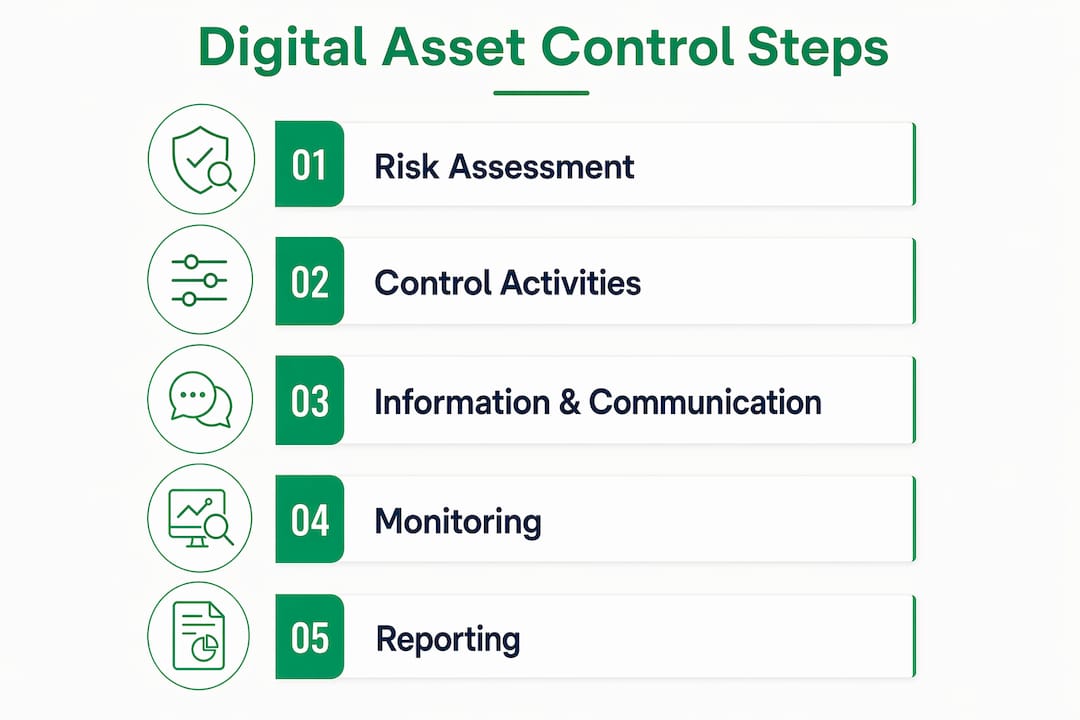
Financial reporting controls for digital assets treat completeness as a wallet inventory problem and valuation as an evidence-heavy, recurring control cycle. Sub-ledger controls, price feed governance, and formal month-end reconciliation are the three pillars of an audit-ready financial reporting stack, according to Blockchain Council’s 2026 guidance.
The following table compares the control objective, the specific control activity, and the evidence required for each reporting control area:
| Control area | Control activity | Evidence required |
|---|---|---|
| Completeness | Wallet inventory reconciliation to general ledger | Signed wallet register, GL tie-out |
| Sub-ledger ingestion | Timestamp and hash validation on each transaction | Sub-ledger import logs |
| Valuation | Price feed hierarchy with anomaly detection | Pricing source documentation, exception log |
| Month-end close | Cost basis verification and cutoff reconciliation | Reconciliation workpapers, sign-off matrix |
| ASC 350-60 compliance | Fair value measurement with Level 1 inputs | Auditor-reviewed pricing methodology |
Robust crypto accounting ties three ledgers: the blockchain, the sub-ledger, and the general ledger. Ridgeway Financial Services describes this as a triple-ledger model where controls at each junction ensure completeness, classification accuracy, and reconciliation. A gap at any junction produces a financial statement error that auditors will find.
Valuation controls are consistently underestimated. They require operationalizing a repeatable, evidence-rich cycle that includes a defined price source hierarchy, anomaly investigation thresholds, and documented cutoff times. ASC 350-60, which took effect for fiscal years beginning after December 15, 2024, requires fair value measurement for crypto assets, making a formal valuation control not optional but mandatory.
Pro Tip: Designate a single pricing data provider as your primary source and document two fallback sources in your valuation policy. When your primary feed goes down at month-end, you need a pre-approved escalation path, not an ad hoc decision that auditors will question.
What role do segregation of duties and IT controls play?
Segregation of duties (SoD) in digital asset operations means that the person who initiates a transaction cannot also approve it, execute it, or reconcile it. Auditors focus heavily on documented SoD and process compliance, not just technical controls like multi-sig. A multi-sig wallet configured so that one person controls two of three keys defeats the entire purpose of the control.
NIST SP 800-53 AC-5 provides the clearest framework for enforcing role separation in IT systems that support digital asset operations. The standard requires that organizations separate duties for access request versus access approval, and developer versus production deployment. These same principles apply directly to digital asset platforms.
Practical SoD controls for digital asset teams include:
- Separate roles for wallet address creation, transaction initiation, and transaction approval
- Documented approval thresholds that specify dollar limits and required approver count at each tier
- Privileged access restrictions that prevent IT administrators from also holding transaction signing authority
- Continuous access reviews, conducted at least quarterly, to detect role creep or unauthorized privilege escalation
Account management controls must be integrated with your HR offboarding process. When an employee with signing authority leaves, their access must be revoked before their final day. This is a process control, not just a technical one, and it requires coordination between HR, IT, and treasury that many organizations have not formalized.
For a deeper look at how liquidity risk intersects with access controls, Wush covers the operational dependencies that connect SoD failures to broader financial exposure.
How should organizations manage service provider oversight and evidence retention?
Integrating vendor oversight and centralized evidence retention is the control activity most often missing from first-generation digital asset programs. Organizations that manage custody, pricing data, and IT infrastructure through third parties inherit the control risks of each provider.
A mature service provider oversight program follows these steps:
- Obtain and review SOC reports annually. SOC 1 Type II reports from custodians and SOC 2 Type II reports from IT service organizations provide auditor-tested evidence of control effectiveness. Review the complementary user entity controls section to confirm your obligations.
- Assess pricing data providers. Your valuation control is only as strong as your price feed. Document the source, methodology, and fallback hierarchy for every asset class you hold.
- Conduct annual vendor financial condition reviews. Custodian solvency is a direct financial risk. Review audited financials and insurance coverage annually, not just at onboarding.
- Maintain a centralized evidence repository. All reconciliation logs, approval documentation, SOC reports, and exception investigations belong in a single, access-controlled repository. Auditors should be able to pull any control evidence within 24 hours.
- Integrate cybersecurity vendor assessments. Third-party IT providers with access to your digital asset infrastructure require the same security assessment as internal systems. PCI DSS 4.0 readiness frameworks offer a structured evidence toolkit that translates well to digital asset vendor assessments.
The audit trail checklist from Wush details the specific evidence artifacts that enterprise teams need to maintain for each control category, which is a practical complement to the oversight program described above.
Key takeaways
Effective digital asset financial controls require applying COSO’s five components to custody, reporting, SoD, and vendor oversight within a single, evidence-rich control program.
| Point | Details |
|---|---|
| COSO is the organizing framework | Map each control activity to a specific COSO component and documented risk to satisfy auditors. |
| Custody controls come first | Private key lifecycle governance and multi-party custody models are prerequisites for all other controls. |
| Triple-ledger reconciliation is mandatory | Tie blockchain, sub-ledger, and general ledger at every close to produce verifiable financial statement evidence. |
| SoD requires process documentation | Multi-sig alone does not satisfy auditors; document approval thresholds and role assignments formally. |
| Evidence retention drives audit readiness | Centralize SOC reports, reconciliation logs, and pricing documentation in a single repository accessible within 24 hours. |
Why custody governance is still the hardest problem to solve
After working through dozens of digital asset control assessments, the pattern I see most often is this: organizations invest heavily in technology controls and almost nothing in governance documentation. They deploy multi-sig wallets, implement MPC custody, and integrate real-time price feeds. Then an auditor asks for the signed authorization matrix and the key ceremony documentation, and the room goes quiet.
The hardest part of digital asset financial controls is not the technology. It is getting treasury, accounting, and IT to agree on who owns what, document it formally, and keep it current. Treasury teams think in terms of operational efficiency. Accounting teams think in terms of financial statement assertions. IT teams think in terms of system access. None of these groups naturally speaks the language of ICFR, and that gap is where control failures live.
The other thing I would push back on is the assumption that automation solves the valuation problem. Automated price feeds reduce manual error, but they introduce new risks: feed manipulation, API failures at month-end, and undocumented fallback decisions. The organizations with the strongest valuation controls are the ones that have written a valuation policy, tested their fallback sources, and trained their accounting team to recognize an anomaly. Technology supports that process. It does not replace it.
My recommendation for any CFO building or rebuilding a digital asset control program: start with the COSO mapping document, not the technology selection. Define your risks, assign your controls, and document your evidence requirements before you buy a single tool. The framework creates the structure that makes every subsequent decision easier to defend.
— Gregg
Assess your digital asset control readiness with DARE
Finance executives who have read this far already understand that a digital asset financial controls framework is not a one-time project. It is an operating system that requires annual review, evidence maintenance, and alignment with evolving standards like ASC 350-60 and emerging SEC guidance. Wush built the Digital Asset Readiness Evaluation (DARE) specifically to address this challenge. DARE provides modular assessments across custody, financial reporting, compliance, and IT controls, mapped directly to COSO principles and current regulatory expectations. The certification gives finance teams a structured baseline, a documented evidence trail, and a credential that communicates control maturity to auditors and board members. If your organization is building or stress-testing its digital asset control program, explore the DARE platform to see where your gaps are before your auditors do.
FAQ
What is a digital asset financial controls overview?
A digital asset financial controls overview is a structured assessment of the policies, procedures, and activities an organization uses to secure, account for, and report on digital assets. It typically applies the COSO Internal Control Framework to map controls across custody, financial reporting, segregation of duties, and vendor oversight.
How does the COSO framework apply to digital assets?
COSO’s five components, which are control environment, risk assessment, control activities, information and communication, and monitoring, each translate directly to digital asset operations. For example, control activities include multi-sig authorization and daily on-chain reconciliation, while monitoring includes continuous access reviews and control performance dashboards.
What are the most critical controls for digital asset custody?
Private key lifecycle governance covering generation, storage, rotation, and recovery is the highest-leverage control for preventing asset loss. Multi-sig and MPC custody models, combined with address whitelisting and velocity limits, form the operational layer of a complete custody control program.
Why is segregation of duties difficult in digital asset operations?
Digital asset teams are often small, which creates pressure to combine initiation, approval, and reconciliation roles in a single person. NIST SP 800-53 AC-5 provides the standard for enforcing role separation, but the real challenge is documenting and maintaining those role boundaries as teams grow and systems change.
What evidence do auditors expect from a digital asset control program?
Auditors expect signed wallet inventories, reconciliation workpapers tying the blockchain to the sub-ledger and general ledger, documented approval thresholds, SOC reports from custodians and IT providers, and a formal valuation policy with pricing source documentation. All evidence should be retrievable within 24 hours.