
Top Crypto Operational Risk Frameworks for Enterprises

For U.S.-regulated enterprises managing digital assets, the recommended framework stack is CORM + ISO 31000 + COSO ERM + operational resilience principles, with DARE certification from Wush providing the structured pathway to operationalize all four. That combination covers every layer: crypto-specific risk taxonomy, enterprise governance integration, board reporting, and demonstrable technical controls.
Immediate actions for boards and CROs:
- Adopt CORM mapping to classify crypto-specific operational risks within your existing risk taxonomy
- Set impact tolerances for critical crypto business services (key availability, transaction throughput, reconciliation latency)
- Establish board-level reporting on digital asset operational risk, tied to COSO governance expectations
- Commission a scenario test covering at least one severe-but-plausible crypto failure mode (custodian insolvency, smart-contract failure, validator outage)
- Schedule a DARE readiness assessment to identify certification gaps and generate audit-ready evidence
This guidance is calibrated for U.S.-regulated enterprises, including registered investment advisers, broker-dealers, bank holding companies, and fintech firms subject to SEC, OCC, and FinCEN oversight. The framework stack aligns with operational resilience expectations toward which regulators on both sides of the Atlantic are converging.
Table of Contents
- What operational risk in crypto assets actually means at enterprise scale
- Which frameworks to use and how they fit together
- How to structure board oversight and assign accountability
- Cryptographic, custody, and platform controls your teams must deliver
- How to manage custodians, validators, oracles, and other third parties
- Designing scenario tests that actually stress your crypto operations
- Folding crypto operational risks into your existing ERM program
- Phased implementation roadmap with milestones and cost bands
- KPIs, SLAs, and dashboards that prove your controls are working
- What actual failures teach us about crypto operational risk
- How DARE maps to the frameworks and what certification requires
- Next steps and governance-ready motions to bring to the board
- Key Takeaways
- Why the integrated approach is the only one that actually holds up
- DARE: your enterprise certification pathway for digital asset governance
- Useful sources and further reading
What operational risk in crypto assets actually means at enterprise scale
Operational risk for crypto assets is the risk of loss from failed or inadequate internal processes, people, systems, or external events that are specific to the technical and governance characteristics of distributed ledger infrastructure. That definition sounds familiar because it should: it maps directly to the Basel II/III operational risk definition. The difference is that crypto introduces failure modes that traditional operational risk frameworks were never designed to handle.

Private key management is the clearest example. Lose the key, lose the asset permanently. No central authority can reverse it. That single fact changes the entire risk calculus compared to a wire transfer gone wrong.
The eight core risk categories enterprises must define and own:
Private key management. Generation, storage, use, rotation, and retirement of cryptographic keys. A single uncontrolled signing event can drain a treasury wallet with no recourse.
Custody. Where assets are held, by whom, under what legal arrangement, and whether the custodian is solvent. The FTX collapse demonstrated that “custody” on paper and actual segregation of assets are not the same thing.
Smart-contract and code risk. Bugs, logic errors, and upgrade vulnerabilities in on-chain code. Unlike software in a controlled environment, a deployed smart contract is often immutable and publicly exploitable.
Validator and consensus risk. Dependence on external validators or node operators for transaction finality. A long validator outage means transactions cannot settle, which creates cascading reconciliation failures.
Settlement finality. The point at which a transaction is irreversible varies by chain and protocol. Enterprises running cross-chain operations face probabilistic finality windows that traditional settlement systems do not have.
Third-party and custodian risk. Exchanges, custodians, oracle networks, bridge protocols, and node providers are all external dependencies. Each is a potential single point of failure.
AML and transaction monitoring. On-chain transaction tracing, sanctions screening, and suspicious activity reporting under FinCEN rules. The pseudonymous nature of blockchain addresses creates monitoring gaps that traditional payment monitoring tools miss.
Change management. Protocol upgrades, hard forks, and smart-contract migrations require governance controls that most enterprise change management processes were not built for. A chain split can bifurcate an asset balance overnight.
Which frameworks to use and how they fit together
No single framework covers the full operational risk surface for enterprise crypto. The answer is a layered stack, with each framework doing a specific job.

CORM (Crypto-asset Operational Risk Management) is the crypto-specific institutional model. CORM provides the taxonomy, the risk categories, and the multi-layered mitigation strategies that are native to digital assets. It is the layer that makes the other frameworks crypto-aware. CORM emphasizes real-time risk assessment, advanced training, and compliance frameworks aligned with global standards, and it is designed to plug into existing institutional structures rather than replace them.
ISO 31000 provides the principles and process architecture for iterative risk management. It is framework-agnostic, which means it works as the process spine that connects CORM’s crypto taxonomy to COSO’s governance requirements. ISO 31000’s iterative cycle (establish context, identify, analyze, evaluate, treat, monitor) maps cleanly onto crypto risk processes once the CORM taxonomy is in place.
COSO ERM handles the governance and reporting layer. COSO guidance stresses integrating risk management into governance, strategy, and performance. For enterprises, that means crypto risk must appear in board reporting, be tied to strategic objectives, and have clear ownership at the executive level. COSO’s five components (governance and culture, strategy and objective-setting, performance, review and revision, information and communication) give the board a familiar reporting structure.
Operational resilience principles (drawn from FCA FG26-6 and the GBBC/Oliver Wyman Risk Mitigation Framework) add the impact tolerance and scenario-testing layer. These principles require enterprises to identify important business services, map dependencies, set tolerances for disruption, and prove through testing that they can stay within those tolerances.
| Framework | Primary role | Governance layer | Technical controls | Testing | Board reporting |
|---|---|---|---|---|---|
| CORM | Crypto risk taxonomy and mitigation design | Partial | Strong | Partial | Weak |
| ISO 31000 | Risk process architecture and iteration | Strong | Weak | Moderate | Moderate |
| COSO ERM | Enterprise governance and strategic integration | Strong | Weak | Weak | Strong |
| Operational resilience | Impact tolerances, dependency mapping, scenario testing | Moderate | Moderate | Strong | Moderate |
| RMF (GBBC/Oliver Wyman) | Non-financial blockchain risk and deployable RAPs | Moderate | Strong | Moderate | Weak |
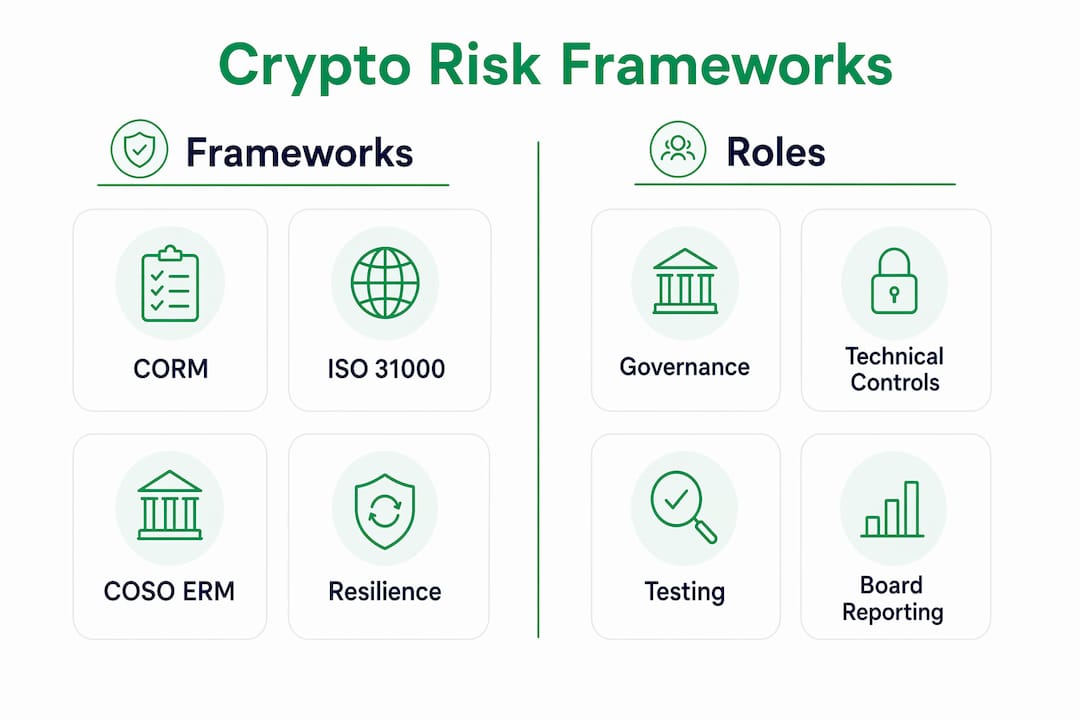
How to combine them: CORM is the crypto-specific layer that plugs into ISO 31000’s process cycle and COSO’s governance structure. Operational resilience principles then add the testing and tolerance-setting discipline that regulators expect to see demonstrated, not just documented.
Which framework leads at each stage:
- Design phase: CORM leads, with ISO 31000 providing the process structure
- Implementation phase: Operational resilience principles lead, with CORM controls as the technical specification
- Audit phase: COSO leads, with ISO 31000 documentation as evidence
- Board reporting: COSO leads, with operational resilience metrics as the content
How to structure board oversight and assign accountability
Board-level oversight of digital asset operational risk is not optional for regulated U.S. enterprises. COSO and ISO 31000 both require risk management to be embedded in governance and culture, which means the board must actively oversee, not merely receive reports on, crypto operational risk.
Board responsibilities include:
- Approving the enterprise’s digital asset risk appetite and impact tolerances
- Receiving quarterly operational risk reports covering key incidents, KRI breaches, and scenario test outcomes
- Overseeing the appointment and performance of the Chief Risk Officer’s crypto mandate
- Approving material changes to custody arrangements, key management architecture, and third-party custodian relationships
- Reviewing and challenging the annual scenario test program
Suggested committee model:
The full board retains ultimate oversight. A Risk Committee (or Audit and Risk Committee) handles ongoing monitoring and receives management reporting. A Technology Subcommittee reviews technical architecture decisions, HSM/MPC procurement, and smart-contract governance. External counsel and forensic specialists are pre-engaged for escalation when incidents involve potential regulatory reporting obligations or litigation.
RACI for core crypto operational risk activities:
| Activity | Responsible | Accountable | Consulted | Informed |
|---|---|---|---|---|
| Key generation and storage | InfoSec / Engineering | CTO | CRO, Legal | Board Risk Committee |
| Custody oversight | Treasury / Operations | CFO | CRO, External Custodian | Board |
| Node operations | Engineering | CTO | CRO | Operations |
| Incident response | InfoSec / Operations | CRO | Legal, External Forensics | Board, Regulators |
| Vendor management | Procurement / Risk | CRO | Legal, Engineering | Board Risk Committee |
| Scenario testing | Risk / Engineering | CRO | External Auditor | Board |
Board checklist for digital asset governance:
- Digital asset risk appetite statement approved and documented
- Impact tolerances set for each important crypto business service
- Custody arrangement reviewed by independent legal counsel
- Scenario test completed in the last 12 months with results reported to the board
- AML/transaction monitoring controls reviewed by compliance
- Third-party custodian and vendor risk assessments current
Sample board agenda item: “The Risk Committee recommends the board approve the Digital Asset Operational Risk Framework, including the impact tolerances set out in Annex A, and authorizes management to commission an independent scenario test exercise by [date], with results to be reported at the next quarterly board meeting.”
Pro Tip: Build crypto risk committee terms of reference that explicitly name digital asset operational risk as a standing agenda item. Regulators reviewing governance adequacy look for evidence that the board engaged with the topic, not just that a policy existed.
Cryptographic, custody, and platform controls your teams must deliver
Written policies are not enough. KPMG and FCA materials are explicit: regulators expect demonstrated operational effectiveness through testing, monitoring, and governance evidence. That means engineering teams must produce artifacts, not just documentation.
Key lifecycle controls cover six stages: generation (in a certified HSM or MPC environment, never on a general-purpose server), storage (cold/warm/hot segregation with access controls and audit logs), use (signing policies that require multi-party authorization for high-value transactions), rotation (scheduled and event-triggered, with old keys retired and logged), retirement (cryptographic destruction with evidence), and audit (immutable logs of every key lifecycle event).
Custody architecture should eliminate single points of failure. Cold storage holds the majority of assets offline, with warm wallets sized only for operational needs. Multi-provider custody (splitting assets across two qualified custodians) reduces concentration risk. Self-custody for any material amount requires HSM-grade hardware and MPC or multisig signing, with geographic distribution of key shards.
Smart-contract controls require a formal review process before any deployment. Code review by an independent security firm, formal verification where the contract complexity justifies it, staged deployments to testnet before mainnet, and a documented upgrade/migration governance process that requires multi-party sign-off. Any contract holding material assets should have an emergency pause function and a defined migration path.
Infrastructure resilience means validator and node redundancy across at least two independent providers, real-time monitoring with automated alerting, and a tested disaster recovery plan that covers the specific scenario of a primary node provider failure. Cryptographic audit logs must be tamper-evident and retained for the period required by applicable regulations.
Technical controls checklist for engineering teams:
- HSM or MPC key generation environment certified and documented
- Multisig signing policy implemented with minimum two-of-three authorization for high-value transactions
- Cold/warm/hot wallet segregation with documented thresholds
- Smart-contract audit completed by independent firm before deployment
- Node redundancy across at least two providers with automated failover
- Immutable audit logs for all key lifecycle events, retained per regulatory requirements
- Disaster recovery plan tested in the last 12 months
- Zero-trust network architecture applied to all signing infrastructure
Metrics to prove control effectiveness: key availability (target: 99.99%), transaction success rate, signing event audit log completeness, node uptime per provider, and time-to-recovery in DR tests.
Pro Tip: For enterprises using a crypto operational risk policy framework, map each technical control to a specific CORM risk category and ISO 31000 treatment action. That crosswalk becomes your primary evidence artifact for auditors.
How to manage custodians, validators, oracles, and other third parties
Third-party risk in crypto is not a subset of vendor risk management. It is a distinct discipline because the failure modes are different: a custodian insolvency can make assets permanently inaccessible, an oracle compromise can corrupt every transaction that depends on its price feed, and a bridge exploit can drain assets across chains in minutes. The RMF is direct on this point: enterprises must map dependencies beyond internal systems to include third-party providers and network-level risks.
Due diligence checklist for third-party crypto providers:
- Financial standing: audited financials, capital adequacy, insurance coverage (crime, cyber, professional indemnity)
- Regulatory status: registration with FinCEN, state money transmitter licenses, SEC/CFTC registration where applicable
- Security posture: SOC 2 Type II report, penetration test results (last 12 months), bug bounty program
- Key management architecture: evidence of HSM or MPC use, cold storage percentage, key ceremony documentation
- Uptime SLAs: historical uptime data, incident history, RTO/RPO commitments
- Audit evidence: independent audit of controls, proof of reserves attestation
- Governance: ownership structure, key personnel, succession plan
Contract-clause requirements:
- Data access rights: enterprise retains right to export transaction data and audit logs at any time
- Key escrow policy: defined process for key recovery if the custodian becomes insolvent or ceases operations
- Audit rights: enterprise has the right to commission an independent audit of the custodian’s controls annually
- SLA commitments: uptime, transaction processing time, and reconciliation latency with financial remedies for breach
- Termination and transition assistance: custodian must provide 90-day transition assistance and asset transfer support on termination
- Incident notification: custodian must notify the enterprise within four hours of any material security incident
Continuous monitoring and escalation triggers:
- SLA breach: any uptime or processing-time breach triggers a formal review within 48 hours
- Material security finding: any critical vulnerability in the custodian’s environment triggers an escalation to the CRO and potential suspension of new transactions
- Governance change: change of ownership, key personnel departure, or regulatory action against the custodian triggers an immediate due diligence refresh
- Proof of reserves: quarterly attestation required; failure to provide triggers escalation
Mapping third-party dependencies to impact tolerances: each custodian, oracle, and validator should be mapped to the business services that depend on them. If a single third party is the sole provider for a critical service, that concentration must be flagged as a tolerance breach risk and either mitigated (add a second provider) or accepted at board level with documented rationale.
Designing scenario tests that actually stress your crypto operations
The standard enterprise scenario test library does not include smart-contract failures, validator outages, or chain splits. Building one that does requires starting from the failure modes that are specific to crypto infrastructure, not from the generic operational resilience playbook.
Design principle: scenarios must be severe but plausible. “Severe” means the scenario would breach at least one impact tolerance if the enterprise’s controls failed. “Plausible” means it has either occurred in the industry or has a credible technical pathway. Both conditions must hold.
Sample scenarios:
Smart-contract failure. A critical on-chain contract used for settlement contains an exploitable logic error. An attacker drains 40% of the contract’s holdings before the enterprise can invoke the emergency pause function. Objective: test whether the pause function works, how quickly the incident is detected, and whether the enterprise can quantify the loss and notify regulators within required timeframes. Success criteria: pause invoked within 15 minutes of detection, loss quantified within two hours, regulatory notification drafted within four hours.
Extended validator outage. The enterprise’s primary node provider experiences a 72-hour outage due to a data center failure. Transactions cannot be submitted or confirmed. Objective: test failover to secondary node provider, reconciliation processes during the outage, and communication to counterparties. Success criteria: failover completed within two hours, reconciliation lag does not exceed the impact tolerance threshold, counterparties notified within four hours.
Custodian insolvency. The enterprise’s primary qualified custodian files for bankruptcy. Assets are frozen pending court proceedings. Objective: test the enterprise’s ability to access assets held with secondary custodians, invoke contractual transition assistance, and maintain operations within impact tolerances. Success criteria: secondary custodian activated within 24 hours, board notified within two hours, legal counsel engaged within four hours.
Chain split or hard fork. A major protocol undergoes a contentious hard fork, creating two competing chains. The enterprise holds assets on both. Objective: test the enterprise’s ability to assess which chain to recognize, update transaction monitoring systems, and communicate the decision to counterparties and the board. Success criteria: decision framework invoked within four hours, transaction monitoring updated within 24 hours.
Oracle compromise. A price oracle used for settlement calculations is manipulated, causing incorrect valuations for a four-hour window. Objective: test detection of anomalous price data, suspension of affected transactions, and reconciliation of any settlements executed during the window. Success criteria: anomaly detected within 30 minutes, transactions suspended within one hour, reconciliation completed within 24 hours.
Exercise runbook outline: each scenario test should define roles (incident commander, technical lead, communications lead, legal/compliance lead), communications protocols (internal escalation path, external notification triggers), decision points (when to invoke DR, when to notify regulators, when to suspend operations), metrics to capture (time-to-detection, time-to-response, time-to-recovery, reconciliation lag), and post-mortem steps (root cause analysis, control gap identification, remediation plan with owner and deadline).
Impact tolerance calibration: set tolerances as time-based thresholds (e.g., transaction processing must resume within four hours of a primary provider failure) and metric-based thresholds (e.g., reconciliation lag must not exceed 24 hours, orphaned transaction rate must not exceed 0.1% of daily volume). Review tolerances annually and after any material incident.
Folding crypto operational risks into your existing ERM program
The most common governance gap enterprises create is treating crypto risk as a separate program. Industry guidance is consistent: integrate crypto risks into standard ERM and non-financial risk frameworks rather than managing them in a silo. A separate crypto risk program means separate reporting, separate taxonomies, and a board that cannot compare crypto risk to other operational risks on a common scale.
CORM-to-COSO crosswalk:
| CORM risk category | COSO component | ISO 31000 process | Treatment action |
|---|---|---|---|
| Private key management | Governance and culture | Risk identification | HSM/MPC controls, key lifecycle policy |
| Custody | Performance | Risk assessment | Custodian due diligence, concentration limits |
| Smart-contract risk | Performance | Risk treatment | Code audit, staged deployment, pause function |
| Validator/consensus risk | Performance | Risk monitoring | Node redundancy, uptime SLA monitoring |
| Third-party risk | Performance | Risk treatment | Vendor due diligence, contract controls |
| AML/transaction monitoring | Governance and culture | Risk monitoring | On-chain monitoring tools, SAR process |
| Change management | Review and revision | Risk monitoring | Change governance policy, fork response plan |
Updating risk taxonomies and KRIs: the RMF identifies the lack of a shared taxonomy for crypto non-financial risks as a major operational gap. The practical fix is to extend your existing taxonomy (whether ORX-based or proprietary) with CORM’s eight categories and define KRIs for each. Example KRIs: key availability rate, transaction success rate, reconciliation lag, node uptime, unresolved incident count, third-party SLA breach count.
Dashboard and reporting cadence:
- Engineering dashboard: real-time telemetry on node uptime, transaction success rate, signing event logs, and alert thresholds
- Operations dashboard: daily reconciliation status, orphaned transaction count, custodian SLA performance
- Risk committee report: monthly KRI summary, incident log, scenario test status, third-party risk register
- Board report: quarterly operational risk summary, KRI trends, impact tolerance status, material incidents
Data and integration challenges: crypto risk data lives in multiple systems: on-chain analytics tools, custodian portals, node monitoring platforms, and internal reconciliation systems. Normalizing that data into a single ERM platform requires API integrations and data mapping work. ERM platforms such as Riskonnect, LogicGate, and ServiceNow GRC can ingest crypto-specific KRI data via API, but the mapping work is non-trivial and typically requires three to six months of integration effort. Manual spreadsheet tracking becomes an operational failure point at scale, as the CORM framework notes: enterprises must move to automated telemetry and real-time risk scoring for crypto signals.
Practical workarounds for the integration gap: start with a dedicated crypto risk register in your existing GRC platform, even if it is not fully integrated with real-time telemetry. Use it to log incidents, track KRI trends, and produce board reports. Build the automated integrations in parallel during the implementation roadmap’s pilot phase.
Phased implementation roadmap with milestones and cost bands
| Phase | Name | Duration | Key deliverables | Gating criteria for next phase |
|---|---|---|---|---|
| 1 | Assess | several weeks | CORM risk mapping, current-state gap analysis, impact tolerance draft, DARE readiness assessment | Board approval of gap analysis and risk appetite |
| 2 | Design | several weeks | Framework architecture, RACI, key management policy, custody model selection, ERM taxonomy update | CRO sign-off on framework design; legal review complete |
| 3 | Pilot | several weeks | HSM/MPC procurement and deployment, custodian contracts executed, first scenario test, KRI dashboard v1 | Scenario test completed; no critical control gaps open |
| 4 | Scale | several weeks | Full technical controls deployed, ERM integration complete, staff training program delivered, second scenario test | All KRIs within tolerance; third-party auditor engaged |
| 5 | Certify | several weeks | DARE certification assessment, independent audit, board reporting package, annual renewal plan | DARE certification issued; board receives final report |
High-level cost bands (U.S. enterprise, indicative ranges only; actual costs depend on existing infrastructure, asset volumes, and vendor selection):
- HSM hardware and MPC software: hundreds of thousands of dollars depending on scale and vendor
- Third-party custodian fees: typically a small percentage of assets under custody annually
- Smart-contract audit (per contract): tens of thousands of dollars from a reputable security firm
- Independent scenario test facilitation: tens to over one hundred thousand dollars
- Staff training and DARE certification: varies by cohort size; enterprise licensing available through Wush
- ERM integration and dashboard build: hundreds of thousands of dollars depending on existing platform and integration complexity
- External legal review (custody and vendor contracts): tens to one hundred thousand dollars
Quick-start actions for the first 90 days:
- Commission a CORM-based gap analysis against your current operational risk controls (weeks 1–4)
- Draft impact tolerances for your three most critical crypto business services and present to the Risk Committee (weeks 2–6)
- Initiate a DARE readiness assessment to identify certification prerequisites (weeks 3–8)
- Issue RFPs to at least two qualified custodians and begin legal review of custody agreements (weeks 4–10)
- Schedule the first scenario test for week 12, using the custodian insolvency or validator outage scenario
KPIs, SLAs, and dashboards that prove your controls are working
“Written policies are insufficient. Firms must show testing, monitoring, and governance evidence to obtain authorizations or satisfy regulatory examinations — and that evidence must be current, not historical.” — KPMG
Core KPIs for crypto operations:
| KPI | Definition | Target threshold | Alert trigger |
|---|---|---|---|
| Key availability | % of time signing infrastructure is available | 99.99% | — |
| Transaction success rate | % of submitted transactions confirmed within SLA | 99.5% | — |
| Reconciliation lag | Time between transaction confirmation and internal book update | Under 4 hours | Over 8 hours |
| Node uptime per provider | % uptime for each node provider | — | Below 99.5% |
| Orphaned transaction rate | % of transactions not confirmed within 24 hours | Under 0.1% | — |
| Unresolved incident count | Open incidents older than 5 business days | 0 | Any open P1/P2 |
| Third-party SLA breach count | Number of custodian/vendor SLA breaches per quarter | 0 | Any breach |
Dashboard structure: engineering teams need real-time telemetry on node uptime, transaction success rate, and signing event logs. Operations teams need daily reconciliation status and orphaned transaction counts. Risk committees need monthly KRI summaries with trend lines, not just point-in-time snapshots. Boards need quarterly summaries that show KRI trends against impact tolerances and flag any tolerance breaches.
Tying KPIs to impact tolerances: each KPI should map to at least one impact tolerance. If reconciliation lag exceeds eight hours, that is a tolerance breach that requires escalation to the CRO and notification to the Risk Committee. If node uptime falls below 99.5%, the failover procedure is triggered automatically. The escalation policy must be documented and tested in scenario exercises.
Proving controls to auditors: sampling and audit approaches should include quarterly review of signing event logs (sample 5% of high-value transactions), annual independent review of key management controls, and real-time monitoring logs retained for the full regulatory retention period. For enterprises subject to SEC oversight, the SEC’s operational risk guidance for digital assets provides a useful reference for the evidence standard regulators expect.
What actual failures teach us about crypto operational risk
The most instructive lessons in crypto operational risk come from documented failures, not theoretical frameworks. Four patterns appear repeatedly across academic and regulatory sources.
Custody and segregation failures. The collapse of major crypto exchanges and custodians demonstrated that contractual custody arrangements mean nothing without actual asset segregation and proof of reserves. Regulators now expect enterprises to obtain independent proof of reserves attestations from custodians, not just contractual representations. The SEC’s digital asset operational risk guidance reflects this expectation directly.
Smart-contract exploit patterns. Academic analysis of on-chain exploits consistently identifies three root causes: reentrancy vulnerabilities, integer overflow/underflow errors, and access control failures. All three are detectable through formal code review and automated static analysis. Enterprises that deploy contracts without independent audit are accepting a risk that is both quantifiable and avoidable.
Oracle manipulation. Price oracle attacks have caused material losses across multiple DeFi protocols. The attack vector is well understood: an attacker manipulates the price feed that a contract relies on, then executes transactions at the manipulated price. Enterprises using oracle-dependent contracts must implement circuit breakers and price deviation alerts.
Validator concentration risk. When a significant portion of a network’s validation is concentrated among a small number of operators, a coordinated outage or governance dispute can halt transaction finality. Enterprises running staking operations or depending on specific validators for settlement must monitor concentration metrics and maintain relationships with multiple independent validators.
Regulatory takeaways for U.S. enterprises:
- The SEC expects digital asset custodians and advisers to demonstrate operational controls, not just disclose risks in filings
- FinCEN’s transaction monitoring requirements apply to crypto assets; enterprises must have documented AML programs with on-chain monitoring capabilities
- The OCC has issued guidance permitting national banks to provide crypto custody services, subject to demonstrating adequate operational controls
- The “same risk, same regulation” principle that KPMG identifies in FCA guidance is increasingly the working assumption of U.S. regulators as well
Authoritative documents for board packets:
- SEC digital asset operational risk input (Metrika)
- FCA FG26-6: Cryptoasset operational resilience
- CORM framework (MDPI)
- GBBC/Oliver Wyman RMF
- COSO ERM guidance
How DARE maps to the frameworks and what certification requires
DARE (Digital Asset Readiness Evaluation), Wush’s enterprise certification program, is structured to map directly to the four-framework stack this article recommends. Each DARE module corresponds to a specific layer of the CORM + ISO 31000 + COSO + operational resilience architecture.
DARE module mapping:
- Governance and strategy module maps to COSO ERM (governance and culture, strategy and objective-setting) and ISO 31000 (context establishment, stakeholder engagement)
- Operational risk module maps to CORM (risk taxonomy, key lifecycle, custody controls, change management) and ISO 31000 (risk identification, assessment, treatment)
- Technical controls module maps to CORM (HSM/MPC, multisig, smart-contract governance) and operational resilience principles (dependency mapping, control implementation)
- Scenario testing module maps to operational resilience principles (scenario design, impact tolerance testing, runbook development) and CORM (crypto-specific failure modes)
- Regulatory compliance module maps to COSO (information and communication, review and revision) and U.S. regulatory expectations (SEC, FinCEN, OCC)
Recommended certification timeline for enterprises:
- Weeks 1–4: DARE readiness assessment (gap analysis against all five modules)
- Weeks 5–16: Module completion, aligned with the implementation roadmap’s assess and design phases
- Weeks 17–28: Evidence collection and artifact preparation, aligned with the pilot phase
- Weeks 29–36: DARE assessment and certification issuance
- Annual: Renewal assessment covering updated controls and regulatory changes
Evidence and artifacts enterprises should prepare:
- Board-approved digital asset risk appetite statement
- CORM risk mapping document
- Key management policy and HSM/MPC architecture documentation
- Custody agreement(s) with proof of reserves attestation
- Smart-contract audit report(s)
- Scenario test runbook and post-exercise report
- KRI dashboard with at least three months of historical data
- Third-party vendor risk register with current due diligence records
- Staff training completion records
How certification supports board reporting: DARE certification provides a verifiable, blockchain-anchored credential that enterprises can present to the board, auditors, and regulators as evidence of operational readiness. The annual renewal process means the credential stays current, which addresses the regulator expectation that controls be demonstrably maintained, not just implemented once. For enterprises subject to SEC oversight or OCC examination, a current DARE certification provides a structured evidence base that maps directly to the operational risk categories regulators examine.
Next steps and governance-ready motions to bring to the board
Top five prioritized actions:
- Adopt CORM mapping (owner: CRO; 90-day deliverable: completed risk mapping document approved by Risk Committee)
- Set impact tolerances for the three most critical crypto business services (owner: CRO + CFO; 90-day deliverable: tolerances documented and presented to the board)
- Schedule the first scenario test using the custodian insolvency or validator outage scenario (owner: CRO + CTO; 90-day deliverable: test completed and post-mortem report issued)
- Select and contract a qualified custodian with HSM-grade controls, proof of reserves, and audit rights (owner: CFO + Legal; 90-day deliverable: custody agreement executed)
- Initiate DARE assessment through Wush to identify certification gaps and generate the evidence roadmap (owner: CRO; 90-day deliverable: readiness assessment report received)
Sample board motion for adoption:
“Resolved: The Board approves the adoption of the Digital Asset Operational Risk Framework, comprising the CORM risk taxonomy, ISO 31000 process architecture, COSO ERM governance integration, and operational resilience principles as set out in the management paper dated [date]. The Board authorizes the Chief Risk Officer to commission an implementation plan with a phased timeline not exceeding 18 months, to engage a qualified custodian, and to initiate a DARE certification assessment through Wush. The Risk Committee will receive quarterly progress reports, with the first scenario test results presented no later than [date + 90 days].”
Suggested owners and 90-day deliverables:
- CRO: CORM mapping, impact tolerance draft, DARE readiness assessment initiation
- CTO: HSM/MPC architecture design, node redundancy plan, smart-contract governance policy
- CFO: Custodian RFP and selection, proof of reserves requirement in custody agreement
- Legal: Custody agreement review, vendor contract clause review, regulatory notification protocol
- Compliance: AML/transaction monitoring program update, FinCEN SAR process documentation
Key Takeaways
The most defensible enterprise crypto operational risk posture combines CORM’s crypto-specific taxonomy with ISO 31000’s process discipline, COSO’s governance integration, and operational resilience principles that require demonstrated testing, not just documented policies.
| Point | Details |
|---|---|
| Recommended framework stack | CORM + ISO 31000 + COSO ERM + operational resilience principles covers taxonomy, process, governance, and testing. |
| Board oversight is mandatory | COSO and ISO 31000 require crypto risk to be embedded in governance, with board-level reporting and approved impact tolerances. |
| Technical controls must be demonstrable | HSM/MPC key management, multisig signing, cold/warm segregation, and smart-contract audits must be evidenced, not just documented. |
| Third-party risk requires continuous monitoring | Custodians, validators, and oracles need due diligence, contract audit rights, and ongoing SLA monitoring with escalation triggers. |
| DARE certification | Wush’s DARE program maps to all four recommended frameworks and provides verifiable, board-ready evidence of operational readiness. |
Why the integrated approach is the only one that actually holds up
The conventional wisdom in enterprise crypto risk is to pick one framework and build around it. That instinct makes sense for most operational risk domains, where a single standard covers the territory. Crypto does not work that way, and the enterprises that have learned this the hard way are the ones that built a technically excellent key management system and then had no governance structure to escalate a custodian insolvency, or built a detailed board reporting framework and then had no technical controls to back it up.
The integrated stack works because each framework fills a gap the others leave open. CORM gives you the crypto-specific vocabulary that ISO 31000 and COSO were never designed to provide. ISO 31000 gives you the iterative process discipline that prevents the framework from becoming a one-time exercise. COSO gives you the governance integration that makes crypto risk visible to the board in the same language as every other operational risk. Operational resilience principles give you the testing discipline that turns written controls into demonstrated ones.
The controls that deliver the most risk reduction fastest are, in order: key management architecture (HSM/MPC with multisig), custody segregation with proof of reserves, and a tested incident response plan. Those three address the failure modes that have caused the largest documented losses. Everything else matters, but those three are where the risk reduction is concentrated.
What most enterprises underestimate is the change management dimension. The technical controls are solvable engineering problems. Getting the board to engage with impact tolerances, getting treasury to accept that a custodian contract needs audit rights, getting legal to review smart-contract upgrade governance — that is where implementation stalls. Build the governance structure first, then the technical controls. The board motion in the previous section is a starting point, not a formality.
DARE: your enterprise certification pathway for digital asset governance
Enterprises that have mapped the frameworks, built the controls, and run the scenario tests still face one practical problem: how do you prove it to a board, an auditor, or a regulator in a format they recognize?
That is the specific gap DARE fills. Wush’s DARE certification is built around the same framework stack this article recommends: CORM, ISO 31000, COSO, and operational resilience principles. Each module produces verifiable evidence artifacts, not just completion records. The credential is blockchain-anchored, which means it is independently verifiable by any counterparty. Annual renewal keeps it current as regulatory expectations evolve.
For enterprises at the start of the implementation roadmap, the DARE readiness assessment is the fastest way to identify gaps and prioritize the first 90 days. For enterprises further along, the certification assessment provides the independent validation that auditors and regulators expect to see. Enterprise licensing is available for teams, with custom pricing for group cohorts.
To schedule a readiness assessment or request an enterprise demo, visit dare.wush.co and contact the Wush team directly. The assessment takes approximately four weeks and produces a gap report mapped to each DARE module and the underlying frameworks.
Useful sources and further reading
These sources are appropriate for board packets, governance documentation, and engineering runbooks. Annotations indicate the primary use case for each.
-
FCA FG26-6: Cryptoasset operational resilience — The most detailed regulatory guidance available on crypto-specific operational resilience requirements. Covers private key management standards, dependency mapping, impact tolerances, and scenario testing expectations. Appropriate for board packets and engineering runbooks.
-
CORM framework (MDPI, Journal of Risk and Financial Management) — The primary academic source for the CORM institutional model. Provides the theoretical and practical basis for the crypto-specific risk taxonomy used throughout this article. Appropriate for governance documentation and framework design.
-
GBBC/Oliver Wyman Risk Mitigation Framework (RMF) — Industry-led cross-sector working group output mapping non-financial blockchain risks to deployable mitigation paths. Includes practical Risk Action Plans (RAPs). Appropriate for engineering runbooks and third-party risk management documentation.
-
COSO Enterprise Risk Management guidance — The authoritative source for COSO ERM principles, including governance integration, strategy alignment, and board reporting expectations. Appropriate for board packets and governance documentation.
-
KPMG: Operational resilience for cryptoasset firms — Practitioner-level analysis of how the “same risk, same regulation” principle applies to crypto firms. Covers the gap between written policies and demonstrated operational effectiveness. Appropriate for board packets and regulatory preparation.
-
SEC digital asset operational risk input (Metrika) — SEC-filed input on operational risk considerations for digital assets. Reflects the evidence standard U.S. regulators expect for custody and operational controls. Appropriate for board packets and regulatory preparation.
-
Crypto compliance framework checklist — Practical checklist for compliance teams implementing crypto controls in line with global financial standards. Appropriate for engineering runbooks and compliance team reference.
-
Enterprise security compliance checklist — Enterprise security controls checklist that complements crypto-specific technical controls. Appropriate for engineering runbooks and InfoSec team reference.
This article provides general information for enterprise risk and compliance professionals and does not constitute legal, regulatory, or financial advice. Enterprises should confirm current regulatory requirements with qualified legal counsel and the relevant primary regulatory sources for their specific jurisdiction and entity type.