
Role of Risk Committees in Crypto Governance

Risk committees in crypto governance are specialized board-level bodies responsible for overseeing the operational, financial, and compliance risks unique to digital asset businesses. Unlike traditional finance, crypto firms face threats that change faster than most boards can track: smart contract exploits, staking exposure, liquidity crises, and shifting AML requirements across multiple jurisdictions. The role of risk committees in crypto governance fills the gap between a board’s strategic mandate and the technical depth those threats demand. Regulatory bodies including the Monetary Authority of Singapore (MAS) and the Hong Kong Exchange (HKEX) now treat dedicated risk oversight as a baseline expectation, not a best practice. Executives and risk managers who treat these committees as optional are operating with a structural blind spot.
What are the primary functions of crypto risk committees?
A crypto risk committee is the board’s specialized instrument for monitoring, challenging, and approving the firm’s exposure to digital asset risks. Its scope covers financial risk, operational risk, cyber risk, and compliance risk, all of which interact in ways that a general audit committee cannot adequately address. The functions of crypto risk committees extend well beyond passive monitoring.
The core responsibilities break down as follows:
- Risk appetite oversight. The committee reviews and recommends the firm’s risk appetite statement for board approval, setting quantitative thresholds for custody limits, counterparty exposure, and staking concentrations.
- Operational risk monitoring. Operational risk committees in institutional crypto firms meet at least quarterly, with a minimum of four independent non-executive directors, to review metrics and monitor exposures including smart contract risk, per May 2026 HKEX guidance.
- Compliance oversight. The committee monitors AML obligations, reviews reporting structures, and ensures internal audit has a direct line to the committee without passing through commercial leadership.
- Control review. Every identified risk must link explicitly to a documented control. The committee reviews those linkages and confirms version control is maintained.
- Incident escalation. When a smart contract exploit or liquidity event occurs, the risk committee, not the full board, leads the initial technical response and escalation decision.
Pro Tip: Set a standing agenda item for the head of internal audit to present directly to the risk committee at every meeting. This single practice prevents the sanitized reporting that obscures real risk culture from board view.
Meeting frequency matters. Quarterly is the floor for institutional firms. High-growth or exchange-facing businesses should consider monthly sessions during product launches or regulatory transitions.

How do regulatory expectations shape crypto risk committee structure?
Regulators are no longer satisfied with governance frameworks that describe risk management in general terms. The 2026 standard, visible across APAC, EMEA, and Middle East AML regimes, requires mandatory separation of second-line risk reporting from commercial leadership. That separation is structural, not procedural. A compliance officer who reports to the Chief Revenue Officer does not satisfy this requirement regardless of how the org chart is labeled.
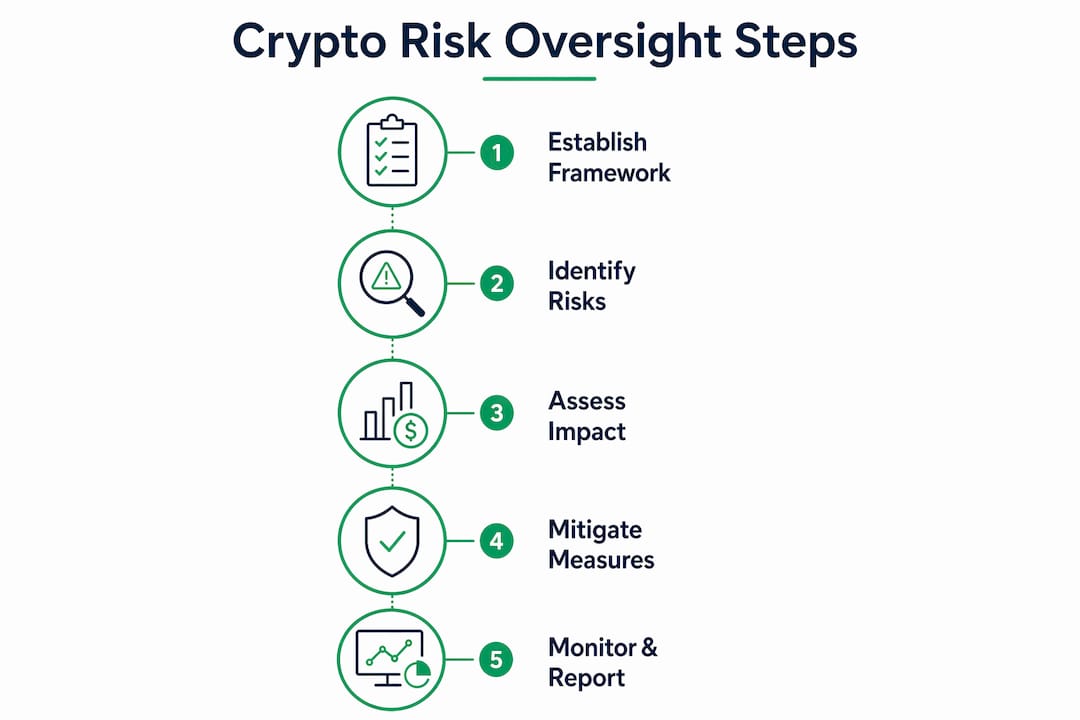
The current regulatory expectations follow a clear sequence:
- Adopt the three lines of defense model. Compliance officers must report through Audit, Risk and Compliance Committees that sit outside commercial influence. This is now a baseline requirement across major jurisdictions.
- Produce quantitative risk scoring. MAS and comparable regulators expect documented risk methodology with board sign-offs and annual reviews. Qualitative assessments alone no longer pass examination.
- Maintain version-controlled documentation. Risk frameworks must carry board approval dates, version numbers, and change logs. Regulators check these during examinations.
- Link risks to controls explicitly. Regulatory examinations fail firms that cannot show a documented connection between each identified risk and the control applied to it, regardless of how thorough the risk assessment appears.
- Conduct annual board sign-off. The risk appetite statement and the broader risk framework both require formal board approval on a defined annual cycle.
The practical implication is significant. A firm that has a well-written risk framework but cannot produce version history and board sign-off records will fail a regulatory examination. Documentation discipline is not administrative overhead. It is the evidence that governance is real.
Crypto governance frameworks that follow the three lines of defense model give regulators the reporting separation they require while giving the board a clear view of risk without commercial filtering.
Why does technical expertise in risk committees matter?
The main board of a crypto firm is not equipped to evaluate a smart contract exploit in real time. That is not a criticism. It reflects the reality that main boards focus on strategic output and alignment, while technical risk committees handle the depth. Combining both functions into one body is one of the most common governance errors executives make in this sector.
“Technical depth in risk committees ensures scrutiny of complex crypto incidents like smart contract exploits and liquidity crises, which boards alone cannot provide.”
The risks that require technical committee expertise include:
- Smart contract exploits. Code vulnerabilities can drain protocol funds within minutes. A committee member with blockchain security knowledge can assess the exposure and authorize emergency controls before a full board meeting is possible.
- Liquidity crises. Staking lockups and on-chain liquidity constraints create cascading risks that differ fundamentally from traditional cash flow problems. Technical members understand the mechanics.
- Market abuse investigations. On-chain transaction analysis requires forensic blockchain knowledge. Independent non-executive directors with this background give the committee credibility with regulators.
- Custody risk. Multi-signature wallet governance, key management procedures, and cold storage thresholds require technical review, not just policy sign-off.
Direct communication between risk committee members and business unit owners, supported by internal audit participation, prevents the information sanitization that distorts risk culture reporting. When committee members only receive management summaries, they lose the signal that matters most: whether the people managing risk day to day believe the controls actually work.
Boards should bring governance, risk, and compliance knowledge beyond financial expertise to optimize risk oversight. That means recruiting independent non-executive directors who understand blockchain infrastructure, not just capital markets.
What are best practices for operating effective crypto risk committees?
Effective crypto risk committees share a set of structural and behavioral characteristics that separate genuine oversight from governance theater.
| Practice | Weak approach | Strong approach |
|---|---|---|
| Committee composition | Mixed with main board | Separate body, 4+ independent NEDs with crypto expertise |
| Reporting line | Via commercial leadership | Direct to board, independent of revenue functions |
| Meeting frequency | Ad hoc or annual | Quarterly minimum; monthly during high-risk periods |
| Risk appetite review | Informal, undated | Annual board sign-off with version control |
| Control documentation | Narrative only | Explicit risk-to-control mapping with audit trail |
| Internal audit access | Filtered through management | Direct participation in committee meetings |
The composition standard matters most. HKEX guidance sets four independent non-executive directors as the floor for institutional firms. That number exists to prevent any single perspective from dominating risk decisions.
Active challenge is the behavioral standard that separates high-performing committees from passive ones. KPMG’s Board Leadership Center advises boards to move from passive monitoring to active challenge of management’s risk position, including stress-testing governance, risk, and compliance models during product launches. A committee that approves every management recommendation without documented dissent or challenge is not performing oversight. It is performing compliance theater.
Pro Tip: Require management to present a “red team” scenario at each quarterly meeting: one plausible risk event the current controls would fail to contain. This single agenda item forces honest risk assessment and surfaces gaps before regulators do.
The pitfalls to avoid are equally clear. Combined audit and risk committees dilute technical focus. Indirect reporting channels through commercial leadership corrupt the independence that regulators require. And risk appetite statements that sit in a document repository without annual review become liabilities, not assets, when an examiner asks for the current version.
Key takeaways
Effective crypto risk committees require structural independence, technical expertise, and documented controls to satisfy both regulators and the board’s fiduciary obligations.
| Point | Details |
|---|---|
| Structural separation is mandatory | Risk reporting must sit outside commercial leadership across APAC, EMEA, and Middle East AML regimes. |
| Technical expertise is non-negotiable | Committees need members who can evaluate smart contract exploits, custody risks, and on-chain liquidity events directly. |
| Documentation drives regulatory outcomes | Every risk must link to a documented control with version history and board sign-off to pass examination. |
| Active challenge defines real oversight | Committees must question management’s risk posture, not just receive and approve it. |
| Composition sets the floor | Four or more independent non-executive directors with crypto expertise is the institutional standard per HKEX guidance. |
The governance gap no one wants to admit
I have reviewed governance frameworks at crypto firms that looked excellent on paper. Separate committees, documented risk appetites, quarterly meetings. Then I asked one question: when did the head of internal audit last present directly to the risk committee without a management summary in between? The silence told me everything.
The decentralization myth is the deeper problem. A significant number of crypto executives still believe that decentralized architecture reduces governance obligations. It does not. Regulators see through that framing immediately. The Bank of England has been explicit: crypto governance must move beyond decentralization narratives and adopt transparent codes of conduct, including code audit standards and commit key disclosures.
The personal liability dimension is where I see executives underestimate their exposure. Academic analysis of the Federal Reserve’s risk committee framework warns that future enforcement actions may tie personal board member liability directly to risk committee effectiveness. That shift is already visible in how regulators frame their examination findings. When a firm fails, the question is no longer just “what went wrong.” It is “what did the risk committee know, and when.”
My honest view: the firms that will survive the next wave of regulatory enforcement are not the ones with the most sophisticated technology. They are the ones that applied proven traditional finance governance models to crypto, adapted them for technical complexity, and documented every decision with the rigor of a firm that expects to be examined. That is not pessimism. That is the standard the market is moving toward, and the executives who build for it now will not be scrambling later.
— Gregg
Strengthen your crypto governance with structured risk oversight
Crypto risk committees require more than a charter and a meeting schedule. They require a framework that connects risk appetite, control documentation, and regulatory expectations into a single auditable structure.
Wush built the Digital Assets Readiness Evaluation (DARE) to address exactly this gap. DARE is an independent certification that equips executives, risk managers, and governance teams with the frameworks and credentials needed to operate digital asset programs at board level. It covers custody governance, AML compliance, operational risk policy, and risk appetite documentation, all structured around the regulatory standards that examiners actually use. Organizations that complete DARE hold a credential backed by blockchain verification and renewed annually to stay current with evolving requirements. If your risk committee needs a structured foundation, DARE provides it.
FAQ
What is the role of risk committees in crypto governance?
Risk committees in crypto governance provide specialized board-level oversight of operational, financial, cyber, and compliance risks unique to digital asset businesses. They review risk appetite statements, monitor control effectiveness, and maintain the reporting independence that regulators require.
How often should a crypto risk committee meet?
Institutional crypto firms should meet at least quarterly, with a minimum of four independent non-executive directors, per HKEX guidance. High-growth or exchange-facing firms should consider monthly sessions during product launches or regulatory transitions.
Why can’t the main board handle crypto risk oversight alone?
Main boards focus on strategic output and lack the technical depth to evaluate complex crypto events like smart contract exploits or on-chain liquidity crises in real time. A separate technical risk committee provides the specialized scrutiny those incidents require.
What documentation do regulators require from crypto risk committees?
Regulators require risk frameworks with board sign-off, version control, and explicit documentation linking each identified risk to its applied control. Firms that cannot produce this audit trail fail regulatory examinations regardless of the quality of their risk assessments.
What is the three lines of defense model in crypto governance?
The three lines of defense model separates business operations, compliance and risk oversight, and internal audit into distinct functions. In crypto firms, this means compliance officers report through Audit, Risk and Compliance Committees that sit outside commercial leadership, satisfying AML regime requirements across APAC, EMEA, and the Middle East.