
Crypto Operational Risk Policy Setup for Finance Pros

Crypto operational risk policy setup is the structured process of defining governance roles, control frameworks, and monitoring protocols that allow an organization to hold and transact cryptocurrency assets without exposing itself to unmanaged financial, legal, or operational loss. In the industry, this practice falls under the broader discipline of operational risk management for digital assets, a category that regulators including the European Union’s Markets in Crypto-Assets Regulation (MiCA) and the Digital Operational Resilience Act (DORA) now treat as mandatory, not optional. Finance and risk professionals who treat this as a peripheral IT task consistently discover governance gaps at the worst possible moment. The right policy setup integrates custody controls, board-level accountability, and real-time monitoring from day one.
What are the essential components of a crypto operational risk policy?
A crypto operational risk policy setup begins with governance structure, not technology. Without defined ownership, every control you build sits on an unstable foundation.
The core governance layer requires three distinct roles:
- Executive sponsor: A C-suite officer, typically the CFO or Chief Risk Officer, who holds board accountability for the digital asset program.
- Policy owner: A designated crypto-savvy compliance officer who maintains the policy document, manages review cycles, and escalates exceptions.
- Risk committee: A cross-functional group covering finance, legal, IT security, and operations that reviews KRIs (Key Risk Indicators) and approves material changes.
The three-lines-of-defense model is the recognized governance standard for crypto operations. The first line is the business unit executing transactions. The second line is the risk and compliance function monitoring those transactions. The third line is internal audit providing independent assurance. MiCA mandates this structure explicitly, requiring that management bodies include crypto, risk, compliance, finance, and IT expertise with genuine independence between lines.
A RACI matrix (Responsible, Accountable, Consulted, Informed) is the most practical tool for making this structure operational. Clear responsibility matrices prevent the dangerous assumption that someone else will handle wallet rekeying, vendor approvals, or incident escalation during a crisis. Map every critical process, from transaction authorization to key rotation, against the RACI before your policy goes live.

Policy review cadence matters as much as the initial document. Quarterly reviews are the minimum for active trading operations. Semi-annual reviews suit treasury hold strategies. Every review cycle must include board sign-off on any material changes to risk appetite or control thresholds.
Pro Tip: Appoint your compliance officer before you write a single policy line. The person who will own the document must shape it. Policies written without the owner’s input become shelf documents within six months.
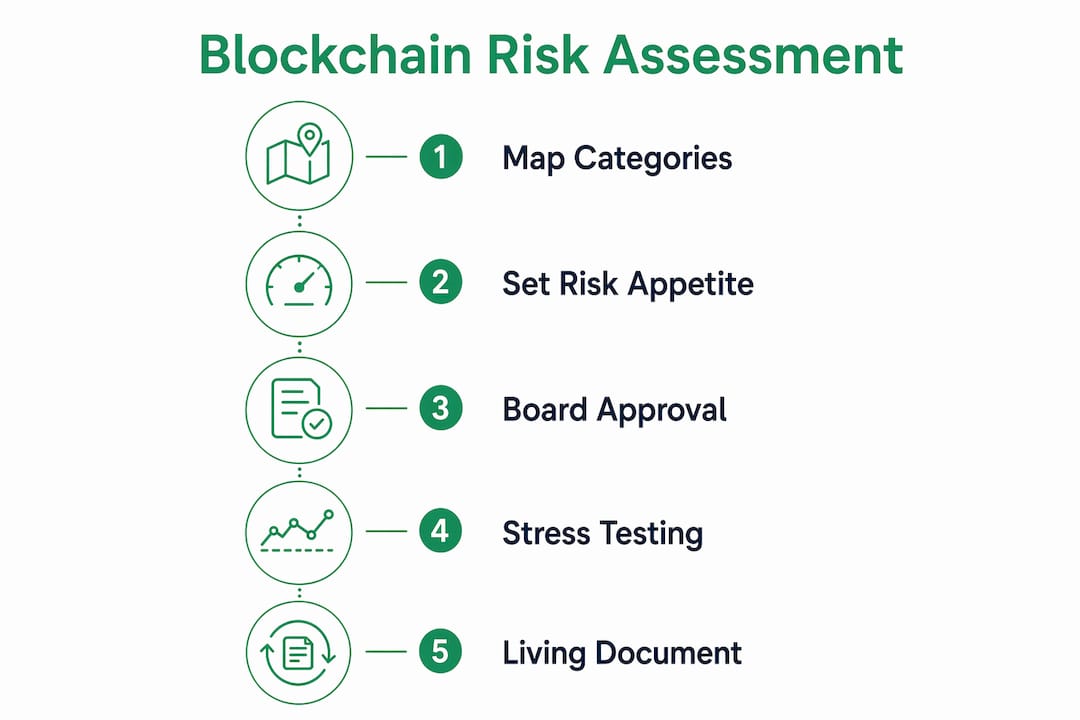
How to conduct a blockchain risk assessment and set risk appetite
A blockchain risk assessment identifies the specific failure modes that apply to crypto operations and assigns probability and impact scores to each. This is not a standard enterprise risk assessment with crypto bolted on. The risk categories are genuinely different.
The five primary operational risk categories for crypto are:
- Cyber and key compromise risk: Unauthorized access to private keys or signing credentials, resulting in irreversible asset loss.
- Custody and counterparty risk: Exchange insolvency, custodian failure, or withdrawal freezes that prevent asset recovery.
- Fraud and social engineering risk: Impersonation attacks targeting transaction approvers or wallet administrators.
- System and smart contract risk: Protocol bugs, oracle failures, or DeFi (Decentralized Finance) contract exploits that drain funds without a recovery path.
- Liquidity and concentration risk: Overexposure to a single exchange or asset class that cannot be unwound quickly in a stress event.
Once you have mapped these categories, you need a board-approved risk appetite statement that sets hard limits. Best practice caps liquid crypto exposure at no more than 10% on any single exchange and 20% in aggregate, with mandatory multi-signature (multi-sig) or Multi-Party Computation (MPC) approvals required for any material transfer. These are not conservative estimates. They reflect the concentration levels at which exchange failures have historically caused unrecoverable losses.
Stress testing must be built into the risk appetite framework, not treated as an annual exercise. Policy stress tests should model at minimum three scenarios: a mild drawdown of 30%, a severe crash of 70%, and a prolonged bear market lasting 12 months or more. Each scenario should trigger pre-defined management actions, either automatic controls or board consultation requirements.
| Risk scenario | Trigger threshold | Required action |
|---|---|---|
| Mild drawdown | 30% portfolio decline | Management review within 48 hours |
| Severe crash | 70% portfolio decline | Board consultation, position review |
| Prolonged bear market | 12+ months below cost basis | Full risk appetite reassessment |
| Exchange concentration breach | Over 10% on single exchange | Mandatory rebalancing within 5 business days |
Pro Tip: Build your risk appetite statement as a living document with version control. Regulators and auditors will ask to see how your limits evolved alongside market conditions.
How to set up operational controls and transaction safeguards
Operational controls are the mechanisms that enforce your risk policy at the transaction level. Governance documents without controls are aspirational fiction.
Follow this sequence when building your control stack:
-
Deploy multi-sig or MPC wallets for all material holdings. Require a minimum of two independent approvers for any transfer above your defined materiality threshold. Multi-sig wallets distribute signing authority across multiple key holders. MPC wallets split the cryptographic key itself, so no single device ever holds a complete key. Both approaches eliminate single points of failure.
-
Implement pre-transfer validation. Address whitelisting and business purpose documentation are the two most effective pre-transfer controls. Whitelisting restricts outbound transfers to pre-approved wallet addresses. Business purpose documentation creates an audit trail that satisfies both internal audit and regulatory inquiry.
-
Establish on-chain and off-chain reconciliation. Every transaction recorded on the blockchain must reconcile with your general ledger within a defined period, typically 24 hours for active operations. Reconciliation gaps are the earliest indicator of unauthorized activity or system error.
-
Write crypto-specific incident response playbooks. Generic IT incident playbooks do not address the irreversibility of blockchain transactions. Crypto incident triggers include unauthorized transactions, signature anomalies, and lost or compromised keys. Your playbook must define who declares an incident, who contacts the custodian to freeze activity, who preserves on-chain evidence, and who manages external communications. These steps must be executable within hours, not days.
-
Build vendor and custodian oversight into the policy. Third-party custody arrangements require annual due diligence reviews covering financial stability, insurance coverage, and security certifications. Your policy should specify minimum acceptable standards and a process for custodian replacement if those standards are not met.
The operational risk framework that ties these controls together must treat wallet governance and ledger accounting as core financial governance functions. Organizations that treat crypto risk as an IT issue rather than a financial governance issue consistently develop blind spots in their control environment.
Pro Tip: Test your incident response playbook with a tabletop exercise before you need it. Simulate a compromised key scenario and time how long it takes your team to reach the custodian freeze step. Most teams discover their playbook has gaps they never anticipated.
For organizations managing automated trading strategies, understanding bot-specific risk controls is also worth incorporating into your vendor oversight framework.
How to monitor and maintain ongoing crypto risk management
Continuous monitoring is the difference between a policy that protects you and a policy that gives you false confidence. Static annual reviews do not match the pace of crypto market events.
The monitoring layer requires three components working together:
- Automated KRI dashboards: Crypto-native Key Risk Indicators like wallet concentration ratios, exchange withdrawal latency, and counterparty credit scores provide early warnings that traditional finance metrics miss entirely. These should feed into a real-time dashboard visible to the second-line risk function.
- Regulatory incident reporting: MiCA requires initial incident reports within 4 hours, intermediate reports within 72 hours, and final reports within one month for ICT-related incidents. DORA imposes similar timelines. Your monitoring system must be capable of detecting and escalating incidents fast enough to meet these deadlines.
- Periodic policy reviews with stress test updates: Quarterly reviews for active operations should include a fresh stress test run against current market conditions. Semi-annual reviews should reassess whether your KRI thresholds still reflect your actual risk appetite.
The most common failure mode in ongoing monitoring is the shadow process. A shadow process develops when the official policy is too rigid for day-to-day operations, so teams create informal workarounds. Policies that empower teams with defined guardrails rather than rigid micro-management prevent this pattern. If your team is regularly seeking exceptions, the policy needs revision, not enforcement.
Integrating crypto risk data into enterprise risk reporting is the final step toward operational resilience. Your board should see crypto KRIs alongside traditional market and credit risk metrics in every risk report. Siloed crypto reporting creates the same governance disconnect as treating it as an IT function.
Key Takeaways
An effective crypto operational risk policy setup requires governance structure, board-approved risk limits, transaction-level controls, and continuous automated monitoring working as a single integrated system.
| Point | Details |
|---|---|
| Governance comes first | Assign executive sponsors, policy owners, and a risk committee before writing any controls. |
| Use the three-lines-of-defense model | Separate execution, oversight, and audit functions with genuine independence between each line. |
| Set hard concentration limits | Cap exposure at 10% per exchange and 20% aggregate, with multi-sig or MPC required for material transfers. |
| Build crypto-specific incident playbooks | Generic IT playbooks fail in crypto. Define triggers, freeze steps, and escalation paths executable within hours. |
| Monitor with crypto-native KRIs | Wallet concentration ratios and exchange withdrawal latency catch risks that traditional metrics miss. |
Why most crypto risk policies fail before they’re tested
I have reviewed a lot of digital asset governance documents across finance teams at various stages of crypto adoption. The pattern I see most often is not a lack of effort. It is a category error. Teams build technically detailed policies covering wallet types, key management, and transaction limits, then file them under IT governance. The CFO has never read them. The board has never approved them. When something goes wrong, the policy is irrelevant because no one with authority knows it exists.
The second failure I see is the assumption that a policy written in a stable market will hold up in a volatile one. A 70% drawdown does not just test your financial exposure. It tests whether your team knows who to call, what decisions require board approval, and whether your custodian can actually execute a freeze in the timeframe your playbook assumes. Most teams find out the answers to those questions for the first time during the event itself.
The fix is not more complexity. It is clarity. Define who owns each decision. Test your playbook before you need it. Set KRI thresholds that trigger real conversations, not just dashboard alerts that no one acts on. Crypto risk management done well looks a lot like good financial governance done well. The technology is different. The discipline is not.
— Gregg
How Wush and DARE support your crypto risk policy setup
Finance and risk teams building or auditing their digital asset governance programs need more than a policy template. They need a structured way to assess whether their controls actually meet the standard regulators and auditors expect.

Wush offers the Digital Asset Readiness Evaluation (DARE), an independent certification program designed specifically for finance professionals managing crypto operations. DARE covers governance structure, custody controls, compliance frameworks, and operational risk management through modular assessments and annual renewal cycles. The credential is blockchain-verified and recognized across enterprise digital asset programs. If you are building a crypto operational risk policy from scratch or stress-testing an existing one, the DARE platform gives you a structured benchmark against current regulatory and industry standards.
FAQ
What is crypto operational risk?
Crypto operational risk is the exposure to financial loss or regulatory breach caused by failures in internal processes, people, systems, or external events specific to cryptocurrency operations. It includes custody failures, key compromise, smart contract exploits, and transaction errors.
How often should a crypto risk policy be reviewed?
Active trading operations require quarterly reviews at minimum. Treasury hold strategies can use semi-annual reviews. Every review cycle should include updated stress testing and board sign-off on any changes to risk appetite thresholds.
What is the three-lines-of-defense model in crypto governance?
The three-lines-of-defense model separates the business unit executing transactions (first line), the risk and compliance function monitoring them (second line), and internal audit providing independent assurance (third line). MiCA mandates this structure for crypto-asset service providers.
What are crypto-native Key Risk Indicators?
Crypto-native KRIs are monitoring metrics specific to digital asset operations, including wallet concentration ratios, exchange withdrawal latency, and counterparty credit scores. They provide early warnings that standard financial risk metrics do not capture.
What incident reporting timelines does MiCA require?
MiCA requires an initial incident report within 4 hours of detection, an intermediate report within 72 hours, and a final report within one month for ICT-related incidents affecting crypto-asset service providers.