
Digital Asset Operational Resilience: A 2026 Guide

Digital asset operational resilience is defined as the ability of a financial entity to build, assure, and review the integrity and reliability of its ICT capabilities so that digital asset services continue without interruption despite disruptions. This definition comes directly from DORA Article 3, the EU’s Digital Operational Resilience Act, which sets the regulatory baseline for financial firms operating in digital asset markets. The concept extends beyond disaster recovery. It covers governance, third-party ICT dependencies, incident response, and continuous testing across the full lifecycle of digital asset operations. For finance and risk professionals in 2026, understanding what digital asset operational resilience means in practice is the foundation for every compliance and risk mitigation decision your organization makes.
What is digital asset operational resilience?
Digital asset operational resilience is the structured capacity of a financial entity to maintain critical digital asset services, including custody, settlement, and trading, through ICT failures, cyberattacks, and third-party outages. The industry term for this capability, formalized under DORA, is digital operational resilience, and it applies specifically to financial entities whose services depend on ICT systems. What makes digital assets distinct is the infrastructure underneath them: blockchain nodes, private key management systems, wallet providers, and smart contract execution environments all introduce failure points that traditional financial resilience frameworks were not designed to address.
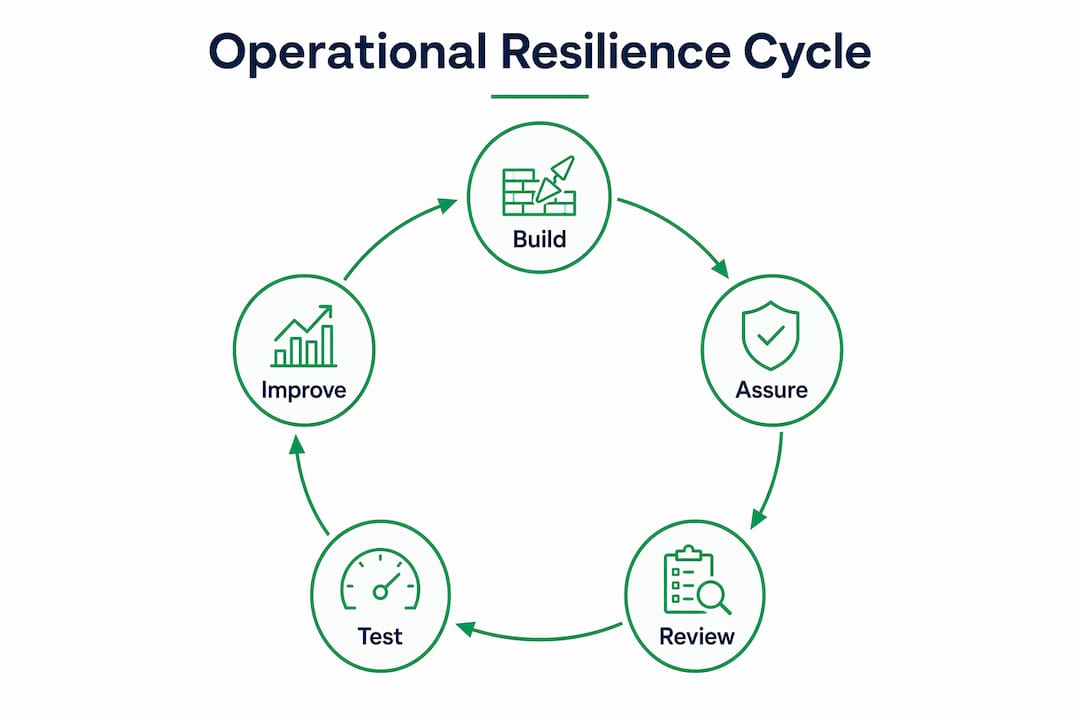
Operational resilience is not a one-time project but a continuous cycle of building, assuring, and reviewing ICT capabilities that support critical financial services. This lifecycle framing matters because it shifts accountability from IT departments to senior management and the board. A firm that passes an audit in Q1 but makes no governance changes by Q4 is not operationally resilient. It has simply documented a point-in-time state.

The practical scope of digital asset resilience meaning covers five domains: governance and accountability, ICT risk management, incident detection and response, third-party risk management, and resilience testing. Each domain requires documented policies, assigned ownership, and evidence of ongoing review. Finance professionals who treat these as separate compliance workstreams rather than an integrated program consistently underperform in regulatory assessments.
What components make up digital asset operational resilience frameworks?
The core components of a digital asset operational resilience framework follow the structure mandated by DORA and reinforced by FCA guidance. DORA implementation covers governance, ICT risk management, incident management, third-party risk, and resilience testing, including threat-led penetration testing, with senior management involvement required at every layer.
The five framework components break down as follows:
- Governance and accountability: Senior leadership must own resilience outcomes, not delegate them entirely to technology teams. Board-level digital asset oversight, including board accountability for ICT risk, is a regulatory expectation under both DORA and FCA rules.
- ICT risk management: This includes documented policies for business continuity, asset inventories, and classification of critical systems. For digital assets, this means mapping wallet infrastructure, key management systems, and blockchain node dependencies.
- Incident detection and response: NIST CSF 2.0 frames incident response as integral to cybersecurity risk management, not a reactive afterthought. Detection capabilities must be tied to defined escalation paths and recovery time objectives.
- Third-party ICT risk: Custody providers, blockchain infrastructure vendors, and cloud platforms are not external to your resilience program. They are part of it. DORA treats third-party ICT providers as integral to the resilience obligation, not as separate vendor management issues.
- Resilience testing: This includes scenario-based testing, tabletop exercises, and for larger firms, threat-led penetration testing (TLPT) conducted against live production environments.
Pro Tip: Map each framework component to a named owner in your organization before you build policies. Frameworks without named accountability produce documentation that satisfies auditors once and fails practitioners permanently.
How do regulators define and enforce digital asset operational resilience?
DORA and the FCA represent the two most consequential regulatory frameworks for digital asset operational resilience in 2026, and they approach enforcement differently despite sharing core principles.
| Dimension | DORA (EU) | FCA (UK) |
|---|---|---|
| Legal basis | Regulation (directly binding on EU financial entities) | Supervisory rules and guidance (PS21/3, SS1/21) |
| Core requirement | ICT risk management, incident reporting, TLPT, third-party oversight | Important business services, impact tolerances, scenario testing |
| BIA requirement | Mandatory, linked to ICT asset redundancy | Required, linked to consumer harm thresholds |
| Third-party scope | Covers all ICT third-party service providers | Focuses on operational dependencies affecting important services |
| Testing cadence | Annual contingency plan testing; TLPT for significant firms | Annual review with board sign-off; scenario testing frequency risk-based |
| Enforcement trigger | Supervisory review and audit under national competent authorities | FCA supervisory review; firms must self-certify compliance |
DORA Article 11 mandates that financial entities implement ICT business continuity policies with documented arrangements to respond to ICT incidents quickly, prioritize recovery, and communicate during crises. This includes conducting a business impact analysis, establishing redundancy for critical components, and testing contingency plans annually. For digital asset firms, the BIA must extend to blockchain infrastructure and custody systems, not just conventional IT assets.
The FCA takes a consumer-harm-centered approach. FCA operational resilience expectations require firms to prevent intolerable consumer harm by mapping dependencies, setting impact tolerances, and running scenario tests aligned to actual risk profiles. Anchoring resilience planning to impact tolerance gives risk leaders a measurable standard: if a disruption causes harm beyond the defined threshold, the firm has failed its resilience obligation regardless of how well its recovery documentation reads.
The practical difference between DORA and FCA enforcement is specificity. DORA prescribes detailed technical requirements. The FCA sets outcome-based expectations and holds firms accountable for demonstrating they can stay within tolerances under stress. Digital asset firms operating across both jurisdictions must satisfy both frameworks simultaneously, which requires a unified governance structure rather than two parallel compliance programs.
What are practical best practices for achieving digital asset resilience?
Operationalizing resilience in a digital asset environment requires more than policy documentation. It demands that your recovery capabilities map directly to the systems your critical services actually depend on.
-
Conduct a BIA specific to digital asset operations. Identify which services, such as custody, settlement, or staking, are critical. Then trace each service back to its ICT dependencies: wallet providers, key management systems, blockchain nodes, and API connections to exchanges. Linking BIA results to ICT asset redundancy is a DORA requirement, and firms that skip this step invest in disaster recovery capabilities that do not protect their most critical functions.
-
Map important business services to infrastructure. Practical resilience requires mapping critical business services to digital asset infrastructures like key management and wallet operations, then testing disruptions that include degraded provider interfaces and operational risks involving people and process. A custody service that depends on a single third-party key management provider with no documented failover is a resilience gap, regardless of how strong your internal controls are.
-
Establish incident detection and response protocols aligned with NIST CSF. Detection must be automated where possible, with defined thresholds that trigger escalation. Response protocols should include containment steps specific to digital asset incidents, such as wallet suspension, node isolation, and smart contract pause mechanisms. Operational resilience in digital asset custody requires evidence-based recovery planning with backup protocols, service level agreements, escalation paths, and incident containment to meet audit expectations.
-
Build redundancy for ICT assets tied to critical services. Redundancy without BIA alignment is wasted investment. Prioritize redundancy for the systems your BIA identifies as critical, including backup key management infrastructure and geographically distributed node access.
-
Treat resilience as continuous risk management. Schedule quarterly reviews of your resilience posture, not just annual audits. Assign a named owner for each critical service’s resilience plan and require documented evidence of review. Successful operational resilience audits require demonstrable continuous assure-and-review practices, showing governance follow-through beyond initial implementation.
Pro Tip: Run at least one scenario test per year that includes a third-party provider failure, not just an internal system outage. Most digital asset resilience gaps surface at the boundary between your firm and your vendors.
How does operational resilience protect against digital asset risks?
Effective digital asset resilience strategies reduce three categories of risk that are specific to digital asset operations: cyberattacks targeting private key infrastructure, service outages caused by third-party ICT failures, and market disruptions triggered by operational failures at systemically important firms.
Scenario testing should vary severity, duration, and nature of incidents to validate that a firm stays within its impact tolerances, revealing vulnerabilities for remediation before a real incident occurs. This is not a theoretical exercise. A custody provider that cannot demonstrate recovery from a key management system failure within its defined tolerance window faces both regulatory sanction and reputational damage that is difficult to reverse.
The risk mitigation benefits of a mature resilience program include:
- Consumer protection: Impact tolerance thresholds define the maximum disruption a firm’s clients can absorb. Staying within those thresholds under stress is the direct mechanism for preventing consumer harm.
- Market integrity: Operational failures at large digital asset custodians or settlement providers can cascade across markets. Resilience programs that include third-party risk management reduce the probability of systemic contagion.
- Regulatory compliance: Firms with documented, tested, and board-approved resilience programs face lower enforcement risk and demonstrate credibility during supervisory reviews.
- Institutional credibility: Counterparties, institutional clients, and regulators assess operational resilience as a proxy for overall governance quality. A firm that cannot demonstrate resilience capabilities loses business to firms that can.
For legal risk management in digital assets, resilience documentation also provides the evidentiary foundation for demonstrating due diligence in the event of a regulatory investigation or client dispute.
Key takeaways
Digital asset operational resilience requires a continuous, governance-led program that links ICT risk management, BIA-driven redundancy, and third-party oversight to defined impact tolerances across all critical digital asset services.
| Point | Details |
|---|---|
| Regulatory definition | DORA Article 3 defines digital operational resilience as building, assuring, and reviewing ICT integrity for financial services. |
| BIA alignment is mandatory | Business impact analysis must connect directly to ICT asset redundancy or recovery investments are misaligned. |
| Third-party risk is internal | ICT providers like custody platforms and key management vendors are part of your resilience obligation, not external to it. |
| Impact tolerance is the measure | FCA and DORA both require firms to define and stay within impact tolerances under scenario-tested stress conditions. |
| Resilience is a lifecycle | Annual audits are insufficient. Continuous assure-and-review governance is the regulatory and operational standard. |
Why most resilience programs fail before they start
Most digital asset resilience programs I have reviewed share a common flaw: they are built around documentation rather than operational reality. A firm produces a business continuity plan, maps a few critical services, and considers the work done. Then a custody provider goes offline and the recovery plan references a contact list that is two years out of date.
The uncomfortable truth is that resilience planning disconnected from actual digital asset workflows is compliance theater. It satisfies an auditor’s checklist without protecting the firm or its clients. The firms that perform best under regulatory scrutiny are the ones that have run live scenario tests involving real third-party failures, not just tabletop exercises with internal teams.
I have also seen organizations invest heavily in backup infrastructure without ever completing a BIA. They build redundancy for systems that are not critical and leave their actual critical functions, such as private key access and blockchain node connectivity, with no documented failover. DORA’s requirement to link BIA results to redundancy exists precisely because this pattern is so common.
The other gap I consistently observe is the treatment of third-party ICT providers as a vendor management problem rather than a resilience problem. Your custody provider’s outage is your outage. Your key management vendor’s incident is your incident. Until risk teams internalize that boundary, resilience programs will keep producing plans that look complete on paper and collapse under real-world pressure.
The firms getting this right in 2026 are those that have built enterprise crypto risk oversight into their governance structures, assigned named owners to every critical service, and treat scenario testing as a standing operational activity rather than an annual compliance event.
— Gregg
Assess your digital asset resilience with DARE
Wush’s Digital Asset Readiness Evaluation (DARE) gives finance and risk professionals a structured, independent framework to assess and certify their organization’s digital asset operational resilience posture. DARE’s modular assessments cover governance, ICT risk management, custody controls, regulatory compliance, and third-party risk, aligned directly with DORA and FCA expectations. Completing the DARE certification produces documented evidence of your resilience capabilities, supports regulatory submissions, and identifies gaps before supervisors do. For teams building or reviewing their digital asset business continuity programs, DARE provides the credentialing framework that turns internal efforts into externally recognized compliance outcomes.
FAQ
What is digital asset operational resilience?
Digital asset operational resilience is the ability of a financial entity to maintain and recover critical digital asset services despite ICT disruptions, cyberattacks, or third-party failures. DORA Article 3 defines it as building, assuring, and reviewing ICT integrity and reliability across all systems supporting financial services.
How does DORA define operational resilience for digital assets?
DORA defines digital operational resilience as a financial entity’s capacity to ensure continued service delivery and ICT security through disruptions, including those caused by third-party providers. It mandates governance, incident management, BIA-linked redundancy, and annual resilience testing.
What is the difference between DORA and FCA resilience requirements?
DORA is a directly binding EU regulation prescribing detailed ICT risk management and testing requirements, while FCA rules set outcome-based expectations centered on impact tolerances and preventing consumer harm. Firms operating in both jurisdictions must satisfy both frameworks simultaneously.
Why is business impact analysis critical for digital asset resilience?
BIA identifies which digital asset services are critical and maps them to their ICT dependencies, ensuring that redundancy and recovery investments protect the right systems. Without BIA alignment, firms invest in disaster recovery capabilities that do not cover their most critical functions.
How often should digital asset resilience programs be tested?
DORA requires annual testing of contingency plans, with threat-led penetration testing for significant firms. The FCA expects annual scenario testing with board sign-off, but firms should conduct additional tests whenever material changes occur in their ICT infrastructure or third-party dependencies.