
Digital Asset Readiness in Treasury: 2026 Guide

Digital asset readiness in treasury is defined as the state of being fully equipped to manage, control, and report digital assets with the same rigor and accountability as traditional financial assets. For treasury professionals, this means far more than holding Bitcoin or stablecoins on a balance sheet. It means building the operational controls, governance frameworks, compliance infrastructure, and technology integrations that regulators and auditors expect. Understanding what digital asset readiness means for treasury is now a baseline requirement, not a differentiator, as the Sarbanes-Oxley Act (SOX), U.S. Treasury guidance, and blockchain transaction transparency standards raise the bar for every enterprise with digital asset exposure.
What does digital asset readiness mean for treasury operations?
Digital asset readiness, formally described in governance circles as treasury digital asset maturity, covers three interconnected layers: operational controls, regulatory compliance, and technology infrastructure. Each layer must function independently and connect to the others without gaps.
The operational layer is where most treasury teams struggle first. Automated daily reconciliation linking on-chain activity to the general ledger is the baseline control for any firm managing digital assets. Firms managing 5%–10% of reserves in volatile assets must maintain this reconciliation daily because market fluctuation can shift valuations materially between reporting periods. A missed day is not a minor gap. It is a compliance exposure.

The governance layer requires documented policies, multi-approval workflows, segregation of duties, and comprehensive audit trails that mirror traditional cash management controls but are adapted for crypto’s unique environment. SOX compliance does not exempt digital assets. Treasury teams that treat on-chain holdings as informal or experimental will fail an audit.
The technology layer connects wallets, reporting systems, and ERP platforms. Without purpose-built infrastructure between wallets and regulatory reporting systems, firms experience massive reconciliation gaps at quarter-end. Spreadsheets cannot capture cost basis, counterparty data, and classification information for continuous on-chain activity.
Core components of operational readiness
- Automated reconciliation: Daily matching of blockchain transactions to the general ledger, with no manual intervention.
- Custody architecture: Cold, warm, and hot wallet structures with defined access controls and approval thresholds.
- Governance documentation: Written policies covering asset classification, transaction approval, and reporting cadence.
- Segregation of duties: No single individual controls both transaction initiation and approval.
- Audit trail creation: Immutable records of every on-chain action linked to internal authorization records.
Pro Tip: Never treat custody and governance as sequential design steps. Custody and governance solutions must be architected simultaneously to avoid operational silos and enable automated liquidity management in 24/7 markets. Sequential design leads to poor integration and escalating operational risk.
How does regulatory compliance shape digital asset readiness?
Regulatory compliance is the most rapidly shifting dimension of treasury digital asset readiness. The U.S. Treasury’s Office of Cybersecurity and Critical Infrastructure Protection (OCCIP) launched a cybersecurity information-sharing initiative giving digital asset firms access to the same high-quality threat intelligence used by traditional financial institutions. That move signals that regulators now treat digital asset firms as part of the core financial system, not a peripheral experiment.
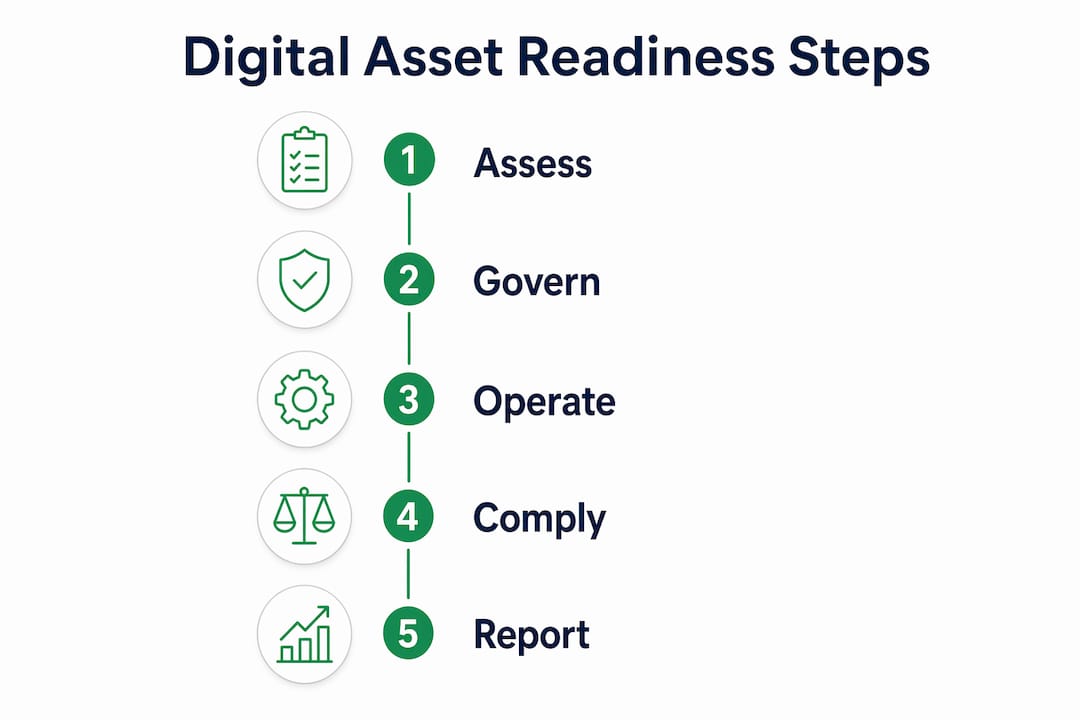
Treasury teams must meet Anti-Money Laundering (AML) requirements, sanctions screening obligations, and financial reporting standards that apply to all asset classes. Digital assets do not receive a compliance exemption. The regulatory exposure for treasury teams that skip documented approval processes or fail to maintain auditability is substantial.
SOX integration is the most concrete compliance requirement for public companies. SOX demands documented internal controls, management attestation, and external audit validation. Digital asset holdings fall within that scope. Treasury teams that cannot produce a clean audit trail for every on-chain transaction will face material weakness findings.
Key compliance requirements for treasury digital asset readiness include:
- AML and sanctions screening: Every counterparty and wallet address must be screened before transaction execution.
- Documented approval policies: Written records of who authorized each transaction, at what threshold, and under what policy.
- SOX-aligned internal controls: Control frameworks that cover digital asset acquisition, custody, valuation, and disposal.
- Cybersecurity participation: Engagement with information-sharing initiatives like those coordinated by OCCIP.
- Regulatory reporting transparency: Real-time or near-real-time reporting capability for digital asset positions and movements.
U.S. Treasury officials have stated that cybersecurity resilience is now integral to digital asset firms’ readiness, bringing them in line with established U.S. financial institutions. That alignment is not optional. It is the direction all regulation is moving.
What risks must treasury teams manage for digital asset readiness?
Risk management for digital assets covers four distinct categories, each requiring a tailored response. Market volatility, liquidity constraints, cybersecurity threats, and operational risk all demand integrated strategies built for 24/7 asset movement and counterparty exposures.
-
Market volatility risk. Digital asset prices can move 10%–20% within a single trading session. Treasury teams must set valuation policies, mark-to-market schedules, and hedging thresholds that account for this volatility without disrupting cash flow planning.
-
Liquidity risk. Unlike traditional money market instruments, digital assets may face thin markets, exchange outages, or settlement delays. Treasury teams need liquidity buffers and counterparty diversification strategies specific to digital asset markets.
-
Cybersecurity risk. Private key compromise is the single largest operational threat in digital asset treasury. Multi-approval workflows, hardware security modules, and cryptographic controls reduce but do not eliminate this risk. Real-time monitoring of wallet activity is a minimum control standard.
-
Operational risk. Manual processes, undocumented procedures, and single points of failure create operational fragility. Business continuity planning must explicitly cover digital asset operations, including key recovery, wallet access, and transaction authorization during system outages.
Pro Tip: Integrate real-time analytics into your risk monitoring stack before you need them. Waiting until a market event or audit to discover gaps in your risk visibility is far more costly than building the capability in advance.
Market volatility, liquidity risks, and cybersecurity threats demand integrated risk management strategies tailored to 24/7 asset movement and counterparty exposures. Treasury teams that apply static, quarterly risk reviews to digital assets will consistently lag behind the actual risk profile of their holdings.
What infrastructure supports treasury digital asset readiness?
Technology infrastructure is the foundation that makes every other layer of readiness possible. Without the right tools, even well-designed governance policies fail at execution.
Wallet infrastructure defines the first layer. Cold wallets hold long-term reserves offline, warm wallets support scheduled transactions with limited connectivity, and hot wallets handle real-time operational flows. Each tier carries a different risk profile and requires distinct access controls. Treasury teams must document the purpose, access policy, and approval threshold for every wallet tier.
Integration with ERP platforms such as SAP and Oracle is the second critical layer. Blockchain wallet activity must flow automatically into financial reporting systems to provide real-time treasury visibility and control. Automated flows from wallets to financial reporting systems eliminate manual processing and reduce operational risk. Manual data entry between blockchain activity and ERP systems is not a viable control environment for any organization operating at scale.
Purpose-built financial data infrastructure sits between wallets and reporting systems as a middleware layer. This infrastructure captures cost basis, counterparty classification, and transaction metadata that spreadsheets cannot handle. It feeds clean, structured data into both the general ledger and regulatory reporting workflows.
| Infrastructure component | Treasury function |
|---|---|
| Cold wallet storage | Long-term reserve custody with offline security |
| Warm wallet layer | Scheduled payments and controlled liquidity access |
| Hot wallet operations | Real-time transaction execution and settlement |
| Blockchain reconciliation platform | Automated matching of on-chain activity to the general ledger |
| ERP integration layer | Real-time financial reporting and audit trail creation |
| Risk analytics dashboard | Continuous monitoring of exposure, volatility, and counterparty risk |
The industry trend toward programmable digital money and embedded finance makes this infrastructure investment more urgent, not less. Treasury teams that build the data layer now will be positioned to operate across both legacy and digital financial rails as the two systems converge.
How do you assess your treasury’s digital asset readiness?
Assessing digital asset readiness starts with a structured maturity benchmark. Climbing a blockchain risk maturity ladder helps institutions benchmark and improve digital asset risk controls from unawareness to strategic risk-driven growth. Higher maturity levels correlate with cost savings, better compliance outcomes, and the ability to offer safe digital asset services.
A practical readiness assessment covers five areas:
- Control gap analysis: Map every existing control against the requirements for SOX compliance, AML screening, and audit trail creation. Identify gaps explicitly.
- Technology audit: Evaluate whether current wallet infrastructure, reconciliation tools, and ERP integrations can support daily automated reporting.
- Policy review: Confirm that written policies exist for asset classification, transaction approval, custody access, and incident response.
- Training assessment: Determine whether treasury staff, legal advisors, and risk managers understand digital asset controls well enough to execute and explain them to auditors.
- Governance structure review: Verify that cross-functional oversight exists across treasury, risk, compliance, and information security teams.
The DARE certification framework from Wush provides a structured path through this assessment. It covers custody, regulatory compliance, risk management, legal, and operational controls in a modular format with annual renewal to keep pace with regulatory change.
Pro Tip: Use internal reporting dashboards to give leadership a live view of digital asset positions, risk exposures, and compliance status. Boards and audit committees increasingly expect this visibility. Building it before they ask is far better than scrambling after a request.
For teams preparing for a formal readiness review, due diligence preparation frameworks from financial consulting practices offer useful benchmarks for documenting controls and demonstrating operational maturity to external reviewers.
Key Takeaways
Digital asset readiness in treasury requires simultaneous investment in operational controls, regulatory compliance, and technology infrastructure, with no layer optional.
| Point | Details |
|---|---|
| Define readiness precisely | Readiness means managing digital assets with the same controls and auditability as traditional financial assets. |
| Automate reconciliation first | Daily automated reconciliation linking on-chain activity to the general ledger is the baseline operational control. |
| Comply with SOX and AML | Documented policies, multi-approval workflows, and audit trails are required for SOX and AML compliance. |
| Build integrated infrastructure | Wallet tiers, ERP integration, and purpose-built reconciliation platforms must work together without manual gaps. |
| Benchmark with a maturity model | Use a structured framework like DARE to identify control gaps and build a prioritized improvement roadmap. |
Treasury’s expanding role is the real story here
The conversation about digital asset readiness tends to focus on technology. New wallets, new integrations, new reconciliation tools. That framing misses the more important shift: treasury is becoming the control center for an entirely new category of financial rails.
I have seen treasury teams that bought the technology but skipped the governance design. They ended up with expensive tools producing unauditable outputs. The technology is not the hard part. The discipline is.
Institutional treasury infrastructure experts emphasize disciplined optionality over chasing innovation, positioning treasury as the control center managing liquidity and risk across legacy and emerging financial rails. That framing is exactly right. The treasury teams that will succeed are not the ones that move fastest. They are the ones that build layered controls capable of surviving an audit, a market shock, and a regulatory inquiry simultaneously.
The most common misconception I encounter is that digital asset readiness is a one-time project. It is not. Regulatory requirements shift. New asset types emerge. Counterparty risks evolve. Readiness is a continuous operating state, not a destination. Treasury teams that treat it as a checkbox will find themselves rebuilding from scratch every two years. Teams that build it as a living governance function will compound their advantage over time.
Cross-functional collaboration is not optional here. Risk, compliance, legal, and information security all have legitimate stakes in how digital assets are managed. Treasury that operates in isolation will miss exposures that other functions would catch. The digital asset treasury policy conversation needs to happen across all of those functions, not just within treasury.
— Gregg
Wush DARE: evaluate your treasury’s readiness
Treasury teams that have read this far already know the gap between where they are and where regulators expect them to be. The question is how to close it systematically.
Wush offers the Digital Asset Readiness Evaluation (DARE), a structured certification program built specifically for finance and treasury professionals. DARE covers custody, regulatory compliance, risk management, legal frameworks, and operational controls through modular assessments with annual renewal. It produces an industry-recognized credential supported by blockchain verification. Teams that complete DARE leave with a documented readiness baseline, identified control gaps, and a clear improvement roadmap. For treasury professionals who need to demonstrate readiness to auditors, boards, or regulators, the DARE certification is the most direct path to that credential.
FAQ
What does digital asset readiness mean in treasury?
Digital asset readiness in treasury means having the operational controls, governance frameworks, compliance infrastructure, and technology integrations needed to manage digital assets with the same rigor as traditional financial assets. It covers daily reconciliation, SOX compliance, AML screening, and audit trail creation.
Why is automated reconciliation critical for treasury digital assets?
Automated daily reconciliation links on-chain blockchain activity to the general ledger, preventing valuation gaps caused by market volatility. Without it, firms face massive reconciliation failures at quarter-end that cannot be resolved manually.
How does SOX apply to digital asset holdings?
SOX requires documented internal controls, management attestation, and external audit validation for all material assets, including digital assets. Treasury teams must produce clean audit trails for every on-chain transaction to avoid material weakness findings.
What is the DARE certification from Wush?
DARE, the Digital Asset Readiness Evaluation, is a modular certification program from Wush that assesses and certifies treasury teams’ readiness across custody, compliance, risk management, legal, and operational controls, with annual renewal to stay current with regulatory changes.
How do you assess digital asset readiness in a treasury function?
A readiness assessment covers control gap analysis, technology audits, policy reviews, staff training evaluations, and governance structure reviews. Structured frameworks like the blockchain risk maturity ladder provide a benchmark for identifying gaps and prioritizing improvements.