
Digital Asset Treasury Policy Explained for Finance Teams

A digital asset treasury policy is the formal, written framework that defines how an organization acquires, secures, manages, and disposes of cryptocurrencies and tokens held on its balance sheet. This is distinct from a traditional treasury policy in one critical way: digital assets operate on 24/7 markets with extreme volatility, self-custody risks, and a regulatory environment that is still taking shape. FASB fair value accounting, effective december 2023, now allows companies to record crypto at market value and report unrealized gains, which makes the absence of a formal governance policy a material financial risk. For finance professionals and treasury teams, getting digital asset treasury policy explained correctly means understanding governance, custody, risk appetite, and operational controls as one integrated system.
What does a digital asset treasury policy actually cover?
A well-structured treasury policy must explicitly define asset purpose, risk appetite, authorized counterparties, segregation of duties, and security incident escalation before any technical custody controls are deployed. These are not optional additions. They are the governance foundation that every operational decision rests on.
The policy begins with a clear statement of purpose. Is the organization holding Bitcoin as a long-term strategic reserve, the way MicroStrategy and Tesla have done? Is it holding stablecoins for cross-border payroll or working capital? Or is it using tokenized assets for yield generation? Each use case carries different risk profiles, accounting treatments, and liquidity requirements. The policy must name the asset classes approved for holding and the business rationale for each.

From there, the policy defines governance structure. This means documenting who approves transactions, who holds signing authority, and what the escalation path looks like when something goes wrong. It also means specifying approved counterparties, such as exchanges, custodians, and OTC desks, along with concentration limits for each.
Here is what a complete digital asset treasury policy covers:
- Asset classification and purpose: Strategic reserve, working capital, payroll, or yield generation
- Governance documentation: Board-level approval requirements, policy ownership, and review cadence
- Risk appetite limits: Maximum allocation thresholds, approved asset types, and counterparty exposure caps
- Custody model: Self-custody, institutional custody via firms like Coinbase Custody or BitGo, or hybrid models using MPC and multisig
- Security incident escalation: Defined response paths, RACI models, and communication protocols for breaches or key loss
- Segregation of duties: Separation between those who initiate, validate, and authorize transactions
Pro Tip: Write your digital asset investment guidelines as a living document with a mandatory quarterly review cycle. Regulatory and market conditions in this space change faster than annual review cycles can accommodate.
Large digital asset treasuries often combine institutional custody with multisig cold storage to balance security and operational speed. A hybrid model gives you the auditability of institutional custody for large reserves while maintaining the agility of hot wallets for operational transactions.
How does governance get enforced in practice?
Governance in digital asset treasury management is not just a written policy. Top operators encode approval workflows, counterparty whitelists, and spend limits directly into transaction infrastructure. That distinction matters enormously. A policy that lives only in a PDF is a policy that gets bypassed under pressure.
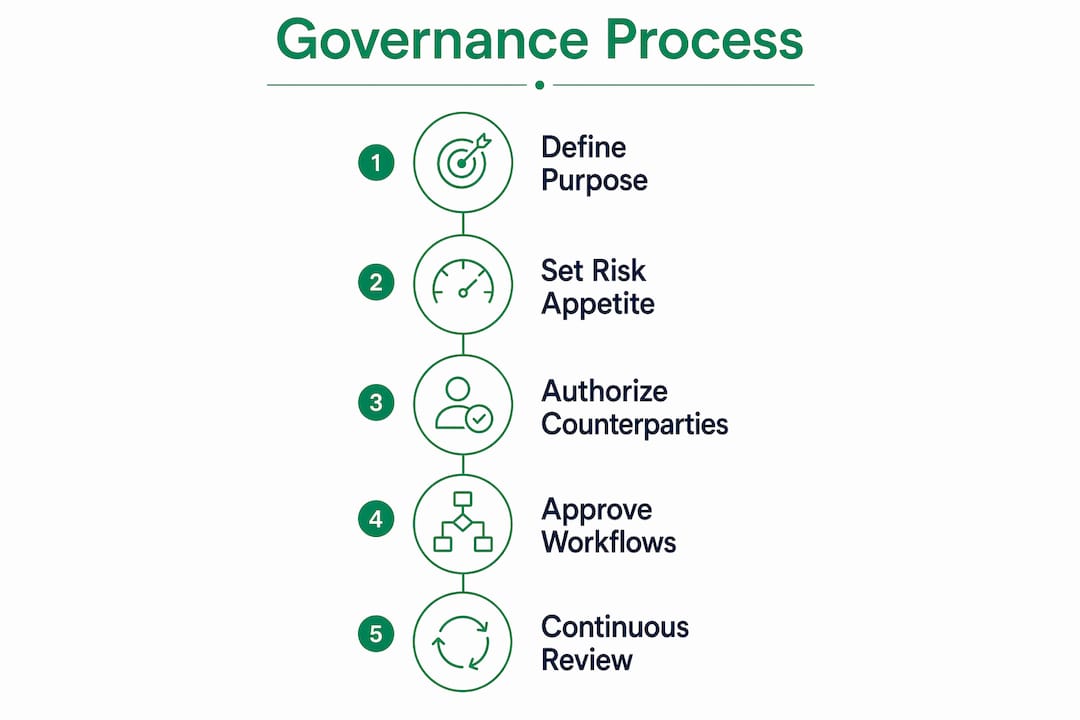
The practical implication is that treasury must be architected as a system, not assembled as a collection of wallets. Custody, governance, liquidity, and yield layers must be built together. Neglecting one layer compromises the whole structure. Platforms like Fireblocks allow organizations to encode governance rules into a trusted execution environment, meaning no individual can override control policies unilaterally. This reduces operational risk at the infrastructure level, not just the procedural level.
Approval workflows for digital asset transfers should mirror traditional wire transfer processes. Here is how a well-designed workflow operates:
- Initiation: A treasury analyst submits a transfer request with full documentation of purpose, amount, and destination address.
- Validation: A treasury manager verifies the request against policy limits, counterparty whitelists, and current liquidity position.
- Authorization: The CFO or designated approver provides final sign-off, with the transaction logged against an audit ticket.
- Execution: The transaction is broadcast to the network, with confirmation recorded in the general ledger.
- Reconciliation: The accounting team reconciles the transaction against the ledger entry, applying FASB fair value rules where applicable.
Approval flows designed this way include audit ticketing and segregation of duties across roles, which satisfies both internal audit requirements and external regulatory scrutiny.
Pro Tip: Build your incident response RACI model before you need it. Defining who is Responsible, Accountable, Consulted, and Informed during a security event is far harder to do clearly when you are already in crisis mode.
Ongoing readiness exercises, such as simulated key loss scenarios or unauthorized transaction drills, keep teams sharp. For board-level governance frameworks, a structured digital asset oversight checklist gives directors the specific questions they need to ask treasury teams.
What risk management practices protect a digital asset treasury?
Crypto treasury management applies traditional financial discipline to 24/7 markets with unique risks, including self-custody exposure and extreme price volatility. The risk management framework for a digital asset treasury must account for threats that simply do not exist in traditional cash management.
The most common pitfall is locking capital into illiquid, high-yield strategies that collapse during market stress. Stress testing portfolios against 70–80% drawdowns and holding 10–15% cash buffers are the recommended practices to avoid forced asset liquidation. That buffer is not idle capital. It is operational insurance.
Effective risk management in this context separates liquidity from solvency. A company can be solvent on paper, with Bitcoin holdings worth $500 million, and still face an operational liquidity crisis if those holdings cannot be converted to fiat quickly enough to meet payroll or vendor obligations. The policy must define minimum liquid reserves in fiat or stablecoins, separate from the strategic reserve position.
Key risk management practices for digital asset treasuries include:
- Position sizing limits: Maximum percentage of total treasury allocated to any single digital asset
- Counterparty due diligence: Formal assessment of custodians, exchanges, and OTC desks before onboarding
- Settlement risk controls: Use of delivery-versus-payment mechanisms where available to reduce exposure during transactions
- Market risk monitoring: Automated alerting for price movements that breach defined thresholds, triggering a policy review
- Regulatory change protocols: Defined response procedures for sudden tax law or securities classification changes affecting held assets
For a deeper look at how digital assets require new risk models, the volatility and custody characteristics of crypto demand frameworks that go well beyond what traditional treasury risk management covers. A liquidity risk assessment specific to digital holdings is a practical starting point for any treasury team building out this layer.
What certifications support digital asset treasury policy implementation?
Professional training in digital asset treasury is accelerating to close the knowledge gap between organizational adoption and operational readiness. The AFP-Kyriba Stablecoins and On-Chain Liquidity certificate offers Certified Treasury Professional credits and covers governance, custody, risk, and integration in a structured curriculum.
The AFP-Kyriba program is structured into four modules. The first covers stablecoin fundamentals. The second addresses instruments and associated risks. The third focuses on operational integration. The fourth is a readiness piloting module that moves treasury teams from understanding to action across digital asset subjects. That progression from theory to operational readiness is exactly what CFOs need from their teams before deploying capital into digital assets.
Certification matters for three concrete reasons:
- Credibility with boards and auditors: A certified treasury team demonstrates that digital asset decisions are made within a structured, reviewed framework rather than ad hoc judgment calls.
- Regulatory defensibility: When regulators or auditors question a treasury decision, documented training and certified competency provide a defensible record of due diligence.
- Policy quality: Teams with formal training write better policies. They know what questions to ask about custody models, counterparty risk, and escalation protocols before problems arise.
For organizations seeking a governance-focused credential, Wush offers the Digital Asset Readiness Evaluation (DARE), a certification built specifically around the governance and compliance requirements of enterprise digital asset operations. It covers custody, regulatory compliance, risk management, legal considerations, and operational controls in a modular format with annual renewal to keep pace with regulatory changes.
Key takeaways
A digital asset treasury policy is only as strong as the governance infrastructure and trained personnel behind it.
| Point | Details |
|---|---|
| Policy before custody | Define asset purpose, risk appetite, and escalation paths before deploying any technical custody solution. |
| Programmatic governance | Encode approval workflows and counterparty limits into transaction infrastructure, not just written documents. |
| Liquidity versus solvency | Maintain fiat or stablecoin buffers to cover operational needs, separate from strategic reserve positions. |
| Stress test regularly | Test portfolios against 70–80% drawdowns to identify forced liquidation risks before market stress hits. |
| Certify your team | Formal credentials from programs like AFP-Kyriba or Wush DARE improve policy quality and regulatory defensibility. |
Why most digital asset policies fail before they start
I have reviewed governance frameworks across organizations that hold everything from Bitcoin to tokenized real-world assets, and the failure pattern is almost always the same. The policy document is thorough. The custody setup is technically sound. But the two were built by different teams who never talked to each other, and the result is a governance gap that only becomes visible during an incident.
The uncomfortable truth about digital asset management policy is that most organizations treat it as a compliance exercise rather than an operational architecture decision. They write the policy to satisfy a board request or an auditor question, then file it away. The transaction infrastructure gets built by the IT or fintech team with different assumptions about who approves what and under what conditions.
Formal written policies prevent the ad hoc decisions that increase risk. But a policy that is not encoded into your transaction layer is not really a policy. It is a statement of intent. The organizations that get this right treat governance as a technical requirement, not a documentation requirement. They build approval workflows, counterparty whitelists, and spend limits into the infrastructure from day one.
The other thing I would push back on is the idea that you can finalize a digital asset treasury policy and move on. This is a domain where the regulatory ground shifts under your feet. FASB updated its crypto accounting standards in 2023. Tax treatment of staking rewards is still contested in U.S. courts. The EU’s MiCA framework is reshaping how European operations must be structured. A policy without a mandatory review cadence is already becoming outdated.
Pursue formal training. Build the governance layer into your infrastructure. And treat your policy as a living document that earns its place on the balance sheet every quarter.
— Gregg
How DARE helps treasury teams build governance that holds
Finance teams that want to move from policy documents to operational readiness need more than a checklist. Wush built the DARE certification specifically for this gap, covering custody, regulatory compliance, risk management, legal exposure, and operational controls in a structured, modular program.
DARE credentials are supported by blockchain verification and require annual renewal, which means your team’s competency stays current as regulations evolve. For CFOs and treasury leaders who need to demonstrate governance maturity to boards, auditors, and regulators, DARE provides the structured framework and recognized credential to do that credibly. Explore the DARE certification to see how it maps directly to the components of a sound digital asset treasury policy.
FAQ
What is a digital asset treasury policy?
A digital asset treasury policy is the formal governance document that defines how an organization acquires, holds, secures, and disposes of cryptocurrencies and tokens on its balance sheet. It covers asset purpose, risk appetite, custody models, approval workflows, and security incident escalation.
How does a digital asset policy differ from a traditional treasury policy?
Traditional treasury policies address cash, foreign exchange, and fixed income in regulated, business-hours markets. Digital asset policies must also address self-custody risk, 24/7 market volatility, blockchain-specific security controls, and rapidly evolving regulatory requirements like FASB fair value accounting standards.
What custody model should a corporate digital asset treasury use?
Large treasuries typically combine institutional custody, through firms like Coinbase Custody or BitGo, with multisig cold storage for strategic reserves. This hybrid approach balances security for long-term holdings with the operational speed needed for working capital transactions.
Why is programmatic governance important for digital asset treasuries?
Written policies alone are insufficient because they depend on human compliance under pressure. Encoding approval workflows, counterparty whitelists, and spend limits directly into transaction infrastructure ensures that governance rules cannot be bypassed by any individual, regardless of seniority.
What certifications are available for digital asset treasury professionals?
The AFP-Kyriba Stablecoins and On-Chain Liquidity certificate offers Certified Treasury Professional credits across four modules covering governance, risk, and operational readiness. Wush’s DARE certification addresses enterprise governance and compliance specifically, with blockchain-verified credentials and annual renewal requirements.