
Digital asset collateral management explained

Collateral settlement that once consumed a full business day can now close in seconds using blockchain and smart contracts. That is not a projection. It already happened. For financial and compliance professionals managing enterprise digital assets, this shift means your collateral workflows, risk controls, and regulatory obligations are all moving at once. This guide covers digital asset collateral management explained from first principles: what it is, how the regulatory landscape is shaping it, which platforms are leading the way, and what your enterprise needs to do to stay ahead of the curve.
Table of Contents
-
Innovative platforms enabling real-time digital collateral management
-
Navigating risks and operational complexities in digital collateral workflows
-
Applying digital collateral management in enterprise environments
-
Practical wisdom and unexpected truths in digital collateral management
-
Enhance your digital collateral management with DARE readiness evaluation
Key Takeaways
| Point | Details |
|---|---|
| Tokenization accelerates settlement | Blockchain and smart contracts reduce collateral settlement from hours to seconds, improving risk management. |
| Technology-neutral regulations apply | Regulators allow tokenized assets as collateral if legal, segregation, valuation, and operational safeguards are met. |
| 24/7 real-time monitoring is critical | Platforms like Anchorage and DTCC enable constant risk oversight and automated margin calls to manage volatility. |
| Operational risks remain significant | Automation reduces but does not eliminate custody, interoperability, and market risks requiring robust controls. |
| Expert readiness evaluation aids adoption | Tools like DARE help enterprises assess compliance and operational preparedness for digital collateral workflows. |
Understanding digital asset collateral management
Collateral management, at its core, is the process of pledging assets to secure a financial obligation. In traditional finance, that means posting cash, government bonds, or equities against derivatives exposure or lending positions. In digital asset contexts, the same logic applies but the mechanics change fundamentally.
Tokenization is the process of representing a real-world asset, such as a Treasury bond or money market fund share, as a digital token on a blockchain. When that token is used as collateral, the entire lifecycle of eligibility testing, margin monitoring, substitution, and settlement can be governed by smart contracts rather than manual back-office processes. The result is a collateral workflow that operates 24 hours a day, 7 days a week, across counterparty boundaries and time zones.
The key components of collateral management for digital assets include:
-
Eligibility testing: Automated rules that verify whether a specific token meets the counterparty’s or regulator’s criteria for acceptable collateral
-
Margin calls: Real-time triggers that fire when collateral value drops below a defined threshold, prompting automatic top-ups
-
Collateral optimization: Algorithms that select the least expensive eligible asset to post, improving capital efficiency
-
Settlement: The actual transfer of collateral ownership, which in blockchain environments can occur atomically in seconds
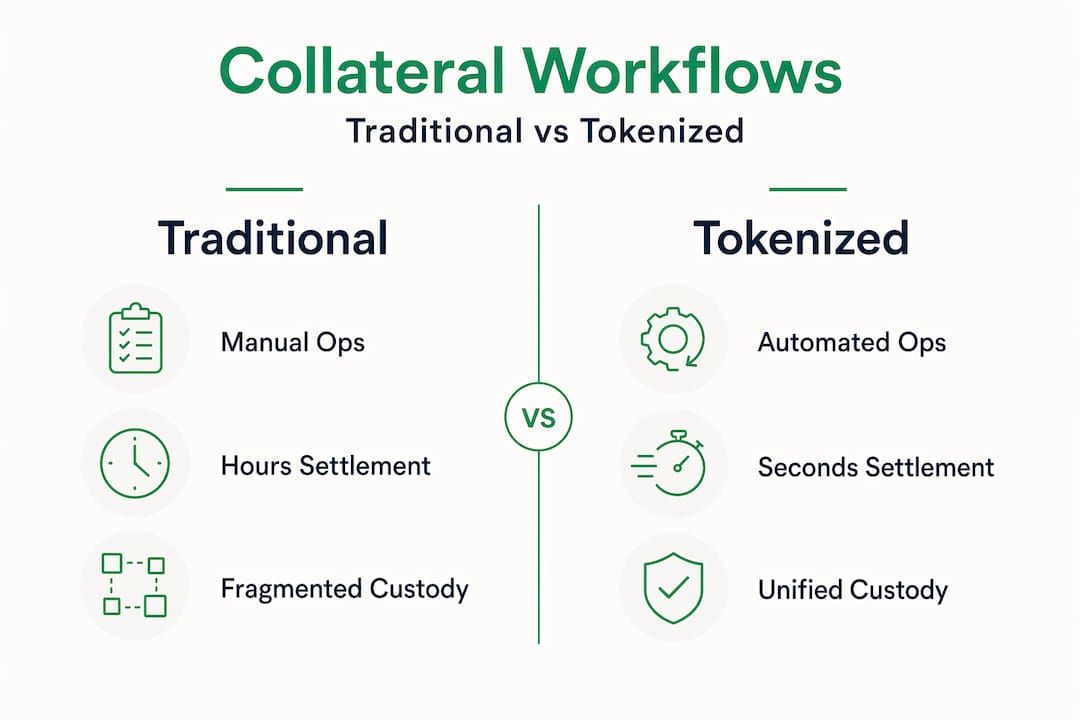
The contrast with traditional workflows is stark. Legacy collateral processes rely on fragmented messaging systems, manual reconciliation across custodians, and batch settlement windows. Errors accumulate. Disputes take days. The DTCC’s Collateral AppChain platform demonstrates what is now possible: near real-time collateral workflows across global markets using integrated data and automation. For compliance professionals building digital asset readiness frameworks, understanding this shift is not optional. It is the foundation of every governance decision that follows.

Regulatory and compliance frameworks for digital collateral
Knowing how the technology works is only half the job. The regulatory environment surrounding digital collateral is active and consequential, and enterprises that treat it as a secondary concern will pay for that mistake.
Two regulatory developments in 2026 deserve close attention:
-
CFTC Letter No. 25-39: The CFTC has issued guidance confirming a technology-neutral approach to tokenized collateral, requiring case-by-case analysis of each asset’s legal enforceability, custody arrangements, haircut methodology, valuation standards, and operational risk profile. The message is clear: tokenized assets are eligible, but the burden of proof sits with the institution.
-
FINMA Guidance 01/2026: Switzerland’s financial regulator requires that crypto-based collateral be legally segregated from the custodian’s bankruptcy estate. This is not a technical requirement. It is a legal one, and it directly affects how custody agreements must be structured.
Key compliance obligations for enterprises managing digital collateral include:
-
Establishing legal enforceability of collateral agreements across all relevant jurisdictions
-
Implementing collateral segregation to protect assets in the event of custodian insolvency
-
Applying risk-based haircuts calibrated to the volatility and liquidity profile of each tokenized asset
-
Maintaining audit trails that satisfy regulatory reporting expectations
-
Reviewing custody arrangements against Swiss regulator custody rules and equivalent domestic standards
The technology-neutral stance from regulators is genuinely useful. It means you are not locked into a specific blockchain or token standard. But it also means you cannot rely on the platform to handle compliance for you. Your legal, risk, and operations teams need to conduct their own analysis for every asset class you intend to post as collateral. Enterprises that use compliance evaluation tools at the start of this process avoid the costly rework that comes from building first and auditing later.
Innovative platforms enabling real-time digital collateral management
The regulatory framework tells you what is required. The platforms tell you what is now possible. Two institutional-grade solutions are setting the standard for compliant, real-time digital collateral management.
Anchorage Digital’s Atlas platform currently supports 24/7 collateral monitoring and automated margin calls for digital asset secured transactions, with nearly 600 participants. It combines regulated custody with real-time position visibility, meaning margin calls are not just triggered automatically but settled within the same custody environment. That eliminates the latency gap that creates risk in traditional workflows.
Komainu CORE takes a collateral-as-a-service approach. It provides real-time visibility into collateral coverage ratios with lock mechanisms and enforceable Notices of Exclusive Control. For compliance teams, the enforceability piece matters as much as the technology. A Notice of Exclusive Control is a legal instrument that establishes priority over collateral in a dispute or insolvency scenario.
| Feature | Anchorage Digital Atlas | Komainu CORE |
|---|---|---|
| Monitoring frequency | 24/7 real-time | Real-time |
| Margin call automation | Yes, automated | Yes, with lock mechanisms |
| Custody model | Regulated, in-house | Third-party compliant custody |
| Legal enforceability tool | Custody agreement | Notice of Exclusive Control |
| Participant network | ~600 institutions | Institutional focus |
| Compliance transparency | High | High |
Both platforms operate on the principle that collateral management and custody cannot be separated. That is a meaningful departure from traditional models where custody and collateral operations were handled by different teams using different systems. For platform evaluation and readiness, this integration is a key criterion.
Pro Tip: When evaluating platforms, ask specifically how margin calls are settled, not just triggered. A platform that triggers a margin call but relies on manual settlement to complete it has not actually solved the latency problem. Look for atomic settlement within the same custody environment.
Interoperability also deserves attention. The value of institutional collateral solutions is multiplied when they can communicate across blockchain networks and with legacy systems. Platforms built on open standards or established interoperability frameworks reduce the risk of collateral being stranded in a single-network silo.
Navigating risks and operational complexities in digital collateral workflows
Understanding collateral management for digital assets means confronting risks that do not have clean answers yet. The technology is maturing fast, but the operational environment is still catching up.
The primary risks to manage include:
-
Settlement failures: Smart contract bugs or network congestion can interrupt automated collateral flows at exactly the wrong moment, during a market stress event.
-
Custody breaches: Digital asset custody introduces private key management risks that have no equivalent in traditional finance. A compromised key is a compromised collateral position.
-
Market volatility exposure: Tokenized assets can lose value faster than margin engines can respond, particularly for assets with thin liquidity or high correlation to crypto market movements.
-
Interoperability failures: Collateral posted on one blockchain may not be recognized or movable across a counterparty’s system, creating trapped capital.
-
Regulatory change risk: Guidance issued today may be superseded. Enterprises need compliance processes that can adapt quickly, not just point-in-time assessments.
Effective risk mitigation follows a structured sequence. Start with smart contract automation for margin top-ups and substitutions, which eliminates the manual errors that account for a disproportionate share of operational failures. Layer in diversified custody arrangements so no single key compromise can expose your entire collateral book. Implement continuous monitoring with real-time margin engines rather than batch checks. Run regular compliance reviews against current regulatory guidance. And document everything, because an audit trail is not just a regulatory requirement. It is your defense in a dispute.
Tokenized collateral improves liquidity velocity, but that same speed amplifies losses when risk controls are inadequate. The enterprises that manage this well treat risk governance as a continuous process, not a one-time setup. Building on operational risk frameworks designed specifically for digital assets gives compliance teams a structured starting point rather than a blank page.
Pro Tip: Atomic Delivery versus Payment (DvP) is one of the most underused tools in digital collateral management. It ensures that collateral transfer and payment occur simultaneously, eliminating counterparty risk at settlement. If your platform does not support atomic DvP, that gap belongs in your risk register.
Applying digital collateral management in enterprise environments
Digital asset management best practices in enterprise settings start with preparation, not implementation. Enterprises that rush to deploy collateral workflows without completing foundational groundwork consistently encounter the same problems: legal gaps, system integration failures, and compliance findings that require expensive remediation.
Use this checklist before going live:
-
Confirm legal enforceability of all collateral agreements in your operating jurisdictions
-
Complete technology integration testing between your collateral platform and existing treasury or risk systems
-
Validate custody arrangements against current regulatory guidance, including segregation requirements
-
Establish documented procedures for margin call escalation when automated systems fail
-
Define eligibility criteria for each tokenized asset class you intend to use as collateral
-
Build reporting templates aligned with regulatory expectations for audit and disclosure
The difference between traditional and tokenized collateral workflows is not incremental. It is structural. 24/7 near real-time collateral management through tokenization and distributed ledger technology fundamentally changes how market risk is managed, moving from end-of-day snapshots to continuous position visibility.
| Dimension | Traditional collateral | Tokenized collateral |
|---|---|---|
| Settlement speed | Hours to one business day | Seconds to minutes |
| Operating hours | Business hours only | 24/7 |
| Transparency | Limited, batch reporting | Real-time, on-chain visibility |
| Manual intervention | High | Low, automated workflows |
| Audit trail | Fragmented across systems | Unified, immutable ledger |
| Counterparty risk at settlement | Present | Eliminated via atomic DvP |
Selecting the right custodian is as important as selecting the right platform. Your custodian must meet the legal segregation requirements your regulators impose, support the asset classes in your collateral program, and have a clear operational resilience record. Use an implementation readiness assessment to evaluate both platform and custodian against your specific risk profile before committing to any arrangement.
Practical wisdom and unexpected truths in digital collateral management
Here is what most guides on this topic will not tell you: the biggest obstacle to successful digital collateral management is not technology. It is the assumption that digital collateral simply replicates what traditional collateral does, only faster.
That assumption is wrong, and it is expensive. Traditional collateral management was designed around batch processes, business hours, and bilateral relationships. Digital collateral management is designed around continuous markets, automated execution, and multi-party networks. Importing your existing governance model into a digital environment without redesigning it for continuous operation is a governance failure waiting to happen.
The custody and enforceability challenge is also underestimated by most enterprises. Advanced platforms solve the technical problem of moving collateral in real time. They do not automatically solve the legal problem of who owns what in an insolvency. As one industry leader put it, bridging traditional finance into digital assets requires trusted gateways with proven custody to unlock collateral value securely. That means legal work, not just platform selection.
Interoperability remains the industry’s most honest unsolved problem. Most enterprises operate across multiple blockchains, multiple custodians, and multiple legacy systems. Collateral that cannot move freely across these boundaries is not liquid collateral. It is trapped capital with a blockchain label on it.
Automation reduces manual errors. It does not eliminate the need for human judgment. Continuous near real-time collateral mobility through distributed ledger technology transforms global market risk management, but someone still needs to set the eligibility rules, review the haircut methodology, and escalate when the margin engine produces an unexpected result. The compliance professional’s role does not shrink in a digital collateral environment. It becomes more consequential.
The enterprises that succeed here are the ones that balance innovation speed with deliberate regulatory navigation. Moving fast without governance infrastructure does not accelerate progress. It accelerates the timeline to a compliance finding. Grounding your approach in digital asset risk perspectives that account for both the opportunity and the operational reality is what separates durable programs from expensive experiments.
Enhance your digital collateral management with DARE readiness evaluation
Implementing digital collateral management without a structured readiness framework is one of the most common and costly mistakes enterprises make in this space. The technical and regulatory complexity is real, and the consequences of gaps in custody, enforceability, or operational controls are significant.
The Digital Asset Readiness Evaluation (DARE) is built specifically for financial and compliance professionals who need to assess their organization’s readiness across technology integration, regulatory compliance, custody arrangements, and operational risk. Rather than working from a blank page, DARE gives your team a structured, modular framework that maps directly to the governance requirements covered in this guide. It includes assessments, credentials, and annual renewal processes to keep your compliance posture current as regulations evolve. For enterprises moving into digital collateral workflows, DARE is the evaluation step that prevents costly rework down the line.
Frequently asked questions
What is digital asset collateral management?
It is the process of using digital tokens or tokenized assets as security to support financial transactions, managed through automated, blockchain-based systems that provide real-time oversight and settlement. Platforms like DTCC’s Collateral AppChain enable near real-time collateral workflows using blockchain and smart contracts.
Are tokenized assets legally accepted as collateral?
Yes, existing regulations like the CFTC guidance allow tokenized assets as collateral if they meet legal enforceability, custody, valuation, and risk management requirements on a case-by-case basis. The CFTC’s guidance confirms that tokenized assets can qualify with appropriate legal and operational safeguards in place.
How does blockchain technology improve collateral settlement times?
Blockchain allows collateral settlement to be compressed from hours to seconds by automating processes through smart contracts and providing immediate transaction visibility across participants. DTCC’s experiment confirmed that traditional settlement timelines spanning a full business day were reduced to seconds.
What risks should enterprises consider in digital collateral management?
Enterprises should assess custody breaches, interoperability challenges, market volatility exposure, and settlement failures, while ensuring automated margin calls and continuous monitoring are in place. Smart contracts reduce operational risk through automated margin management, but human oversight of eligibility rules and escalation procedures remains essential.
Which platforms offer compliant digital collateral management solutions?
Leading platforms include Anchorage Digital’s Atlas with 24/7 collateral monitoring and automated margin calls, and Komainu CORE, which provides real-time collateral visibility and enforceable control mechanisms for institutional participants.