
Cold Storage and Treasury Risk: A Finance Team Guide

Cold storage is defined as the practice of keeping digital asset private keys on devices or media with no connection to the internet, eliminating the online attack vectors that account for the majority of institutional crypto losses. The role of cold storage in treasury risk is to reduce theft probability from as high as 15% in hot wallet environments to under 0.01% in properly managed offline systems. That single statistic reframes cold storage from a technical preference into a financial risk control. For treasury teams managing material digital asset positions, offline key custody is not optional. It is the primary defense against a category of loss that no insurance policy fully covers and no audit can reverse.
The industry term for the broader practice is “cold custody,” which extends beyond simply keeping keys offline. Cold custody adds physical security, governance controls, and disaster recovery to the baseline of network isolation. Finance professionals need both concepts: cold storage as the mechanism, and cold custody as the architecture that makes it institutional grade.
What role does cold storage play in treasury risk?
Cold storage addresses the most damaging risk category in digital asset management: remote, network-based theft. A private key exposed to an internet-connected device can be extracted by malware, phishing attacks, or compromised infrastructure without any physical access to the organization. Cold storage eliminates that entire attack surface by design.

The cold storage impact on treasury goes beyond preventing individual incidents. Organizations without documented cold storage procedures experience 47% higher security incidents than those with structured, cold-storage-integrated treasury policies. That gap reflects not just the technical protection of offline keys, but the discipline that a formal cold storage policy forces on the broader treasury operation.
The risks that cold storage does not eliminate are equally worth naming. Physical theft of hardware devices, hardware failure, insider misconduct, and human error in key handling all remain live threats. True security requires layered cold custody with governance, distributed trust, and disaster recovery on top of network isolation. Cold storage is the foundation, not the finished structure.
Multi-signature controls, known as multi-sig, are the most effective governance layer to add on top of cold storage. A 3-of-5 or 3-of-7 multi-sig setup requires multiple independent signers to authorize any transaction. This distributes trust and prevents any single insider from moving funds unilaterally.
How does cold storage reduce specific types of treasury risk?
Cold storage directly neutralizes three of the five most common digital asset loss categories: remote hacking, malware injection, and unauthorized API access. The remaining two, physical theft and key mismanagement, require additional controls but are far easier to defend against than network attacks.
The risk reduction by category breaks down as follows:
- Network-based cyberattacks: Eliminated entirely when keys never touch an internet-connected device.
- Malware and ransomware: Ineffective against air-gapped signing devices with no persistent network connection.
- Exchange counterparty risk: Removed when assets are not held on exchange platforms.
- Physical theft: Mitigated through geographic distribution of hardware and multi-sig requirements.
- Insider risk: Reduced through multi-sig controls, segregation of duties, and access logging.
Pro Tip: Treat your cold storage hardware the same way you treat bearer instruments. Physical possession equals control. Store devices in separate, access-controlled locations with documented chain-of-custody logs.
The importance of cold storage becomes clearest when you consider what a single compromised hot wallet can cost. Hot wallets hold live private keys in memory on networked devices. Any breach of that device, at any point in the key’s lifecycle, can result in total loss of the assets it controls. Cold storage removes that exposure entirely for the assets it protects.
What are best practices for integrating cold storage into a tiered treasury strategy?
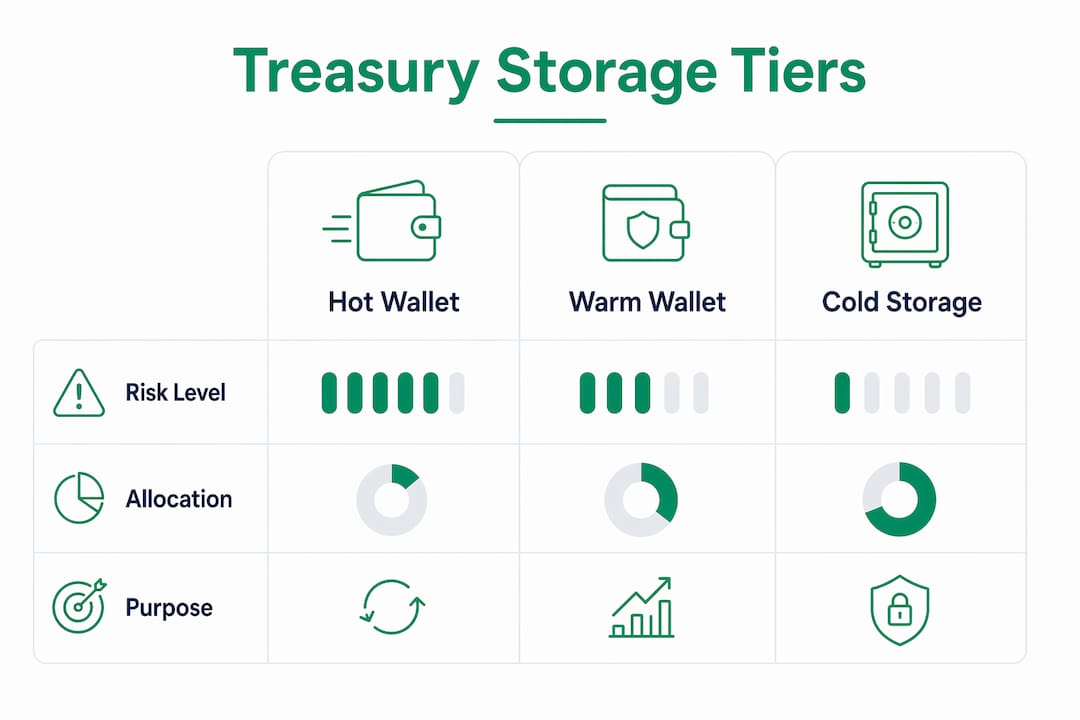
The most effective treasury architecture uses three tiers: hot wallets for daily operational liquidity, a warm layer for short-term settlement, and cold storage for the bulk of reserves. Industry best practices set the allocation at 1–3% of assets in hot wallets, 0–1% on exchanges, and 95% or more in cold storage. That ratio is not arbitrary. It caps the maximum loss from a hot wallet breach at a fraction of total holdings.
Hot wallets should hold no more than 7–30 days of expected outflows. Assets beyond that threshold move to cold storage on a scheduled basis. The key word is “scheduled.” Successful treasuries automate fund sweeps from operational wallets to cold storage rather than reacting to wallet balances ad hoc. Automated sweeps maintain predictable exposure limits and remove human judgment from a decision that should be policy-driven.
| Tier | Allocation | Purpose | Risk Level |
|---|---|---|---|
| Hot wallet | 1–3% | Daily operations and payroll | Highest |
| Exchange | 0–1% | Active trading only | High |
| Cold storage | 95%+ | Long-term reserves | Lowest |
Pro Tip: Document your sweep thresholds in a written treasury policy, not just in system settings. When personnel change, written policy survives. System configurations often do not.
Governance for the cold storage tier requires a formal digital asset treasury policy that defines who can authorize transfers, under what conditions, and with what approval chain. Multi-sig architecture enforces that policy at the cryptographic level. Policy and technology must align, or one will undermine the other.
How does cold storage compare with cold custody in treasury risk management?
Cold storage and cold custody are related but distinct. Understanding the difference matters for regulatory compliance, insurance eligibility, and audit readiness.
Cold storage is a method. It describes the practice of keeping private keys offline on hardware wallets, air-gapped computers, or paper backups. It eliminates network exposure but creates new risks if not supported by physical security and governance controls.
Cold custody is an architecture. It includes cold storage as its technical foundation and adds physical security protocols, multi-layer governance, geographic redundancy, disaster recovery planning, and independent audit controls. Regulated cold custody systems qualify for insurance and bonding, and meet institutional requirements under SEC and SOC 2 standards. Simple cold storage methods do not.
The practical difference shows up in three areas:
- Insurance eligibility: Insurers require documented governance, physical controls, and audit trails. Cold storage alone rarely satisfies underwriting criteria.
- Regulatory compliance: SEC guidance and SOC 2 Type II audits require multi-layer security and governance documentation that cold storage alone cannot provide.
- Single points of failure: A single cold storage device with one keyholder is one lost device or one unavailable person away from permanent inaccessibility.
For finance teams managing institutional-grade digital asset positions, cold custody is the target state. Cold storage is the starting point. The gap between them is filled by governance, access control practices, and documented procedures. Compliant crypto banking solutions, such as those offered by high-risk industry specialists, often require evidence of cold custody architecture before onboarding institutional clients.
What operational risks should treasury teams anticipate with cold storage?
The most underestimated failure mode in cold storage is not a cyberattack. It is “policy drift,” the gradual erosion of documented procedures as personnel change, signers become unavailable, and informal workarounds replace formal controls. Maintaining accurate multi-sig registries and enforcing mandatory periodic reauthorization prevents stalled transactions and governance gaps.
Key management failures account for a staggering share of permanent digital asset loss. An estimated 10–20% of all Bitcoin is permanently inaccessible due to inadequate key management. That represents approximately $100–300 billion in lost value. The lesson is not that cold storage is dangerous. The lesson is that cold storage without disciplined key management is dangerous.
The operational risks treasury teams must plan for include:
- Lost or destroyed hardware: Devices fail, flood, and burn. Geographically distributed backups and tested recovery procedures are non-negotiable.
- Unavailable signers: A 3-of-5 multi-sig setup only works if at least three signers are reachable. Signer registries must stay current and succession plans must exist.
- Restore drill failures: Many teams discover their recovery procedures do not work during an actual emergency. Scheduled restore drills catch failures before they become crises.
- Insider misconduct: Segregation of duties and access logging reduce the opportunity for insider theft, but they require active enforcement.
- Hardware malfunction: Cold storage devices have finite lifespans. Periodic device rotation and key migration are part of a mature disaster recovery plan.
Pro Tip: Run a full restore drill at least twice per year. Test the process of recovering access from backup materials without using the primary device. Document the results and update procedures based on what you find.
How can finance teams implement cold storage to manage treasury risk?
Effective implementation starts with a written policy, not a hardware purchase. The policy defines asset allocation thresholds, sweep schedules, multi-sig configurations, signer eligibility criteria, and escalation procedures. Without that document, cold storage is a technical control without governance, and governance is what auditors and regulators actually examine.
The implementation sequence that works for institutional treasuries follows a clear order. First, define risk appetite and set maximum hot wallet exposure limits. Second, design the multi-sig architecture, selecting signer counts and threshold requirements that balance security with operational availability. Third, procure and configure hardware security modules (HSMs) or dedicated air-gapped signing devices. Fourth, document all procedures, including key generation ceremonies, backup protocols, and transfer authorization workflows. Fifth, test the full cycle, from fund sweep to cold storage to authorized withdrawal, before moving material assets.
Private key risk management is the technical discipline that underpins all of this. Key generation must happen in a controlled, offline environment. Key backups must be encrypted, physically secured, and stored in multiple locations. Access to backup materials must require multi-party authorization, not just a single administrator’s credentials.
The governance layer connects cold storage to the broader enterprise crypto risk oversight framework. Segregation of duties means the person who initiates a transfer cannot also be the person who approves it. Audit logs must capture every access event, every signing request, and every policy exception. Those logs are what make cold storage defensible to a board, an auditor, or a regulator.
Key Takeaways
Cold storage reduces digital asset theft probability from up to 15% in hot wallet environments to under 0.01%, making it the single most effective financial risk control available to treasury teams managing digital assets.
| Point | Details |
|---|---|
| Cold storage vs. cold custody | Cold storage isolates keys offline; cold custody adds governance, physical security, and disaster recovery for institutional use. |
| Tiered allocation | Hold 95% or more of assets in cold storage, with hot wallets capped at 1–3% to limit maximum breach exposure. |
| Automated sweeps | Schedule fund sweeps from hot wallets to cold storage by policy, not by reaction, to maintain predictable risk thresholds. |
| Policy drift prevention | Maintain active multi-sig signer registries and enforce periodic reauthorization to prevent governance failures over time. |
| Regulatory readiness | Regulated cold custody with documented controls meets SEC and SOC 2 standards; cold storage alone does not qualify for institutional insurance. |
Why cold storage is still misunderstood by most treasury teams
Finance teams I work with consistently make the same mistake: they treat cold storage as a one-time setup rather than an ongoing governance discipline. They buy the hardware, generate the keys, and move assets offline. Then they stop. Six months later, a signer has left the organization, the restore procedure has never been tested, and the sweep schedule has been ignored because “nothing bad has happened.”
That logic is exactly backward. Cold storage works precisely because you maintain it before something goes wrong. The discipline of scheduled sweeps, restore drills, and signer registry updates is not overhead. It is the control itself. Skip the maintenance and you have not reduced risk. You have just moved it from cyberattack to operational failure.
The other pattern I see is treasury teams pursuing yield on digital assets before they have custody infrastructure in place. The principle here is blunt: yield without infrastructure is just risk with a coupon. Build the custody layer first. Establish the governance framework. Then consider yield strategies, and only with assets that are not in cold storage reserves.
The outlook for 2026 and beyond is clear. Regulatory expectations around digital asset custody are tightening. Boards are asking harder questions. Auditors are requesting documented evidence of controls, not just verbal assurances. Treasury teams that treat cold custody as an architecture, not just a hardware decision, will be the ones that pass those reviews without incident.
— Gregg
Assess your treasury’s cold storage readiness with Wush
Finance teams that have cold storage hardware but no documented governance framework carry more risk than they realize. The gap between having cold storage and having institutional-grade cold custody is exactly what the Wush Digital Asset Readiness Evaluation (DARE) is built to measure.
The DARE certification walks treasury teams through a structured assessment covering custody controls, key management procedures, multi-sig governance, and regulatory alignment. It identifies gaps before auditors or regulators do. Finance professionals who complete DARE leave with a documented readiness profile, a credential recognized across the digital asset industry, and a clear remediation path for any control weaknesses. If your treasury holds digital assets and your cold storage policy has not been formally assessed, DARE is the logical next step.
FAQ
What is the role of cold storage in treasury risk management?
Cold storage eliminates online attack vectors by keeping private keys on air-gapped devices, reducing theft probability from up to 15% in hot wallet environments to under 0.01%. It is the primary technical control for protecting the bulk of a treasury’s digital asset reserves.
How much of a treasury’s digital assets should be in cold storage?
Industry best practices set cold storage at 95% or more of total digital asset holdings, with hot wallets holding no more than 1–3% for operational liquidity and exchanges holding 0–1% for active trading.
What is the difference between cold storage and cold custody?
Cold storage refers to keeping private keys offline. Cold custody is a full architecture that adds physical security, multi-layer governance, geographic redundancy, and disaster recovery, meeting the standards required for institutional insurance and regulatory compliance under SEC and SOC 2 frameworks.
What causes cold storage to fail in practice?
The most common failure modes are policy drift from outdated signer registries, lost or untested key backups, and hardware failure without a tested recovery procedure. Scheduled restore drills and mandatory multi-sig reauthorization prevent most of these failures.
Does cold storage satisfy regulatory requirements for institutional digital asset custody?
Cold storage alone does not meet institutional regulatory standards. Regulated cold custody with documented governance, multi-sig controls, and audit trails is required to satisfy SEC guidance, SOC 2 Type II audits, and insurance underwriting criteria.