
Private Key Risk Management: 2026 Security Guide

Private key risk management is the systematic process of securing, governing, and monitoring cryptographic keys that control access to digital assets. Compromised private keys account for 44%–50% of all digital asset losses, making this the single most consequential security discipline in digital finance. Whether you manage a personal wallet or oversee an institutional treasury, the controls you apply to private keys determine whether your assets remain yours. Technologies like Hardware Security Modules (HSMs), Multi-Party Computation (MPC), and multi-signature wallets, combined with formal governance policies, form the foundation of any credible key protection program.
What is private key risk management?
Private key risk management is the formal discipline of identifying, assessing, and controlling threats to the cryptographic keys that authorize digital asset transactions. The industry term for the broader practice is cryptographic key lifecycle management, which covers generation, storage, rotation, and retirement of keys. Both terms apply here, and understanding the full lifecycle is what separates organizations that survive incidents from those that don’t.
The core problem is irreversibility. Unlike a stolen password, a compromised private key cannot be reset. Any attacker who obtains your key owns your assets permanently. That reality makes private key management a business imperative, not just a technical checkbox. Failures cascade across operations, finance, and reputation, even for teams not directly handling keys on a daily basis.

A complete risk management program covers three layers: the technical controls protecting keys at rest and in use, the operational procedures governing who can access and use them, and the governance policies that define accountability and compliance obligations.
What are the primary risks of private key storage?
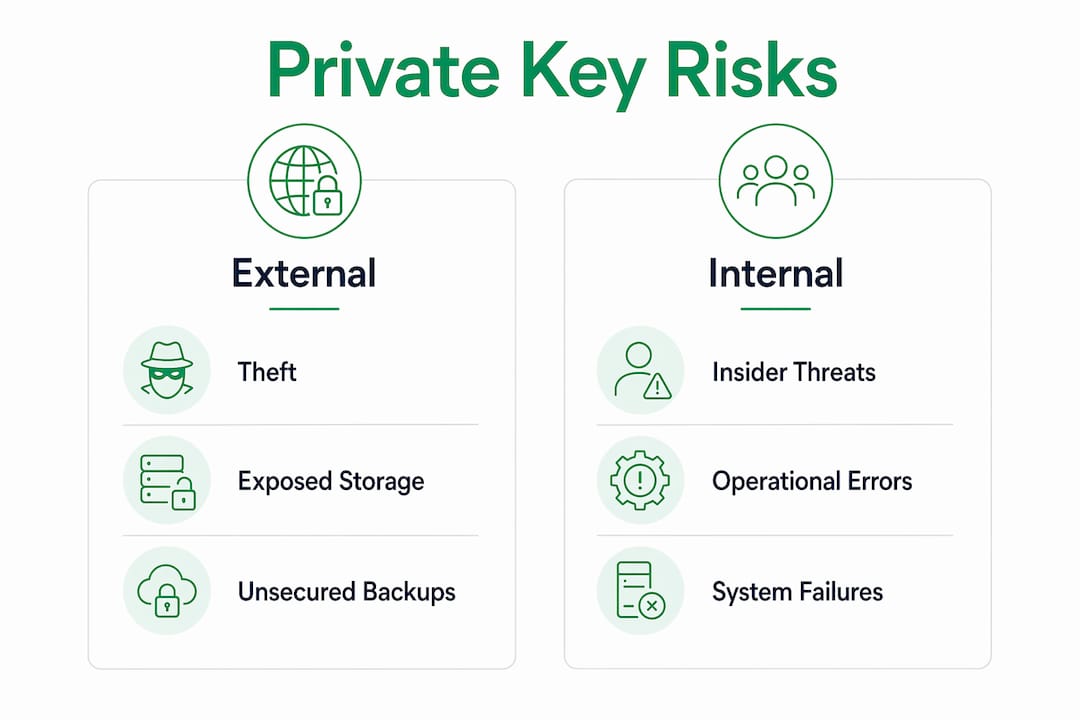
Private key vulnerabilities fall into four categories: external theft, insider threats, operational mistakes, and systemic storage failures. Each carries distinct attack vectors and requires a different control response.
External theft targets keys stored in accessible locations. Storing keys in configuration files or secret managers exposes them entirely if an attacker gains server access. This includes .env files, cloud-based secret vaults with recoverable plaintext, and code repositories where developers accidentally commit credentials.
Insider threats are the most underestimated vector. A privileged employee with access to key material can exfiltrate it with no external attack required. HSMs address this with multi-layer authentication and physical tamper resistance, but organizations without hardware controls rely entirely on trust.
Operational mistakes at the individual level are staggeringly costly. Personal-level key mismanagement caused over $1.2 billion in losses in 2025, driven by practices like saving seed phrases as cloud screenshots, storing keys in plaintext notes apps, or emailing recovery phrases. That figure represents individual users, not institutional breaches.
Systemic storage failures occur when organizations treat private keys like ordinary passwords. Keys stored in shared credential managers, backed up to unencrypted cloud storage, or accessible to multiple administrators without audit logging create exposure windows that persist for months or years before discovery.
Pro Tip: The riskiest moment for a private key is not during a transaction. It is during backup and recovery. Most organizations harden their signing environment but leave recovery procedures completely uncontrolled.
What are the best private key management strategies and technologies?
Choosing between HSMs, MPC, multi-signature wallets, and zero-persistence architectures shapes your entire security posture. The architecture you select fundamentally determines your organization’s compliance profile and resilience against both external and internal threats.
Hardware security modules (hsms)
HSMs generate and store keys inside tamper-resistant hardware, preventing keys from ever appearing outside the device in plaintext. They provide hardware roots of trust that shift security from vulnerable software environments to hardened cryptographic hardware. Providers like Thales, Utimaco, and AWS CloudHSM serve institutional deployments. The limitation is that HSMs still represent a single physical point of failure if not paired with redundancy controls.
Multi-party computation (MPC)
MPC spreads signing across multiple parties so no single entity ever holds a complete private key. Signing occurs through collaborative computation across key shares, and the full key is never reconstructed in any one location. This eliminates the single point of failure inherent in traditional key storage. Fireblocks and Qredo are well-known institutional MPC providers. MPC is particularly effective against insider threats because no individual employee can unilaterally sign a transaction.
Multi-signature wallets
Multi-sig wallets require a defined threshold of signatures (for example, 3 of 5 authorized parties) before a transaction executes. This creates collaborative governance over asset movement and is widely used in DAO treasuries and institutional custody. The tradeoff is operational complexity: coordinating multiple signers adds latency to time-sensitive transactions.
Zero-persistence key models
Zero-persistence architectures reconstruct keys inside secure hardware only at the moment of signing, then immediately destroy them. No private key exists at rest anywhere in the system. This reduces the attack surface to nearly zero because there is nothing to steal between transactions. Critically, zero-persistence models integrate disaster recovery into normal operation flows with no weaker fallback processes, which is a significant operational advantage over traditional backup-dependent architectures.
| Technology | Core Benefit | Primary Use Case | Key Limitation |
|---|---|---|---|
| HSM | Tamper-resistant key storage | Institutional custody, signing servers | Single point of failure without redundancy |
| MPC | No complete key ever exists | Enterprise treasury, exchange custody | Requires coordination infrastructure |
| Multi-Sig | Collaborative transaction approval | DAO governance, joint custody | Operational latency in signing |
| Zero-Persistence | No keys stored at rest | High-security automated signing | Requires secure enclave infrastructure |
Pro Tip: Hybrid architectures combining MPC with HSM-backed key shares deliver the strongest protection for institutional deployments. Neither technology alone covers every threat vector.
How should organizations govern private key risk management?
Governance is the security foundation that technical controls alone cannot replace. Operational risk frameworks that integrate key management governance protect against the most consequential attack vector in digital asset finance. Without documented policies, even the best hardware controls fail under human pressure.
Key generation ceremonies
Key generation ceremonies are the most security-critical events in the key lifecycle. A compromise during generation creates a permanent, undetectable breach. Ceremonies should occur in air-gapped environments, with multiple witnesses, documented procedures, and hardware-verified randomness sources. Any deviation from the documented ceremony protocol should trigger an automatic restart.
Rotation and retirement policies
Key rotation policies limit exposure windows by replacing keys on a defined schedule and immediately after any suspected compromise. Retirement procedures must include secure destruction of old key material, not just deactivation. Keys that are deactivated but not destroyed remain a liability.
Operational controls
Core governance practices for any organization managing private keys include:
- Role-based access controls: Only authorized personnel with documented need can access key material or signing systems.
- Transaction signing controls: All signing events require multi-party approval above defined transaction thresholds.
- Audit logging: Every key access, signing event, and administrative action is logged to an immutable record.
- Incident response procedures: Documented steps for suspected key compromise, including immediate asset migration protocols.
- Continuous monitoring: Automated alerts for anomalous signing patterns or unauthorized access attempts.
Integrating these controls into a broader digital asset operational risk framework ensures that key management does not operate in isolation from your organization’s wider risk governance structure.
What practical steps secure private keys effectively?
Securing private keys requires consistent execution across generation, storage, access, and monitoring. The following steps apply to both individuals and organizations, scaled to the complexity of your holdings.
-
Generate keys in controlled environments. Use dedicated hardware wallets like Ledger or Trezor for personal use, or certified HSM infrastructure for institutional deployments. Never generate keys on internet-connected general-purpose computers.
-
Eliminate plaintext storage entirely. Plaintext storage in .env files or recoverable secret managers is the most common and most preventable vulnerability. Encrypted backups stored on offline media are the minimum acceptable standard.
-
Apply the 3-2-1 backup rule to key material. Keep three copies of encrypted key backups, on two different media types, with one stored off-site in a physically secured location. Test recovery procedures quarterly.
-
Restrict access with multi-factor authentication. Every system that touches key material requires MFA. For institutional systems, hardware tokens like YubiKey provide stronger protection than software-based authenticators.
-
Monitor access and signing activity continuously. Integrate key management systems with your SIEM platform. Anomalous signing volumes or off-hours access attempts are early indicators of compromise.
-
Integrate key management into compliance programs. Review your access control practices against current regulatory expectations. Finance teams should also cross-reference the 2026 compliance checklist to confirm alignment with evolving requirements.
-
Conduct annual key risk assessments. Map every key in your environment, document its purpose and custodian, and evaluate whether current controls match the risk level of the assets it protects.
Key takeaways
Private key risk management requires technical controls, governance policies, and continuous monitoring working together. No single technology eliminates all risk without the operational discipline to support it.
| Point | Details |
|---|---|
| Keys are the primary attack vector | 44%–50% of all digital asset losses trace back to private key compromise or insider threats. |
| Technology choice shapes your posture | HSMs, MPC, multi-sig, and zero-persistence models each address different threat profiles and use cases. |
| Governance is non-negotiable | Key generation ceremonies, rotation policies, and audit logging are the controls that prevent undetected breaches. |
| Individual practices carry real cost | Poor personal key storage caused over $1.2 billion in losses in 2025 alone. |
| Compliance requires integration | Key management must connect to your broader operational risk and regulatory compliance frameworks. |
The uncomfortable truth about private key security in 2026
Most organizations I work with have invested in the right hardware. They have HSMs, they have MPC providers, and they have multi-sig policies on paper. What they consistently lack is governance that matches the sophistication of their technology.
The uncomfortable truth is that the majority of key compromise incidents I have seen do not exploit the hardware. They exploit the humans and processes around it. A well-configured HSM does nothing to prevent an administrator from photographing a recovery phrase during a key ceremony. A multi-sig policy does nothing if the approval workflow can be bypassed under “emergency” conditions that are never formally defined.
Zero-persistence models represent the most significant architectural shift I have seen in this space. Eliminating stored keys at rest removes the entire category of “keys at rest” attacks. That is not incremental improvement. It is a structural change in the threat model. The organizations moving toward zero-persistence are not doing it because regulators require it yet. They are doing it because they understand that the next generation of attacks will target stored key material with increasing sophistication.
The other shift worth watching is the convergence of key management governance with board-level oversight. Private key risk is no longer a technical team concern. Boards that lack a digital asset oversight framework are making governance decisions about assets they do not fully understand. That gap is where the next institutional failures will originate.
My recommendation: treat your key management architecture review as an annual governance obligation, not a one-time technical project. The threat environment changes faster than most policy cycles.
— Gregg
Strengthen your key governance with DARE certification
Private key risk management is only as strong as the governance framework behind it. Wush’s Digital Asset Readiness Evaluation (DARE) certification gives finance professionals, risk managers, and treasury teams a structured path to assess and formalize their digital asset governance controls, including private key security, custody practices, and regulatory compliance. The DARE program covers the exact frameworks discussed in this article: key lifecycle governance, operational risk controls, and compliance alignment. If you are responsible for digital assets and need a recognized credential that demonstrates your organization’s governance maturity, the DARE certification is the structured next step.
FAQ
What is private key risk management in simple terms?
Private key risk management is the practice of protecting the cryptographic keys that control digital assets through secure storage, access controls, governance policies, and monitoring. A compromised private key gives an attacker permanent, irreversible access to the assets it controls.
Why is private key management important for organizations?
Compromised private keys account for 44%–50% of all digital asset losses, making key management the highest-impact security discipline in digital finance. Failures affect operations, finances, and regulatory standing simultaneously.
What is the safest way to store private keys?
Hardware Security Modules and zero-persistence architectures provide the strongest protection. For individuals, dedicated hardware wallets like Ledger or Trezor with encrypted offline backups are the minimum standard.
What is MPC and how does it reduce private key risk?
Multi-Party Computation splits a private key into shares distributed across multiple parties, so no single party ever holds the complete key. Signing requires collaborative computation, which eliminates single points of failure and significantly reduces insider threat risk.
How often should private keys be rotated?
Key rotation frequency depends on the risk level of the assets protected and your governance policy. At minimum, rotate keys annually and immediately following any suspected compromise, personnel change with key access, or system breach.