
U.S. Crypto Teams: 180 Day Roadmap to Money Transmitter Readiness

A crypto money transmitter license, in practical terms, is not a state permit at all. It is a documented, auditable governance framework that proves your organization can meet money-transmitter regulatory expectations before an examiner ever asks. The three things regulators want to see first: a written AML program built for crypto’s actual risks, custody controls enforced by technology rather than policy alone, and audit evidence for every vendor that touches your infrastructure. Start by mapping every crypto-facing activity to its regulatory obligation with a clear KYC process for entrepreneurs, then begin capturing evidence now.
TL;DR:
- Meeting US crypto money transmitter licensing requirements demands a tailored AML program, effective custody controls, and comprehensive vendor oversight verified by audit evidence.
- Examiners rigorously test logs, control enforcement, and incident records, identifying gaps where policies are not technologically enforced or evidence is not properly organized.
- Continuous vendor audits, explicit contractual audit rights, and a well-organized evidence package are crucial to maintaining readiness and passing regulatory exams.
- Building and updating control mappings, evidence, and policies early and often prevents delays and reduces findings during the exam process.
- Third-party assessments like DARE certifications support ongoing compliance verification, reducing the risk of stale evidence and demonstrating regulatory readiness.
Table of Contents
- Why Readiness Matters in the US Regulatory Landscape
- Core Components of a Money-Transmitter Readiness Program for Crypto
- Operational Controls Examiners Will Test and How to Evidence Them
- Vendor Diligence and Audit Expectations for Digital-Asset Infrastructure
- Preparing Evidence Packages: What to Compile and How to Organize It
- Practical Readiness Roadmap and Role Assignments
- How DARE Aligns to Readiness Requirements and Speeds Exam Preparation
- What Enterprise Compliance Teams Keep Getting Wrong
- Get DARE Certified: Your Path to Exam-Ready Evidence
- Sources
Why Readiness Matters in the US Regulatory Landscape
FinCEN sets the federal floor: any business that accepts and transmits convertible virtual currency for others generally qualifies as a money services business under FinCEN’s guidance on convertible virtual currency. State licensing regimes stack additional obligations on top of that floor, and the fragmented US framework means your program has to satisfy multiple regulators at once, not just one.
Under 31 U.S.C. § 5318, every MSB needs a written AML program reasonably designed for its actual risk profile, not a generic template pulled from a law firm’s boilerplate library. Examiners know the difference. What they actually prioritize:
- Whether logs and system records back up what the policy claims happens
- Whether controls are enforced automatically, not just described in a manual
- Whether the program scope matches your real transaction volume and risk
Core Components of a Money-Transmitter Readiness Program for Crypto
A readiness program has four load-bearing pillars, and skipping any one of them creates the exact gap examiners are trained to find.
- A written AML program tailored to crypto risk. This covers KYC onboarding, transaction monitoring tuned to blockchain-specific typologies, SAR filing workflows, and recordkeeping that survives an audit. FinCEN expects SARs to be filed promptly upon detection, with continuing reports as needed until resolution, and supporting documentation retained for a substantial period.
- Travel Rule handling. Virtual-asset transfers meeting or exceeding a specified threshold require capturing and transmitting originator and beneficiary information, which means your systems need to store that metadata at the transaction level, not bolt it on after the fact.
- Custody and key management enforced by technology. Multi-operator signing, hardware security modules, and separation of duties need to be built into the infrastructure, not just written into a policy document nobody checks.
- Vendor oversight with contractual teeth. Third-party risk management for custodians, exchanges, and infrastructure providers needs audit rights, not just a signed attestation.
Pro Tip: Build your control matrix before you build your evidence log. Mapping each obligation to a specific system, owner, and control ID first means every piece of evidence you capture later slots into a structure an examiner can actually follow.
A crypto financial controls checklist helps finance teams turn these four pillars into assignable, trackable work rather than a wish list.
Operational Controls Examiners Will Test and How to Evidence Them
Examiners don’t take your word for it. They sample your logs, pull specific transactions, and cross-reference what happened against what your policy says should happen. Three areas get the most scrutiny.
System logs and monitoring evidence. Export transaction monitoring alerts, disposition decisions, and the underlying rule logic. Examiners often pull a sample of flagged and unflagged transactions side by side to see if your thresholds actually work as designed.
Key-management proof. Multi-signature or quorum enforcement needs a paper trail: signing logs, HSM attestations, and a separation-of-duties matrix showing who can approve what and under which conditions. Banking-sector guidance on custody controls increasingly treats manual override capability as a red flag rather than a convenience.
Incident response and reconciliation records. Every incident, near-miss, and reconciliation break needs a timestamped record showing detection, escalation, and resolution.
- Export monitoring rule logic alongside alert disposition history
- Keep signing and quorum logs retrievable by date range and wallet
- Reconcile on-chain and internal ledger balances on a fixed cadence
- Document every incident from detection through closure
One pattern shows up constantly in examiner findings: policies describe a control that the technology never actually enforces. A quorum requirement written into a policy document means nothing if the wallet software allows a single-signer override. That gap between paper and practice is the single most common deficiency MSB best-practices guidance warns against.
Vendor Diligence and Audit Expectations for Digital-Asset Infrastructure
SOC 2 reports and vendor attestations tell you what a provider claims about itself at one point in time. They don’t tell you whether that provider’s key management actually holds up under your specific transaction volume, or whether a subcontractor three layers down has access you never approved. Regulators increasingly expect direct, ongoing audits of critical providers, not a filing cabinet of attestation letters.
Contracts with custody providers, exchanges, and infrastructure vendors should include:
- Explicit audit rights, not just “reasonable cooperation” language
- Incident notification windows measured in hours, not “promptly”
- Advance notice before subcontracting any part of the service
- SLAs tied to specific security controls, not just uptime
When you scope a vendor audit, cover cryptographic architecture, key lifecycle management, signing processes, incident response playbooks, and every subcontractor relationship the vendor maintains. Periodic tabletop exercises with the vendor validate that their controls work under stress, not just on paper.
Preparing Evidence Packages: What to Compile and How to Organize It
An evidence package that takes three weeks to assemble under exam pressure is a package that should have been built six months earlier. The goal is an index an examiner can navigate without asking you to explain it.
- Build a control-reference table mapping every policy statement to a control ID, an owner, and a specific evidence location.
- Compile canonical evidence items: KYC files, SAR logs, transaction monitoring output, Travel Rule metadata, and signed policy documents, each tagged to its control ID.
- Pull representative samples, not your cleanest transactions. Examiners trust a program more when the sample includes edge cases and shows how they were handled.
- Attach test results from your most recent internal control testing, dated and signed off by whoever ran it.
- Retain everything for at least five years, matching the SAR documentation retention standard, and show a continuous monitoring cadence rather than a one-time snapshot.
A legal risk management framework for digital assets can help distinguish which artifacts belong in a compliance-readiness package versus which fall under separate licensing documentation.
Practical Readiness Roadmap and Role Assignments
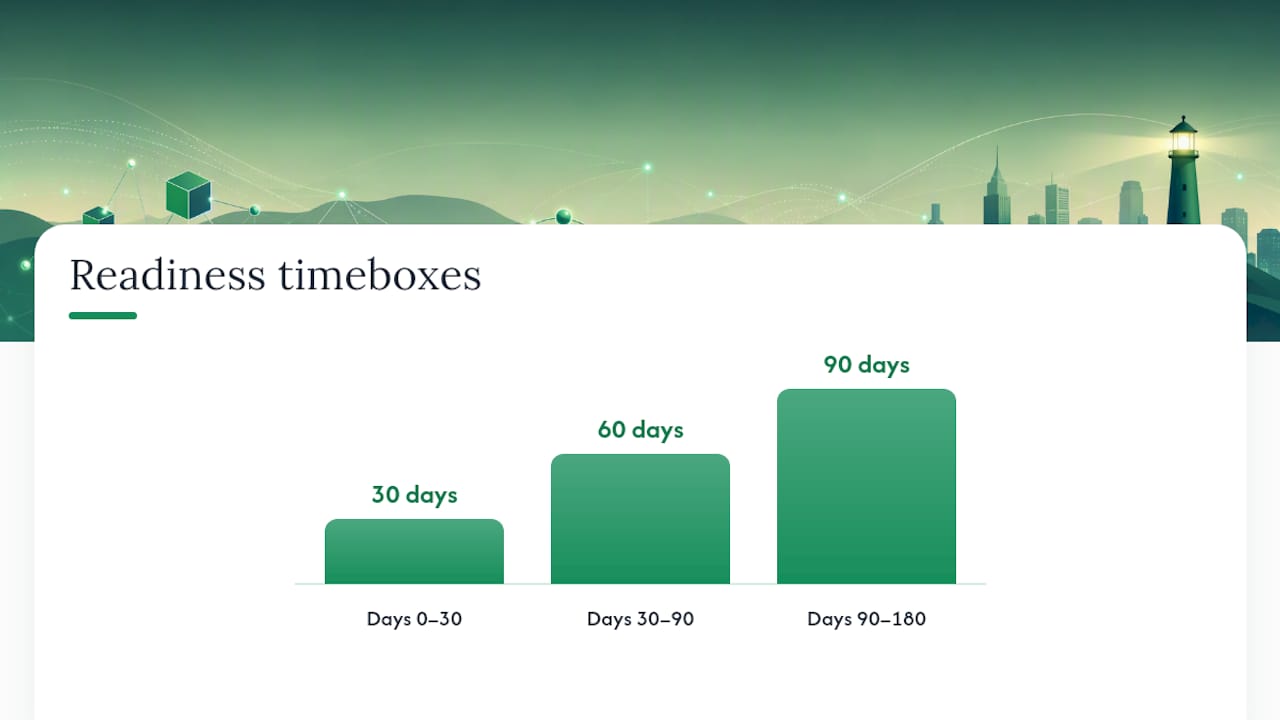
Readiness work moves fastest when it’s time-boxed and someone senior owns the outcome.
- Days 0 to 30: Map every crypto-facing activity to its regulatory obligation. Name a governance sponsor at the executive or board level. Run a quick risk triage to find your highest-exposure gaps.
- Days 30 to 90: Fix the highest-priority control gaps first. Start capturing evidence and run sample tests against your own control matrix.
- Days 90 to 180: Complete vendor audits, run tabletop incident tests, and formalize the evidence package for board-level reporting.
Pro Tip: Front-load evidence capture for your highest-risk transaction flows. A prioritized, time-boxed plan that tackles the riskiest activity first tends to shorten the actual exam engagement and cut down on findings.
Building enterprise crypto risk oversight into this roadmap early keeps the board looped in rather than surprised at the 90-day mark.
How DARE Aligns to Readiness Requirements and Speeds Exam Preparation
A Digital Asset Readiness Evaluation assesses key areas examiners test: governance, AML program alignment, custody and key controls, vendor oversight, and operational testing. Each module maps to control IDs to support evidence package organization.
Because some assessments issue verifiable, blockchain-backed credentials with an annual renewal cycle, they can function as a standing trust signal rather than a one-time checkbox. Teams can incorporate assessment results into their evidence index alongside internal test artifacts, giving examiners an independent reference point next to their own documentation.
What Enterprise Compliance Teams Keep Getting Wrong
The deficiency I see most often has nothing to do with missing policies. Every organization has policies. The problem is a policy describing a control that the actual system never enforces, whether that’s a quorum rule a wallet doesn’t require or a monitoring threshold nobody has recalibrated since launch.

Three fixes deliver outsized returns relative to their cost. Enforce multi-party signing at the infrastructure level so no policy exception is even possible. Add real audit rights to every vendor contract, not just cooperation language. Index every piece of evidence to a control ID before an exam forces you to do it under pressure.
None of this is a one-time project. Readiness decays the moment your transaction mix or vendor stack changes, which is exactly why annual reassessment isn’t a formality. It’s the mechanism that keeps evidence current instead of stale.
— Gregg
Get DARE Certified: Your Path to Exam-Ready Evidence
Building a regulator-ready evidence package from scratch, with no external reference point, means your compliance team is grading its own homework. An independent, third-party assessment covering governance, AML alignment, custody controls, and vendor oversight can be structured so each module maps to a control ID for easy incorporation into evidence indexing.
Enterprises typically use DARE results as the backbone of their remediation plan and board reporting, rather than a separate compliance exercise running parallel to everything else. The modular assessments and annual renewal cycle mean your credential stays current as your crypto activity evolves, instead of going stale the way a one-time audit does. Review the DARE certification program to see how the assessment areas map to your current gaps, or check pricing options to find the right fit for your team’s size and scope.
Sources
- FinCEN guidance on convertible virtual currency — Katten
- Banking blueprint and custody/vendor expectations — Fireblocks
- United States — Crypto regulation guide — Block Clarity Hub
This article is general information, not a substitute for advice from a qualified financial advisor. Consult a qualified financial professional about your own circumstances before acting on anything here.