
Crypto Regulatory Reporting Obligations Guide for 2026

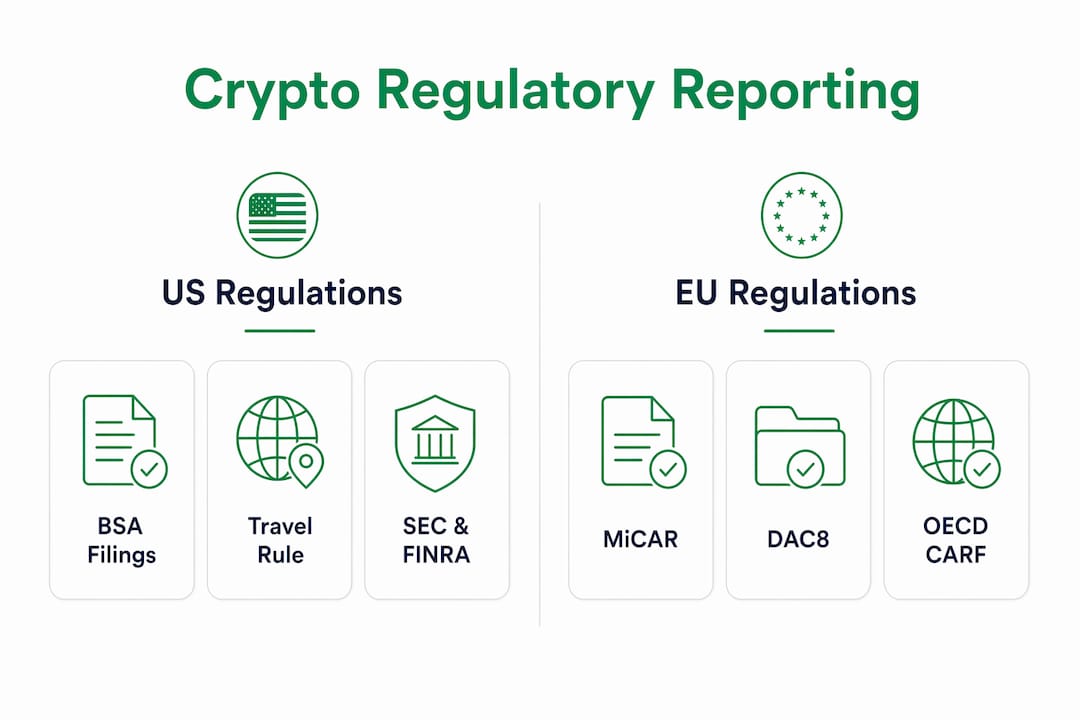
Crypto regulatory reporting obligations in 2026 divide into two distinct tracks: tax transparency reporting under frameworks like the OECD Crypto-Asset Reporting Framework (CARF) and EU DAC8, and AML/CFT transfer reporting under rules like the Travel Rule. Both tracks are tightening simultaneously, and firms operating in the US or EU now face overlapping deadlines, data collection mandates, and enforcement exposure that did not exist three years ago. The core obligations compliance officers need to track right now:
- Tax transparency: EU DAC8 reporting begins January 1, 2026, with first automatic exchanges due by September 30, 2027; OECD CARF provides the global template.
- AML/CFT transfer reporting: The Travel Rule applies at $3,000 in the US (31 CFR 1010.410(f)), from the first euro in the EU, and at $1,000/€1,000 under the FATF baseline.
- US-specific filings: FinCEN requires Suspicious Activity Reports (SARs) and Currency Transaction Reports (CTRs) from money services businesses (MSBs) dealing in crypto.
- EU market structure: Markets in Crypto-Assets Regulation (MiCAR) governs crypto-asset service providers (CASPs) operating in EU member states, with the European Banking Authority (EBA) providing technical standards.
- Governance certification: The Digital Asset Readiness Evaluation (DARE) from Wush offers a structured framework for organizations building audit-ready compliance programs.
The two tracks share one underlying demand: financial institution-level data verification. Firms that treat crypto reporting as a lighter-touch obligation than traditional finance are already behind.
What are the key US crypto regulatory reporting obligations?
The Bank Secrecy Act (BSA) is the foundation of US crypto compliance. Any firm that qualifies as an MSB under FinCEN’s rules, including crypto exchanges, wallet providers, and payment processors, must register with FinCEN and maintain a written AML program. That program must include internal controls, independent testing, a designated compliance officer, and ongoing employee training.
The two most operationally demanding BSA filings are SARs and CTRs. CTRs are required for cash transactions exceeding $10,000, while SARs must be filed when there is suspected money laundering, fraud, or other illicit activity. Both carry strict filing deadlines: CTRs within 15 days, SARs within 30 days of detection (or 60 days when no suspect is identified).
The Travel Rule, codified at 31 CFR 1010.410(f), requires MSBs to collect and transmit originator and beneficiary information for transfers meeting or exceeding the regulatory threshold. That threshold is widely misunderstood. The obligation to maintain a risk-based AML program does not disappear for transactions below $3,000; FinCEN guidance makes clear that MSBs must monitor all transactions for suspicious patterns regardless of individual transaction size.
State-level licensing adds another layer. Federal FinCEN registration is necessary but not sufficient. Most states require separate money transmitter licenses, each with its own renewal cycle, bonding requirements, and examination schedule. Automated license tracking is not optional for any firm operating across multiple states.
Key US obligations at a glance:
- FinCEN MSB registration (federal)
- State money transmitter licenses (jurisdiction-specific)
- Written AML/BSA compliance program
- SAR filings: transactions of $2,000+ with suspected illicit activity
- CTR filings: cash transactions exceeding $10,000
- Travel Rule data collection and transmission at $3,000+
- Ongoing risk-based transaction monitoring
Pro Tip: The $3,000 Travel Rule threshold triggers data collection and transmission requirements, but your AML program must cover transactions below that amount too. Regulators look at the program holistically, not just at whether individual filings were made above the threshold.
How do EU frameworks MiCAR and DAC8 shape crypto reporting?
The EU’s approach to crypto reporting runs on two parallel rails: MiCAR governs market conduct and authorization for CASPs, while DAC8 handles tax transparency and automatic information exchange.

DAC8 and OECD CARF
DAC8 is the EU’s domestic implementation of the OECD CARF, extended to cover all EU member states through the administrative cooperation directive. Reporting obligations begin with transactions from January 1, 2026, and the first automatic exchanges between member state tax authorities are due by September 30, 2027. Platforms serving EU residents, whether incorporated inside or outside the EU, must register in at least one member state and comply with full due diligence and reporting requirements.
The due diligence process requires platforms to collect self-certifications from both new and pre-existing account holders, validating taxpayer identification numbers (TINs) and residency status. CARF and DAC8 together shift the compliance model from a crypto-specific approach to the same data verification standards applied to traditional financial institutions. Compliance audits now focus specifically on TIN validation and residency confirmation.
| DAC8 reporting element | Requirement | Timeline |
|---|---|---|
| Reporting period start | January 1, 2026 | Mandatory |
| First automatic exchange | September 30, 2027 | Mandatory |
| Self-certification collection | New and pre-existing accounts | End of 2026 |
| Data format | XML schema (OECD standard) | Per submission |
| Non-EU platforms serving EU users | Must register in one member state | Before first report |
| TIN and residency validation | Required for all reportable users | Ongoing |
One practical complication: DAC8 implementation varies across member states. A reporting system built purely on the OECD CARF template often fails local submission requirements because individual member states have added jurisdiction-specific validation rules. Firms need country-level testing, not just a single CARF-compliant XML pipeline.
MiCAR and EBA guidance
MiCAR requires CASPs to obtain authorization in their home member state before offering services across the EU. The European Banking Authority has issued detailed guidance on reporting requirements under MiCAR, covering prudential disclosures, transaction reporting, and client asset segregation rules. Non-EU platforms that actively market to EU residents without authorization face enforcement action under MiCAR’s extraterritorial provisions.
The EU Travel Rule under Regulation (EU) 2023/1113 applies from the first euro transferred, with no de minimis threshold. CASPs must include originator and beneficiary information with every crypto transfer and implement procedures to detect missing or incomplete data. Transfers involving self-hosted addresses require enhanced due diligence.
What do SEC and FINRA require for crypto asset disclosure?
US securities regulation adds a third compliance layer for firms whose crypto activities touch securities law. The SEC’s position is that many tokens qualify as securities under the Howey test, which means broker-dealers and investment advisers handling those assets face the full weight of securities disclosure requirements.
FINRA guidance requires broker-dealers to apply existing rules to crypto-related activities, including suitability, communications, and supervisory obligations. Retail communications involving crypto assets must be fair, balanced, and not misleading, with specific disclosure of material risks. Firms cannot treat crypto marketing as categorically different from other investment product communications.
The classification question drives reporting triggers. A token classified as a security requires registration or an applicable exemption, periodic reporting under the Exchange Act, and insider trading controls. A utility token may avoid those triggers, but the line between the two is actively contested, and SEC staff guidance makes clear that economic substance, not labeling, determines classification.
Quarterly audits of crypto business lines are the practical standard for firms with evolving product offerings. A firm that adds a new token to its platform, launches a staking product, or begins acting as a custodian may cross a reporting threshold it did not previously face. Catching that shift requires structured, periodic review, not a one-time classification exercise.
Best practices for SEC/FINRA compliance:
- Conduct quarterly reviews of all crypto business lines for new reporting triggers
- Document the legal basis for each token’s classification (security vs. non-security)
- Apply FINRA communication rules to all retail-facing crypto content
- Maintain written supervisory procedures specific to crypto activities
- Coordinate with outside counsel when new products launch or token classifications change
- Keep audit trails of classification decisions with supporting legal analysis
For a broader view of how fintech compliance reporting intersects with securities obligations, the 2026 landscape includes several new disclosure triggers worth tracking.
How does governance certification strengthen your crypto compliance program?
Governance is where most crypto compliance programs break down. Firms invest in technology and legal review but skip the structural layer: clear ownership of obligations, documented escalation paths, and a tested response process when regulators ask questions. That gap is exactly what structured certification addresses.
The Digital Asset Readiness Evaluation (DARE) from Wush is built for this. It covers the governance elements that pure legal or IT solutions miss: risk management frameworks, legal controls, operational oversight, and custody governance. Certification is modular, so teams can work through the areas most relevant to their current obligations, and annual renewal keeps credentials current as regulations evolve.
Firms that have gone through a structured readiness assessment consistently find the same thing: their documentation is weaker than their processes. They are doing the right things operationally but cannot demonstrate it to an examiner. That documentation gap is what turns a routine examination into a protracted enforcement inquiry.
Steps to embed governance in your compliance program:
- Assign named owners to each regulatory obligation (Travel Rule, SAR/CTR, DAC8, MiCAR)
- Document escalation procedures for suspicious activity and regulatory inquiries
- Conduct annual governance reviews tied to regulatory calendar updates
- Build enterprise crypto risk oversight into board-level reporting
- Use structured certification to benchmark readiness against current standards
- Schedule annual renewal to capture regulatory changes before they become compliance gaps
Pro Tip: Governance does not live in a policy document. It lives in whether your team can answer an examiner’s question on the spot, with documentation to back it up. Certification programs that include scenario-based assessments build that muscle in a way that reading regulations alone does not.
The benefits of digital asset risk frameworks extend beyond audit readiness. Firms with documented governance structures also tend to move faster when regulations change, because they have clear processes for assessing impact and updating controls.
Why does cross-border reporting coordination create compliance gaps?
The US and EU have built their crypto reporting frameworks largely in parallel, with different thresholds, different data formats, and different enforcement timelines. For firms operating in both jurisdictions, that divergence creates real operational problems.
The Travel Rule illustrates the gap most clearly. The US applies a $3,000 threshold; the EU applies no threshold at all under Regulation (EU) 2023/1113; the FATF baseline sits at $1,000/€1,000. A transaction that triggers no Travel Rule obligation in the US may require full originator and beneficiary data collection under EU rules. Firms need jurisdiction-aware transaction monitoring, not a single global rule set.
Data format mismatches compound the problem. DAC8 requires XML submissions built to the OECD CARF schema, while US FinCEN reporting uses its own BSA e-filing system. A firm reporting in both jurisdictions maintains two separate technical pipelines, two validation processes, and two sets of submission deadlines. Reconciling those pipelines without errors requires dedicated compliance infrastructure.
Secure data sharing between virtual asset service providers (VASPs) is another pressure point. Travel Rule compliance requires transmitting personal data across institutional boundaries, often across borders. Privacy regulations in both the US and EU constrain how that data can be shared, stored, and retained. Firms need interoperable protocols that satisfy both the AML obligation and the data protection requirement simultaneously. The AML compliance checklist for 2026 covers the specific controls that address this dual obligation.
What regulatory changes should you watch for in 2026 and beyond?
The pace of regulatory change in crypto is not slowing. Several developments are already in motion that will reshape compliance obligations over the next 12–24 months.
OECD CARF global rollout: More than 50 jurisdictions have committed to implementing CARF, with many targeting 2027 as their first exchange year. Firms with users in multiple jurisdictions will face a growing patchwork of domestic CARF implementations, each with local variations. The OECD’s step-by-step implementation guide is the authoritative reference for understanding how those domestic frameworks should be structured.
EU AML package: The EU’s new AML Authority (AMLA) will take over direct supervision of certain high-risk CASPs from 2026 onward. That shift from national to supranational supervision raises the stakes for firms that have relied on lighter-touch national regulators.
US digital asset legislation: Congressional activity on a comprehensive digital asset market structure bill has accelerated. Any legislation that clarifies the SEC/CFTC jurisdictional split will directly affect which reporting regime applies to specific tokens and platforms.
Stablecoin-specific rules: Both the US and EU are developing stablecoin-specific frameworks. The EU’s MiCAR already covers asset-referenced tokens and e-money tokens with distinct requirements; US stablecoin legislation is pending. Firms issuing or handling stablecoins should monitor both tracks closely.
DeFi and self-hosted wallets: Regulators on both sides of the Atlantic are actively working on how to apply reporting obligations to decentralized protocols and self-hosted wallet interactions. The OECD CARF FAQ guidance addresses non-custodial services at the FATF level, but domestic implementations vary. This is the area of greatest regulatory uncertainty heading into 2027.
How should you build recordkeeping and audit trails for crypto transactions?
Recordkeeping is the foundation every other compliance obligation rests on. Without complete, accurate, and retrievable transaction records, SAR filings, Travel Rule transmissions, and DAC8 reports all become unreliable.
The minimum retention standard under US BSA rules is five years for most records, including SAR filings, CTR filings, and Travel Rule data. The UK’s CARF implementing regulations set the same five-year retention period from the end of the calendar year to which the records relate. EU member states implementing DAC8 follow the same OECD baseline. Firms operating across jurisdictions should default to the most demanding retention requirement across all applicable rules.
Audit trails for crypto transactions need to capture more than just the transaction itself. A complete record includes the originator and beneficiary identification data collected at onboarding, the due diligence steps taken to verify that data, any self-certifications received, the transaction details (asset type, amount, timestamp, wallet addresses), and any AML monitoring alerts triggered by the transaction. The OECD CARF requires that Digital Token Identifier codes be used to name crypto assets in reports wherever available, which means your recordkeeping system needs to map internal asset identifiers to the DTI Foundation registry.
Automated systems reduce error rates significantly compared to manual recordkeeping, but they introduce their own audit trail requirement: you need to document what the system does, when it was last validated, and how exceptions are handled. Regulators examining a firm’s records will ask about the system as well as the records it produces. The digital asset compliance readiness framework from Wush includes specific guidance on documenting automated systems for examination purposes.
Key Takeaways
Crypto regulatory reporting in 2026 requires firms to maintain parallel compliance programs for tax transparency (CARF/DAC8) and AML/CFT (Travel Rule/BSA), each with distinct data standards, deadlines, and enforcement bodies.
| Point | Details |
|---|---|
| DAC8 reporting starts in 2026 | EU DAC8 requires reporting from January 1, 2026, with first automatic exchanges due by September 30, 2027. |
| US Travel Rule threshold is $3,000 | MSBs must collect and transmit originator/beneficiary data at $3,000, but AML monitoring applies below that threshold too. |
| EU Travel Rule has no minimum | Regulation (EU) 2023/1113 applies from the first euro transferred, stricter than both the US and FATF baselines. |
| Governance gaps drive enforcement risk | Firms that cannot document their compliance processes face greater examination exposure than those with weaker controls but stronger documentation. |
| Five-year retention is the standard | US BSA, UK CARF regulations, and OECD DAC8 all require a minimum five-year retention period for transaction and due diligence records. |
Get Certified Before the Deadlines Hit
The 2026 reporting deadlines are not hypothetical. DAC8 is live, MiCAR is enforced, and FinCEN examinations of crypto MSBs are increasing in frequency and depth. The firms that navigate this environment without enforcement action are the ones that built their governance infrastructure before regulators came asking.
Wush’s DARE certification program gives compliance officers, legal advisors, and finance professionals a structured path to audit readiness. The modular format covers custody, regulatory compliance, risk management, legal controls, and operational oversight, with annual renewal built in to keep credentials current as frameworks evolve. It is the only certification built specifically for the governance gap in enterprise digital asset operations.