
Digital Asset Regulatory Change Monitoring in 2026

Digital asset regulatory change monitoring is the systematic, automated tracking of regulatory updates across global jurisdictions to maintain legal compliance and control integrity in digital asset operations. Finance and compliance professionals now face a regulatory environment where 75% of EU crypto firms risk losing their license by july 1, 2026, without MiCA authorization. The industry term for this discipline is “regulatory change management,” and it extends far beyond passive data collection. Effective monitoring maps every update to a specific internal control, whether that control lives in policy, process, technology, or training. Without that mapping, your compliance program accumulates information but never converts it into protection.
What does digital asset regulatory change monitoring require?
Digital asset regulatory change monitoring requires three inputs working together: authoritative regulatory sources, automated scanning infrastructure, and a classification system that connects updates to internal controls. Miss any one of these and your monitoring program produces noise rather than intelligence.
Regulatory sources and coverage
Financial firms must track 50–100+ regulatory sources to maintain adequate coverage across global digital asset frameworks. That number reflects the reality of monitoring bodies like the Financial Action Task Force (FATF), the European Securities and Markets Authority (ESMA), the U.S. Securities and Exchange Commission (SEC), the Commodity Futures Trading Commission (CFTC), and dozens of national regulators simultaneously. Sanctions updates require scanning intervals of just a few minutes. A missed Office of Foreign Assets Control (OFAC) designation that hits your wallet screening database six hours late is not a monitoring delay. It is a compliance failure.

Manual vs. automated monitoring
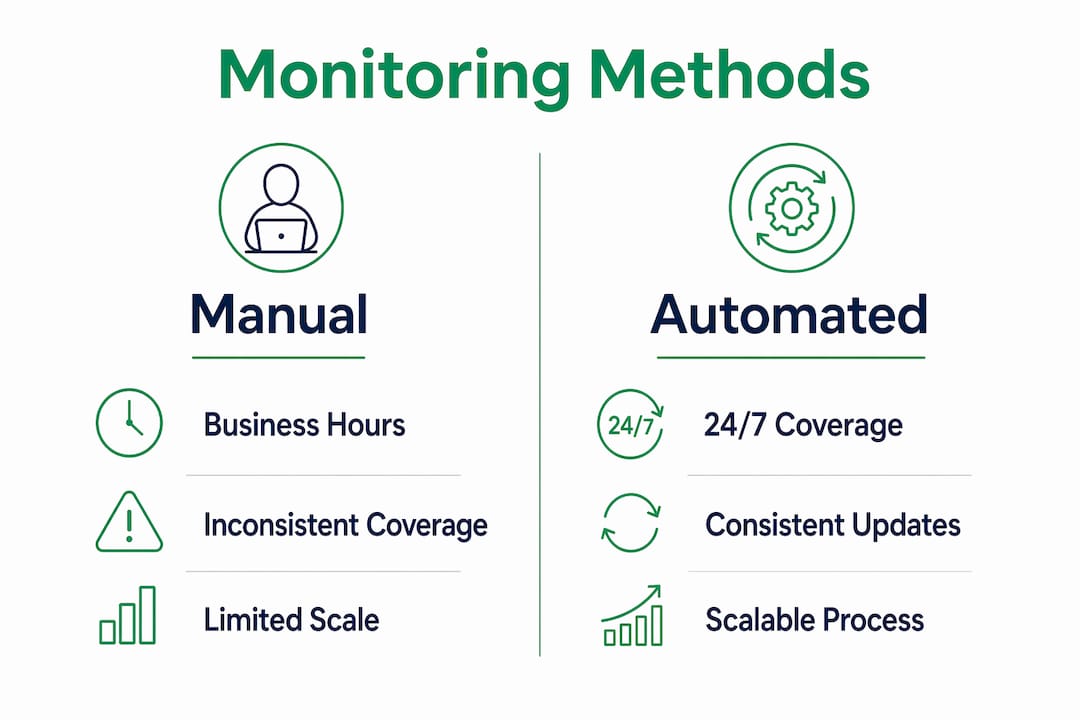
Manual monitoring misses critical updates outside business hours, produces inconsistent coverage, and cannot scale across 50+ sources. The data on adoption reflects this reality clearly.
| Factor | Manual monitoring | Automated monitoring |
|---|---|---|
| Coverage hours | Business hours only | 24/7 continuous |
| Source scalability | 10–15 sources realistically | 50–100+ sources |
| Sanctions alert speed | Hours to days | Minutes |
| Consistency | Analyst-dependent | Rule-based and uniform |
| Audit trail | Manual logs | Automated and timestamped |
87% of Tier 1 banks now use continuous automated monitoring. That adoption rate signals that manual processes are no longer a viable baseline for any institution with material digital asset exposure.
Pro Tip: Before selecting a monitoring platform, audit your current source list. Most compliance teams discover they are tracking fewer than 20 sources. Build toward 50+ by adding FATF, ESMA, national FIUs, and state-level regulators relevant to your operating jurisdictions.
How to set up an automated digital asset monitoring system
A structured implementation process separates programs that generate alerts from programs that drive control changes. Follow these five steps to build a monitoring system that produces operational outcomes.
-
Collection. Aggregate feeds from all relevant regulatory bodies, including FATF, ESMA, the SEC, the CFTC, FinCEN, and applicable national regulators. Use RSS feeds, API connections, and licensed regulatory intelligence databases to automate ingestion.
-
Classification. Tag each incoming update by jurisdiction, asset class, and regulatory domain (AML, custody, licensing, reporting). Classification is what separates a monitoring system from a document archive.
-
Relevance filtering. Apply your organization’s profile, including asset types held, jurisdictions of operation, and customer segments, to filter updates by materiality. A stablecoin issuer and a crypto custodian face different exposure from the same MiCA technical standard.
-
Alert delivery. Route filtered alerts to the right owner. AML updates go to your compliance officer. Custody rule changes go to your operations lead. Tax reporting updates go to your finance team. Generic all-staff alerts train people to ignore the system.
-
Action assignment. Map each material update to a specific internal control category: Policy, Process, Reporting, Technology, or Training. Mapping updates to internal controls rather than filing them as raw data is the single most important step in the entire process. An update without an assigned owner and a control category is not monitored. It is stored.
Wallet-level screening requires an additional layer. Chain-aware analytics tools visualize multi-hop sanctions exposure that standard KYC processes cannot detect. If a counterparty wallet is two or three hops from a sanctioned entity on-chain, standard screening misses it. Chain-aware tools do not. Build this capability into your technology stack before you need it in an enforcement conversation.
Pro Tip: Set a noise threshold during implementation. If your system generates more than 30 alerts per analyst per week, your relevance filters are too broad. Tune filters by jurisdiction and asset class until alert volume matches your team’s actual review capacity.
What are the common pitfalls in crypto regulation monitoring?
The most common mistake in digital asset compliance tracking is treating monitoring as a data collection problem rather than a control integrity problem. Teams invest in aggregation tools, build dashboards, and declare success. Then an examiner asks which control changed in response to a specific regulatory update, and no one can answer.
Here are the most frequent failures and their fixes:
-
Relying on pending applications as safe harbor. Pending MiCA authorization applications offer no legal protection after the july 1, 2026, deadline. Firms that treat “application submitted” as a compliance status will face service interruption. Fix: treat the deadline as hard and plan for full authorization, not pending status.
-
Ignoring jurisdictional divergence. US compliance remains fragmented between federal and state levels, even as MiCA creates a more unified European model. A monitoring program calibrated only for EU frameworks will miss state money transmission license requirements in New York, Texas, or Wyoming. Fix: maintain separate jurisdiction tracks in your classification system.
-
Monitoring textual changes instead of material impact. Incremental regulatory amendments generate dozens of textual updates that change nothing operationally. Baseline-aware monitoring systems compare new text against settled law to identify only the changes that require a control response. Fix: configure your system to flag delta from baseline, not every document revision.
-
No audit trail from alert to action. Regulators do not want to see that you received an alert. They want to see what changed in your controls as a result. Fix: require every material alert to generate a documented control review, even if the conclusion is “no change required.”
“Procedural clarity gaps in new regulatory regimes require proactive documentation and dialogue to mitigate compliance risk.” This principle applies directly to the GENIUS Act stablecoin framework, where firms should maintain certification paths and active regulatory dialogue rather than waiting for definitive guidance that may not arrive before an examination.
For a deeper look at how enforcement actions connect to monitoring gaps, the Wush resource on digital asset enforcement actions is worth reviewing before your next internal audit cycle.
How do global regulatory trends affect compliance monitoring in 2026?
Regulatory convergence is the defining trend of 2026, but convergence does not mean uniformity. MiCA is functioning as a global template, with jurisdictions in Asia, Latin America, and the Middle East referencing its structure for their own frameworks. That is useful for compliance teams building cross-border monitoring programs. It means a MiCA-aligned classification taxonomy transfers to new jurisdictions faster than building from scratch.
The US picture is more complicated. The SEC issued its first formal definitions for crypto asset securities in march 2026, which resolved some long-standing ambiguity. The GENIUS Act introduced a federal stablecoin framework, but implementation guidance varies across agencies and states. US firms need monitoring programs that track both federal and state-level developments simultaneously, because a federal rule does not preempt state licensing requirements in most cases.
FATF Recommendation 16, the travel rule, adds a cross-border data obligation that monitoring programs must track in real time. VASPs must exchange originator and beneficiary data for transfers above USD/EUR 1,000. That threshold is fixed, but the technical standards for data exchange vary by jurisdiction. Your monitoring program needs to track not just whether the travel rule applies, but which technical implementation standard each counterparty jurisdiction requires.
| Regulatory framework | Jurisdiction | Key compliance impact | 2026 status |
|---|---|---|---|
| MiCA | European Union | Licensing, custody, stablecoin rules | Deadline july 1, 2026 |
| GENIUS Act | United States | Federal stablecoin framework | Implementation ongoing |
| FATF Recommendation 16 | Global | Travel rule data exchange above USD/EUR 1,000 | Active enforcement |
| SEC crypto asset definitions | United States | Securities classification for tokens | Issued march 2026 |
For a full breakdown of how these frameworks interact with your digital asset regulatory exposure, the Wush blog provides jurisdiction-specific analysis updated for 2026.
Key Takeaways
Effective digital asset regulatory change monitoring requires automated source coverage, control-mapped alert workflows, and jurisdiction-aware classification to convert regulatory updates into documented compliance actions.
| Point | Details |
|---|---|
| Automate across 50+ sources | Manual monitoring cannot cover the volume or speed required for sanctions and licensing updates. |
| Map alerts to internal controls | Every material update must link to a Policy, Process, Technology, Reporting, or Training action. |
| Treat MiCA deadlines as hard | Pending authorization applications offer no legal protection after the july 1, 2026, deadline. |
| Use chain-aware screening | Standard KYC misses indirect sanctions exposure; chain-aware analytics detect multi-hop wallet risk. |
| Track US federal and state levels separately | Federal frameworks like the GENIUS Act do not replace state licensing requirements. |
Why most monitoring programs fail before they start
The programs I have seen fail share one characteristic: they were built to satisfy an audit question rather than to protect the organization. Someone asked “do you monitor regulatory changes?” and the answer became a dashboard with 200 unreviewed alerts and no assigned owners. That is not a monitoring program. It is a liability with a user interface.
The compliance teams that get this right treat monitoring as an operational function, not a reporting function. They assign every material alert to a control owner within 48 hours. They run quarterly reviews that compare their control inventory against the regulatory baseline. They document not just what changed in the regulation, but what changed in their operations as a result. When an examiner arrives, they can trace a line from a specific FATF guidance update to a specific change in their travel rule data exchange process, with timestamps and sign-offs.
The technology side has improved significantly. Chain-aware analytics tools now make it possible to detect indirect sanctions exposure that would have required manual blockchain analysis two years ago. KYC and AML compliance trends in the fintech space show that wallet screening is moving from a periodic batch process to a continuous real-time function. That shift matters for how you architect your monitoring program. Batch screening is no longer sufficient for high-velocity transaction environments.
My honest observation after working across multiple compliance frameworks: the organizations that invest in structured governance, including formal certification of their compliance readiness, consistently outperform those that rely on ad hoc monitoring. Certification forces the discipline of mapping controls to requirements. That discipline is exactly what a monitoring program needs to produce outcomes rather than outputs.
— Gregg
How DARE certification supports your monitoring program
A monitoring program generates alerts. A governance framework converts those alerts into documented, auditable compliance actions. Wush’s DARE certification is built specifically for this gap. The Digital Asset Readiness Evaluation covers custody, AML, regulatory compliance, risk management, and operational controls in a structured assessment framework. It gives compliance teams a baseline against which every regulatory update can be measured, and it produces credentials that demonstrate readiness to regulators, counterparties, and boards. For organizations building or maturing their digital asset compliance programs in 2026, DARE provides the governance structure that turns monitoring data into defensible compliance evidence.
FAQ
What is digital asset regulatory change monitoring?
Digital asset regulatory change monitoring is the systematic, automated tracking of regulatory updates from bodies like FATF, ESMA, and the SEC, mapped to internal controls to maintain compliance. It differs from data collection in that every material update must produce a documented control response.
How many regulatory sources should a compliance team monitor?
Financial firms should track 50–100+ regulatory sources, including global bodies, national regulators, and state-level agencies relevant to their operating jurisdictions. Sanctions sources require scanning intervals of just a few minutes.
What is the MiCA authorization deadline for EU crypto firms?
The MiCA authorization deadline is july 1, 2026. Up to 75% of EU crypto firms risk losing their operating license if they have not secured authorization by that date, and pending applications do not provide legal protection after the deadline.
What does the FATF travel rule require for digital asset transfers?
FATF Recommendation 16 requires virtual asset service providers to exchange originator and beneficiary data for transfers above USD/EUR 1,000. The threshold is fixed globally, but technical implementation standards vary by jurisdiction.
How does chain-aware analytics improve sanctions screening?
Chain-aware analytics tools detect indirect sanctions exposure by tracing wallet connections multiple hops away from a flagged address. Standard KYC screening only checks direct counterparties, missing exposure that exists two or three transaction layers removed.