
Digital Asset Enforcement Actions Explained for Legal Pros

A digital asset enforcement action is a formal legal procedure where federal authorities seize, freeze, or restrain cryptocurrencies and related assets based on suspected illicit activity, triggering a cascade of regulatory and judicial obligations for all parties involved. The DOJ, IRS, FinCEN, and OFAC each play distinct roles in these proceedings, and the governing statutes, including the Civil Asset Forfeiture Reform Act (CAFRA), the Bank Secrecy Act (BSA), and the newly enacted GENIUS Act, define the procedural rules that finance and legal professionals must understand cold. A digital asset enforcement action explained properly is not just about seizure mechanics. It covers reporting obligations, claimant rights, sanctions compliance, and the operational controls that determine whether your organization survives regulatory scrutiny intact.
What legal frameworks govern digital asset enforcement actions?
Digital asset enforcement combines civil forfeiture, criminal prosecution, sanctions enforcement, and securities regulation into a single, often overlapping legal process. Understanding which statute applies to a given situation determines your timeline, your rights, and your exposure.
CAFRA is the primary statute governing federal civil forfeiture of digital assets in the United States. Under CAFRA, the government must issue notice within 60 days of seizure, and claimants have at least 35 days from the mailing date to file a verified claim. Miss that window and the assets are forfeited by default, with no further recourse. That 35-day clock is not a soft deadline. It is the hard cutoff that ends your legal standing.

The IRS added a critical reporting layer in 2025. Brokers must now report digital asset transaction proceeds on Form 1099-DA starting January 1, 2025, with cost basis reporting following on January 1, 2026. This means enforcement investigators now have a structured paper trail for every taxable digital asset transaction, making it significantly harder for parties to claim ignorance of gains or transfers during a forfeiture proceeding.
The GENIUS Act introduced the most consequential stablecoin-specific compliance framework to date. FinCEN and OFAC’s proposed 2026 rules require permitted payment stablecoin issuers (PPSIs) to maintain AML programs and operational sanctions compliance capabilities, including the technical ability to block or freeze transactions on-chain. This is not a policy checkbox. It is a technology requirement.
| Law / Rule | Scope | Key Deadline or Obligation |
|---|---|---|
| CAFRA | Civil forfeiture of seized digital assets | Government notice: 60 days; claimant claim: 35+ days |
| Bank Secrecy Act (BSA) | AML reporting for financial institutions | Ongoing SAR and CTR filing obligations |
| IRS Form 1099-DA | Broker reporting of digital asset transactions | Proceeds: Jan 1, 2025; Basis: Jan 1, 2026 |
| GENIUS Act / OFAC Rules | Stablecoin AML and sanctions compliance | Operational blocking capability required for PPSIs |
| Federal Criminal Statutes | Wire fraud, money laundering, forfeiture | Case-specific; criminal forfeiture runs parallel to civil |
Pro Tip: Map your organization’s digital asset activities against each of these frameworks separately. A stablecoin issuer faces GENIUS Act obligations that a crypto broker does not, and conflating the two creates dangerous compliance gaps.
How do enforcement actions typically unfold in practice?
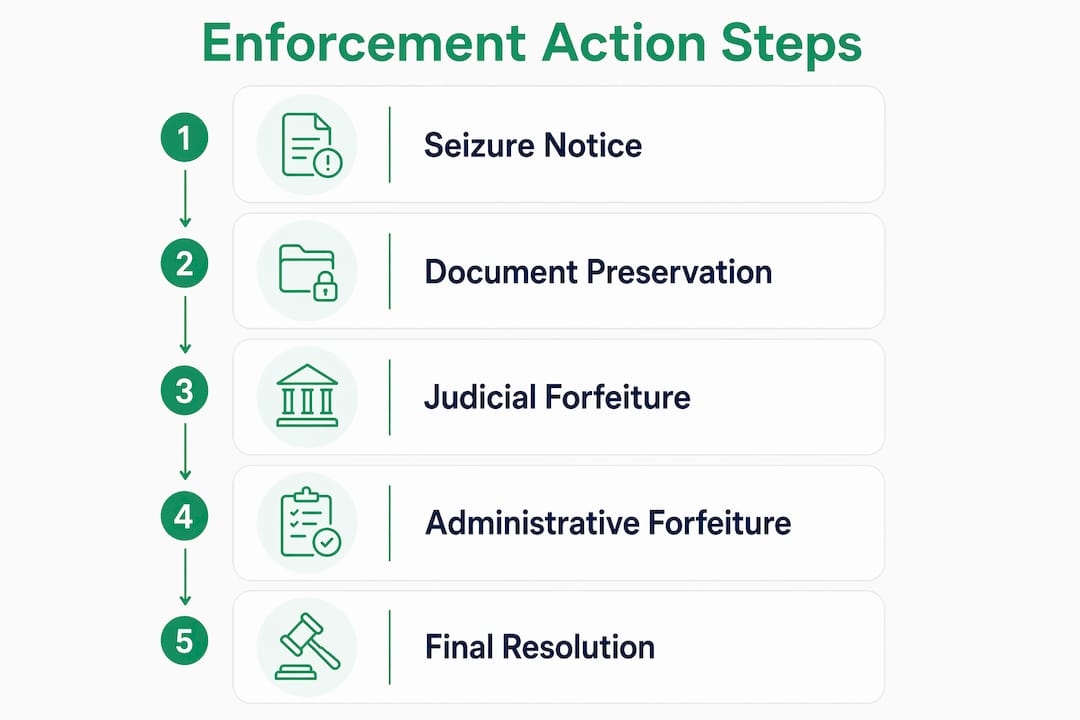
Enforcement of digital assets follows a recognizable sequence, though the specific pathway varies depending on whether authorities pursue civil forfeiture, criminal charges, or both simultaneously. Knowing the sequence lets legal teams intervene at the right moment rather than reacting after the damage is done.
- Investigation and evidence gathering. Agencies use blockchain forensic tools, victim reports, and exchange subpoenas to identify wallets, trace fund flows, and establish probable cause. The DOJ frames these investigations as money laundering conspiracies, not just consumer harm cases, which broadens the scope of assets subject to forfeiture.
- Seizure execution. Authorities execute seizure through exchange warrants (compelling platforms to freeze and transfer assets), stablecoin issuer freeze requests (leveraging on-chain blocking capabilities), or direct wallet key acquisition through court orders or cooperation agreements.
- Government notice issuance. Under CAFRA, the seizing agency must send written notice to all known interested parties within 60 days. The notice specifies the property, the legal basis for seizure, and the deadline for filing a claim.
- Claimant response window. Interested parties have at least 35 days from the mailing date to file a verified claim asserting ownership and demanding judicial process. Filing this claim is the single most important step a claimant can take.
- Judicial or administrative forfeiture. If no claim is filed, the government proceeds administratively and the assets are forfeited. If a verified claim is filed, the government has 90 days to initiate judicial forfeiture or incorporate the assets into a criminal case. Missing that 90-day deadline forces the government to return the property unless an independent legal basis exists to retain it.
- Litigation or settlement. Claimants contest forfeiture by challenging probable cause, asserting innocent owner status, or attacking procedural defects. Settlement negotiations often occur in parallel.
Pro Tip: The moment a seizure notice arrives, treat document preservation as a legal obligation. Blockchain transaction records, wallet ownership proofs, exchange account statements, and any communications related to the seized assets must be preserved immediately. Courts have penalized parties for spoliation in forfeiture cases.
The distinction between judicial and administrative forfeiture matters enormously. Administrative forfeiture is faster and cheaper for the government, but filing a verified claim forces the matter into federal court, where constitutional protections are stronger and discovery tools become available to the claimant.
What are the recent trends and priorities in digital asset enforcement?
Enforcement priorities in 2026 reflect a clear shift toward large-scale, coordinated takedowns targeting fraud ecosystems rather than individual bad actors. The DOJ, FBI, and international partners are operating at a scale that would have been unimaginable five years ago.
The FBI’s Operation Blackout seized over 127,000 BTC, valued at approximately $8 billion, marking the largest single crypto forfeiture in US history. This figure signals that enforcement agencies now have the technical capability and inter-agency coordination to pursue and recover assets at institutional scale.
The DOJ’s 2026 crackdown on crypto scam centers produced at least 276 arrests, targeting the managers and recruiters behind “pig-butchering” fraud schemes that funneled billions from US victims into offshore crypto wallets. These operations demonstrate that enforcement now targets the full organizational structure of fraud networks, not just the wallets holding the proceeds.
Blockchain forensic analysis has become the backbone of these cases. Agencies use tools that trace fund flows across hundreds of wallet hops, correlate on-chain activity with off-chain victim reports, and reconstruct the full transaction history needed to support both criminal charges and civil forfeiture claims. The implication for compliance teams is direct: any transaction that touches a flagged wallet, even unknowingly, can draw your organization into an enforcement proceeding.
Sanctions enforcement against stablecoin issuers is the newest frontier. OFAC’s proposed framework under the GENIUS Act requires PPSIs to build operational blocking capabilities that can reject or freeze sanctioned transactions at the protocol level. This moves sanctions compliance from a reporting function to an engineering requirement, and organizations that treat it as the former will face enforcement exposure.
What practical compliance considerations arise from enforcement actions?
Finance and legal teams that wait for a seizure notice to think about digital asset compliance are already behind. The enforcement environment in 2026 demands proactive, integrated programs that address tax reporting, AML, sanctions, and incident response as a single framework.
- Align broker reporting workflows with IRS deadlines. Form 1099-DA basis reporting begins January 1, 2026. Brokers and custodians that have not built cost basis tracking into their recordkeeping systems face both enforcement scrutiny and significant operational liability when clients dispute reported figures.
- Build blockchain tracing into your audit trail. Enforcement agencies use the same forensic tools that compliance teams can access. Maintaining a documented audit trail of wallet addresses, transaction hashes, and counterparty identifications gives your legal team the evidence needed to contest wrongful seizures and demonstrate good-faith compliance.
- Implement operational sanctions controls for stablecoin activity. The GENIUS Act framework requires more than a written sanctions policy. Organizations handling stablecoins need technical controls capable of screening transactions against OFAC lists in real time, with documented procedures for blocking and reporting.
- Establish a cross-functional incident response protocol. When a seizure notice arrives, the clock starts immediately. Legal, compliance, finance, and IT must have pre-defined roles. The process calendar for managing CAFRA deadlines is not something to build under pressure.
- Conduct periodic liquidity risk assessments that account for enforcement scenarios. A seizure can freeze assets that your treasury depends on for operational liquidity. Stress-testing your digital asset holdings against enforcement scenarios is now a standard risk management practice, not an edge case.
- Coordinate with external counsel experienced in digital asset forfeiture. General commercial litigators often lack familiarity with CAFRA’s specific procedural requirements. Retaining counsel with forfeiture experience before an incident occurs is far less expensive than finding them under a 35-day deadline.
The board-level oversight dimension of digital asset enforcement risk is also growing. Regulators increasingly expect executives and directors to demonstrate awareness of enforcement exposure, not just delegate it to compliance teams.
Key takeaways
Effective digital asset compliance requires integrating CAFRA procedural deadlines, IRS reporting obligations, and GENIUS Act sanctions controls into a single, cross-functional enforcement response framework.
| Point | Details |
|---|---|
| CAFRA deadlines are absolute | Claimants have 35+ days to file a verified claim; missing it forfeits assets permanently. |
| IRS basis reporting starts 2026 | Brokers must track and report cost basis on Form 1099-DA starting January 1, 2026. |
| Stablecoin compliance is now technical | GENIUS Act rules require PPSIs to build on-chain blocking and freezing capabilities, not just policies. |
| Enforcement scale is unprecedented | FBI’s Operation Blackout seized $8 billion in crypto, signaling institutional-level enforcement capacity. |
| Incident response must be pre-built | Cross-functional protocols for legal, compliance, and finance must exist before a seizure notice arrives. |
The part most compliance programs still get wrong
The most common failure I see in digital asset enforcement situations is not a legal error. It is a calendar error. Organizations receive a CAFRA notice, route it through three internal departments for review, and arrive at outside counsel with four days left on a 35-day deadline. At that point, the legal team is managing triage, not strategy.
The second failure is treating enforcement risk as a legal department problem. The IRS 1099-DA basis reporting requirement is an accounting and systems problem. Sanctions compliance under the GENIUS Act is an engineering problem. The verified claim process under CAFRA is a legal problem. None of these can be solved in isolation, and organizations that silo them will find the gaps exposed at the worst possible moment.
What I find genuinely underappreciated is the role of blockchain forensics in both offense and defense. Enforcement agencies use it to build cases. Claimants can use the same analysis to demonstrate that seized assets have clean provenance, trace the legitimate transaction history, and challenge the government’s probable cause narrative. Organizations that invest in forensic-grade recordkeeping are not just complying. They are building their defense before they need it.
Multi-jurisdiction enforcement is also no longer the exception. The DOJ’s 2026 scam center takedowns involved coordination across Southeast Asia, Europe, and the US. If your organization operates across borders, your enforcement exposure does too, and your compliance program needs to reflect that reality rather than assume US rules are the only ones that apply.
— Gregg
How DARE helps you stay ahead of enforcement risk

The enforcement environment described in this article is not theoretical. It is the operating reality for every finance and legal team handling digital assets in 2026. Wush built the DARE certification specifically to address the governance gap that leaves organizations exposed when enforcement actions arrive. The Digital Asset Readiness Evaluation covers custody controls, regulatory compliance, AML and sanctions frameworks, and incident response protocols in a structured, assessable format. Finance and legal professionals who complete DARE gain both the credential and the operational framework to demonstrate readiness to regulators, auditors, and counterparties. If your organization’s digital asset compliance program has not been formally assessed against 2026 enforcement standards, explore your readiness edge before the next enforcement cycle begins.
FAQ
What is a digital asset enforcement action?
A digital asset enforcement action is a formal legal procedure where government agencies seize, freeze, or restrain cryptocurrencies or related assets based on suspected illicit activity, followed by civil forfeiture, criminal prosecution, or sanctions proceedings.
What is CAFRA and why does it matter for crypto seizures?
CAFRA is the Civil Asset Forfeiture Reform Act, the primary US statute governing federal digital asset seizures. It requires the government to issue notice within 60 days and gives claimants at least 35 days to file a verified claim before assets are forfeited by default.
When does IRS Form 1099-DA reporting take effect?
Brokers must report digital asset transaction proceeds on Form 1099-DA starting January 1, 2025, with cost basis reporting requirements beginning January 1, 2026, per final IRS regulations.
What do the GENIUS Act rules require for stablecoin issuers?
FinCEN and OFAC’s proposed 2026 rules require permitted payment stablecoin issuers to maintain AML programs and build operational capabilities to block or freeze sanctioned transactions at the protocol level, not just report them.
What should a legal team do immediately after receiving a seizure notice?
Retain experienced forfeiture counsel immediately, preserve all relevant transaction records and wallet documentation, and map the CAFRA deadline calendar. Missing the 35-day claim filing window forfeits the assets permanently with no appeal.