
CFTC Crypto Regulation: A Guide for Legal & Compliance Teams

The CFTC regulates derivatives and related market infrastructure for crypto assets, not the cash spot market, and recent 2025–2026 agency actions have materially clarified that scope. The March 2026 joint CFTC–SEC interpretation, the tokenized-collateral pilot program, and updated perpetual contracts guidance together represent the most significant shift in the crypto regulatory framework since the agency first asserted commodity jurisdiction over Bitcoin in 2015.
Three things compliance teams need to know immediately:
- Jurisdiction is activity-driven, not asset-driven. A token being a “commodity” under the Commodity Exchange Act (CEA) does not automatically put your firm under CFTC registration requirements. The operative question is whether your product is a derivative. As the CFTC’s own infographic states, the actionable jurisdictional question is whether a derivatives product exists, not whether the underlying asset is a commodity or a security.
- The March 2026 joint interpretation narrows uncertainty. The CFTC joined the SEC in issuing a March 2026 interpretation clarifying how federal securities laws apply to crypto assets, with the CFTC committing to administer the CEA consistently with that taxonomy. This is the clearest jurisdictional map the two agencies have produced together.
- Compliance focus areas right now: product design review (derivative vs. spot), actual delivery documentation for retail commodity transactions, custody and segregation controls, and registration obligations for any derivatives venue or intermediary.
Run the activity checklist in Section 3, review your tokenized collateral policies against the pilot guidance in Section 7, and inventory any derivatives exposures before your next board or risk committee meeting.
Key Takeaways
CFTC crypto regulation is activity-driven: the operative question is whether a product is a derivative, not whether the underlying asset is a commodity, and the March 2026 joint interpretation with the SEC is now the primary jurisdictional map both agencies apply.
| Point | Details |
|---|---|
| Jurisdiction is activity-driven | Ask whether the product is a derivative first; commodity status alone does not trigger CFTC registration. |
| Actual delivery documentation is critical | The 28-day possession-and-control test requires transaction-level records: timestamps, wallet addresses, and evidence of customer control. |
| March 2026 joint interpretation is operative | The CFTC and SEC published a joint taxonomy in March 2026; update all jurisdictional memos to reflect this classification framework. |
| AML and custody gaps carry the highest enforcement risk | BitMEX-style failures (no AML program, commingled funds) attract the most severe CFTC penalties and criminal referrals. |
| DARE supports ongoing readiness | Wush’s DARE certification maps directly to CFTC compliance obligations and provides the documented audit trail examiners expect. |
Table of Contents
- How CFTC crypto regulation works: jurisdiction and statutory authority
- How to determine whether a crypto activity falls under CFTC authority
- Primary CFTC documents your legal team should read first
- How crypto derivatives get listed: self-certification, DCMs, clearing, and settlement
- Enforcement record: what CFTC crypto cases teach compliance teams
- Recent policy developments: the 2025–2026 CFTC–SEC joint interpretation, Project Crypto, and what changes now
- Operationalizing CFTC obligations: a governance and controls readiness framework
- The next 12 months: how compliance leaders should prioritize
- DARE helps you operationalize CFTC requirements from day one
- Primary sources and further reading
- Sources
How CFTC crypto regulation works: jurisdiction and statutory authority
The CFTC derives its authority from the Commodity Exchange Act, which defines “commodity” broadly enough to include virtually any digital asset that is not a security. Bitcoin, Ether, and most fungible tokens have been treated as commodities under that definition. But commodity status alone is not the jurisdictional trigger most compliance teams think it is.
The CEA gives the CFTC two distinct types of authority that operate differently. Regulatory authority covers derivatives markets: futures contracts, swaps, options, and the venues and intermediaries that trade or clear them (Designated Contract Markets, Swap Execution Facilities, Futures Commission Merchants, and clearinghouses). Enforcement authority is broader and reaches fraud and manipulation in any commodity market, including cash spot markets. That distinction matters enormously in practice. A firm running a spot crypto exchange has no CFTC registration obligation, but it can still face CFTC enforcement if it manipulates prices or defrauds customers.
The table below maps the two authority types against the most common digital asset activities:
The March 2026 joint interpretation published in the Federal Register adds a taxonomy layer: it classifies crypto assets into categories and explains when a non-security crypto asset might become an investment contract, which would shift primary jurisdiction to the SEC. For compliance teams, the practical takeaway is that product classification must be revisited whenever a token’s economic structure changes, not just at launch.
One common misconception worth addressing directly: the Howey test (the SEC’s investment contract analysis) and the CEA commodity definition are not mutually exclusive. A token can simultaneously be a commodity under the CEA and an investment contract under the Securities Act, depending on the transaction. The joint interpretation is designed to reduce that ambiguity, but it does not eliminate the need for a transaction-level legal analysis.
How to determine whether a crypto activity falls under CFTC authority
This checklist is designed for counsel and compliance officers triaging a new product, business line, or third-party relationship. Work through it in order.
Step 1: Is there a derivatives contract?
- Does the product involve a futures contract, option, swap, or leveraged/margined transaction?
- Is there a defined settlement date, or does the position roll continuously (perpetual structure)?
- Does the customer post margin or collateral rather than paying the full notional amount upfront?
- Is there a counterparty exposure that creates mark-to-market gains or losses before settlement?
If the answer to any of these is yes, the product is likely a derivative. Proceed to Step 2. If no, the product is likely a spot transaction. Stop here and assess only enforcement exposure under CEA § 6©.
Step 2: Does the “actual delivery” exception apply?
For retail commodity transactions (leveraged or margined crypto sold to retail customers), the CEA’s actual delivery exception is critical. The CFTC’s 2020 interpretive guidance establishes a 28-day possession-and-control test. Actual delivery has occurred only when:
- The customer has full possession and control of the commodity within 28 days of the transaction.
- The commodity is transferable off-platform to any third-party wallet or custodian the customer chooses.
- The seller (or its affiliates) does not retain any interest, legal title, or control over the commodity after delivery.
Weak documentation of these elements is the most common pivot point in CFTC enforcement and recharacterization disputes. Document at the transaction level: record the timestamp of transfer, the wallet address, and evidence that the customer controls the private key or has the right to move the asset to an external address.
Step 3: What registration path applies?
- If the product is a futures contract or option on a commodity: the trading venue must be a registered DCM; the intermediary must be a registered FCM.
- If the product is a swap: the venue must be a registered SEF (or qualify for an exemption); dealers above the de minimis threshold must register as Swap Dealers.
- If the product is a novel perpetual contract: the CFTC has signaled a preference for pre-approval review under Regulation 40.3 rather than self-certification under 40.2. See Section 5 for the self-certification process.
Step 4: Are there clearing obligations?
- Does the swap fall within a CFTC-mandated clearing category? Check the current clearing determination orders.
- If the product is physically settled, does the firm have custody arrangements that satisfy CEA § 4d segregation requirements?
Pro Tip: When documenting an actual delivery analysis, create a transaction-level memo that captures: (1) the exact timestamp of transfer, (2) the blockchain transaction hash, (3) confirmation that the customer controls the receiving wallet’s private key, and (4) a legal opinion that no affiliate retains any interest in the asset. This memo becomes your primary defense in any CFTC inquiry.
Primary CFTC documents your legal team should read first
These are the specific documents that carry the most weight in any CFTC examination, enforcement proceeding, or product approval submission. One-line summaries help teams prioritize.
Must-read regulatory text and interpretive guidance:
- Retail Commodity Transactions Involving Certain Digital Assets (2020 Actual Delivery Guidance) — The definitive CFTC statement on the 28-day possession-and-control test; required reading for any firm offering leveraged or margined crypto to retail customers.
- Federal Register: Application of Federal Securities Laws to Crypto Assets (March 2026) — The joint SEC–CFTC interpretation that classifies crypto asset categories and sets the jurisdictional taxonomy both agencies will apply going forward.
- Policy Statement Concerning the Listing of Perpetual Contracts (91 FR 33160) — Explains why perpetual contracts require case-by-case Commission review and what product teams must document for a 40.3 submission.
Staff advisories:
- CFTC Staff Advisory No. 18-14 — Issued to DCMs and derivatives clearing organizations (DCOs), this advisory sets out the CFTC’s expectations for surveillance, market data sourcing, and coordination with spot platforms when listing digital asset derivatives. It remains the foundational operational document for any venue listing crypto futures.
- Digital Assets Primer — A staff-level overview of the CFTC’s regulatory framework for digital assets, covering the commodity definition, derivatives jurisdiction, and practical steps for registrants. Good starting point for teams new to CFTC oversight.
Press releases and pilot guidance:
- Tokenized Collateral Pilot Program (2025) — Describes the conditions under which FCMs may accept BTC, ETH, and USDC as collateral in derivatives markets, including weekly reporting requirements and the technology-neutral analysis framework.
- CFTC Joins SEC on March 2026 Interpretation — The press release version of the joint interpretation; useful for board-level briefings and as a citation anchor in legal memoranda.
How to track updates: The CFTC publishes proposed rules, final rules, and staff advisories in the Federal Register and on its website at cftc.gov. Subscribe to the agency’s email alerts and monitor the digital asset regulatory change monitoring resources for structured tracking of public comment periods and rulemaking timelines. Public comment periods typically run 30–60 days from Federal Register publication.
Citing these materials in legal memoranda: Federal Register publications (rules and interpretations) carry the highest citation weight and are binding or near-binding authority. Staff advisories (like No. 18-14) are persuasive but not binding; cite them as “CFTC Staff Advisory No. [number], [date].” Press releases are useful for establishing agency intent and timing but should be paired with the underlying Federal Register citation in formal legal work.
How crypto derivatives get listed: self-certification, DCMs, clearing, and settlement
Getting a digital asset derivative to market through a CFTC-regulated venue involves a defined process with specific decision points that compliance and product teams need to understand before they start building.
The two product approval paths
Under Regulation 40.2, a DCM or SEF can self-certify a new product by submitting a certification to the CFTC at least one business day before listing. The product goes live unless the Commission objects. This path works for products that fit established templates: cash-settled futures on major digital assets with robust reference price sources and established surveillance arrangements.
Regulation 40.3 voluntary approval is different. The venue submits the product for Commission review, which takes longer but provides more certainty. The CFTC has signaled clearly, through its policy statement on perpetual contracts, that novel perpetual products referencing asset classes not previously contemplated should go through 40.3 rather than self-certification. Perpetual contracts raise unique surveillance challenges because funding mechanisms must operate reliably on a continuous basis, and the CFTC wants to review those mechanics before the product goes live.
Process flow and timeline
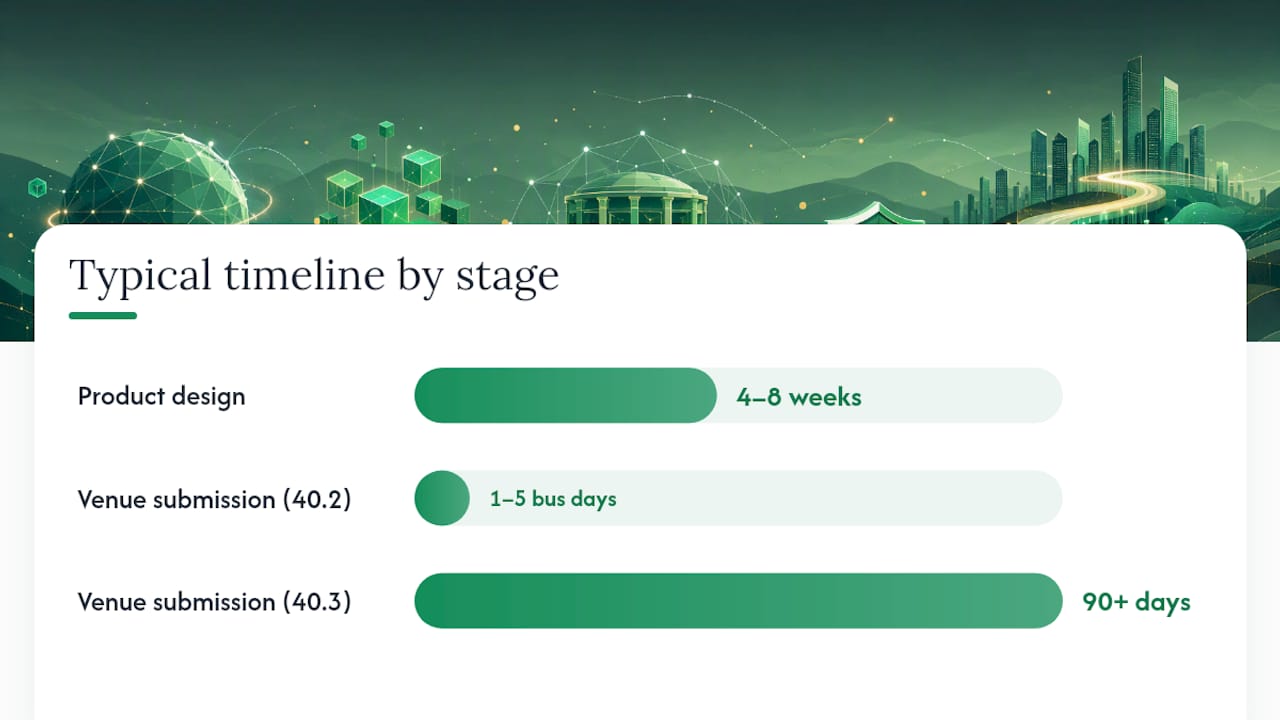
| Stage | Key Actions | Typical Timeline | Primary Risk |
|---|---|---|---|
| Product design | Define settlement mechanics, reference price, margin model | 4–8 weeks | Recharacterization as spot or security |
| Venue submission (40.2) | Draft certification, surveillance plan, margin methodology | 1–5 business days before listing | Commission objection; inadequate price source |
| Venue submission (40.3) | Full application, legal analysis, market data documentation | 90+ days | Requests for additional information |
| Clearing determination | Assess mandatory clearing; engage DCO | Concurrent with submission | Clearing refusal; segregation gaps |
| Surveillance and settlement | Implement monitoring; confirm settlement source integrity | Ongoing | Price manipulation; settlement failure |
Operational requirements for a robust submission
Staff Advisory No. 18-14 and the Digital Assets Primer together set out what the CFTC expects in a product submission. The key elements are:
- Reference price integrity: The settlement price must come from a source with sufficient liquidity, manipulation resistance, and methodology transparency. Using a single exchange’s price without a volume-weighted composite is a common deficiency.
- Surveillance plan: The DCM must demonstrate it can monitor for manipulation in both the derivatives market and the underlying spot market. This typically requires a surveillance sharing agreement with major spot platforms.
- Margin methodology: The initial margin model must account for the volatility profile of the underlying digital asset, including tail-risk scenarios.
- Custody and segregation for physically settled products: If the contract calls for physical delivery of the digital asset, the FCM must have custody arrangements that satisfy CEA § 4d segregation requirements. The tokenized collateral pilot guidance is directly relevant here for firms exploring physically settled or collateral-backed structures.
Pro Tip: Before submitting a 40.2 self-certification for a new digital asset derivative, run a pre-submission consultation with CFTC staff through LabCFTC. LabCFTC’s informal guidance process can surface objections before they become formal Commission responses, saving weeks of back-and-forth on a submission that needs revision.
Enforcement record: what CFTC crypto cases teach compliance teams
The CFTC’s enforcement record in digital assets is not a list of edge cases. It is a map of the most common compliance failures, and every case on it was avoidable.
Coinflip (2015)
Coinflip operated a Bitcoin options trading platform without registering as a DCM. The CFTC’s order established, for the first time in a formal enforcement action, that Bitcoin is a commodity under the CEA and that options on Bitcoin are subject to CFTC jurisdiction. The firm was ordered to cease and desist. The compliance lesson is straightforward: if your platform allows customers to trade options or futures on any digital asset, registration is not optional regardless of how the product is marketed.
BitMEX (2021)
The BitMEX case is the most instructive enforcement action in CFTC crypto history. The CFTC charged BitMEX and its founders with operating an unregistered trading platform (FCM and DCM violations), failing to implement any AML/BSA program, and failing to implement a customer identification program. The firm settled for $100 million in civil monetary penalties. Individual founders faced criminal charges separately.
The compliance failures at BitMEX were not subtle. The firm had no AML program at all, accepted customers from jurisdictions it was prohibited from serving, and made no effort to register with the CFTC despite operating a derivatives platform with U.S. customers. The case established that operating offshore does not insulate a firm from CFTC jurisdiction if U.S. customers can access the platform.
Enforcement risk matrix
| Issue Type | Typical Statutory Basis | Likely Sanctions | Mitigation Priority |
|---|---|---|---|
| Unregistered derivatives venue | CEA § 4(a), § 4d | Cease and desist; civil monetary penalties | Register before launch; no U.S. customer access without registration |
| AML/BSA failures | CEA § 6©; Bank Secrecy Act | Civil penalties; criminal referral | Implement full AML program; KYC all customers |
| Fraud/manipulation | CEA § 6©(1), § 9(a)(2) | Disgorgement; civil penalties; injunction | Surveillance; market integrity controls |
| Custody/segregation failures | CEA § 4d | Civil penalties; customer fund shortfall liability | Segregated accounts; daily reconciliation |
| Actual delivery recharacterization | CEA § 2©(2)(D) | Unregistered FCM liability | Document delivery at transaction level |
Lessons for compliance teams
- Registration gaps are the most common trigger. If there is any doubt about whether a product is a derivative, treat it as one and seek registration or a no-action letter before launch.
- AML/BSA failures attract the most severe penalties. The CFTC coordinates with FinCEN and DOJ on AML cases; a CFTC enforcement action for AML failures rarely travels alone.
- Cross-border operations do not create a safe harbor. The CFTC applies a “significant nexus” test: if U.S. customers can access the platform, U.S. jurisdiction applies. Geoblocking without enforcement is not a defense.
- Surveillance blind spots in spot markets create derivatives enforcement exposure. If your derivatives settlement price is manipulable in the underlying spot market, and you have no surveillance sharing agreement with that spot market, you have a documented enforcement risk.
Recent policy developments: the 2025–2026 CFTC–SEC joint interpretation, Project Crypto, and what changes now
The period from late 2025 through March 2026 produced more jurisdictional clarity for crypto derivatives than the prior five years combined. Here is what happened and what it means for your compliance program.
Timeline of major developments
- 2025 (ongoing): Tokenized Collateral Pilot. The CFTC launched a digital assets pilot program permitting FCMs to accept BTC, ETH, and USDC as collateral in derivatives markets under specific conditions. The pilot requires weekly reporting, conservative haircuts, legal enforceability opinions for the tokenization wrapper, and ready escalation protocols. The CFTC emphasized a technology-neutral approach: each tokenized asset must be analyzed individually for enforceability, custody, valuation, and segregation.
- 2025–2026: Project Crypto. The CFTC formed Project Crypto as an internal coordination initiative to align staff guidance, rulemaking priorities, and enforcement posture across the agency’s divisions. Project Crypto has accelerated the pace of staff-level guidance and increased interagency coordination with the SEC.
- 2026: Policy Statement on Perpetual Contracts. The CFTC published a policy statement on perpetual contracts signaling that novel perpetual products should be submitted for Commission review under Regulation 40.3 rather than self-certified. This directly affects any firm planning to list perpetual crypto derivatives on a U.S.-regulated venue.
- March 2026: Joint CFTC–SEC Interpretation. The CFTC joined the SEC in issuing an interpretation clarifying how federal securities laws apply to crypto assets. The CFTC committed to administering the CEA consistently with the SEC’s asset taxonomy. The Federal Register publication provides the full classification framework.
What these developments mean for registrants and product teams
- The joint interpretation is the clearest signal yet that the two agencies are coordinating on jurisdictional lines rather than competing for them. Compliance programs should be built to satisfy both agencies’ expectations simultaneously, not sequentially.
- The tokenized collateral pilot creates a real operational opportunity for FCMs, but the monitoring conditions are tight. Weekly reporting and individual asset analysis are not optional; they are conditions of the pilot.
- The perpetual contracts policy statement increases the time and documentation burden for product teams planning novel perpetual structures. Build 40.3 review time (90+ days) into your product roadmap.
- The March 2026 interpretation is intended as a bridge while Congress considers comprehensive market-structure legislation. Treat it as the current operative framework, but build monitoring processes to catch legislative changes quickly. The President’s Working Group on Financial Markets (PWG) has historically published recommendations that precede legislative action; track PWG reports as leading indicators.
What is enforceable now vs. what signals future rulemaking
The joint interpretation and the tokenized collateral pilot guidance are enforceable now as agency statements of position. The CFTC will apply them in examinations and enforcement actions. The perpetual contracts policy statement is also enforceable as a statement of Commission policy. Legislative proposals (market structure bills) are not yet law and should be monitored but not treated as binding until enacted.
Operationalizing CFTC obligations: a governance and controls readiness framework
Having the right policies on paper is not the same as having a defensible compliance program. The CFTC looks for evidence of operational controls, not just written procedures. This section gives compliance teams a practical framework they can implement now.
Governance and roles
Every firm with CFTC-regulated digital asset activity needs a clear accountability structure. At minimum:
- A designated Chief Compliance Officer (CCO) with direct board access and authority to escalate.
- A legal product review process that produces a written jurisdictional memo for each new product or business line before launch.
- A board-level reporting cadence that covers regulatory developments, open enforcement matters, and compliance program gaps. See the crypto strategic risk disclosure examples for board-level reporting frameworks.
Controls table: core CFTC compliance controls
| Control | Owner | Monitoring Frequency | Evidence to Retain |
|---|---|---|---|
| AML/BSA customer identification | Compliance / BSA Officer | Daily (transaction screening); quarterly (program review) | KYC records; SAR filings; training logs |
| Custody and segregation reconciliation | Operations / Finance | Daily | Reconciliation reports; custodian confirmations |
| Actual delivery documentation | Legal / Operations | Per transaction | Transaction memos; blockchain transaction hashes; wallet control evidence |
| Surveillance (derivatives and spot) | Compliance / Technology | Real-time (automated); weekly (manual review) | Alert logs; investigation records; surveillance sharing agreements |
| Tokenized collateral reporting (pilot participants) | Finance / Compliance | Weekly | Collateral reports; haircut calculations; enforceability opinions |
| Margin model validation | Risk | Quarterly | Model documentation; back-test results; stress scenarios |
| Regulatory change monitoring | Legal / Compliance | Monthly | Federal Register subscriptions; comment letter drafts; internal briefing memos |
Pro Tip: For firms participating in the CFTC’s tokenized collateral pilot, build a dedicated weekly reporting workflow that captures: (1) the current market value of each tokenized asset held as collateral, (2) the applied haircut and its basis, (3) the legal enforceability opinion status for each tokenization wrapper, and (4) any custody or segregation exceptions. This workflow doubles as your audit trail if the CFTC requests records during the pilot period.
AML/BSA obligations
The Bank Secrecy Act applies to FCMs and other CFTC registrants. A compliant AML program requires: a written AML policy approved by senior management; a designated AML compliance officer; ongoing employee training; independent testing; and customer due diligence (CDD) and enhanced due diligence (EDD) for higher-risk customers. The BitMEX enforcement action is the clearest illustration of what happens when these elements are absent.

Custody and segregation
CEA § 4d requires FCMs to segregate customer funds from firm funds. For digital assets, this means maintaining separate custody arrangements for customer assets, with daily reconciliation. Physically settled digital asset derivatives add complexity: the FCM must have a custody solution that satisfies both the segregation requirement and the actual delivery test. The crypto financial controls checklist maps these requirements to specific operational controls.
Internal certification cadence
Compliance programs degrade without regular review. Build an annual certification cycle that requires each business line to attest to the accuracy of its jurisdictional memos, the completeness of its AML controls, and the adequacy of its custody arrangements. The DARE framework from Wush structures this cadence through modular assessments and annual renewal, giving teams a documented record of their readiness posture over time.
The next 12 months: how compliance leaders should prioritize
The current regulatory environment rewards firms that move from awareness to documentation to operational control. Here is how to sequence that work.
The highest priority right now is triage. If your firm has any live derivatives activity referencing digital assets, confirm that every product has a current jurisdictional memo, a registration status review, and a surveillance plan that meets Staff Advisory No. 18-14 standards. If you are participating in the tokenized collateral pilot, your weekly reporting workflow needs to be operational and tested before the next reporting cycle.
The second priority is fixing custody and AML gaps. These are the two areas where CFTC enforcement actions have been most severe and most public. A custody gap (commingled customer and firm assets, inadequate reconciliation) and an AML gap (no customer identification, no transaction monitoring) are the two fastest paths to a CFTC enforcement action. Address them before you address anything else.
The third priority is documentation. Actual delivery analyses, jurisdictional memos, and product design records are your primary defense in any CFTC inquiry. Weak documentation is frequently the pivot point in enforcement and recharacterization disputes. Build the documentation habit now, not after you receive a CFTC information request.
12-month priority matrix
| Priority | Focus Area | Timeline | Governance Owner |
|---|---|---|---|
| High | Triage live derivatives; confirm registration status | Months 1–2 | CCO / Legal |
| High | Fix custody segregation and AML gaps | Months 1–3 | Operations / BSA Officer |
| High | Document actual delivery analyses (transaction level) | Months 1–3 | Legal / Operations |
| Medium | Prepare for joint agency engagement; update jurisdictional memos for March 2026 taxonomy | Months 2–6 | Legal / Compliance |
| Medium | Build tokenized collateral reporting workflow (pilot participants) | Months 2–4 | Finance / Compliance |
| Medium | Review perpetual contract products against 40.3 requirements | Months 3–6 | Product / Legal |
| Low | Monitor Congressional market-structure legislation; engage in public comment periods | Months 6–12 | Legal / Government Affairs |
The firms that will be best positioned when the next wave of CFTC rulemaking arrives are the ones that have already built the documentation and governance infrastructure to respond quickly. That is not a prediction; it is what the enforcement record shows.
DARE helps you operationalize CFTC requirements from day one
Compliance teams that have read this far know exactly what the CFTC expects. The harder problem is translating that knowledge into a documented, auditable program that holds up under examination.

Wush’s DARE (Digital Asset Readiness Evaluation) certification platform is built for exactly this gap. DARE’s modular framework covers the full range of CFTC compliance obligations: jurisdictional analysis, AML/BSA controls, custody and segregation, actual delivery documentation, surveillance, and governance. Each module maps directly to the controls table in Section 8. Teams complete structured assessments, earn verifiable blockchain-backed credentials, and renew annually to maintain a documented readiness posture.
For firms preparing for CFTC examination, responding to an enforcement inquiry, or onboarding new compliance staff, DARE provides the structured framework and audit trail that generic training programs do not. Start your DARE certification or run a gap assessment against the readiness checklist today.
Primary sources and further reading
These are the official materials your legal team needs for citations and deeper research. Federal Register publications carry the highest citation weight in formal legal work; staff advisories are persuasive but not binding; press releases establish agency intent and timing.
CFTC primary sources:
- CFTC Joins SEC to Clarify the Application of Federal Securities Laws to Crypto Assets (March 2026) — Press release announcing the joint interpretation; cite alongside the Federal Register publication for intent and timing.
- Federal Register: Application of Federal Securities Laws to Crypto Assets (March 2026) — The binding Federal Register text of the joint interpretation; primary citation for jurisdictional taxonomy in legal memoranda.
- Retail Commodity Transactions Involving Certain Digital Assets (2020 Actual Delivery Guidance) — Definitive CFTC statement on the 28-day actual delivery test; cite as “CFTC Final Interpretive Guidance, 85 FR 37734 (June 24, 2020)” in formal work.
- Tokenized Collateral Pilot Program Press Release (2025) — Describes pilot conditions, weekly reporting requirements, and the technology-neutral analysis framework for FCMs accepting digital asset collateral.
- Digital Assets Primer (CFTC Staff) — Staff-level overview of the CFTC’s digital asset framework; useful for onboarding new compliance staff and as background in board briefings.
- CFTC Regulatory Authority Infographic — Concise visual explanation of the commodity vs. security vs. derivative jurisdictional question; good for internal training materials.
- Policy Statement on Perpetual Contracts (91 FR 33160) — Commission policy on novel perpetual products; cite when advising on 40.2 vs. 40.3 submission decisions.
Citing these materials correctly: In a legal memorandum, cite Federal Register publications by volume and page number (e.g., “85 FR 37734”). Cite staff advisories by number and date (e.g., “CFTC Staff Advisory No. 18-14 (May 21, 2018)”). Press releases are cited by release number and date and should be paired with the underlying Federal Register citation when the document has one. Never cite a press release as a substitute for the binding regulatory text it announces.
This article is general information, not a substitute for advice from a qualified lawyer. Consult a qualified legal professional about your own circumstances before acting on anything here.
Sources
- CFTC Joins SEC to Clarify the Application of Federal Securities Laws to Crypto Assets | CFTC
- Application of the Federal Securities Laws to Certain Types of Crypto Assets and Certain Transactions Involving Crypto Assets
- Acting Chairman Pham Announces Launch of Digital Assets Pilot Program for Tokenized Collateral in Derivatives Markets | CFTC
- COMMODITY FUTURES TRADING COMMISSION — Retail Commodity Transactions Involving Certain Digital Assets — voting draft / final interpretive guidance
- Digital Assets: Clarifying CFTC Regulatory Authority & the Fallacy of the Question, ‘Is it a Commodity or a Security?’
- Digital Assets Primer