
Digital Asset Stakeholder Communication Explained

Digital asset stakeholder communication is the structured process of delivering targeted, timely information to distinct stakeholder groups to support governance, compliance, and investor confidence. Finance and compliance professionals who treat this as a single broadcast function consistently underperform those who segment audiences and tailor every message. With digital asset stakeholder communication explained as a multi-audience discipline, the gap between projects that hold institutional trust and those that lose it becomes clear. Frameworks like the Blockworks Token Transparency Framework, regulatory bodies such as the SEC and MiCA-aligned authorities in Europe, and segmentation tools like the power-interest grid now define the baseline for institutional-grade communication in 2026.
What are the core components of digital asset stakeholder communication?
Effective communication in digital assets starts with segmentation. The power-interest grid maps stakeholders by how much influence they hold and how directly they are affected by decisions. Institutional allocators sit in the high-power, high-interest quadrant and require formal, consistent disclosures. Retail holders occupy the high-interest, lower-power quadrant and need plain-language summaries. Governance participants need practical translations of technical proposals, not raw on-chain data.
Every communication plan must define four objectives: decision support, risk escalation, visibility, and feedback. Decision support means giving allocators the data they need before a vote or capital commitment. Risk escalation means predefined escalation paths that trigger alerts without waiting for a scheduled update. Visibility means publishing information on a cadence that stakeholders can rely on. Feedback means closing the loop so stakeholders know their input shaped an outcome.
Assigning clear ownership for each communication type is non-negotiable. Without a named responsible party for each report, alert, and governance summary, messages get delayed or dropped during high-pressure periods. Responsibility matrices, often formatted as RACI charts, solve this by specifying who is responsible, accountable, consulted, and informed for every communication stream.
- Institutional allocators: Require stable, long-term URLs for reports, formal financial disclosures, and regulatory context in every update.
- Retail holders: Need digestible summaries, community IR channels, and access to live formats like AMAs.
- Governance participants: Benefit from non-technical proposal translations and structured working sessions rather than raw governance data.
- All segments: Require a named point of contact and a clear escalation path for urgent questions.
Pro Tip: Build your stakeholder map before you draft a single communication. Segment by power and interest first, then assign a communication owner to each segment. This prevents the common failure of sending one update to everyone and satisfying no one.
How do you structure communication cadences and channels to build trust?
Predictability is the foundation of stakeholder trust. Maintaining monthly and quarterly cadences reduces the activation energy required for stakeholders to stay informed and lowers the risk of speculative narratives filling information gaps. A project that publishes treasury reports on the first Monday of each month trains its audience to expect and rely on that rhythm.

The channel mix matters as much as the schedule. Centralized investor relations hubs with stable URLs, downloadable reports, and links to on-chain data serve institutional allocators who need audit trails. Community channels and social platforms serve retail holders who want real-time context. Live formats like AMAs serve both groups by creating a space for direct questions that no dashboard can replicate.
Structuring a communication cadence for a digital asset project typically follows this sequence:
- Monthly treasury and operations update: Published in consistent format regardless of performance results. Includes token supply data, treasury movements, and protocol metrics.
- Quarterly financial report: Formal disclosure aligned to institutional standards, covering revenue, expenses, and governance outcomes.
- Event-driven alerts: Triggered by token unlocks, governance votes, regulatory developments, or material protocol changes.
- Live engagement sessions: AMAs or office hours scheduled at least quarterly to address stakeholder questions in real time.
- Annual governance summary: A full review of decisions made, outcomes achieved, and priorities for the coming year.
Token unlock events deserve special attention. Proactively publishing unlock calendars with detailed context, including vesting curves and allocation breakdowns, reduces market volatility compared to reactive disclosures. The market interprets silence around a large unlock as a warning sign. A clear, pre-published calendar with narrative context removes that ambiguity.
Pro Tip: Set your communication calendar at the start of each quarter and share it publicly. Stakeholders who know when to expect updates stop filling the gap with speculation. That alone reduces inbound noise significantly.
What are the challenges in communicating to diverse stakeholder groups?
The biggest failure in digital asset communication is the one-size-fits-all update. A single report that tries to serve institutional allocators, retail holders, and governance participants simultaneously serves none of them well. Institutional readers skip past plain-language summaries. Retail holders disengage from dense financial tables. Governance participants ignore updates that don’t connect protocol changes to practical outcomes.
Distinguishing investor relations from marketing is the clearest way to solve this. Marketing builds awareness. Investor relations builds capital confidence through structured, audience-specific communication. Conflating the two produces content that sounds promotional to allocators and technical to retail holders.
The table below shows how communication format and content should differ by stakeholder segment:
| Stakeholder segment | Preferred format | Core content need |
|---|---|---|
| Institutional allocators | Formal reports, stable IR hub | Supply schedules, financial disclosures, regulatory context |
| Retail holders | Plain-language summaries, AMAs | Protocol updates, community Q&A, digestible metrics |
| Governance participants | Proposal translations, working sessions | Practical implications of votes, outcome tracking |
| Policy and regulatory contacts | Tier-one press placements, direct briefings | Compliance posture, regulatory alignment narrative |
High-influence stakeholders respond better to structured working sessions than to surveys or emails when input on critical decisions is needed. Moving from one-way updates to active feedback loops improves governance participation and risk assessment quality. A working session with three institutional allocators before a major protocol change produces better input than a post-announcement survey sent to thousands.
Feedback loops also require closure. Showing stakeholders how their input influenced a decision builds trust and encourages ongoing participation. Without that closure, stakeholders stop contributing because they see no evidence their input matters.
Which frameworks and tools support best practices in this field?
The Blockworks Token Transparency Framework is the most widely referenced voluntary disclosure standard in institutional digital asset communication. It organizes disclosures into four categories: supply schedule, allocation breakdown, protocol financial reporting, and market structure arrangements. Projects that adopt this framework signal institutional readiness without waiting for a regulatory mandate to force disclosure.
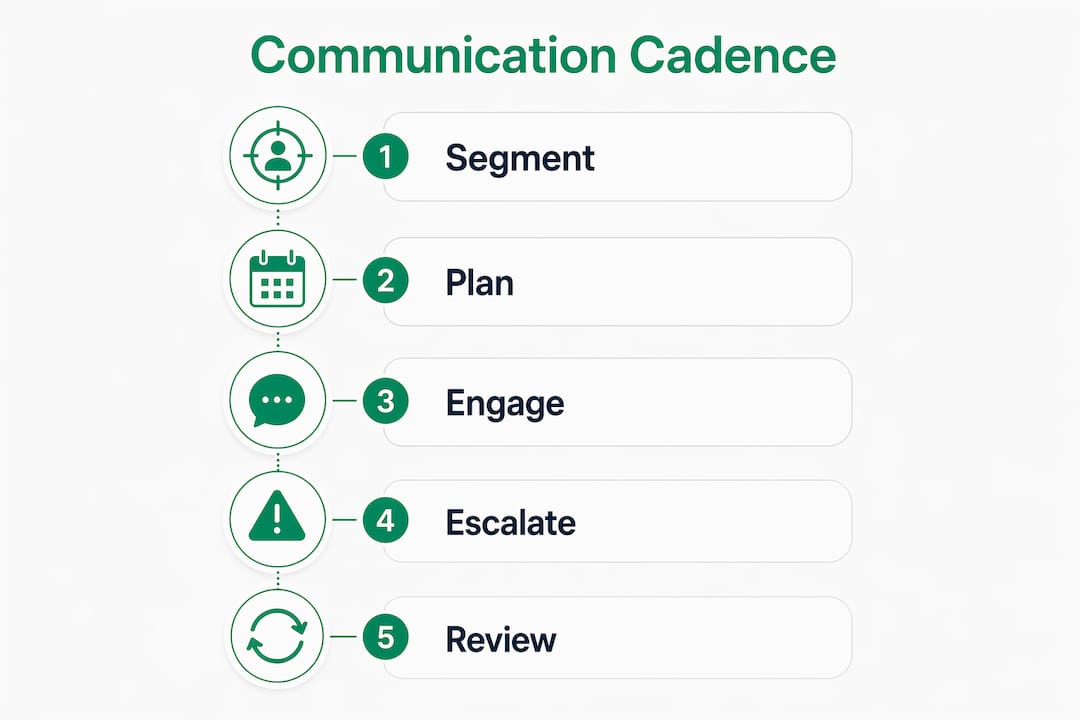
The power-interest grid, borrowed from project management, translates directly into digital asset stakeholder segmentation. It places stakeholders on a two-axis map and prescribes a communication approach for each quadrant. High-power, high-interest stakeholders get managed closely with tailored, frequent updates. Low-power, low-interest stakeholders receive periodic general updates. This prevents over-communicating to passive audiences and under-communicating to decision-makers.
Trigger-based escalation protocols sit alongside routine cadences as a separate communication layer. A formal escalation path defines which events trigger an immediate alert, who receives it, and who is responsible for drafting and approving the message. Without this, urgent events default to improvised responses that damage credibility. Crisis communication playbooks, pre-drafted templates, and dark sites, which are pre-built holding pages activated during a crisis, complete the escalation architecture.
On-chain analytics platforms and public dashboards serve as always-on transparency tools. They give retail holders and governance participants access to real-time data without requiring a new report for every query. Linking these dashboards from the central IR hub creates a single source of truth that all stakeholder segments can reference.
Institutional press placements in outlets like Bloomberg, the Wall Street Journal, and the Financial Times carry more weight with allocators than crypto-native media alone. Coordinating communication launches across issuers and infrastructure partners compounds reach and shapes allocator decisions at the moment they are forming. Finance professionals who treat digital asset disclosures as a compliance checkbox rather than a credibility signal miss this entirely.
For high-influence stakeholders in adjacent financial markets, the methodology used by institutional buyers in structured asset classes offers a useful reference point. Feedback-driven engagement, formal documentation, and tiered communication by influence level apply across asset classes, not just digital assets.
Key Takeaways
Effective digital asset stakeholder communication requires audience segmentation, defined cadences, formal escalation paths, and framework-aligned disclosures to build institutional trust and reduce volatility.
| Point | Details |
|---|---|
| Segment before you communicate | Use the power-interest grid to map stakeholders and assign a communication owner to each segment. |
| Cadence builds credibility | Monthly and quarterly updates published on a fixed schedule reduce speculation and maintain stakeholder confidence. |
| Escalation paths prevent crises | Trigger-based protocols with pre-drafted templates stop urgent events from becoming improvised communication failures. |
| Frameworks signal readiness | The Blockworks Token Transparency Framework provides a voluntary disclosure structure that institutional allocators recognize. |
| Feedback loops close the gap | Structured working sessions and documented follow-through on stakeholder input improve governance quality and long-term engagement. |
The part most teams get wrong from the start
The teams I see struggle most with digital asset stakeholder communication are not failing because they lack information. They are failing because they treat communication as a single function rather than three or four parallel programs running simultaneously. They write one update, send it everywhere, and wonder why institutional allocators stop responding and retail communities start speculating.
The clearest lesson I have taken from working with finance and compliance teams on this is that investor relations and marketing must be structurally separated. Marketing can share the same facts, but the format, tone, and channel must be completely different. An allocator reading a report that sounds like a press release immediately discounts the credibility of everything in it.
The second lesson is about escalation. Most teams have a routine communication plan and nothing else. When a material event hits, such as a large token unlock, a regulatory inquiry, or a governance dispute, they improvise. That improvisation is where reputations are lost. A pre-built escalation protocol with named owners and pre-drafted templates is not bureaucracy. It is the difference between a controlled response and a credibility crisis.
Building policy-press relationships proactively, before a regulatory event forces the conversation, is the third lever that most teams ignore until it is too late. Regulators and policy journalists form opinions about projects based on what they read before they ever engage directly. Shaping that narrative early is far easier than correcting it under pressure.
The role of C-suite executives in owning communication accountability is also consistently underestimated. When communication responsibility sits only with marketing or IR teams, escalation decisions get delayed because no one has the authority to act. Assigning executive ownership to the escalation layer solves this immediately.
— Gregg
Certification that supports communication and compliance readiness
Finance and compliance professionals who want to build communication infrastructure that meets institutional standards need more than a playbook. They need a structured framework that connects governance, disclosure, and operational controls into a single, creditable system.
Wush offers the DARE certification, the Digital Asset Readiness Evaluation, as an independent credential that covers exactly this ground. DARE addresses custody, regulatory compliance, risk management, and operational controls through modular assessments and annual renewal. For teams building or auditing their stakeholder communication architecture, DARE provides the governance structure that institutional allocators and regulators expect to see. It is the credential that turns a communication plan into a compliance-grade program.
FAQ
What is digital asset stakeholder communication?
Digital asset stakeholder communication is the structured process of delivering targeted, timely information to distinct groups, including institutional allocators, retail holders, and governance participants, to support decision-making, compliance, and investor confidence.
Why does stakeholder segmentation matter in digital assets?
Different stakeholders need different formats, channels, and content. Institutional allocators require formal disclosures, while retail holders need plain-language summaries. One-size-fits-all updates cause disengagement and can spread misinformation.
What is the Blockworks Token Transparency Framework?
The Blockworks Token Transparency Framework is a voluntary disclosure standard that organizes digital asset communications into four categories: supply schedule, allocation breakdown, protocol financial reporting, and market structure arrangements. Projects that adopt it signal institutional readiness to allocators.
How do escalation protocols improve communication?
Trigger-based escalation protocols define which events require immediate alerts, who receives them, and who approves the message. This prevents improvised responses during material events and protects project credibility under pressure.
How often should digital asset projects communicate with stakeholders?
Monthly treasury updates, quarterly financial reports, and event-driven alerts form the baseline cadence. Live formats like AMAs should occur at least quarterly to give stakeholders direct access to project leadership.