
Digital Asset Licensing Requirements Explained: 2026 Guide

If your firm custodies, exchanges, transmits, or issues stablecoins for U.S. residents, you almost certainly need one or more state authorizations, a FinCEN MSB registration, and possibly SEC or CFTC registration on top. There is no single federal “digital asset license.” Instead, multiple regulatory frameworks apply simultaneously depending on what you do and where your customers live.
The regulators that matter most right now:
- DFPI (California) under the Digital Financial Assets Law (DFAL), effective July 1, 2026
- IDFPR (Illinois) under the Digital Assets Consumer Protection Act (DACPA), with staged milestones through July 2027
- NYDFS (New York) under the BitLicense framework or limited-purpose trust charter
- OFI (Louisiana) under the Virtual Currency Businesses Act (VCBA)
- Texas Department of Banking for money-transmission requirements affecting digital-asset platforms
- FinCEN for federal MSB registration
- SEC and CFTC where tokens qualify as securities or derivatives
The most common license triggers are custody of customer assets, exchange or conversion services, money transmission, and stablecoin issuance. Your immediate action: map every product feature to these triggers, document which U.S. states your customers reside in, and launch a pre-filing gap assessment before July 1, 2026.
Deadline alert: California’s DFAL requires a license or a pending application by July 1, 2026 for any entity engaging in digital financial asset business activity with or on behalf of a California resident.
Table of Contents
- Which business activities actually trigger a license?
- State-by-state snapshot: where licensing risk concentrates
- What are the main licensing pathways, and how do they overlap?
- What ongoing obligations come with a digital-asset license?
- How do you determine which licenses you need? A practical roadmap
- How DARE helps compliance teams operationalize licensing requirements
- Enforcement risks and the compliance mistakes that trigger them
- Key Takeaways
- The compliance leader’s honest prioritization problem
- DARE: the operational readiness layer your licensing work needs
- Primary sources and regulator pages to consult next
Which business activities actually trigger a license?
The activity-first principle is the foundation of U.S. digital-asset licensing. One company can require multiple authorizations depending on its business model, so the right question is never “are we a crypto company?” but “what specific activities do we perform?”
| Activity | Definition | Likely Authorization |
|---|---|---|
| Custody | Holding or controlling customer digital assets | State custody license, trust charter, or BitLicense |
| Exchange / conversion | Buying, selling, or converting digital assets for customers | Money-transmitter license, BitLicense, or virtual-currency license |
| Money transmission | Receiving and transmitting value on behalf of customers | State money-transmitter license + FinCEN MSB registration |
| Brokerage | Arranging transactions between buyers and sellers | Broker-dealer registration (SEC) if securities involved |
| Stablecoin issuance | Issuing fiat-backed tokens to the public | State licensing + reserve/capital requirements |
| Kiosk operation | Operating physical digital-asset ATMs | DFAL license (CA); state money-transmitter license elsewhere |
| Token listing | Listing assets for trading on an exchange | DACPA pre-listing certification (IL); securities analysis required |
Edge cases worth flagging:
- DeFi protocols and DAOs generally fall outside current state licensing frameworks if they provide only software with no custody or transmission, but regulators are actively scrutinizing this.
- Node operators and miners who only contribute computing power or connectivity are typically exempt under statutes like California’s DFAL.
- Software-only providers that do not hold customer funds or control assets usually qualify for a processing/settlement exemption.
- Gaming tokens with no fiat on/off ramp and no secondary market tend to fall below licensing thresholds, but the analysis is fact-specific.
Common exemptions across most state statutes include federally insured banks, registered broker-dealers operating within their licensed scope, merchants accepting digital assets as payment for goods, and personal or household use.
Pro Tip: Ask three questions for each product feature: (1) Do we hold or control customer assets? (2) Do we receive and transmit value on behalf of a customer? (3) Does the token we list or issue look like a security or commodity? A “yes” to any one of these almost always triggers a licensing obligation.
State-by-state snapshot: where licensing risk concentrates

California: DFAL (effective July 1, 2026)
Regulator: California Department of Financial Protection and Innovation (DFPI) Statute: Financial Code Division 1.25, §§ 3101–3907
The DFAL covers any entity engaging in digital financial asset business activity with or on behalf of a California resident, regardless of where the entity is located. That extraterritorial reach makes California the highest-priority jurisdiction for most U.S. firms.
Capital requirement: DFPI has indicated an initial tangible net worth expectation as part of the DFAL license application, plus a surety bond or trust account to safeguard customer assets.
Kiosk operators face specific transaction caps per day per customer, plus mandatory pre-transaction disclosures and kiosk location registration with DFPI. Applications are expected to flow through NMLS, with fingerprinting and cybersecurity program documentation required.
Exemptions under DFAL include licensed trust companies, registered broker-dealers operating within their scope, merchants accepting digital assets as payment, and entities whose annual digital-asset activity with California residents falls below certain low thresholds.
Illinois: DACPA (staged milestones through 2027)
Regulator: Illinois Department of Financial and Professional Regulation (IDFPR) Statute: Illinois Public Act 104-0428
Illinois takes a phased approach. Custody and disclosure protections take effect January 1, 2027; full licensing requirements become effective July 1, 2027. IDFPR holds broad enforcement authority, including the power to impose fines.
The DACPA’s most distinctive feature is its pre-listing certification requirement. Exchanges must certify that they assessed whether an asset could be a security and must disclose conflicts of interest and detailed risk assessments before listing any asset for Illinois residents. That obligation applies now, ahead of full licensing.
New York: BitLicense and limited-purpose trust charter
Regulator: New York Department of Financial Services (NYDFS)
NYDFS offers two pathways: the BitLicense for virtual currency business activity, and a limited-purpose trust company charter. The charter is often the better fit for custody-focused firms because it conveys fiduciary powers and can subsume money-transmission obligations without a separate license. Bond minimums and capital requirements vary by business model and are set during the application review.
Louisiana: Virtual Currency Businesses Act (VCBA)
Regulator: Louisiana Office of Financial Institutions (OFI)
Louisiana’s VCBA requires licensure for virtual currency businesses operating in the state. Like California and Illinois, it emphasizes consumer disclosures, reserve rules for stablecoin issuers, and examination authority. Application materials are available through OFI directly.
Texas: HB 1666 and money-transmission requirements
Regulator: Texas Department of Banking
Texas HB 1666 clarified and updated the state’s money-transmission requirements as they apply to digital-asset platforms. Firms transmitting value in Texas using digital assets must hold a Texas money-transmitter license. The Texas Department of Banking has published guidance on which activities fall within the money-transmission definition.
Other states to watch
Wyoming, Colorado, and Florida have active rulemaking or existing virtual-currency frameworks. Nevada and Georgia apply money-transmission statutes to many digital-asset activities. Any firm with a national customer base should monitor NMLS for new state filings and subscribe to state banking department rulemaking alerts.
What are the main licensing pathways, and how do they overlap?
There is no single unified federal digital-asset license in the U.S. Firms typically need a combination of state and federal authorizations, and the right mix depends on the activity set and target markets.
Common pathways:
- State money-transmitter license (MTL): Required in most states for receiving and transmitting value. Applied through NMLS in most jurisdictions. Surety bond requirements vary by state.
- Virtual-currency / BitLicense-style license: New York’s BitLicense is the most established; California’s DFAL license is the 2026 equivalent for the West Coast. These cover custody, exchange, and transmission of digital assets.
- Limited-purpose trust charter: Available in New York and Wyoming. Provides fiduciary powers and can eliminate the need for a separate MTL. Better suited to custody-focused or institutional-grade businesses.
- FinCEN MSB registration: Federal baseline for any money services business. Required alongside state licenses, not instead of them. Triggers Bank Secrecy Act AML/KYC obligations.
- Broker-dealer registration (SEC): Required if the firm facilitates transactions in tokens that qualify as securities. Registered through FINRA and the SEC.
- Futures commission merchant or swap dealer (CFTC): Required for derivatives or leveraged trading products tied to digital assets.
Overlaps and exemptions worth knowing:
Federally insured banks can engage in certain digital-asset activities under OCC guidance without state MTLs. Registered broker-dealers are exempt from DFAL to the extent they operate within their licensed scope. A New York limited-purpose trust charter can subsume MTL obligations in New York, reducing the total license count for firms focused on that market. For firms with fiduciary responsibilities in custody arrangements, the trust charter pathway deserves serious analysis.
Typical application requirements across pathways:
- Surety bond or trust account (amount varies by state and volume)
- Minimum tangible net worth (DFPI: $100,000 initial; other states vary)
- AML/KYC program documentation
- Cybersecurity and incident-response policies
- Board-approved governance documents and organizational charts
- Background checks and fingerprinting for principals
Timeline and cost reality: State MTL applications typically take 3–12 months per state depending on completeness and regulator workload. BitLicense reviews have historically run 12–18 months. Budget application fees ranging from a few hundred to several thousand dollars per state, plus surety bond premiums, legal fees, and remediation costs that can reach six figures for a multi-state filing.
Pro Tip: Consider a phased licensing strategy. Secure the MTL in your highest-customer-concentration states first, then layer on virtual-currency-specific licenses and federal registrations. This gets you to market faster and lets you build operational evidence before the more demanding reviews.
What ongoing obligations come with a digital-asset license?

Licensing is not a one-time event. Regulators treat it as the start of a supervisory relationship, and examiners increasingly expect controls that are operationally applied, not just written down.
Recurring reporting and supervisory obligations:
- Periodic regulatory reports (financial condition, transaction volumes, incident disclosures)
- Annual audits by an independent auditor, with results submitted to the regulator
- Reserve and liquidity maintenance for stablecoin issuers and custodians
- Outage and material-incident reporting within regulator-specified timeframes
- Customer restitution procedures for losses attributable to platform failures
Compliance program controls:
- AML/KYC: customer due diligence, enhanced due diligence for high-risk accounts, suspicious activity reporting to FinCEN. A practical AML compliance workflow should be documented and tested at least annually.
- Transaction monitoring: automated screening against OFAC sanctions lists and behavioral anomaly detection
- Customer asset segregation: customer funds held separately from operating funds, with documented reconciliation
- Cybersecurity: incident-response plan, penetration testing, access controls, and vendor risk management
- Consumer disclosures: clear, accurate disclosures about fees, risks, and asset characteristics, updated when material changes occur
Examiners want to see board-level approval of key policies, evidence that controls are tested and exceptions are tracked, and a compliance calendar that assigns ownership to specific individuals. A policy that exists only as a PDF with no evidence of implementation is a red flag in every exam.
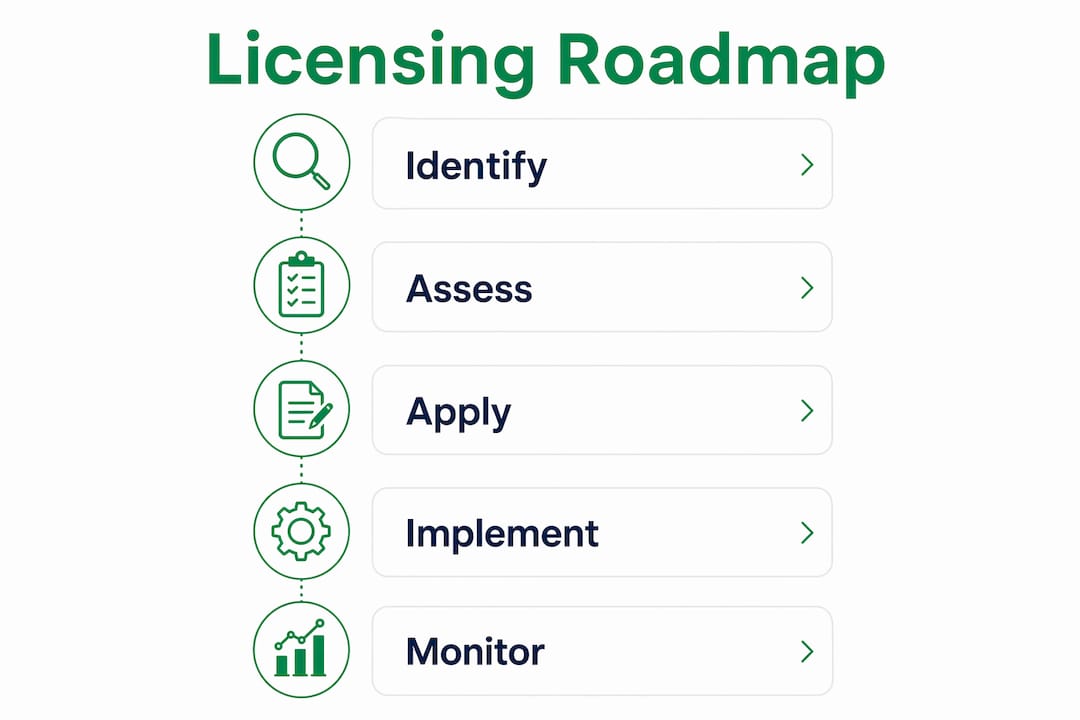
How do you determine which licenses you need? A practical roadmap
Treat this as an operational project with cross-functional ownership across product, engineering, compliance, legal, and finance from day one.
- Map every product activity to license triggers. List each feature (custody, exchange, transmission, stablecoin issuance, kiosk, token listing) and apply the activity-first framework above.
- Document customer-residence nexus. Pull data on where your customers reside. States where you have material customer concentration are your priority filing jurisdictions.
- Run a gap assessment. Compare your current controls (AML, cybersecurity, governance, capital) against the requirements of each target license. Identify what needs to be built or remediated before filing.
- Build or remediate controls in parallel with application prep. Do not wait for the application to be submitted before starting control buildout. Regulators like DFPI and NYDFS expect mature controls at the time of application review, not after approval.
- Engage regulators and counsel early. Request pre-filing meetings where available. Ask for the regulator’s application checklist. Read proposed rules and comment letters to understand examiner priorities.
- Submit applications through NMLS where applicable and maintain a tracking log of each state’s status, outstanding items, and renewal dates.
Interim mitigations while applications are pending:
- Geofence services away from states where you lack a license or pending application
- Limit product features to activities that fall within exemptions
- Use agent or partner models where a licensed entity can front the regulated activity
- Restrict stablecoin issuance to accredited or institutional counterparties
Evidence to prepare early:
- Board minutes approving AML, cybersecurity, and compliance policies
- SOC 2 Type II report or equivalent operational security evidence
- Network architecture diagrams and data-flow maps
- Capital and liquidity projections for the license period
- Organizational chart with named compliance and AML officers
Pro Tip: Read the DFPI’s application preparation guidance and NYDFS’s BitLicense application checklist before you start drafting. Both regulators publish detailed lists of required exhibits. Building your evidence package around those lists saves weeks of back-and-forth during review.
How DARE helps compliance teams operationalize licensing requirements
The Digital Asset Readiness Evaluation (DARE) from Wush is an independent certification framework built specifically for the governance gap that licensing work exposes. It is not a regulatory license and does not guarantee regulatory approval. What it does is give compliance teams a structured, externally validated way to assess and document their readiness across the exact control domains that state regulators examine.
Primary use cases for licensing teams:
- Pre-filing evidence packaging: DARE’s modular assessments map directly to the control categories regulators require (AML/KYC, custody controls, cybersecurity, governance, consumer protections). Completing the evaluation produces documented evidence you can include in application exhibits.
- Remediation prioritization: The assessment identifies gaps and ranks them by severity, so teams can sequence remediation work before the application window closes.
- External demonstration of readiness: A DARE credential signals to regulators, investors, and institutional partners that the organization has been independently assessed against a recognized governance framework.
DARE is designed for finance professionals, treasury teams, legal advisors, risk managers, and executives who need a credible, structured way to demonstrate that their digital-asset program meets governance standards. Annual renewal keeps the credential current as regulations evolve. For teams building out digital asset risk frameworks alongside their licensing work, DARE provides the structured scaffolding that internal assessments often lack.
Enforcement risks and the compliance mistakes that trigger them
Regulators are not waiting for firms to self-report problems. Enforcement patterns across DFPI, NYDFS, and FinCEN show consistent themes: unlicensed activity, weak AML programs, inadequate custody segregation, misleading disclosures, and kiosk operators ignoring transaction limits.
Common application and operational mistakes:
- Submitting applications with incomplete documentation or unsigned board resolutions
- Describing controls in policies that do not yet exist operationally
- Understating tangible net worth or failing to account for surety bond costs in capital projections
- Failing to analyze whether listed tokens could be securities before listing them for Illinois or New York residents
- Operating kiosks without registering locations or providing required pre-transaction disclosures
Red flags examiners look for:
- AML transaction monitoring that is configured but not actively reviewed or tuned
- Customer asset commingling with operating funds
- No documented incident-response plan or evidence of tabletop exercises
- Board minutes that reference compliance policies but show no substantive review or challenge
Consequences of getting it wrong:
Unlicensed activity can result in cease-and-desist orders, civil money penalties, and forced customer restitution. In the most serious cases, criminal referrals are possible. Business interruption while a firm remediates and reapplies is often the most damaging outcome, particularly for firms that have already onboarded customers. Understanding your regulatory exposure before you launch is far cheaper than managing an enforcement action after the fact.
Staged mitigation steps:
- Conduct a rapid pre-filing assessment to identify unlicensed activity exposure
- Implement geofencing for states where you lack a license or pending application
- Engage outside counsel with digital-asset licensing experience before submitting any application
- Document every compliance decision, including the legal analysis behind exemption claims
Key Takeaways
U.S. digital asset licensing requirements are activity-driven and state-specific: custody, exchange, transmission, and stablecoin issuance each trigger distinct authorization requirements across California, Illinois, New York, Louisiana, and Texas.
| Point | Details |
|---|---|
| Activity mapping is the foundation | Identify every licensable activity your firm performs before determining which states and licenses apply. |
| California’s July 1, 2026 deadline is immediate | Any entity serving California residents needs a DFAL license or pending application by that date. |
| Multiple authorizations are the norm | Most firms need a state MTL, FinCEN MSB registration, and possibly a virtual-currency or broker-dealer license simultaneously. |
| Controls must be operational, not just documented | Regulators examine evidence of working AML, cybersecurity, and asset-segregation controls, not just written policies. |
| DARE accelerates application readiness | Wush’s DARE certification structures the evidence and gap analysis compliance teams need to support licensing applications. |
The compliance leader’s honest prioritization problem
The conventional advice is to pursue every license you might need simultaneously. In practice, that approach burns out small compliance teams and produces mediocre applications across the board.
Start with customer concentration. If 60% of your users are in California and New York, those two jurisdictions are your entire first-year licensing program. Get those applications right, with mature controls and complete documentation, before you file in Illinois or Louisiana. A well-prepared application in two states beats a rushed filing in six.
The phased approach also gives you something regulators actually value: evidence that your controls work at scale in a live environment. By the time you file in your third or fourth state, you have exam-ready documentation, tested AML procedures, and board minutes that reflect genuine oversight rather than rubber-stamp approvals.
One thing most guides understate: the legal analysis behind exemption claims matters as much as the license applications themselves. If you believe a product feature falls under the broker-dealer carve-out or the merchant exemption, document that analysis in writing, have counsel review it, and keep it in your compliance file. Regulators do not always agree with your reading, and a documented good-faith analysis is your best defense if they push back.
Engage your primary regulator before you file. DFPI and NYDFS both accept pre-filing inquiries. Use them. The questions you ask in a pre-filing meeting shape the application you submit, and a well-framed pre-filing conversation can cut months off your review timeline.
DARE: the operational readiness layer your licensing work needs
Licensing applications demand evidence that most compliance teams have never had to produce in this form before: board-attested policies, documented control testing, cybersecurity architecture summaries, and AML program narratives that hold up under examiner scrutiny. That evidence gap is exactly what Wush’s DARE certification is built to close.
DARE is not a substitute for a license, and completing it does not guarantee regulatory approval. What it does is give your team a structured, independent assessment across the governance and control domains that regulators examine most closely, producing a prioritized remediation list and packaged evidence you can use directly in your application exhibits. For firms preparing for California’s July 1, 2026 DFAL deadline or Illinois’s 2027 milestones, that head start on evidence packaging is the difference between a complete application and a deficiency letter.
Start your DARE evaluation and get a clear picture of where your program stands before you file.
Primary sources and regulator pages to consult next
Bookmark these directly. They are the authoritative sources for application materials, statute text, and regulator guidance.
- DFPI DFAL FAQ and application preparation guide: dfpi.ca.gov/regulated-industries/digital-financial-assets — covers license triggers, exemptions, kiosk rules, capital requirements, and NMLS filing expectations
- DFPI application preparation page: DFAL Preparing for your Application — tangible net worth guidance, surety bond requirements, and required exhibits
- NYDFS virtual currency licensing: dfs.ny.gov/virtual_currency_businesses — BitLicense requirements, limited-purpose trust charter guidance, and application checklist
- Illinois DACPA statute text: Available through ILGA at ilga.gov — covers pre-listing certification, consumer protections, and IDFPR enforcement authority
- FinCEN MSB registration and BSA guidance: fincen.gov — federal baseline for AML/KYC obligations and MSB registration requirements
- SEC digital assets resources: sec.gov/digital-assets — securities analysis framework, no-action letters, and enforcement actions
- CFTC digital assets guidance: cftc.gov — derivatives and commodity treatment of digital assets, registration requirements for FCMs and swap dealers
- Texas Department of Banking: dob.texas.gov — HB 1666 guidance and money-transmission licensing for digital-asset platforms
- Louisiana OFI: ofi.la.gov — VCBA application materials and examination expectations
- EY digital asset regulatory overview: EY US digital asset licensing — practical framework for mapping activities to existing regulatory pathways
- Risk disclosure best practices: Trade Feed risk disclosure guidance — useful reference for structuring consumer-facing risk disclosures and user agreements