
Institutional Digital Asset Adoption: A 2026 Guide for Finance Pros

What institutional digital asset adoption actually means
Institutional digital asset adoption is the deliberate integration of blockchain-based assets and supporting infrastructure by traditional financial organizations, including asset managers, hedge funds, pension funds, and banks. It covers two distinct layers: portfolio exposure (buying Bitcoin, stablecoins, or tokenized securities) and operational infrastructure (custody solutions, compliance systems, and trading platforms built to institutional standards). Both layers matter. A pension fund that holds Bitcoin through a spot ETF without building the governance infrastructure around it has only done half the work.
The significance goes beyond any single institution’s balance sheet. When large, regulated players enter a market, they bring liquidity, price discovery, and legitimacy that retail participation alone cannot provide. Spot bitcoin ETFs represent one of the clearest examples: their approval and rapid uptake signaled to regulators, auditors, and corporate boards that digital assets had crossed a threshold from speculative curiosity to allocatable asset class.
Key product categories driving this shift include:
- Bitcoin as a macro hedge and store-of-value allocation
- Stablecoins for settlement efficiency and treasury management
- Tokenized assets, including tokenized Treasuries and private fund shares, enabling on-chain automation and liquidity in previously illiquid markets
- Security tokens and NFTs representing ownership rights in real-world assets
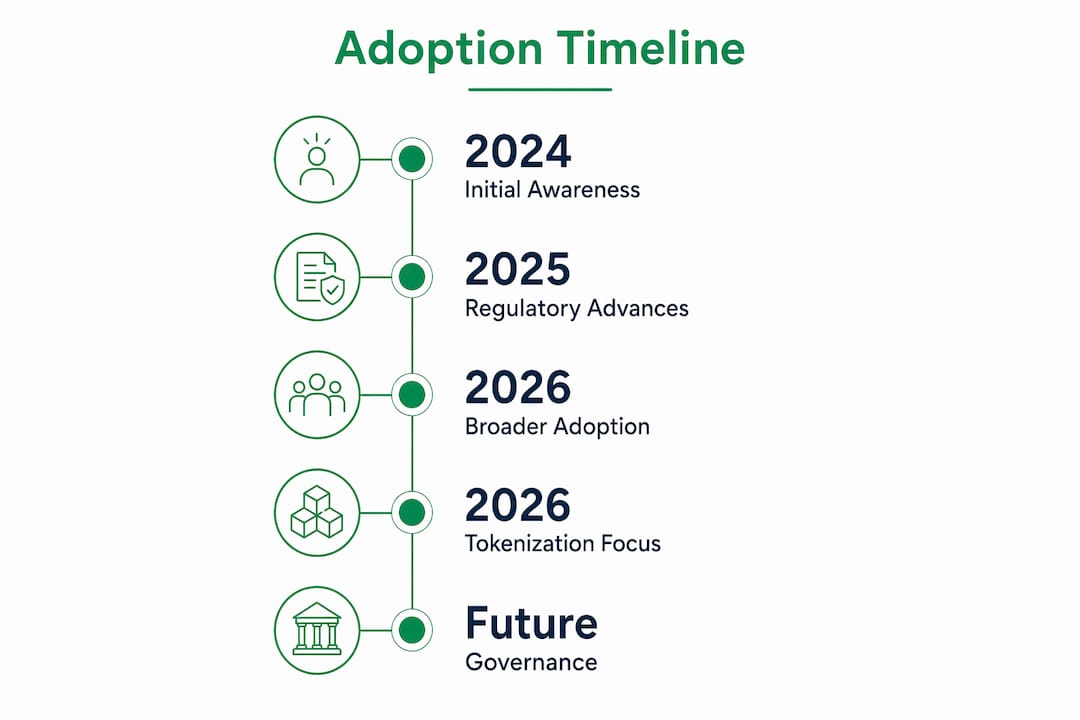
Regulatory milestones have accelerated the timeline considerably. The U.S. GENIUS Act, signed into law in 2025, established a federal framework for payment stablecoins, giving institutions a compliance pathway that simply did not exist two years prior. Custody technology has matured in parallel, with qualified custodians now offering segregated cold storage, multi-signature controls, and insurance coverage that meet fiduciary standards.
What drives institutions toward digital assets?
The motivations are concrete and, for most institutions, financially grounded rather than ideological. Understanding them helps you evaluate whether a given allocation fits your mandate or your clients’ objectives.
- Portfolio diversification. Digital assets, particularly Bitcoin, have historically shown low correlation to traditional equities during certain market regimes, offering a genuine diversification benefit when sized appropriately within a broader portfolio.
- Asymmetric return potential. The risk-return profile of early-stage digital assets differs from mature asset classes. Institutions with longer time horizons and higher risk budgets have used small allocations to capture outsized upside.
- Inflation hedging. Bitcoin’s fixed supply of 21 million coins makes it structurally different from fiat currencies. Institutions facing inflationary pressure on fixed-income portfolios have increasingly treated Bitcoin as a partial hedge, similar in logic to gold but with different liquidity characteristics.
- Regulatory clarity. Approved products like spot Bitcoin ETFs, combined with clearer stablecoin legislation, have removed the compliance ambiguity that kept many institutions on the sidelines. Compliance officers now have documented frameworks to work within.
- Technology maturity. Institutional-grade custody platforms, prime brokerage services for digital assets, and real-time settlement infrastructure have closed the operational gap between digital and traditional markets.
- Client demand. Wealth management clients, endowments, and family offices have pushed their advisors to provide digital asset exposure. Institutions that ignore this pressure risk losing assets under management to competitors who don’t.
What barriers still slow institutional adoption?
The obstacles are real, and underestimating them is where institutions get into trouble. The core barriers fall into three broad categories: regulatory, operational, and risk-related.
- Regulatory uncertainty. Even with progress on stablecoins and ETFs, the treatment of digital assets under securities law, tax code, and accounting standards (particularly SAB 121’s impact on bank custody) remains contested. Institutions operating across multiple jurisdictions face compounding complexity.
- Custody selection. Choosing a qualified custodian is harder than it sounds. Not all custodians offer the same segregation standards, insurance coverage, or regulatory standing. A misstep here carries fiduciary liability, and the custody infrastructure required for institutional-grade security is genuinely different from retail solutions.
- Legacy system integration. Most institutional back-office systems were not built to handle 24/7 settlement, on-chain transaction records, or the reconciliation requirements of tokenized assets. Connecting digital asset workflows to existing portfolio management, accounting, and reporting systems creates friction that slows adoption timelines.
- Volatile allocation management. Digital assets can move 20%+ in a week. Without formal position sizing protocols and rebalancing triggers, a small allocation can drift into a material portfolio risk within months.
- Fragmented data and siloed workflows. Front-office trading desks and back-office operations teams often work from different data sources when managing digital assets. That fragmentation creates reconciliation errors, compliance gaps, and reporting delays that would be unacceptable in traditional asset management.
How is the institutional landscape evolving through 2026?
The trajectory is clearly toward broader, deeper adoption, though the pace varies by institution type and jurisdiction.
Spot bitcoin ETF assets have grown rapidly, compressing the timeline for what many analysts expected to take a decade into a significantly shorter period. That velocity has pulled in a second wave of institutions: insurance companies, sovereign wealth funds, and corporate treasuries that were waiting for proof of product-market fit before committing.

Tokenization is the next frontier getting serious institutional attention. Tokenized U.S. Treasuries, money market funds, and private credit instruments are already live on public and permissioned blockchains. The appeal is operational: on-chain automation reduces fund administration costs, enables fractional ownership, and creates secondary liquidity in markets that have historically been illiquid. Tokenization also demands new treasury and operational competencies that most institutions are still building.
DeFi protocols are attracting institutional interest more cautiously. The yield opportunities are real, but the smart contract risk, lack of counterparty identity, and regulatory ambiguity around DeFi participation keep most compliance teams from approving direct engagement. Permissioned DeFi environments, where participants are KYC-verified, are emerging as a middle path.
Looking ahead, the institutions that will lead are those treating digital assets as part of an integrated financial ecosystem rather than a separate trading book. That means shared data infrastructure, unified risk reporting, and governance frameworks that cover digital and traditional assets under the same oversight structure.
Why governance and certification matter more than most institutions realize
Governance is where most institutional digital asset programs fail quietly. The trading infrastructure gets built, the custody provider gets selected, and then the compliance team discovers that nobody documented the approval workflow for on-chain transactions, or that the risk committee has no framework for reviewing smart contract exposure. Structured governance is not optional at institutional scale.
The DARE certification from Wush addresses this gap directly. It offers modular learning and assessments covering custody governance, legal compliance, operational risk controls, and regulatory adherence, with annual renewal to keep pace with a fast-moving regulatory environment. For finance professionals and risk managers who need to demonstrate competency to boards, auditors, or regulators, a credential backed by structured assessment carries weight that self-study cannot replicate.
Key governance areas the certification framework covers:
- Custody controls: segregation standards, key management protocols, and custodian due diligence
- Legal and compliance: jurisdiction-specific regulatory requirements, AML/KYC obligations, and reporting frameworks
- Operational risk: workflow documentation, incident response, and system integration controls
- Risk management: position limits, rebalancing protocols, and liquidity stress testing
The EY institutional digital assets survey found that heightened volatility is pushing institutions to formalize risk protocols, including position sizing, liquidity forecasts, and leverage risk management. Certification frameworks give teams a structured path to meet that standard rather than building from scratch.
Pro Tip: When presenting a digital asset program to your board or investment committee, a recognized governance certification signals that your team has been assessed against an independent standard, not just internal policy. That distinction can accelerate approval timelines considerably.
How leading institutions have approached adoption in practice
The most instructive examples are not the ones that moved fastest, but the ones that moved deliberately.
JPMorgan Chase has pursued digital assets across multiple fronts simultaneously. The bank built its own blockchain infrastructure through Onyx, issued JPM Coin for institutional settlement, and is now exploring crypto-backed loans that would allow clients to borrow against cryptocurrency holdings. That progression, from internal infrastructure to client-facing products, reflects a pattern other large banks are following.

Franklin Templeton has gone further into public blockchain infrastructure than most traditional asset managers. The firm tokenized a money market fund on a public blockchain and developed a Four P’s evaluation framework, assessing digital assets across People, Potential, Protocol, and Price, to distinguish long-term value from speculative momentum. That kind of structured evaluation methodology is exactly what institutional investment committees need before approving new asset class exposure.
The broader pattern across successful adopters is consistent: start with regulated securities like ETFs to satisfy compliance requirements, then build toward direct custody and more complex products as operational infrastructure matures. Institutions that tried to skip the regulated-product phase and go straight to direct token custody generally encountered more friction with their compliance and legal teams, slowing overall timelines.
What regulatory frameworks apply to institutional digital asset investors?
The U.S. regulatory picture has clarified substantially since 2024, though it remains a patchwork rather than a unified framework.
The GENIUS Act, signed in July 2025, created the first federal licensing regime for payment stablecoin issuers, requiring reserves, redemption rights, and AML compliance. For institutions using stablecoins in settlement or treasury operations, this legislation provides the legal certainty that was previously absent.
The FIT21 Act (Financial Innovation and Technology for the 21st Century Act) passed the House and addresses the longstanding question of whether digital assets are securities or commodities, allocating jurisdiction between the SEC and CFTC based on the decentralization of the underlying network. Institutions holding or trading tokens need to track this legislation closely, as it directly affects reporting obligations and eligible counterparties. Thomson Reuters has published detailed analysis of the jurisdictional implications.
Outside the U.S., the Monetary Authority of Singapore has clarified its regulatory regime for digital token service providers, and the Hong Kong Monetary Authority continues to develop its virtual asset framework, making both jurisdictions active regulatory laboratories that U.S. institutions with international operations need to monitor.
For compliance teams, the practical requirements include:
- AML/KYC screening for counterparties and wallet addresses, using blockchain analytics tools
- Travel Rule compliance for transfers above threshold amounts, now enforced in multiple jurisdictions
- Custody segregation standards aligned with qualified custodian requirements under the Investment Advisers Act
- Tax reporting under IRS Notice 2014-21 and subsequent guidance, including cost-basis tracking for every on-chain transaction
- Audit trail documentation sufficient to satisfy both internal audit and external regulatory examination
The IMF’s work on cyber resilience for digital currency ecosystems is also shaping how regulators think about operational risk standards for institutions holding or transacting in digital assets. Institutions that build their compliance programs around these emerging standards, rather than waiting for final rules, will be better positioned when enforcement priorities shift.
Key Takeaways
Institutional digital asset adoption requires both portfolio exposure and governance infrastructure, and institutions that build only one without the other face material compliance and operational risk.
| Point | Details |
|---|---|
| Adoption covers two layers | Portfolio exposure (ETFs, direct custody) and operational infrastructure (custody, compliance, risk systems) must develop together. |
| Spot Bitcoin ETFs have enabled more than $200 billion in institutional assets, according to recent industry analyses, catalyzing broader adoption by insurance companies, sovereign wealth funds, and corporate treasuries. | |
| Regulatory clarity is accelerating | The GENIUS Act and FIT21 give U.S. institutions compliance pathways for stablecoins and token classification that did not exist before 2025. |
| Governance gaps are the hidden risk | Fragmented workflows, undocumented approval processes, and siloed data create compliance exposure that trading infrastructure alone cannot fix. |
| Certification builds board-level credibility | Structured frameworks like DARE provide assessed, renewable credentials that satisfy auditors and investment committees beyond internal policy. |