
Why Enterprises Need Digital Asset Frameworks in 2026

Digital asset frameworks are the governance and compliance systems enterprises must implement to manage digital assets securely, legally, and at scale. Without them, treasury teams operate on improvised infrastructure that cannot survive regulatory scrutiny or multi-jurisdictional complexity. 73% of firms cite regulation as their top concern when adopting digital assets. That figure signals a governance gap, not a technology gap. Regulations like the EU’s Markets in Crypto-Assets Regulation (MiCA) and the U.S. GENIUS Act have created a clearer baseline, but enterprises that lack structured frameworks still face serious legal and operational exposure.
Why enterprises need digital asset frameworks: the core case
Digital asset frameworks are not optional infrastructure for large organizations. They are the difference between a treasury operation that scales and one that collapses under its own complexity. Fragmented or improvised infrastructure for multi-jurisdictional, large-scale digital asset treasuries is unsustainable. That means enterprises holding nine-figure digital asset portfolios across multiple wallets and jurisdictions cannot rely on spreadsheets, ad hoc approvals, or siloed custody arrangements.
The industry term for what enterprises are building is a digital asset governance framework, sometimes called a digital asset management framework in operational contexts. Both refer to the same thing: a structured system that governs how digital assets are held, moved, approved, and reported. The SEO phrase “digital asset frameworks” captures the concept well, but compliance professionals should recognize that the formal discipline sits within enterprise risk management and treasury governance.

Regulatory clarity is arriving faster than most legal teams anticipated. The SEC and CFTC now coordinate on a shared taxonomy for crypto assets, clarifying how securities law applies to different token types. That clarity reduces ambiguity, but it does not eliminate legal risk. Enterprises still need internal controls that map to these evolving standards.
What are digital asset frameworks and their core components?
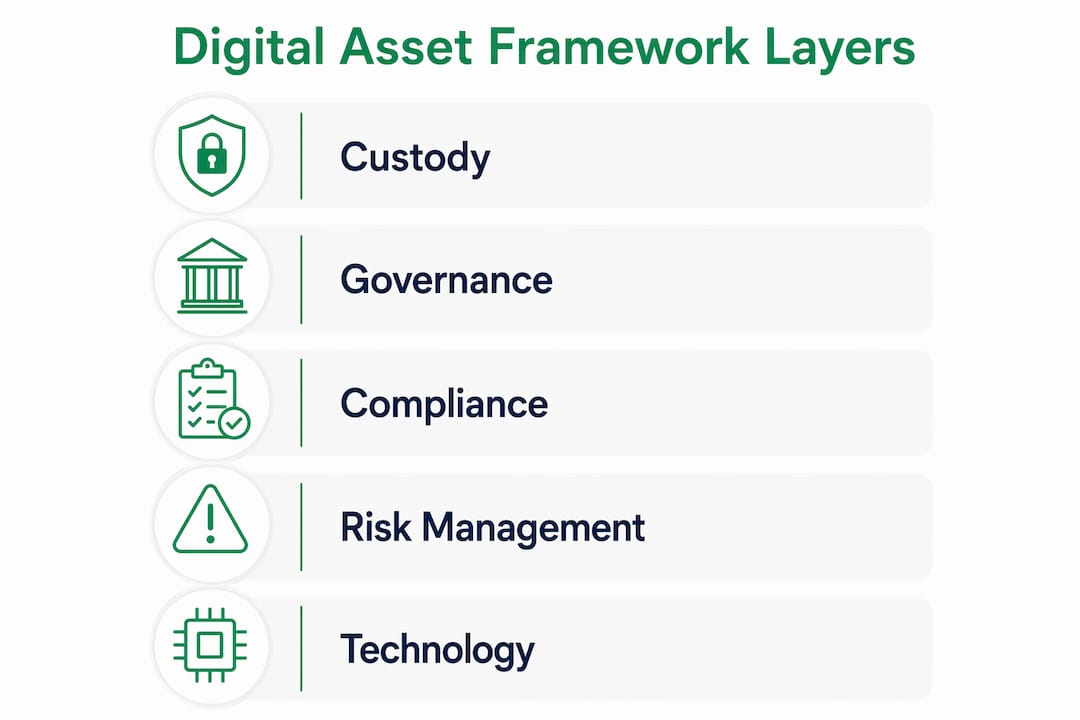
A well-built digital asset framework operates across four layers, each dependent on the one beneath it. Skipping a layer creates the kind of operational failure that gets misattributed to market volatility or technology limitations.
-
Custody. This is the foundation. Effective custody uses distributed key management through MPC-CMP (Multi-Party Computation with Continuous Message Passing) and secure hardware enclaves, eliminating single points of failure. A single compromised key should never be able to move funds.
-
Governance. Governance encodes policy directly into the transaction infrastructure. Programmable policy engines enforce transaction limits, counterparty whitelists, and compliance screening automatically. This is a critical distinction: governance encoded in systems is far harder to bypass than governance written in documents.
-
Liquidity. Once custody and governance are stable, enterprises can manage liquidity across wallets and counterparties without manual bottlenecks. Orchestrating liquidity through structured systems reduces the approval delays that slow treasury operations.
-
Yield. Responsible yield management sits on top of the first three layers. Enterprises that chase yield before establishing custody and governance create compounding risk. Sequencing these layers correctly is the single most important architectural decision a treasury team makes.
Pro Tip: Map your current digital asset operations against these four layers before purchasing any new technology. Most enterprises discover their governance layer is the weakest link, not their custody solution.
The benefits of digital asset frameworks become visible at each layer. Custody reduces theft and loss. Governance reduces unauthorized transactions. Liquidity management reduces operational friction. Yield management reduces reputational risk from speculative exposure.
How do digital asset frameworks support regulatory compliance and risk mitigation?
Regulatory compliance is the most urgent reason enterprises build digital asset frameworks. The global regulatory environment is not uniform, and enterprises operating across borders face a patchwork of requirements that no single legal team can track manually.
Key compliance functions that frameworks must support include:
- KYC and AML controls. Know Your Customer and Anti-Money Laundering requirements apply to digital asset transactions in most major jurisdictions. Frameworks automate screening against sanctions lists and flag suspicious activity.
- MiCA alignment. The EU’s MiCA regulation sets disclosure, reserve, and governance requirements for crypto asset service providers. Enterprises with European operations must map their internal controls to MiCA’s standards.
- GENIUS Act readiness. The U.S. GENIUS Act establishes a federal framework for payment stablecoins. Treasury teams holding or transacting in stablecoins need policies that address reserve requirements and issuer due diligence.
- SEC and CFTC guidance. The 2026 interpretive guidance from the SEC, coordinated with the CFTC, provides a clearer taxonomy for token classification. Enterprises must apply this taxonomy to their existing holdings.
- Audit trail requirements. Regulators expect complete, tamper-evident records of every transaction. Programmable governance systems generate these trails automatically.
Harmonizing with MiCA and other global regulations lowers the probability of cross-jurisdictional enforcement surprises. That is not a minor benefit. Enforcement actions in the digital asset space carry reputational consequences that far exceed the direct financial penalties.
Legal frameworks are powerful compliance tools, but they require supplementation with ongoing due diligence and cross-functional coordination. A policy document without a programmable enforcement layer is not a framework. It is a liability.
The risks of non-use may outweigh the costs of framework implementation. KPMG’s analysis of enterprise digital asset governance makes this point directly: legal teams that wait for perfect regulatory clarity before acting expose their organizations to sudden enforcement and market shifts that a proactive framework would have absorbed.
For a deeper look at how internal controls translate into legal protection, the Wush guide on legal risk management for digital assets covers the compliance architecture in detail.
What operational challenges do enterprises face without structured frameworks?
Operational failure in digital asset management rarely announces itself. It accumulates quietly through fragmented systems, manual workarounds, and governance gaps that no one owns.
The most common operational challenges enterprises face without structured frameworks include:
- Key loss and insider risk. Without distributed key management, a single employee departure or device failure can make funds permanently inaccessible. Insider risk is equally serious when approval workflows are informal.
- Transaction delays. Manual approval processes create bottlenecks that slow treasury operations. A transaction requiring three approvals across two time zones can take days without a programmatic workflow.
- Jurisdictional blind spots. Enterprises managing assets across multiple countries face different tax, reporting, and custody requirements. Without a framework, compliance with one jurisdiction often creates violations in another.
- Audit failures. Regulators and auditors expect structured records. Enterprises that reconstruct transaction histories from emails and spreadsheets fail audits and invite deeper scrutiny.
Operational friction in digital asset management originates in fragmented infrastructure, not in market conditions or technology limitations. This is a critical insight for enterprise leaders who have blamed poor performance on external factors. The problem is almost always internal governance architecture.
Pro Tip: Before attributing treasury underperformance to market conditions, audit your approval workflows. Bottlenecks in transaction authorization are the most common and most fixable source of operational drag.
Wush’s guide on access control practices provides a practical framework for authorization protocols that eliminate these bottlenecks without sacrificing security. For enterprises concerned about continuity, business continuity planning for digital assets addresses how to maintain operations when key personnel or systems fail.
How should enterprise leaders implement a digital asset governance framework?
Implementation requires cross-functional coordination from the first day. A framework built by the IT team alone will fail compliance requirements. A framework built by legal alone will fail operational requirements.
-
Form a Digital Asset Task Force. Integrated task forces must include legal, compliance, IT, treasury, and risk professionals collaborating regularly. This group owns framework design, policy development, and regulatory monitoring.
-
Draft comprehensive policies. Policies must cover custody arrangements, transaction approval thresholds, counterparty due diligence, and incident response. Generic policies copied from other industries will not survive regulatory review.
-
Educate the board. Board oversight requires regular briefings on regulatory developments, risk exposure, and strategy alignment. Directors who cannot articulate the enterprise’s digital asset risk posture are a governance liability.
-
Pilot with compliance guardrails. Launch digital asset programs at limited scale with full governance controls active from day one. Pilots that bypass controls to move faster create technical debt that is expensive to unwind.
-
Engage regulators and industry groups. Proactive engagement with regulators signals good faith and provides early warning of enforcement priorities. Industry groups like the Digital Chamber and the Global Digital Finance organization publish guidance that supplements formal regulation.
The comparison between enterprises that implement frameworks early and those that delay is instructive. Early adopters build institutional knowledge, establish regulator relationships, and develop audit-ready records before enforcement pressure arrives. Late adopters scramble to retrofit governance onto live operations, which is significantly more expensive and disruptive.
For enterprises assessing their current control maturity, the Wush benefits of risk frameworks guide outlines how structured frameworks translate into measurable compliance outcomes. Monitoring tools that support ongoing compliance tracking, such as those available through Evibe’s security infrastructure, can supplement internal controls with external oversight capabilities.
Key Takeaways
Enterprises that build digital asset governance frameworks before regulatory pressure arrives gain a durable competitive and compliance advantage over those that wait.
| Point | Details |
|---|---|
| Frameworks are foundational, not optional | Improvised infrastructure cannot support nine-figure digital asset treasuries across multiple jurisdictions. |
| Sequence the four layers correctly | Build custody, then governance, then liquidity, then yield. Skipping layers causes compounding failure. |
| Encode governance in systems | Programmable policy engines enforce controls automatically and generate audit trails that manual processes cannot match. |
| Cross-functional teams drive success | Legal, compliance, IT, treasury, and risk professionals must collaborate from day one, not after a crisis. |
| Proactive adoption reduces enforcement risk | Enterprises that wait for perfect regulatory clarity face higher enforcement exposure than those that build frameworks now. |
The governance gap no one talks about
Most enterprise digital asset discussions focus on custody technology or token selection. The real risk sits one layer up: governance. I have seen organizations with excellent custody solutions and no enforceable approval policies. The private keys were safe. The decision-making process was not.
The enterprises that get this right treat governance as a technical problem, not a policy problem. They encode approval workflows, counterparty limits, and compliance checks directly into their transaction infrastructure. A document that says “three approvals required” is not governance. A system that makes a transaction technically impossible without three approvals is governance.
The other pattern I consistently observe is the cost of delay. Legal teams that wait for MiCA, the GENIUS Act, or SEC guidance to “settle down” before building frameworks are making a strategic error. Regulations will always be evolving. The enterprises that build adaptable frameworks now will absorb new requirements as updates. The enterprises that wait will face them as crises.
The most effective digital asset strategy for enterprises integrates legal, technical, and compliance functions from the start. Siloed implementations always produce the same result: a technically sound custody solution sitting on top of a governance vacuum.
— Gregg
How Wush’s DARE certification supports enterprise framework readiness
Enterprise leaders who recognize the governance gap often face the same question: how do we know if our framework is actually sufficient? Internal assessments are valuable, but they cannot provide the independent benchmark that regulators and stakeholders expect.
Wush’s Digital Asset Readiness Evaluation (DARE) addresses this directly. DARE is an independent certification program that assesses enterprise control maturity across custody, governance, compliance, and risk management. It gives treasury teams, legal advisors, and compliance professionals a structured benchmark against current regulatory standards. The certification supports cross-functional governance cohesion and provides a credential that demonstrates readiness to auditors, regulators, and board members. Annual renewal keeps the certification current as regulations evolve.
FAQ
What is a digital asset framework?
A digital asset framework is a structured governance system that covers how an enterprise holds, moves, approves, and reports on digital assets. It typically operates across four layers: custody, governance, liquidity, and yield.
Why do enterprises need digital asset legal frameworks specifically?
73% of firms cite regulation as their top concern in digital asset adoption. Legal frameworks map internal controls to requirements like MiCA, the GENIUS Act, and SEC guidance, reducing enforcement exposure across jurisdictions.
What happens without a structured digital asset framework?
Enterprises without structured frameworks face key loss, transaction bottlenecks, audit failures, and jurisdictional compliance gaps. Operational friction almost always originates in governance architecture, not market conditions.
How does a Digital Asset Task Force support governance?
A cross-functional task force integrating legal, compliance, IT, treasury, and risk professionals enables ongoing policy development, regulatory monitoring, and incident response. It is the organizational structure that keeps a framework current and enforceable.
What is the DARE certification from Wush?
DARE is the Digital Asset Readiness Evaluation, an independent certification from Wush that benchmarks enterprise control maturity across custody, governance, compliance, and risk management. It provides an externally verifiable credential for stakeholders and regulators.