
Digital Asset Custody: What Institutional Investors Must Know

Digital asset custody is defined as the secure storage and management of cryptographic private keys that grant access to blockchain-based assets, not the holding of the assets themselves. That distinction matters enormously for institutional investors. Whoever controls the private keys controls the assets. The custody models available today range from self-custody, where the owner retains 100% control, to hybrid arrangements, to fully managed third-party custody using hardware security modules. Regulatory bodies including the Financial Stability Board and frameworks like NIST Cybersecurity Framework 2.0 now shape how institutions approach these decisions.
What is digital asset custody, and why does it differ from traditional asset holding?
Digital asset custody centers on private key management, not asset storage. A private key is a cryptographic string that authorizes transactions on a blockchain. Lose the key, and the assets become permanently inaccessible. Compromise the key, and the assets can be stolen without recourse.
This is fundamentally different from traditional securities custody, where a custodian holds legal title or a registered interest on behalf of a client under well-established statutory frameworks. Digital asset custody relies on private contract law with limited statutory precedent, which raises insolvency risks and requires extra safeguards. Institutions cannot assume the legal protections they rely on in equities or fixed income will transfer to this asset class.

The phrase “not your keys, not your coins” captures a real operational truth. True custody requires bailment legal agreements that establish the client’s beneficial ownership, not just a login to a platform. Without that legal structure, clients may have no protected claim if a provider fails.
What are the primary models of digital asset custody?
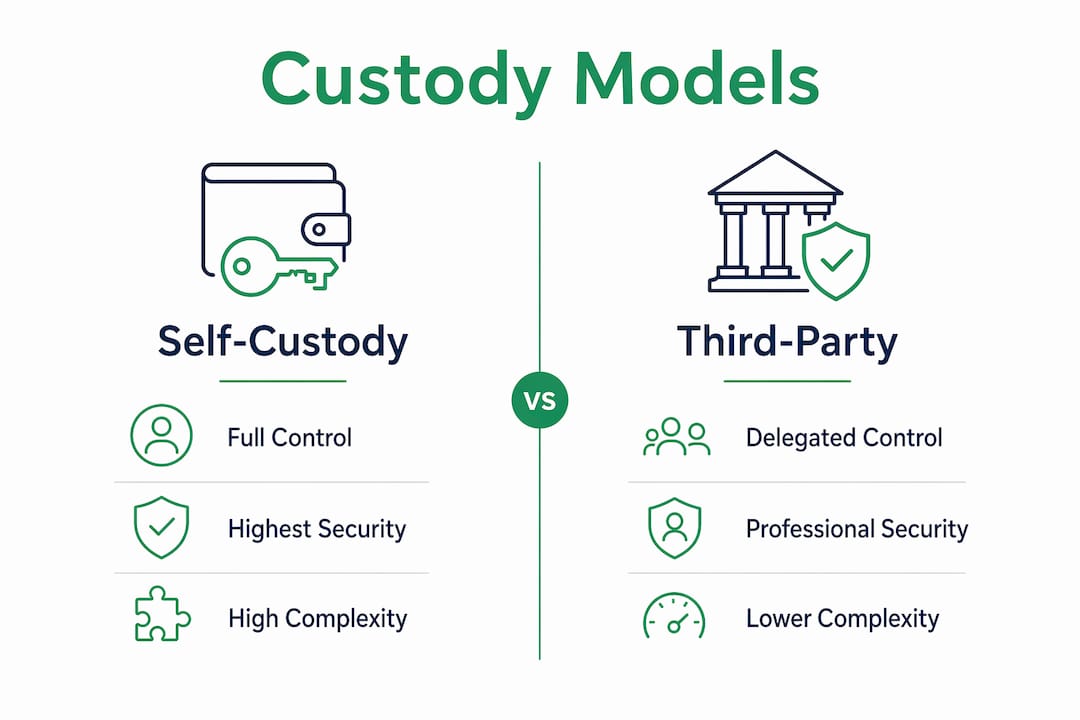
Three custody models define the field, each with distinct trade-offs in control, security, and operational complexity.
Self-custody places full responsibility on the asset owner. The institution generates and stores its own private keys, typically using hardware wallets or air-gapped systems. Control is absolute, but so is the operational burden. A single procedural failure, such as a lost key or a compromised signing device, can result in permanent loss with no third-party recourse.
Hybrid custody distributes key control across multiple parties using multi-signature or multi-party computation (MPC) technology. No single party holds a complete key. This model reduces concentration risk while preserving meaningful owner involvement in transaction approvals. Many institutional treasury teams favor this approach because it balances control with operational resilience.
Third-party custody delegates key management to a professional custodian. These providers use hardware security modules (HSMs), conduct regular audits, and maintain formal recovery procedures. The trade-off is reduced direct control and dependence on the custodian’s governance quality.
| Custody model | Owner control | Security approach | Operational complexity |
|---|---|---|---|
| Self-custody | Full | Owner-managed hardware | High |
| Hybrid | Shared | MPC or multi-signature | Medium |
| Third-party | Delegated | HSMs, audits, formal recovery | Low for owner |
Pro Tip: Custody is not equivalent to wallet access. A shared admin console or a hot wallet without independent approval paths and formal recovery procedures does not meet the standard of true custody, regardless of what a provider’s marketing materials claim.
Which governance controls are essential for secure custody?
Governance failures, not technology failures, cause most custody losses. 77% of security incidents causing tangible damage result from failure to separate key ownership from transaction authority. That single finding should reframe how institutions think about custody risk.
Effective governance requires several specific controls:
- Separation of duties: The person who holds signing authority must not be the same person who initiates or approves transactions. This mirrors the dual-control principles used in traditional banking.
- Multi-signature and MPC protocols: Require multiple independent approvals before any asset movement. This prevents unilateral action by any single operator, employee, or team.
- Key ceremony protocols: Formal, documented procedures for generating, distributing, and storing key material. These ceremonies should be witnessed, recorded, and audited.
- Recovery procedures: Every custody arrangement needs a tested, documented process for recovering access if a key holder is unavailable. Untested recovery plans are not recovery plans.
- Least-privilege access: NIST Cybersecurity Framework 2.0 recommends controlling approval paths and minimizing trust in signing workflows. No employee or system should have more access than their specific role requires.
Pro Tip: Overprivileged access is the most common governance failure Wush sees in institutional custody reviews. Audit every role that touches key material and ask whether that level of access is genuinely necessary.
Operational resilience also demands regular audits of custody controls, not just at onboarding but on a recurring schedule. Custody arrangements that pass an initial review can degrade over time as personnel change and systems evolve.
How do regulatory frameworks shape institutional custody practices?
Regulatory expectations for digital asset custody are tightening globally, and institutions that treat compliance as optional will face increasing exposure. The Financial Stability Board emphasizes bankruptcy-remote arrangements that protect institutional client assets from a custodian’s insolvency estate. That requirement alone changes how custody agreements must be structured.
Country-specific mandates add further complexity. Türkiye, for example, requires custodians to hold 90% of client assets in cold wallet storage to reduce cyber risk. That rule reflects a broader regulatory trend: prescriptive operational requirements, not just principles-based guidance.
Institutions must address several regulatory dimensions:
- Bankruptcy-remote structures: Client assets must be legally segregated from the custodian’s own assets. Commingling creates insolvency risk that regulators in multiple jurisdictions now explicitly prohibit.
- Exclusive control thresholds: Banks must demonstrate that no single employee has unilateral access to private keys. This is a specific regulatory compliance threshold, not a general best practice.
- Bank Secrecy Act integration: Involvement of Bank Secrecy Act officers is recommended to assess illicit financing risks within custody operations.
- AML and KYC requirements: Custody operations must integrate with AML compliance frameworks to satisfy anti-money laundering obligations across all relevant jurisdictions.
- Audit and reporting obligations: Regulators expect documented evidence of controls, not just assertions. Custody arrangements need audit trails that can withstand regulatory scrutiny.
Fiduciary responsibility in digital asset custody is still being defined by courts and regulators, which means institutions cannot rely on precedent. They must build that clarity into their contracts and operational frameworks now.
What are the key risks and legal challenges in digital asset custody?
The legal framework for digital asset custody remains immature compared to securities law. Institutions must compensate for that legal uncertainty with technological and operational rigor. That is not a temporary gap. It reflects the structural difference between an asset class built on code and one built on centuries of property law.
The most significant risks include:
- Concentration of control: When one person or system can unilaterally move assets, the entire custody arrangement depends on that single point. Operational failures, insider threats, and external attacks all exploit this vulnerability.
- Inadequate custody agreements: Generic Terms of Service are legally insufficient as custody agreements. A valid digital asset custodial agreement must explicitly appoint the provider as custodian, define fiduciary duties, specify asset recovery procedures, and limit liability for cyber incidents. ToS language that does not include operative custodian appointment language leaves clients without legal protection.
- Unclear asset ownership: If a custodian becomes insolvent, clients with poorly drafted agreements may find their assets treated as general creditor claims rather than segregated client property.
- Weak recovery processes: Recovery procedures that exist on paper but have never been tested create false confidence. Institutions should conduct annual recovery drills and document the results.
The secure payment infrastructure that connects custody to broader financial operations also introduces risk at integration points. Every API connection, every third-party system with access to custody data, is a potential attack surface that governance frameworks must address.
Board-level oversight of custody arrangements is no longer optional. Boards that cannot demonstrate active governance of digital asset custody risk will face regulatory and fiduciary scrutiny.
Key Takeaways
Effective digital asset custody requires private key governance, legal clarity, and regulatory alignment, not just secure technology.
| Point | Details |
|---|---|
| Custody means key control | Whoever holds the private keys controls the assets; custody is about key management, not asset storage. |
| Governance failures dominate losses | 77% of damaging security incidents trace back to failure to separate key ownership from transaction authority. |
| Legal agreements are non-negotiable | Generic Terms of Service do not constitute a custody agreement; explicit custodian appointment language is required. |
| Regulatory requirements are prescriptive | FSB bankruptcy-remote rules and country mandates like Türkiye’s 90% cold storage rule set specific operational floors. |
| Recovery must be tested | Documented recovery procedures that have never been rehearsed provide no real protection against key loss or compromise. |
The governance gap institutions keep underestimating
Most institutional custody failures I have seen do not start with a technology breach. They start with a governance assumption. A treasury team assumes their third-party provider handles compliance. A legal team assumes the platform’s Terms of Service constitute a binding custody agreement. An IT team assumes that multi-signature means multi-party governance. None of those assumptions hold up under scrutiny.
The uncomfortable truth is that digital asset custody sits at the intersection of cryptography, contract law, and operational risk management, and most institutions are only fluent in one of those three. Technology teams understand the cryptography but not the legal exposure. Legal teams draft agreements without understanding the operational controls that give those agreements meaning. Risk teams assess the technology but miss the governance gaps that create real liability.
What I find most striking is how often institutions treat custody as a vendor selection problem. They evaluate providers, check a compliance box, and move on. The real work is internal: defining your governance model, stress-testing your recovery procedures, and ensuring your custody agreements actually say what you think they say.
Regulatory evolution will not wait for institutions to catch up. The FSB framework, NIST Cybersecurity Framework 2.0, and country-specific mandates are already setting floors that will only rise. Institutions that build genuine custody governance now will have a structural advantage over those that treat it as a compliance checkbox.
— Gregg
How Wush supports institutional custody readiness
Custody governance is complex, but assessing your institution’s readiness does not have to be.
Wush offers the Digital Asset Readiness Evaluation (DARE), a structured certification program built specifically for finance professionals, treasury teams, and risk managers navigating digital asset custody and compliance. DARE covers custody models, governance controls, regulatory alignment, and legal frameworks through modular assessments and annual renewal cycles. Institutions that complete the DARE certification receive blockchain-verified credentials that demonstrate operational and compliance readiness to regulators, boards, and counterparties. If your institution is building or reviewing its custody framework, DARE’s compliance readiness program provides the structured foundation to do it right.
FAQ
What is digital asset custody in simple terms?
Digital asset custody is the secure management of private cryptographic keys that control access to blockchain-based assets. The custodian does not hold the assets; they control the keys that authorize transactions.
Why does digital asset custody need legal review?
Digital asset custody relies on private contract law rather than established statutory frameworks, which means custody agreements must explicitly define fiduciary duties, asset segregation, and recovery procedures to protect clients legally.
What is a digital asset custodial agreement?
A digital asset custodial agreement is a formal contract that appoints a provider as custodian, establishes the client’s beneficial ownership, defines liability for cyber incidents, and specifies asset recovery procedures. Generic Terms of Service do not satisfy this requirement.
How does asset custody work for institutional investors?
Institutional investors choose a custody model, either self-custody, hybrid, or third-party, and implement governance controls including multi-signature approvals, separation of duties, and formal key ceremony protocols to protect assets and meet regulatory requirements.
What are the biggest risks in digital asset custody?
The primary risks are concentration of control, inadequate custody agreements, unclear asset ownership in insolvency scenarios, and untested recovery procedures. Governance failures cause the majority of significant custody losses, not technology failures.