
Digital Asset Balance Sheet Examples for Finance Teams

Under ASU 2023-08, in-scope crypto assets sit on the balance sheet as a separate fair-value line item, with every remeasurement gain or loss flowing directly to net income. That single structural fact reshapes how treasury teams build reports, how auditors test valuations, and how disclosure notes are drafted.
Key points to know include: digital assets are presented as separate line items disaggregated by significant holdings; disclosures generally include units held, cost basis, fair value, and rollforward activity; and operationally, treasury teams maintain detailed records and price sources to support financial statements.
The governing standards are ASC 350-60 and Topic 820. Every filing, policy memo, and disclosure note for digital assets should cite both.
Key Takeaways
Under ASU 2023-08, in-scope crypto assets must be carried at fair value on a separate balance-sheet line, with remeasurement gains and losses flowing to net income each period and supported by lot-level cost records, an independent price source, and a rollforward disclosure.
| Point | Details |
|---|---|
| Separate fair-value line item | In-scope digital assets appear as a discrete balance-sheet line, distinct from other intangible assets, measured at fair value under ASC 350-60 and Topic 820. |
| Rollforward disclosure required | Each period requires a five-line rollforward: beginning balance, additions, disposals, remeasurement, and ending balance, with units and dollar amounts by significant asset. |
| Lot-level cost tracking is non-negotiable | FIFO or specific identification must be applied consistently; retrofitting lot assignments at disposal is the most common audit remediation failure. |
| Cumulative-effect adjustment at adoption | Teams adopting ASU 2023-08 record a direct retained-earnings adjustment for the fair-value step-up at transition — it does not run through the income statement. |
| Wush DARE certification | The DARE program from Wush provides governance modules, disclosure templates, and verifiable credentials to support audit-ready digital asset reporting. |
Table of Contents
- Which digital assets are in-scope vs. out of scope for ASU 2023-08?
- How are in-scope digital assets measured and presented under US GAAP?
- What do concrete balance-sheet extracts and rollforward tables look like?
- Worked journal-entry examples and how they map to financial statements
- What disclosures does US GAAP now require for digital assets?
- What operational controls does treasury need to support accurate reporting?
- What do SEC filings and Big Four guidance show about real-world adoption?
- The mistake most teams make — and one thing to fix this quarter
- DARE certification supports your digital asset governance and reporting
- Useful primary sources and guidance
- Sources
Which digital assets are in-scope vs. out of scope for ASU 2023-08?
Not every token triggers the fair-value regime. ASU 2023-08, codified in ASC 350-60, applies only when an asset meets all four scoping criteria simultaneously:
- The unit of account is the token itself (not a contract referencing it).
- The holder has no enforceable right to receive goods, services, or cash from the issuer.
- The asset is fungible — one unit is interchangeable with another of the same type.
- The asset is not a financial asset under other GAAP topics (no debt, equity, or derivative classification).
Bitcoin and Ether are the clearest in-scope examples. Both are fungible, carry no redemption rights, and are not classified as securities under current U.S. regulatory treatment. Most proof-of-work and proof-of-stake layer-1 tokens with no issuer redemption feature will land here.
Borderline cases require more work. Stablecoins backed by fiat reserves often carry an enforceable redemption right, which pushes them toward financial-asset treatment outside ASC 350-60. Tokenized securities — a tokenized Treasury bill, for instance — are financial assets by definition and stay under ASC 320 or ASC 321. Utility tokens that grant access to a specific platform service may fail the “no enforceable claim” test depending on the terms.
Deloitte’s classification guidance makes the point plainly: whether a token is a security, utility, or commodity determines the applicable accounting model and can change whether it falls in-scope for ASC 350-60 entirely. That classification analysis should be documented before the first reporting date, not after. For novel tokens, involve internal legal counsel and external advisors early. The PwC crypto-assets accounting guide reinforces this: tokens with redemption rights or enforceable claims frequently qualify as financial assets, not crypto intangibles, and the scoping memo needs to reflect that distinction explicitly.
How are in-scope digital assets measured and presented under US GAAP?
Fair value measurement and the income-statement impact
ASU 2023-08 requires subsequent measurement at fair value for every in-scope crypto asset, with remeasurement changes recorded in net income each period. There is no option to carry these assets at cost or under the prior impairment-only model once the standard is adopted. The ASC 350-60 guidance and Topic 820 together govern both the measurement mechanics and the disclosure requirements.
Under the fair-value hierarchy, most liquid crypto assets (BTC, ETH traded on active exchanges) qualify as Level 1 — quoted prices in active markets for identical assets. That is the cleanest valuation scenario. Less liquid tokens, or positions subject to sale restrictions, may fall to Level 2 or Level 3, which demands more documentation: observable inputs, comparable transactions, or internal models. The level assigned affects both the valuation memo and the disclosure note, since Topic 820 requires entities to disclose the level used and, for Level 3, the significant unobservable inputs.
Fair-value reporting also increases income-statement volatility. Finance teams must update forecasting models and earnings communication to incorporate unrealized gains and losses on in-scope holdings. Fair-value reporting also increases income-statement volatility, so finance teams must update forecasting and earnings communication playbooks to incorporate unrealized gains and losses for in-scope holdings.
Balance-sheet and income-statement presentation
- Balance sheet: Present digital assets as a separate line item, distinct from goodwill, patents, and other intangible assets. For significant individual holdings, disaggregate in the notes (e.g., Bitcoin, Ether, Other).
- Current vs. noncurrent: Apply ASC Topic 210. Assets expected to be converted to cash within 12 months are current; strategic treasury reserves held longer are noncurrent. Many companies split the presentation based on stated treasury policy.
- Income statement: Remeasurement gains and losses appear as a separate line, typically labeled “Remeasurement gain (loss) on digital assets” or similar, within operating or other income depending on the entity’s policy and the nature of the holding.
For teams building their first digital asset accounting standards policy, the presentation choices made here will cascade into every disclosure note and internal report.
What do concrete balance-sheet extracts and rollforward tables look like?
Sample balance-sheet extract
The following illustrates how a corporate balance sheet presents digital assets as a discrete line item, with supporting detail in the notes.
Partial Balance Sheet — Digital Assets (as of December 31, 20XX)
The “Cost Basis” column reflects the acquisition price by lot (FIFO or specific identification, stated in the policy note). “Fair Value” uses the Level 1 quoted price at the reporting date close. The unrealized gain/loss column is informational in the notes; the balance-sheet carrying amount is fair value, not cost.
Rollforward table
SEC filings commonly present a rollforward covering the full reporting period. This structure matches what auditors expect and what ASC 350-60 requires.
Digital Assets Rollforward — Year Ended December 31, 20XX
Column notes:
- Units column: Sourced from custody reports and exchange statements reconciled to the general ledger each period.
- Additions: Include purchases, mining rewards, and staking rewards. Initial recognition for staking rewards uses fair value at receipt; a mismatch between that initial value and the period-end fair value produces an immediate unrealized gain or loss.
- Disposals: Reflect derecognition at the lot-level cost basis (FIFO in this example), with the difference between proceeds and cost basis recognized as a realized gain or loss.
- Remeasurement: The period-end fair value adjustment, flowing to the income statement under ASC 350-60.
- Sale restrictions: If any holdings are subject to lock-up or transfer restrictions, disclose that fact and note whether it affects the Level 1 classification.
The AICPA practice aid recommends rollforward reconciliations as a core audit procedure, and auditors will tie every line back to custody statements and the general ledger.
Worked journal-entry examples and how they map to financial statements
The four entries below cover the lifecycle of a typical digital asset position. Each maps to a specific balance-sheet or income-statement caption.
-
Purchase (initial recognition)
Dr. Digital assets (Balance Sheet — Current/Noncurrent Asset): $500,000 Cr. Cash and cash equivalents: $500,000
The asset is recognized at cost, which equals fair value at acquisition. No gain or loss at inception.
-
Period-end remeasurement — fair value increase
Dr. Digital assets: $75,000 Cr. Remeasurement gain on digital assets (Income Statement — Other Income): $75,000
The carrying amount on the balance sheet increases to current fair value. The gain flows to net income immediately; there is no option to defer it to OCI.
-
Period-end remeasurement — fair value decrease
Dr. Remeasurement loss on digital assets (Income Statement — Other Expense): $30,000 Cr. Digital assets: $30,000
Symmetric treatment. The balance-sheet carrying amount drops; the loss hits net income in the current period.
-
Sale / derecognition (FIFO cost basis)
Assume 10 BTC sold for $650,000. FIFO cost basis for those 10 BTC is $450,000. The carrying amount on the balance sheet at the time of sale (after remeasurement) is $600,000.
Dr. Cash: $650,000 Cr. Digital assets (carrying amount): $600,000 Cr. Gain on sale of digital assets (Income Statement): $50,000
The $50,000 gain is the difference between proceeds and the remeasured carrying amount. The FIFO cost basis of $450,000 is relevant for tax purposes and for the cost-basis disclosure in the notes, but the accounting gain is measured against the fair-value carrying amount. EY’s technical guidance highlights that lot-level cost tracking is necessary for both the disclosure and the tax calculation, even when the GAAP gain is computed against carrying value.
What disclosures does US GAAP now require for digital assets?
Required and common disclosure checklist
- Presentation line item label and balance-sheet classification (current vs. noncurrent) with the reasoning.
- Cost basis by asset type (FIFO, specific identification, or average cost — state the method).
- Fair value by asset type as of the reporting date, with the Level 1/2/3 hierarchy level.
- Number of units held by significant asset.
- Rollforward for the period (beginning balance, additions, disposals, remeasurement, ending balance).
- Valuation method and price source (e.g., principal market, specific exchange, pricing service).
- Sale restrictions or transfer limitations affecting any holding.
- Remeasurement gains and losses for the period, presented separately on the income statement.
- Qualitative risk disclosures: custody arrangements, counterparty risk, regulatory risk, and hedging strategies if applicable.
- For lending or staking arrangements that transfer control: derecognition rationale and recognition of a crypto asset loan receivable, including credit-loss considerations.
Annual disclosures are more granular than interim. For interim periods, ASC 270 allows condensed presentation, but the rollforward and fair-value table are still expected for material holdings. When a single asset (BTC, for example) represents more than a threshold the entity deems significant, by-asset disaggregation is required rather than aggregated totals.
Annotated sample disclosure paragraph
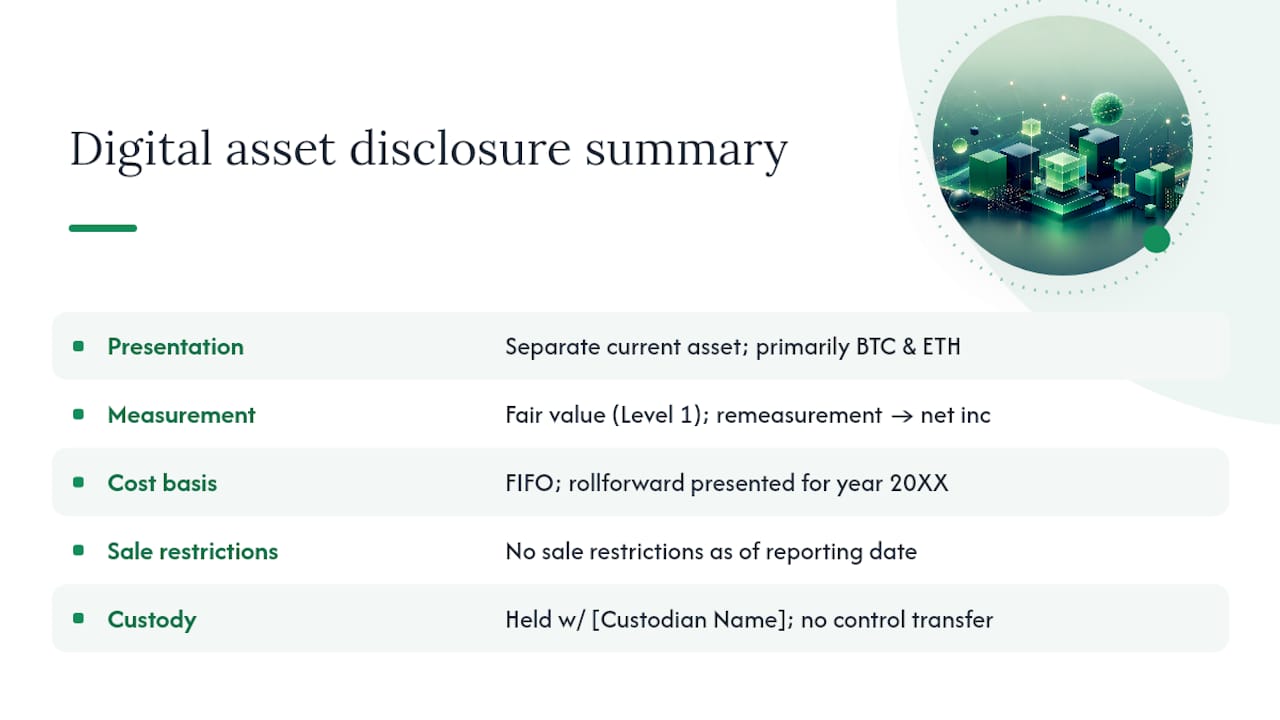
Note X — Digital Assets. [Presentation and classification] The Company holds digital assets consisting primarily of Bitcoin and Ether, presented as a separate current asset on the consolidated balance sheet. [Measurement] Digital assets are measured at fair value using Level 1 inputs (quoted prices on active exchanges) in accordance with ASC 350-60 and ASC 820. [Rollforward reference] A rollforward of digital asset activity for the year ended December 31, 20XX is presented in the table above. [Cost basis] Cost basis is determined using the first-in, first-out (FIFO) method. [Remeasurement] Remeasurement gains and losses are recognized in net income and presented as “Remeasurement gain (loss) on digital assets” in the consolidated statements of operations. [Sale restrictions] No holdings are subject to sale restrictions as of the reporting date. [Custody] Digital assets are held in custody with [Custodian Name], a qualified custodian, under a custody agreement that does not transfer control of the assets to the custodian.
Each bracketed label corresponds to a required disclosure element from the checklist above. Finance teams can adapt this paragraph directly, substituting their own custodian, cost-basis method, and hierarchy level. For strategic risk disclosures that go beyond the accounting note, boards increasingly expect a separate qualitative section covering regulatory and market risk.
What operational controls does treasury need to support accurate reporting?
Getting the balance-sheet number right is one problem. Keeping it auditable is another.
Control checklist
- Custody reconciliation cadence: Reconcile custody statements to the general ledger at least monthly, and at every reporting date. Discrepancies between the custodian’s unit count and the ledger are a material weakness waiting to happen.
- Source of truth for units and cost basis: Designate a single system of record. Custody reports, exchange statements, and internal ledgers must all tie to the same lot-level register.
- Segregation of duties: The person who initiates a transfer should not be the same person who records it in the ledger or reconciles the custody statement.
- Independent price vendor: Use a recognized pricing service (not just the exchange where you trade) as the primary fair-value source, with a documented fallback procedure if the primary source is unavailable.
- Record retention: Retain wallet addresses, transaction hashes, exchange statements, and custody confirmations for at least the period required by your document retention policy, and longer if under audit.
Common pitfalls
- Cost-basis-by-lot complexity: Teams that aggregate purchases rather than tracking individual lots cannot support FIFO or specific identification on disposal. The AICPA practice aid and EY’s technical guidance both flag this as the most common operational failure.
- Failure to derecognize lent or staked assets: When a lending or staking arrangement transfers control, the asset must be derecognized and a receivable recognized. Leaving the original asset on the balance sheet while also recording a receivable double-counts the exposure.
- Timing mismatches: Custody statements often settle on a different calendar than the general ledger close. A position purchased on December 30 may not appear in the custody report until January 2. Document the cutoff policy explicitly.
- Weak audit trails for noncash receipts: Staking rewards and airdrops received as noncash income need a documented fair-value determination at receipt date. Without a timestamped price record, the initial recognition figure is unsupportable.
For a full digital asset audit trail checklist, treasury and accounting teams should document every step from wallet creation to general-ledger posting.
Pro Tip: Automate lot-level cost tracking at the point of acquisition, not at disposal. Retrofitting lot assignments after the fact — especially across multiple exchanges and custodians — is the single most time-consuming audit remediation task finance teams face. A dedicated crypto sub-ledger or a specialized accounting tool that ingests custody feeds and assigns lot IDs on receipt eliminates most of that pain before it starts.

What do SEC filings and Big Four guidance show about real-world adoption?
Anonymized sample table from SEC filings (ASU 2023-08 adoption)
Early adopters of ASU 2023-08 disclosed a cumulative-effect adjustment at adoption, increasing the carrying amount of digital assets from historical cost to fair value with an offsetting adjustment to retained earnings (or accumulated deficit). SEC filing disclosures show this pattern consistently across registrants that adopted before the mandatory effective date.
Illustrative Adoption Adjustment (based on SEC filing patterns)
The retained earnings adjustment is the net of the fair-value step-up across all holdings at the adoption date. It does not run through the income statement; it is a direct equity adjustment at transition.
Common presentation choices in 2024–2026 filings
- Disaggregation by significant holding: Most registrants with material BTC or ETH positions present those separately, with “other digital assets” aggregated in a residual line.
- Cost-basis method language: FIFO is the most common method cited, though some registrants use specific identification for large, individually tracked lots. Average cost is rare in public filings.
- Mining and staking rewards: Companies that earn rewards through mining or staking typically recognize them at fair value at receipt and include them in the “Additions” line of the rollforward, with a separate footnote explaining the recognition policy.
- Transition language: Filings from early adopters consistently include a sentence stating the adoption date, the method (modified retrospective), and the cumulative adjustment amount.
The trend through 2024–2026 filings shows increasing standardization of rollforward table formats, with most registrants converging on the five-line structure (beginning balance, additions, disposals, remeasurement, ending balance) that ASC 350-60 effectively prescribes. Sample fund financial statements from investment entities show additional line items — digital assets borrowed, receivables from exchanges — that operating companies typically do not need but that treasury teams at financial firms should review.
For teams managing cross-jurisdictional holdings, the regulatory classification analysis in other markets can affect how assets are classified for local reporting, even when the US GAAP treatment is clear.
The mistake most teams make — and one thing to fix this quarter
The most common failure pattern is not a measurement error. It is a documentation gap. Teams that adopted ASU 2023-08 on schedule but skipped the lot-level cost register, the custody reconciliation policy, and the written valuation source hierarchy are carrying fair-value numbers on the balance sheet that they cannot fully defend under audit. The balance-sheet line looks right; the supporting workpapers do not.
The second most common failure is the remeasurement presentation. Finance teams sometimes net remeasurement gains and losses against other income or bury them in a catch-all “other” line. ASC 350-60 requires separate presentation. Auditors and SEC reviewers will flag it.
The single action worth prioritizing this quarter: run a scoped ASU 2023-08 readiness exercise on one reporting date and one asset class. Pull the custody statement, reconcile it to the general ledger, document the price source, and draft the rollforward table. That dry run will surface every gap — missing lot records, undefined cutoff policy, undocumented valuation fallback — before they become audit findings. Fiduciary responsibility for digital asset holdings starts with being able to prove, not just assert, that the balance-sheet number is right.
DARE certification supports your digital asset governance and reporting
Finance and treasury teams that have worked through the sections above often arrive at the same realization: the accounting standards are clear, but the operational infrastructure to support them — lot-level tracking, custody reconciliation, disclosure templates, control documentation — takes time to build without a structured framework.

The DARE certification from Wush is built for exactly this gap. The Digital Asset Readiness Evaluation covers governance modules across custody, regulatory compliance, risk management, legal classification, and operational controls — the same dimensions that drive audit readiness for digital asset balance-sheet reporting. Assessments are modular, credentials are blockchain-verified, and annual renewal keeps teams current as standards evolve. Finance professionals who complete DARE leave with documented control frameworks, disclosure templates, and the credential to demonstrate governance maturity to auditors and boards. Start your DARE assessment at Dare.
Useful primary sources and guidance
The sources below are the authoritative starting points for drafting policy, disclosure notes, and audit workpapers on digital asset balance-sheet reporting.
- FASB ASU 2023-08 / ASC 350-60: The primary standard. Read this first for scoping criteria, measurement requirements, and the full disclosure checklist.
- ASC Topic 820 (Fair Value Measurement): Governs how fair value is determined, the Level 1/2/3 hierarchy, and the disclosure requirements for valuation inputs.
- PwC Crypto-Assets Accounting Guide: Comprehensive practitioner guide covering scoping, measurement, presentation, and worked examples; updated regularly.
- Deloitte: Accounting for Crypto and Digital Assets: Strong on classification analysis and the interaction between token type and applicable accounting model.
- EY Technical Line: Accounting for Digital Assets (2025): Detailed on lot-level cost tracking, FIFO vs. specific identification, and operational controls.
- SEC Filing Example — ASU 2023-08 Adoption Disclosure: A real-world registrant filing showing cumulative-effect adjustment, rollforward tables, and cost-basis disclosure language.
- SEC Filing Exhibit — Rollforward Tables: Three-month rollforward format showing additions, disposals, and fair-value changes by asset type.
- Why digital asset disclosures matter for compliance: DARE blog overview of disclosure risk and regulatory expectations for US registrants.
This article is general information, not a substitute for advice from a qualified financial advisor. Consult a qualified financial professional about your own circumstances before acting on anything here.
Sources
- PwC crypto-assets accounting guide
- ASC FASB: Subtopic 350-60 / ASU excerpts
- EY technical line: Accounting for digital assets (2025)
- Deloitte: Accounting for crypto and digital assets
- SEC filing example with ASU 2023-08 adoption disclosure