
Digital Asset Reconciliation Process Explained for Finance Teams

Digital asset reconciliation is defined as the continuous process of verifying that on-chain blockchain transaction data aligns precisely with internal accounting ledger entries across every wallet, exchange, and custodian your organization uses. Unlike traditional bank reconciliation, this process runs in near real time and spans multiple blockchains simultaneously. The stakes are high: inaccurate reconciliation creates tax miscalculations, audit failures, and distorted financial statements. Finance teams that treat this as a month-end task rather than a continuous operational control face compounding discrepancies that become exponentially harder to unwind. This guide covers the digital asset reconciliation process explained in full, from core definitions to compliance requirements and technology integration.
What distinguishes digital asset reconciliation from traditional reconciliation?
Traditional bank reconciliation works with structured, periodic statements. Your bank delivers a clean file on a predictable schedule, and your team matches it against the general ledger. Digital asset reconciliation operates in a fundamentally different environment.
Blockchain data arrives continuously, not periodically. Unlike traditional T+1 to T+3 cycles, digital asset reconciliation requires near real-time data ingestion to prevent discrepancy compounding. A single day’s delay in processing can cascade into hundreds of unmatched entries by the end of the week.

The settlement patterns are also structurally different. A DeFi swap does not produce one ledger entry. It generates multiple simultaneous entries: the outgoing asset, the incoming asset, gas fees, protocol fees, and sometimes liquidity pool tokens. Each leg requires its own matching rule. Traditional reconciliation software has no framework for this.
| Dimension | Traditional reconciliation | Digital asset reconciliation |
|---|---|---|
| Data source | Bank statements (structured) | Blockchain nodes, APIs, custodians (unstructured) |
| Timing | Periodic (daily, monthly) | Continuous, near real-time |
| Settlement pattern | 1-to-1 matching | 1-to-many (DeFi, staking, swaps) |
| Currency complexity | Single or dual currency | Multi-asset, multi-chain |
| Audit trail | Bank-generated records | Self-documented evidence chain |
Pro Tip: Map every asset type your organization holds to its settlement pattern before building matching rules. Staking rewards, wrapped tokens, and bridged assets each behave differently and require distinct reconciliation logic.
What are the core steps in a modern digital asset reconciliation process?
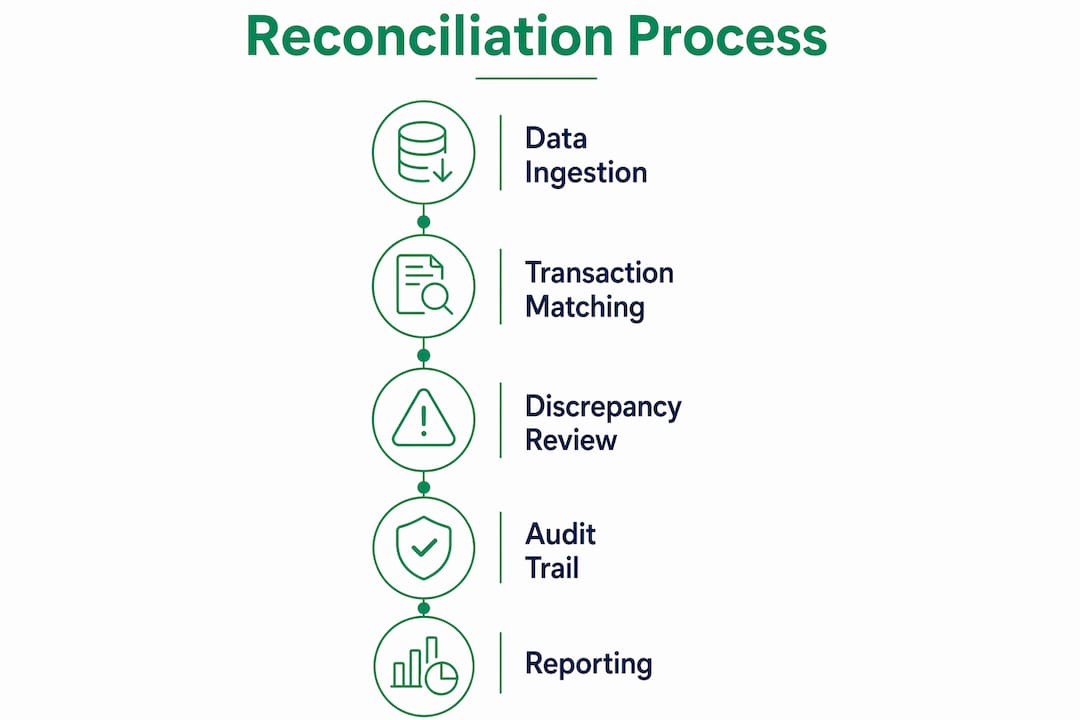
Effective reconciliation follows a five-step framework: blockchain data ingestion, data normalization, automated matching, exception management, and audit trail logging. Each step builds on the previous one, and skipping any step breaks the evidence chain auditors require.
Manual reconciliation cannot scale. A mid-size enterprise holding assets across five blockchains and three custodians can generate thousands of transactions daily. No spreadsheet-based process survives that volume without errors.
-
Blockchain data ingestion. Pull raw transaction data directly from blockchain nodes or via API connections to exchanges and custodians. Dedicated infrastructure with direct data ingestion is required because legacy ERP systems cannot natively handle multi-chain, multi-format data streams.
-
Data normalization. Standardize timestamps, asset identifiers, and amounts across sources. A transaction recorded in UTC on a blockchain and in local time in your ERP creates a false mismatch. Normalization eliminates format-driven discrepancies before matching begins.
-
Automated rule-based matching. Apply predefined rules to pair on-chain transactions with internal ledger entries. Rules must account for gas fees, multi-leg transactions, and cross-chain bridges. Crypto subledgers that integrate with ERP systems like NetSuite or QuickBooks handle this layer without requiring manual intervention for standard transactions.
-
Exception management. Flag unmatched or partially matched transactions for human review. Not every transaction resolves automatically. Staking events, governance votes, and slashing penalties require controller judgment. Build a clear escalation workflow so exceptions do not sit unresolved.
-
Audit trail logging. Record every step: the raw input data, the matching logic applied, and the resulting journal entry. Auditors require an immutable, timestamped evidence chain for every transaction. Without this log, your reconciliation output is unverifiable.
Pro Tip: Build matching rules as modular components, not monolithic scripts. When a new asset type or protocol enters your portfolio, you add a module rather than rewriting the entire rule set.
What compliance and audit requirements influence digital asset reconciliation?
FASB ASU 2023-08 changed how enterprises measure and report digital assets. Under this standard, entities must measure crypto assets at fair value each reporting period and recognize gains and losses in net income. That requirement makes accurate, asset-by-asset reconciliation a financial reporting necessity, not just an operational preference.
ASC 350-60-50-3 adds disclosure obligations. Enterprises must document additions, dispositions, and fair value changes for each crypto asset class. Auditors require full evidence chains including raw input data, matching logic, and final journal entries to satisfy these standards. A reconciliation process that produces only a summary balance fails this test.
Compliance readiness and audit readiness are related but distinct. Compliance readiness covers real-time transaction screening, while audit readiness requires documented, verifiable reconciliation trails. Your process must deliver both outputs simultaneously.
Critical compliance tasks your reconciliation process must support:
- Track gains and losses at the individual crypto asset level, not the portfolio level
- Document every addition and disposition with timestamps and source data
- Maintain an immutable log linking each on-chain event to its journal entry
- Produce disclosure-ready reports aligned with ASC 350-60-50-3 requirements
- Support AML compliance workflows with transaction-level audit records
- Flag and escalate transactions that fall outside normal operating parameters
Inaccurate reconciliation creates compounding legal exposure. Tax miscalculations on crypto dispositions can trigger IRS penalties. Audit failures can delay financial statement filings and damage relationships with external auditors. The cost of getting reconciliation wrong far exceeds the cost of building the right infrastructure.
What challenges do finance teams face when reconciling digital assets?
Data fragmentation across exchanges, wallets, custodians, and pricing vendors is the most common operational failure point. Each source uses different data formats, asset identifiers, and timestamp conventions. A portfolio that looks balanced across three dashboards may carry hidden exposure because the dashboards are not drawing from the same normalized data set.
Timing mismatches create a second category of problems. A blockchain confirms a transaction at a specific block timestamp. Your custodian records it when they process the settlement. Your ERP captures it when the journal entry is posted. These three timestamps rarely match exactly, and naive matching logic treats the gap as a discrepancy.
Reconciliation is no longer a month-end activity. It is a continuous operational process requiring automation and real-time monitoring. Finance teams that run reconciliation weekly or monthly accumulate exception queues that take longer to clear than the next cycle allows.
Common challenges and the technology responses that address them:
- Multi-source data fragmentation. Use a centralized data layer that ingests from all sources and normalizes before matching. A crypto portfolio tracker can provide a unified view across wallets and exchanges.
- Timing mismatches. Apply tolerance windows in matching rules rather than requiring exact timestamp alignment.
- High transaction volume. Automate standard matching entirely. Reserve human review for exceptions only.
- Multi-leg DeFi events. Build transaction decomposition logic that breaks complex events into individual ledger entries before matching.
- AI false positives. AI and automation reduce manual work but cannot replace human judgment for complex events like staking, slashing penalties, and governance-related spending.
Pro Tip: Tag internal transfers between your own wallets as a distinct transaction type before they enter the matching engine. Treating them as external transactions creates phantom discrepancies that consume exception review time.
How should enterprises integrate digital asset reconciliation into financial controls?
Reconciliation belongs inside your financial control framework, not alongside it. DLT transparency exposes data integrity and system integration challenges faster, making reconciliation the trust layer that connects blockchain reality to your accounting records. Treating it as a standalone task disconnects it from the controls that give it authority.
Integration with your ERP is the starting point. Specialized crypto subledgers connect to NetSuite, QuickBooks, or SAP and push reconciled journal entries automatically. This eliminates manual data transfer and the transcription errors that come with it. Your financial controls framework should define which transactions auto-post and which require controller approval before posting.
Reconciliation frequency should match your trading activity. A treasury team executing daily transactions needs daily reconciliation. A corporate holding a single Bitcoin position may reconcile weekly without material risk. The frequency decision is a risk management judgment, not a default setting.
Best practices for embedding reconciliation into enterprise financial controls:
- Assign role-based access so only authorized personnel can approve exception resolutions
- Set reconciliation frequency based on transaction volume and asset volatility
- Build escalation workflows that route unresolved exceptions to senior controllers within defined timeframes
- Maintain a digital asset audit trail that satisfies both internal audit and external auditor requirements
- Review and update matching rules quarterly as new asset types and protocols enter the portfolio
Key Takeaways
Accurate digital asset reconciliation requires continuous data ingestion, automated matching, and an immutable audit trail that satisfies both ASC 350-60-50-3 disclosure standards and external auditor scrutiny.
| Point | Details |
|---|---|
| Continuous process, not periodic | Digital asset reconciliation runs in near real-time, not at month-end, to prevent discrepancy compounding. |
| Five-step framework | Ingestion, normalization, automated matching, exception management, and audit logging form the required sequence. |
| Compliance is asset-level | FASB ASU 2023-08 requires gains and losses tracked per crypto asset, not at portfolio level. |
| Data fragmentation is the top risk | Fragmented sources across wallets, exchanges, and custodians create hidden exposure even when dashboards appear balanced. |
| Automation needs human oversight | AI reduces manual work but cannot replace controller judgment for complex events like staking and DeFi transactions. |
The control layer that most finance teams underestimate
The finance teams I see struggle most with digital asset reconciliation are not the ones with bad technology. They are the ones that built their process reactively, chasing breaks after they appear rather than designing a system that surfaces them before they compound.
The shift that matters most is moving from break detection to system health monitoring. When your reconciliation process is healthy, you know it because your exception queue is small and your matching rate is high. When it degrades, you see it in the exception queue before you see it in the financial statements. That early warning is the real value of continuous reconciliation.
I have also seen finance teams over-rely on AI matching without verifying the source data quality feeding into it. An AI that matches confidently against bad input data produces clean-looking results that are wrong. The audit trail requirement is not bureaucratic overhead. It is the mechanism that forces you to verify source data quality at every step.
The teams that get this right build reconciliation as a repeatable, governed process with clear ownership. They do not treat it as an accounting task. They treat it as an operational control with financial reporting consequences. That mindset shift is what separates teams that pass audits from teams that scramble before them.
— Gregg
How Wush supports enterprise digital asset readiness
Finance teams that have built their reconciliation process need to know whether that process meets the governance and compliance standards auditors and regulators now expect.
Wush offers the Digital Asset Readiness Evaluation (DARE), a structured certification that assesses your organization’s readiness across custody, reconciliation, compliance, and operational controls. DARE gives finance and treasury teams a documented, credible baseline for their digital asset governance posture. The modular assessment covers the exact areas where reconciliation processes most often fall short, including audit trail completeness, exception management workflows, and regulatory disclosure readiness. Teams that complete DARE leave with a clear picture of where their process holds up and where it needs work. Learn more at dare.wush.co.
FAQ
What is digital asset reconciliation?
Digital asset reconciliation is the continuous process of verifying that blockchain transaction data matches internal accounting ledger entries across all wallets, exchanges, and custodians. It differs from traditional reconciliation in timing, data complexity, and the volume of transactions requiring matching.
How often should finance teams reconcile digital assets?
Reconciliation frequency should match transaction volume and asset volatility. Teams executing daily transactions need daily reconciliation, while lower-activity portfolios may reconcile weekly without material risk.
What does ASC 350-60-50-3 require for digital asset reporting?
ASC 350-60-50-3 requires enterprises to document additions, dispositions, and fair value changes for each crypto asset class. Auditors expect a full evidence chain linking every on-chain event to its journal entry.
Why can’t standard ERP systems handle digital asset reconciliation?
Standard ERP systems cannot natively process multi-chain, multi-format blockchain data streams. Specialized crypto subledgers that integrate with platforms like NetSuite or QuickBooks are required to handle the volume and complexity.
What is the biggest risk in digital asset reconciliation?
Data fragmentation across exchanges, wallets, custodians, and pricing vendors is the leading risk. Fragmented sources create inconsistent portfolio views that can hide true exposure even when individual dashboards appear balanced.