
Why Executives Need Digital Asset Education Now

Digital asset education is a governance necessity for every executive responsible for organizational strategy and risk in the digital economy. The term “digital asset education” describes the structured process of building governance-level literacy around blockchain technology, custody models, regulatory frameworks, and operational risk controls. This is distinct from technical training. Boards do not need to write code. They need to understand what questions to ask, what risks to own, and when to push back on management. Public companies increasingly mandate specialized training for executives to align strategy and prevent speculative behavior. The gap between informed and uninformed boards is widening fast, and the cost of that gap is no longer theoretical.
Why executives need digital asset education: the governance case
Governance-level digital asset literacy is not optional for boards overseeing any organization with exposure to digital finance. Digital asset literacy is now the most critical risk-mitigation asset amid intensifying regulatory scrutiny. That means a board member who cannot distinguish between custodial and non-custodial wallet risk is operating blind in a domain that can erase institutional value overnight.
The standard industry term for what executives need is “digital asset governance literacy.” This is broader than knowing what Bitcoin is. It covers the full digital asset lifecycle, from issuance and custody to settlement and regulatory reporting. Executives who treat this as a technology question rather than a governance question consistently make the same mistake: they delegate oversight entirely to management, then discover too late that management had no independent check on its assumptions.
Boards must treat digital asset oversight with the same rigor applied to financial controls, cybersecurity, and legal compliance. Countries implementing frameworks like the VASP Act consider leadership education essential for market credibility and cybersecurity resilience. That regulatory signal is clear: governments expect boards to be literate, not just briefed.

What does digital asset education actually cover for boards?
Most executives assume digital asset education means learning blockchain mechanics. The reality is more useful and less technical than that.
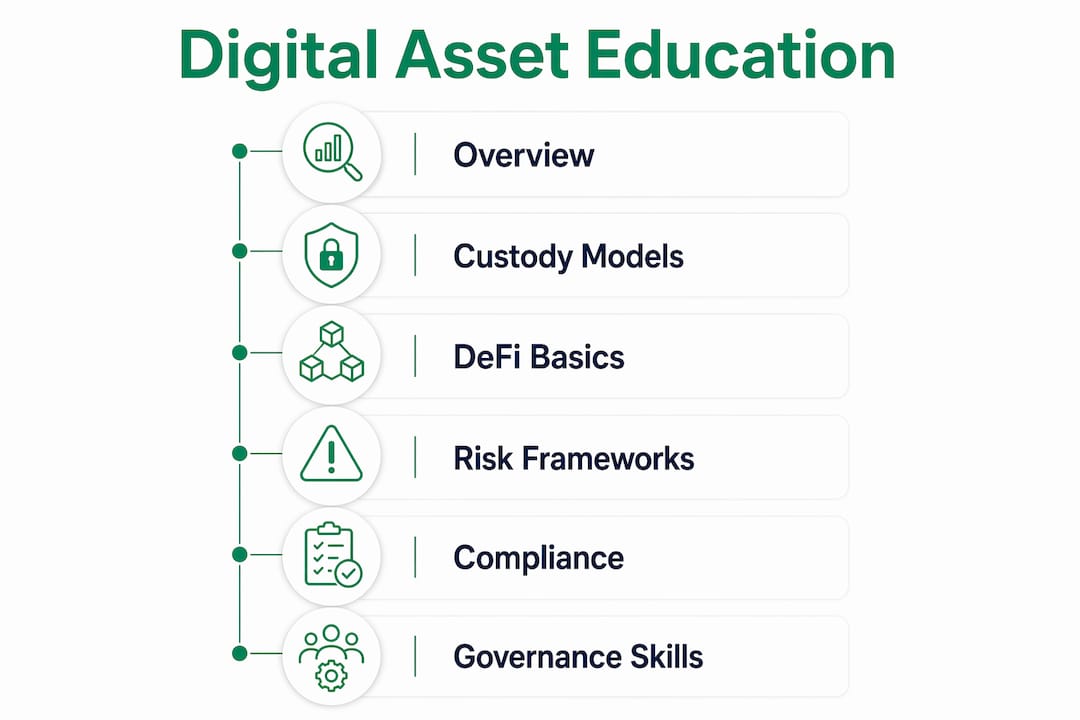
Governance-level education covers five core areas:
- Blockchain fundamentals: How distributed ledgers work, why they are immutable, and what that means for audit trails and record-keeping.
- Digital asset lifecycle: How assets are created, transferred, held, and retired, and where operational risk lives at each stage.
- Custody models: The difference between self-custody, third-party custody, and multi-signature arrangements, and why custody risk distinctions matter for preventing unrecoverable losses.
- DeFi and smart contracts: What decentralized finance protocols do, how smart contracts execute automatically, and what governance controls can and cannot catch.
- Regulatory frameworks: How jurisdictional rules differ across the US, EU, and Asia-Pacific, and why localized compliance knowledge is the only reliable defense against unintended breaches.
The table below shows the difference between technical and governance educational focus:
| Focus area | Technical education | Governance education |
|---|---|---|
| Primary audience | Developers, engineers | Executives, board members |
| Core question | How does it work? | What risk does it create? |
| Custody models | Protocol-level mechanics | Counterparty and operational risk |
| Regulatory compliance | Code compliance | Jurisdictional obligations |
| Smart contracts | Code logic | Liability and audit exposure |
Pro Tip: Executives who complete governance-level digital asset training before a crisis report far greater confidence in challenging management assumptions during board reviews.
Executives often mistakenly view digital asset education as purely technical rather than a governance necessity. That misconception is the single biggest obstacle to effective board oversight in 2026.
How does digital asset education reduce organizational risk?
Education is the only scalable risk control that works across divergent users and fast-moving markets. Technology controls help, but they cannot replace the judgment of an informed decision-maker. Educated participants can identify vulnerabilities and maintain discipline despite rapid innovation. That is a capability no firewall or compliance software can replicate.
The most common risks that executive education prevents include:
- Speculative overexposure: Boards without literacy approve treasury allocations to digital assets without understanding volatility profiles or liquidity constraints.
- Custody failures: Executives who cannot distinguish operational custody risk from counterparty custody risk cannot catch the errors that lead to catastrophic asset loss.
- Regulatory breaches: Regulatory regimes differ by region. A board that does not understand jurisdictional nuance will approve a product or transaction that is legal in one market and illegal in another.
- Vendor over-reliance: Without independent expertise, boards accept management’s technology choices without the ability to question security assumptions or audit controls.
“The gap between informed and uninformed executives has widened as market tolerance for mistakes has decreased significantly. Organizations that treat education as a cost rather than a control are the ones most exposed to regulatory and operational failure.”
The C-suite’s role in compliance is not ceremonial. Executives who understand digital asset risk frameworks make materially better decisions about vendor selection, custody arrangements, and regulatory disclosures.
Pro Tip: Map your board’s current digital asset knowledge against the five governance areas above. Any gap you find is a risk your organization is currently carrying without a control.
Why boards cannot delegate digital asset oversight to management
Delegating digital asset oversight entirely to management is the governance equivalent of signing financial statements without reading them. Boards should not rely solely on management and must develop their own digital asset expertise or recruit specialized advisors. Independent oversight is what allows a board to question operational and cybersecurity assumptions effectively.
The practical steps for building independent board expertise follow a clear sequence:
- Assess current literacy. Survey board members on their familiarity with custody models, regulatory frameworks, and digital asset lifecycle risk. Identify the specific gaps rather than assuming a general deficit.
- Recruit or appoint a specialist. Governance experts recommend that boards include at least one member with direct digital asset governance experience. This person provides independent judgment that management cannot self-supply.
- Commission structured education. Formal certification programs, such as the Digital Asset Readiness Evaluation (DARE) offered by Wush, provide modular, assessable learning that builds documented competency rather than informal awareness.
- Establish an ongoing review cadence. Digital asset markets and regulations change faster than annual board cycles. Quarterly briefings from qualified advisors keep board literacy current without requiring continuous deep study.
- Integrate oversight into governance charters. Digital asset risk should appear explicitly in board committee mandates, not as a subset of general technology risk.
Boards that build their own expertise improve transparency with shareholders and regulators. Digital asset governance credentials signal to stakeholders that oversight is active and informed, not reactive and delegated. That signal matters for institutional investors who increasingly assess governance quality as a proxy for organizational resilience.
Practical steps to build and maintain digital asset literacy
Executive digital asset awareness is not a one-time achievement. The regulatory environment, the technology, and the market structure all change continuously. A board that was well-informed in 2024 may be operating on outdated assumptions by mid-2026 without a structured renewal process.
The most effective approaches to building and maintaining literacy include:
- Formal certification programs: Structured programs like Wush’s DARE certification provide modular learning, formal assessments, and annual renewal requirements. They create documented, verifiable competency rather than informal exposure.
- Expert briefings: Quarterly sessions with qualified digital asset advisors keep boards current on regulatory changes, market developments, and emerging risk categories without requiring deep independent study.
- Workshops and scenario exercises: Tabletop exercises that simulate a custody failure, a regulatory inquiry, or a smart contract exploit force boards to apply their knowledge under pressure. These reveal gaps that passive learning does not.
- Integration into board culture: Digital asset risk should appear on every relevant board agenda, not just during crisis moments. Boards that discuss it regularly build literacy incrementally and normalize the oversight function.
The board-level oversight checklist for 2026 published by Wush provides a practical starting point for executives who want to assess their current governance posture before committing to a formal education program.
Connecting education to compliance and investment decisions is the final step. Boards that understand digital asset risk frameworks make better decisions about which assets to hold, which custodians to use, and which regulatory disclosures to prioritize. Education is not a prerequisite for strategy. It is the foundation of it.
Pro Tip: Annual certification renewal is more valuable than a one-time course. The digital asset regulatory environment changes fast enough that last year’s knowledge can create this year’s liability.
Key Takeaways
Executive digital asset education is a governance control, not a technical elective, and boards that treat it as optional carry measurable, unmanaged risk.
| Point | Details |
|---|---|
| Governance literacy, not technical skill | Executives need to understand risk frameworks and custody models, not write code. |
| Education prevents specific, costly failures | Custody errors, regulatory breaches, and speculative overexposure are all reduced by informed boards. |
| Delegation to management is insufficient | Boards must develop independent expertise to question management assumptions effectively. |
| Ongoing renewal is required | Digital asset regulations and markets change fast enough to make one-time training obsolete within a year. |
| Certification creates verifiable competency | Formal programs like DARE provide documented credentials that satisfy regulatory and stakeholder expectations. |
The uncomfortable truth about digital asset board literacy
I have worked with enough boards to know that the most dangerous executives in the digital asset space are not the ones who admit they know nothing. They are the ones who attended a single conference, heard a few buzzwords, and now believe they have sufficient context to oversee a treasury allocation or approve a custody arrangement.
Governance-level digital asset literacy is not about accumulating information. It is about building a mental model that lets you ask the right question at the right moment. The difference between a board that catches a custody risk early and one that discovers it after a loss is almost always a difference in structured education, not intelligence or experience.
The misconception I see most often is that digital asset education is a technology problem that the CTO or CIO should own. That thinking produces boards that are permanently one step behind management, unable to independently assess the assumptions they are being asked to approve. The new risk models in digital finance require board-level understanding, not just executive-level delegation.
My honest recommendation: treat digital asset education the way you treat financial literacy for audit committee members. It is a baseline governance requirement, not a personal interest. The boards that build this infrastructure now will be the ones that avoid the regulatory and operational failures that are already claiming organizations that did not.
— Gregg
How the DARE certification supports executive governance
Wush built the Digital Asset Readiness Evaluation specifically to close the governance gap that most boards carry without realizing it. The DARE certification covers custody models, regulatory compliance, risk management, and operational controls through modular learning and formal assessments. Each module is designed for executives and board members, not developers.
The program includes annual renewal to keep credentials current as regulations evolve. Boards that complete DARE can demonstrate documented, verifiable digital asset governance competency to regulators, institutional investors, and auditors. For organizations that need to meet mandatory education standards or build a defensible governance record, the DARE program provides a structured path from awareness to certified readiness. Explore the full program at dare.wush.co to assess which modules fit your board’s current knowledge gaps.
FAQ
Why do executives need digital asset education specifically?
Executives need governance-level digital asset literacy to oversee custody arrangements, regulatory compliance, and risk frameworks without relying entirely on management. Boards that lack this literacy cannot independently assess the assumptions they are asked to approve.
What topics should executive digital asset training cover?
Executive training should cover the digital asset lifecycle, custody models, DeFi basics, smart contract risk, and jurisdictional regulatory frameworks. Technical coding knowledge is not required.
How often should board members update their digital asset knowledge?
Board members should update their digital asset knowledge at least annually, given how quickly regulations and market structures change. Programs with built-in renewal requirements, like Wush’s DARE certification, provide a structured way to stay current.
Can boards rely on management to handle digital asset oversight?
Governance experts recommend that boards develop independent digital asset expertise rather than relying solely on management. Independent oversight allows boards to question operational and cybersecurity assumptions that management cannot self-audit.
What is the DARE certification and who is it for?
The Digital Asset Readiness Evaluation (DARE) is a certification program from Wush designed for executives, board members, and finance professionals. It provides modular learning, formal assessments, and annual renewal to build and document digital asset governance competency.