
Digital Asset Sanctions Compliance Guide for 2026

Digital asset sanctions compliance is defined as the set of legal obligations requiring organizations to screen transactions, counterparties, and blockchain addresses against government-maintained sanctions lists to prevent prohibited dealings with designated entities or jurisdictions. This digital asset sanctions compliance guide covers every layer of that obligation: the governing statutes, risk assessment methods, program design, screening technology, and the pitfalls that trip up even experienced teams. Sanctions compliance operates as a strict liability regime. Violations can occur without intent, and OFAC civil penalties can reach the greater of $356,579 or twice the transaction value, with criminal exposure up to $1 million and 20 years imprisonment per willful violation under IEEPA. That penalty structure makes this one of the highest-stakes compliance obligations your organization faces.
What are the legal and regulatory requirements for digital asset sanctions compliance?
Sanctions obligations for digital assets are identical to those for fiat currency. OFAC applies the same SDN List, Sectoral Sanctions Identifications (SSI) List, and comprehensive country programs to blockchain transactions that it applies to wire transfers. The practical scope, however, is wider because blockchain addresses, smart contracts, and protocol-level interactions are all within scope.

The Tornado Cash designation confirmed that autonomous smart contracts can be sanctioned. Compliance teams can no longer treat protocol-level risk as someone else’s problem. Any interaction with a sanctioned protocol carries the same exposure as a direct transaction with a designated person.
The statutory framework in 2026 includes several layers:
- IEEPA (International Emergency Economic Powers Act): The primary authority for OFAC designations and the source of civil and criminal penalty authority.
- GENIUS Act: Introduces federal stablecoin reserve and disclosure requirements, adding a new compliance surface for stablecoin issuers and holders.
- SDN List and comprehensive programs: Cuba, Iran, North Korea, Syria, and specific regions of Ukraine carry comprehensive prohibitions. Any transaction touching these jurisdictions requires blocking, not just flagging.
- State-level licensing: Federal crypto regulation is more structured in 2026, but state money transmission licenses and BitLicense-style regimes add jurisdiction-specific obligations that federal clarity does not resolve.
- Reporting obligations: Blocked transactions must be reported to OFAC within 10 business days and annually thereafter.
The key compliance takeaway here is that your legal requirements checklist must cover federal statutes, OFAC program-specific guidance, state licensing conditions, and any applicable foreign sanctions regimes if your organization operates internationally.
How to assess and map your sanctions risk exposure in digital assets
A sanctions risk assessment for crypto starts by mapping every surface where your organization touches digital assets. Generic risk frameworks miss the blockchain-specific exposure points that regulators now scrutinize.
Work through these exposure surfaces in order:
- Onramps and offramps: Fiat-to-crypto and crypto-to-fiat conversion points are the highest-volume screening touchpoints. Every counterparty at these points requires SDN screening.
- Custody arrangements: Third-party custodians introduce indirect exposure. Assess whether your custodian’s screening program meets your own standards.
- Stablecoins: Stablecoin holdings carry dual risk. The issuer can freeze assets independently of OFAC action, and the underlying reserve assets may carry their own sanctions exposure.
- Bridges and cross-chain activity: Cross-chain transfers obscure the origin of funds. Blockchain analytics tools that perform cross-chain transaction graph analysis are required to trace exposure across networks.
- Smart contract interactions: Post-Tornado Cash, any protocol interaction requires a protocol-level sanctions check, not just a counterparty check.
- Jurisdictional exposure: IP geolocation, user-declared residence, and transaction routing all create jurisdictional risk that must be assessed separately from entity-level risk.
Pro Tip: Document your risk assessment in a format that can be produced during an audit. Regulators expect to see a dated, signed risk assessment that identifies each exposure surface, assigns a risk rating, and maps it to a specific control.
Blockchain analytics tools identify direct matches (exact SDN address hits) and indirect exposure through hop analysis and cluster attribution. A wallet that has never directly transacted with a sanctioned address may still carry material exposure if it sits two hops from a known cluster. Your risk assessment must account for both. Update the assessment at least annually, and trigger an out-of-cycle update whenever OFAC issues a new designation in your asset class or sector.
What practical steps make up an effective digital asset sanctions compliance program?
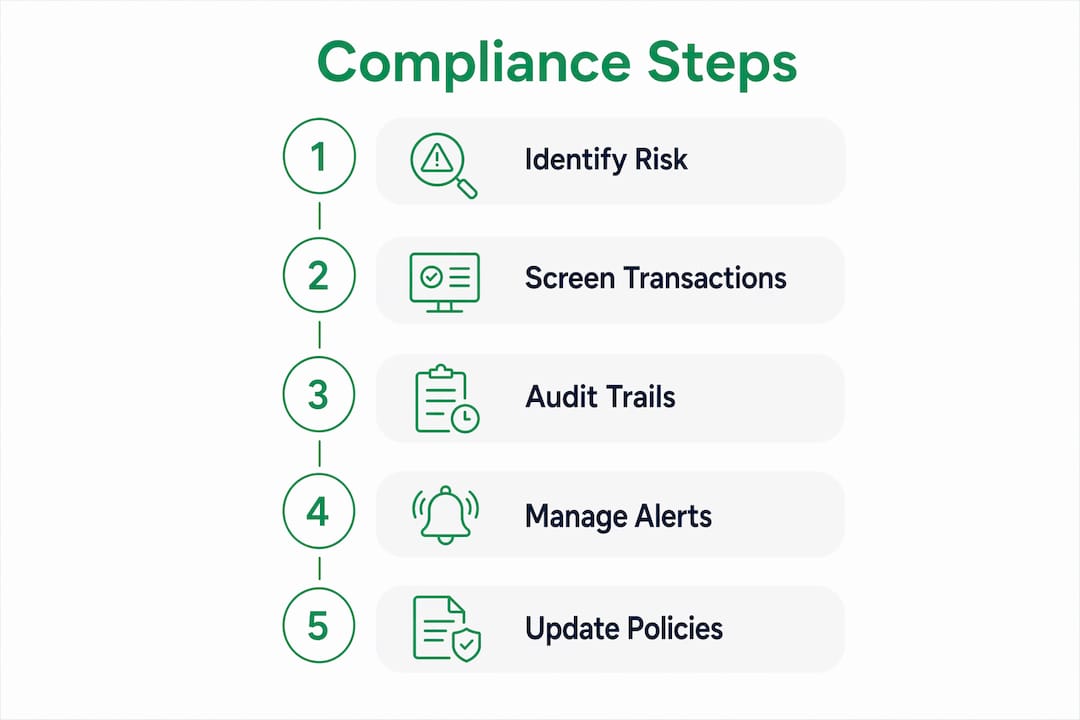
Effective 2026 sanctions compliance programs require five foundational elements: management commitment, enterprise-wide risk assessment, real-time controls, independent testing, and ongoing training. Each element is necessary. Skipping any one of them creates an audit gap that regulators will find.
The five-step program framework
- Management commitment: Board and senior leadership must formally approve the sanctions compliance policy, allocate budget for screening tools, and designate a sanctions compliance officer with clear authority.
- Risk assessment: Complete the exposure mapping described above. Assign risk ratings. Prioritize controls based on the highest-risk surfaces.
- Real-time controls: Deploy automated screening that blocks transactions before execution. Manual review alone is insufficient under a strict liability framework.
- Independent testing: Conduct annual audits by a party independent of the compliance function. Test both the screening logic and the escalation pathways.
- Ongoing training: Train all staff who touch digital asset transactions, not just the compliance team. Front-office teams that onboard clients or approve transactions carry direct exposure.
Screening workflow design
Your screening workflow must cover three stages:
- Onboarding: Screen all new counterparties, wallet addresses, and beneficial owners against the SDN List and applicable SSI and country lists before any transaction occurs.
- Transaction monitoring: Screen each transaction in real time. Hard blocks must trigger automatically for exact SDN matches. Soft blocks should route to an investigation queue for indirect exposure hits.
- Continuous rescreening: Rescreen existing counterparties whenever OFAC updates a list. Latency between a new designation and your system’s response is a compliance metric regulators now measure directly.
Layered control architecture
| Control layer | Trigger | Action |
|---|---|---|
| Hard block | Exact SDN match | Automatic rejection and blocking |
| Soft block | Indirect exposure or cluster hit | Route to investigation queue |
| Investigation | Analyst review | Escalate or clear with documented rationale |
| Escalation | Confirmed or unresolved match | Senior compliance officer decision, OFAC reporting if required |
Pro Tip: Build your case management system so that every investigation produces a timestamped audit trail. Regulators now ask for operational proof of screening, not just written policies.
Stablecoin freeze risk requires a separate control. Stablecoin issuers can freeze assets independently of OFAC action. A wallet may pass your SDN screen but be functionally frozen by the issuer. Integrate issuer freeze status checks into your screening workflow as a distinct step, not an afterthought.
What technologies and tools support sanctions screening for digital assets?
Technology is not optional in a digital asset sanctions program. The volume and speed of blockchain transactions make manual screening operationally impossible at any meaningful scale. Your technology stack must cover these capabilities:
- Blockchain analytics platforms: These tools perform address clustering, entity attribution, and hop analysis to identify both direct and indirect sanctions exposure across major blockchains.
- Real-time SDN List integration: Your screening system must ingest OFAC list updates with minimal latency. Latency in sanctions screening is increasingly used by regulators as a compliance performance metric. A system that takes hours to reflect a new designation creates a measurable audit risk.
- Cross-chain analysis: Bridges and wrapped assets move value across chains. Tools that trace transactions across networks are required for any organization that handles multi-chain activity.
- IP geofencing: Jurisdictional screening based on IP address and user-declared location catches comprehensive country program violations that address-level screening misses.
- KYC and AML integration: Sanctions screening must share data with your Know Your Customer and Anti-Money Laundering systems. Siloed tools create gaps where a flagged entity clears one system but not another.
- Alert management and false positive reduction: High false positive rates degrade analyst capacity and create backlogs. Tools with tunable risk scoring and machine-learning-assisted triage reduce noise without sacrificing detection.
For organizations building or upgrading their digital asset compliance readiness, the technology selection decision should follow the risk assessment, not precede it. Buy for your actual exposure surface, not for the broadest possible feature set.
What are common pitfalls in digital asset sanctions programs?
Most sanctions program failures share a small set of root causes. Knowing them in advance is the most efficient form of risk management.
- Relying on direct matches only: SDN List exact matches represent a fraction of real sanctions exposure. Indirect exposure through hops, clusters, and protocol interactions is where most violations originate. Programs that skip blockchain analytics miss this entirely.
- Manual investigation at scale: Sanctions compliance demands real-time automated blocking because the strict liability framework does not allow time for manual review before a transaction settles. Manual processes work for investigations after a block, not as the primary control.
- Ignoring stablecoin issuer freeze risk: Separating sanctions screening from stablecoin freeze monitoring creates a compliance gap. A wallet that passes your SDN screen may already be frozen by the issuer, creating an operational failure that looks like a compliance failure to regulators.
- Slow list update response: Regulators now expect evidence of up-to-date screening and fallback procedures for vendor outages. A system that cannot demonstrate rapid response to new designations will fail an audit.
- Weak documentation: Policies without operational proof are insufficient. Regulators ask for audit trails, investigation records, and escalation logs, not just written procedures.
- Misreading jurisdictional overlap: Federal guidance does not preempt state licensing requirements. Organizations operating across multiple states or countries must map each jurisdiction’s requirements separately.
Pro Tip: Review your digital asset regulatory exposure at least quarterly. Regulatory interpretations shift faster than annual review cycles can track.
Key Takeaways
Effective digital asset sanctions compliance requires real-time automated controls, layered screening across entities and protocols, and documented audit trails that prove program operation to regulators.
| Point | Details |
|---|---|
| Strict liability applies | Violations occur without intent, making automated blocking the only reliable primary control. |
| Protocol-level risk is real | Smart contract interactions require sanctions screening equal to entity-level checks after Tornado Cash. |
| Latency is a compliance metric | Regulators measure the lag between new designations and system response as a program quality indicator. |
| Stablecoin freeze risk is separate | Integrate issuer freeze status checks into your screening workflow as a distinct control layer. |
| Documentation proves compliance | Audit trails, investigation logs, and escalation records are what regulators actually examine. |
Why sanctions compliance is the hardest operational problem in digital finance
I have spent years watching organizations treat sanctions compliance as a policy exercise. They write the procedures, deploy a screening tool, and move on. The programs that fail audits are almost always the ones that stopped there.
The thing that separates programs that hold up under scrutiny from those that don’t is operational proof. Regulators in 2026 do not want to read your policy document. They want to see the timestamp on your last list update, the investigation log from last Tuesday’s soft block, and the escalation record from the alert that cleared three weeks ago. If you cannot produce those records in under an hour, your program has a documentation problem regardless of how good your screening logic is.
The Tornado Cash designation changed something fundamental. Compliance teams that were built around entity screening had to rebuild their mental model overnight. Protocol-level risk is now a first-class compliance obligation, and most programs I have seen are still catching up. The risk frameworks in digital finance that work in 2026 treat smart contract interactions with the same rigor as counterparty onboarding.
Latency is the metric I watch most closely. A program that screens perfectly but takes four hours to reflect a new OFAC designation is a program that has a four-hour window of uncontrolled exposure every time a new designation drops. That is not a technology problem. It is a program design problem. Solve it at the architecture level, not with a faster vendor.
— Gregg
How DARE supports your sanctions compliance readiness
Sanctions compliance for digital assets requires more than policy. It requires a structured framework that maps your actual exposure, tests your controls, and produces credentials that demonstrate program maturity to regulators and partners.
Wush built the Digital Asset Readiness Evaluation (DARE) to address exactly this gap. DARE provides modular assessments covering custody, regulatory compliance, risk management, and operational controls, with annual renewal to keep pace with regulatory change. Compliance officers and legal advisors who complete DARE earn blockchain-verified credentials that demonstrate program rigor to auditors, counterparties, and regulators. The DARE platform is built for organizations that need to prove their compliance posture, not just describe it.
FAQ
What is digital asset sanctions compliance?
Digital asset sanctions compliance is the obligation to screen blockchain transactions, wallet addresses, and counterparties against OFAC’s SDN List and other government sanctions lists to prevent prohibited dealings. It applies the same strict liability standard as traditional financial sanctions.
Which laws govern digital asset sanctions in the US?
OFAC administers sanctions authority under IEEPA, which covers all digital asset transactions by US persons and entities. The GENIUS Act adds stablecoin-specific requirements, and state licensing regimes layer additional obligations on top of federal rules.
What does strict liability mean for crypto sanctions compliance?
Strict liability means a violation occurs even without knowledge or intent. An inadvertent transaction with a sanctioned address or protocol can trigger civil penalties up to $356,579 per violation or twice the transaction value, whichever is greater.
How often should a sanctions risk assessment be updated?
Update your risk assessment at least annually and trigger an out-of-cycle review whenever OFAC issues a new designation in your asset class, a major protocol is sanctioned, or your organization adds a new product or market.
What is the biggest gap in most digital asset sanctions programs?
The most common gap is relying on direct SDN matches while ignoring indirect exposure through blockchain hops, clusters, and protocol-level interactions. Blockchain analytics tools that perform hop analysis and cluster attribution are required to close this gap.