
What Does Regulatory Readiness Mean in Legal Practice?

Regulatory readiness is defined as an organization’s continuous, operational capability to demonstrate compliance with legal and regulatory obligations through executed controls, documented evidence, and clear ownership. It is not a policy binder or a pre-audit sprint. It is the state of being provably compliant at any moment a regulator, counterparty, or auditor asks. For legal professionals and compliance specialists working with digital assets, this distinction carries direct consequences for enforcement exposure, transaction risk, and organizational credibility.
What does regulatory readiness mean in legal terms?
Regulatory readiness means having an operationally executable, documented program that demonstrates a credible ability to meet legal and regulatory obligations. The emphasis is on “operationally executable.” A policy that exists in a shared drive but has never been tested, trained against, or evidenced in practice does not constitute readiness. Regulators demand not just the existence of controls but consistent execution with verifiable evidence, available at any time and not just at audit.
Three elements define legal readiness in practice: control execution, evidence availability, and ownership clarity. Control execution means the process actually runs as designed. Evidence availability means records are retrievable on demand, not reconstructed after the fact. Ownership clarity means a named individual or function is accountable for each obligation and its corresponding record. Without all three, an organization may be technically compliant on paper while being operationally exposed.

This distinction matters most in regulated sectors where the cost of non-compliance is asymmetric. In digital assets, where frameworks like the EU AI Act and Markets in Crypto-Assets Regulation (MiCA) are still maturing, the gap between documented intent and operational reality is where enforcement risk lives. Legal counsel advising digital asset businesses must assess readiness as a program state, not a filing status.
How does regulatory readiness differ from compliance and audit readiness?
These three terms are often used interchangeably, but they describe different states with different legal implications.
Regulatory compliance is the baseline. It means an organization adheres to the applicable laws, rules, and standards. Compliance is a status. It tells you whether obligations are met at a point in time. It does not tell you whether the organization can prove it, sustain it, or recover from a gap.
Audit readiness is narrower and more tactical. Audit readiness focuses on evidence quality at a specific point in time. An organization that scrambles to organize documentation before an announced inspection may achieve audit readiness without ever having compliance readiness. This is the “last-minute effort” trap that compliance teams fall into repeatedly.
Compliance readiness is the broadest and most demanding state. It requires ongoing alignment of controls and policies with obligations over time, surviving what practitioners call operational drift. Governance must continuously align operating reality with documented policies. When staff turn over, systems change, or products evolve, the compliance story must update in parallel.
| Concept | What it measures | Time horizon | Legal risk if absent |
|---|---|---|---|
| Regulatory compliance | Adherence to rules | Point in time | Enforcement action |
| Audit readiness | Evidence quality | Point in time | Citation, remediation order |
| Compliance readiness | Sustained control alignment | Continuous | Systemic exposure, deal risk |
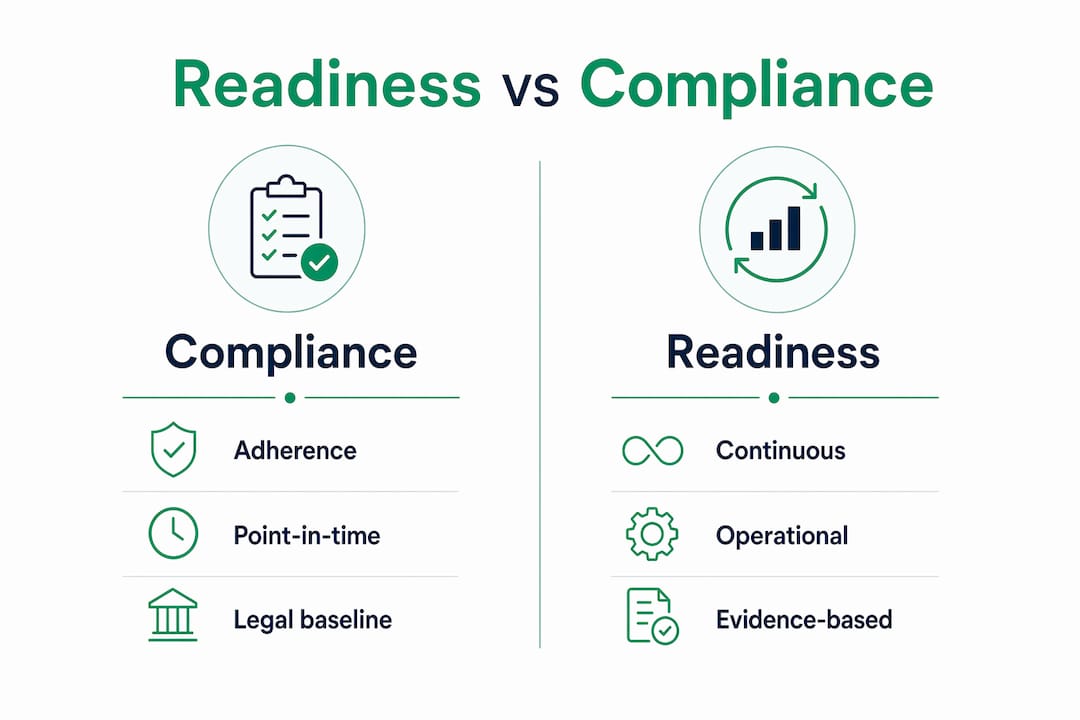
Pro Tip: Map your organization’s current state against all three columns. Most digital asset firms score well on compliance but poorly on compliance readiness. That gap is where regulators and acquirers find leverage.
Regulatory readiness is not the same as regulatory delay. When delays occur, the first question regulators ask is what was not ready. That framing shifts accountability from the regulator’s timeline to the organization’s preparation. Cross-functional credibility and time-to-activation metrics improve predictability and reduce that exposure.
What practical steps build regulatory readiness in a legal framework?
Building readiness is a structured discipline. The most widely applied approach follows a five-phase gap-assessment process that culminates in a documented evidence pack ready for regulatory review. For digital asset legal teams, this process maps directly to frameworks like the EU AI Act readiness assessment.
-
Inventory. Catalog every regulatory obligation that applies to the organization. For digital asset firms, this includes MiCA, applicable AML directives, data protection requirements, and any jurisdiction-specific licensing conditions. Do not rely on a single team to own this list.
-
Classification. Assign each obligation a risk tier based on enforcement likelihood and consequence severity. High-risk obligations require more frequent evidence refresh cycles and named senior owners.
-
Gap analysis. Compare current control design and execution against each classified obligation. The output is a gap register, not a narrative report. Each gap needs a description, a risk rating, and a remediation owner.
-
Remediation. Execute fixes against the gap register with tracked deadlines. This is where most programs stall. Remediation requires operational change, not just policy updates.
-
Evidence pack. Compile retrievable documentation that demonstrates control execution for each obligation. This is the deliverable that supports regulatory review, conformity assessment, or due diligence.
Operationalized readiness requires evidence mapping from obligation to control to record type to owner to refresh cadence. Poor mapping leads to “can’t retrieve, can’t explain” findings rather than substantive failures. That distinction matters legally because a retrieval failure looks identical to a control failure from the outside.
Pro Tip: Build your evidence map in a spreadsheet or governance platform before you need it. Columns should include: obligation reference, control description, record type, record location, owner name, and last refresh date. Review it quarterly.
Readiness programs fail mainly due to degrading evidence quality rather than the absence of controls. Stale records, scattered documentation, and records that cannot meet tight retrieval deadlines are the primary causes of audit citations. Retrievability and currentness are not administrative concerns. They are legal ones.
How does regulatory readiness apply to digital assets and emerging legal frameworks?
Digital assets present a specific readiness challenge because the regulatory frameworks governing them are still being written, amended, and interpreted. MiCA came into full effect in December 2024. The EU AI Act applies risk-tiered obligations to AI systems embedded in financial products. Both frameworks use readiness as an assurance concept, requiring organizations to demonstrate ongoing compliance rather than submit a one-time filing.
For digital asset legal teams, the evidence pack is the central deliverable. It must document:
- Custody controls and their execution records
- AML and KYC procedure logs with timestamps
- Risk assessment outputs tied to specific asset classes or transaction types
- Governance decisions and the records that support them
- Change control logs showing how updates to systems or processes were reviewed for compliance impact
In digital asset and AI environments, readiness cannot be a static submission pack. It must include drift management, change control, and continuous validation to ensure the operating reality aligns with the compliance story after every update. A custody platform that upgrades its signing infrastructure without a corresponding compliance review creates a gap between the evidence pack and actual operations. That gap is precisely what regulators look for.
The digital asset audit trail is a foundational component of this evidence architecture. Without a complete, tamper-evident record of transactions, approvals, and system changes, the evidence pack cannot support a credible conformity assessment. Legal advisors should treat audit trail integrity as a threshold requirement, not an IT concern.
Structured evidence methodology aligned with regulations and risks is vital to make readiness repeatable and auditable. Organizations that build this methodology once and maintain it continuously outperform those that reconstruct it before each review cycle.
What role does regulatory readiness play in M&A legal due diligence?
In transactions involving regulated digital asset entities, readiness checks evaluate regulatory health beyond what a standard compliance audit captures. The focus shifts from “are you compliant?” to “what would it cost to get and stay compliant, and what risk does the gap create for the acquirer?”
This reframing has direct consequences for deal structure and valuation. Readiness gaps found during diligence translate into:
- Remediation cost estimates that reduce purchase price or require escrow arrangements
- Regulatory approval timelines that affect deal certainty and closing conditions
- Integration complexity where the target’s compliance program cannot be absorbed without redesign
- Post-closing liability exposure if gaps were known and not disclosed
Readiness as a pressure test supports transaction confidence and cost modeling. Legal counsel advising on digital asset acquisitions should request the target’s evidence pack, gap register, and remediation log as standard diligence items. These documents reveal the operational state of the compliance program in a way that policy documents and audit reports do not.
Readiness checks in deal transactions reduce uncertainty by linking regulatory condition assessment with cost and integration impact modeling. A target that cannot produce a current evidence pack on short notice is signaling a readiness deficit regardless of its compliance status. That signal should inform both the risk assessment and the negotiation.
For legal professionals advising on legal risk management for digital assets, embedding readiness assessment into the standard diligence checklist is now a baseline expectation, not a specialist add-on.
Key takeaways
Regulatory readiness in a legal context is a continuous operational discipline, not a compliance status, and organizations that treat it as a one-time event accumulate hidden legal and transaction risk.
| Point | Details |
|---|---|
| Readiness is operational, not documentary | Controls must be executed and evidenced, not just written into policy. |
| Three concepts, three risk profiles | Compliance, audit readiness, and compliance readiness each carry distinct legal exposure when absent. |
| Evidence mapping is the core mechanism | Map every obligation to a control, record type, owner, and refresh cadence to survive scrutiny. |
| Digital assets require drift management | Static evidence packs become stale after system or process changes; continuous validation is required. |
| M&A diligence must include readiness checks | Gap registers and evidence packs reveal compliance program health that audit reports miss. |
Why most organizations are less ready than they think
Most compliance programs I have reviewed look solid on paper and fall apart the moment someone asks for a specific record under time pressure. The policy exists. The control was designed correctly. But the evidence is six months old, stored in three different systems, and owned by someone who left the organization in February. That is not a compliance failure in the traditional sense. It is a readiness failure, and it carries the same legal consequence.
The uncomfortable truth is that readiness degrades silently. No one decides to let records go stale. It happens because evidence maintenance is not treated as a legal obligation in its own right. It is treated as an administrative task, delegated to whoever has capacity, and reviewed only when an audit is announced. By then, the gap between the compliance story and operational reality has widened to the point where reconstruction is the only option.
For digital asset organizations specifically, this problem is amplified by the pace of change. A custody arrangement that was compliant under one framework version may require updated evidence under an amendment six months later. If the change control process does not trigger a compliance review, the evidence pack becomes misleading rather than just incomplete.
The organizations I have seen handle this well share one characteristic: they treat evidence maintenance as a standing operational obligation with a named owner, a refresh schedule, and a consequence for missing it. They also use structured frameworks like the Digital Asset Governance Gap Assessment to identify where their evidence architecture has drifted from their obligations. That discipline is not glamorous. It is the difference between a clean regulatory interaction and an expensive one.
— Gregg
Build and maintain your readiness with DARE
Wush built the Digital Asset Readiness Evaluation (DARE) specifically for legal advisors, compliance specialists, and finance professionals who need a structured, credible framework for demonstrating regulatory readiness in digital assets. DARE covers custody, AML, governance, legal controls, and operational risk through modular assessments that produce a documented evidence base aligned with current regulatory expectations. The DARE certification provides an independently verified credential that signals readiness to regulators, counterparties, and boards. If your organization is building or stress-testing its readiness program for digital assets, DARE gives you the framework, the assessment methodology, and the credential to back it up.
FAQ
What does regulatory readiness mean in a legal context?
Regulatory readiness means an organization can demonstrate compliance with its legal and regulatory obligations at any time through executed controls, retrievable evidence, and clear ownership. It goes beyond having policies in place to proving those policies operate as designed.
How is regulatory readiness different from being compliant?
Compliance is a status that confirms obligations are met at a point in time. Regulatory readiness is the ongoing operational capability to prove that status on demand, including after system changes, staff turnover, or process updates.
Why does regulatory readiness matter for digital asset firms?
Digital asset frameworks like MiCA and the EU AI Act require continuous conformity, not one-time filings. Firms that cannot produce a current evidence pack face enforcement exposure and deal risk in M&A transactions where readiness gaps directly affect valuation.
What is an evidence pack in a regulatory readiness program?
An evidence pack is a compiled, retrievable set of documents that demonstrates control execution for each regulatory obligation. It typically includes training logs, transaction records, governance decisions, risk assessments, and change control logs organized by obligation.
How often should a regulatory readiness assessment be conducted?
A formal gap assessment should run at least annually, with continuous evidence refresh built into daily operations. In fast-moving environments like digital assets, any significant system or process change should trigger a targeted readiness review.