
Treasury Digital Asset Diversification for Finance Teams

Treasury digital asset diversification is the practice of allocating a defined portion of corporate excess cash across multiple digital asset categories to improve risk-adjusted returns while preserving liquidity and governance controls. The industry term for this practice is digital asset treasury allocation, and it sits squarely within the capital allocation decisions that boards and treasury managers make alongside traditional fixed income and money market positions. Finance professionals who treat this as a speculative bet rather than a structured allocation decision consistently underperform those who apply the same discipline they use for any other asset class. The core principle of diversification applies directly: spreading exposure across asset types with different risk profiles reduces the impact of any single position going wrong.
What is treasury digital asset diversification, and why does it matter?
Treasury digital asset diversification is defined as the deliberate spread of corporate treasury holdings across distinct digital asset classes, each with a different risk, liquidity, and return profile. This is not a single-asset Bitcoin position. It is a structured allocation that combines volatile cryptocurrencies, stablecoins, and yield-generating instruments to balance appreciation potential with capital stability.

The practice matters because a single-asset digital treasury carries concentrated risk. Bitcoin can drop 40% in a quarter while stablecoins hold their peg and tokenized treasuries continue generating yield. A treasury holding only Bitcoin experiences the full force of that drawdown. A treasury holding Bitcoin alongside USDC and tokenized short-duration instruments absorbs the same market event with far less damage to its overall cash position.
Boards and audit committees increasingly require that digital asset holdings be framed as capital allocation decisions with defined risk parameters. That framing demands a diversified structure, not a single speculative position.
What digital asset types belong in a treasury portfolio?
Three main categories of digital assets serve distinct roles in a treasury portfolio. Understanding each category is the foundation of sound digital asset management strategies.
Volatile cryptocurrencies such as Bitcoin and Ethereum are held for long-term appreciation. They carry the highest price volatility and the highest potential return. Treasury teams typically hold these in cold or institutional custody and treat them as a long-duration position, not a liquidity source.
Stablecoins such as USDC serve a completely different function. Stablecoins provide liquidity and access to yield opportunities in decentralized finance protocols without exposing the treasury to price volatility. They function as a digital cash equivalent, useful for on-chain settlements, vendor payments in digital rails, and short-term yield generation.
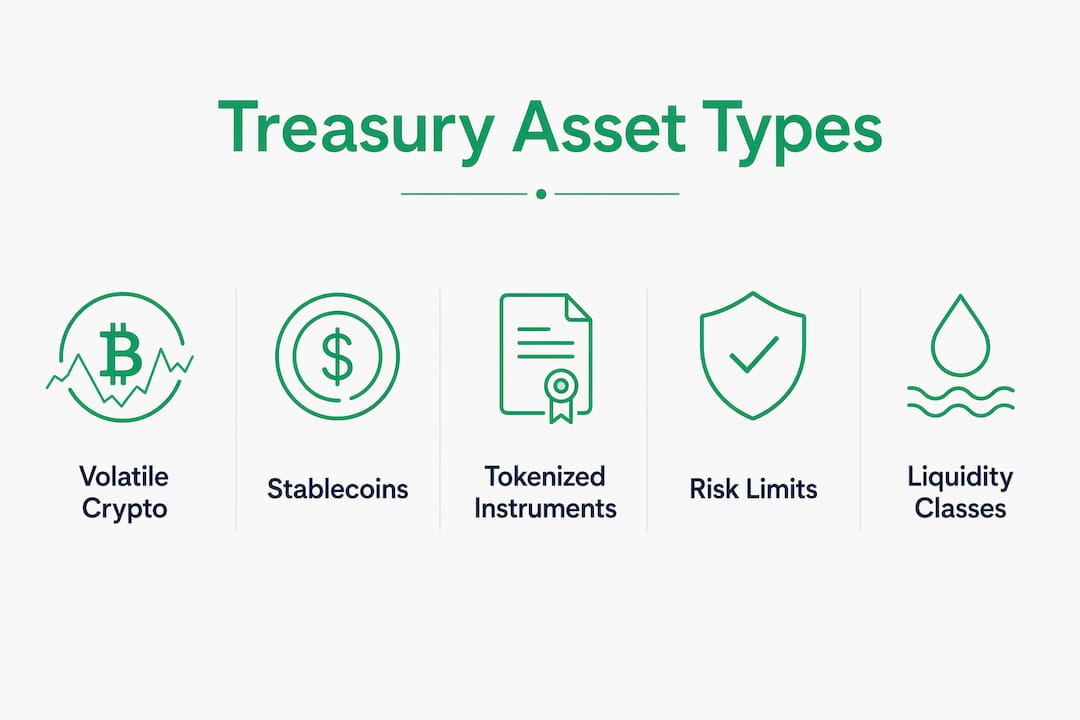
Tokenized instruments represent the emerging third layer. Tokenized treasury bills and money market funds now exist on public and permissioned blockchains, offering yields comparable to traditional short-duration fixed income with the settlement speed and transparency of blockchain infrastructure. DeFi lending protocols also provide yield, though they carry smart contract risk that requires separate due diligence.
Pro Tip: Treat each asset category as a separate sleeve with its own allocation target, risk limit, and liquidity classification. Do not pool them into a single “digital assets” line item on your treasury dashboard.
Mixing these three categories achieves the core benefit of digital currency diversification. Volatile assets provide upside. Stablecoins provide liquidity and steady yield. Tokenized instruments provide yield with lower volatility. Together, they replicate the logic of a traditional tiered liquidity structure applied to the digital asset space.
How do you set allocation frameworks and limits?
Allocation discipline is the single most important factor in digital asset treasury performance. Industry-standard allocation ranges place volatile assets like Bitcoin at 2–7% of total treasury holdings. That range is not arbitrary. It reflects the point at which the asset improves risk-adjusted returns without creating a drawdown large enough to threaten operational liquidity.
For the broader digital asset allocation, board-approved policies typically set a range of 5–15% of non-operational cash, reviewed annually. That annual review is not optional. It realigns the allocation with current liquidity needs, market conditions, and the board’s updated risk tolerance.
Three principles define a sound allocation framework:
- Define minimum and maximum limits. A target of 5% with a floor of 3% and a ceiling of 8% gives the treasury team a rebalancing trigger without requiring board approval for every market move.
- Exclude operational cash entirely. Capital must come from excess, non-operational cash only. Using working capital or funded debt reserves adds liquidity risk and creates balance sheet complications that auditors and rating agencies will flag.
- Require board approval for initial policy and material changes. Day-to-day rebalancing within approved limits can be delegated to the treasury team. Changes to the overall allocation range require board sign-off.
The digital asset treasury policy that governs these limits should also specify which asset types are permitted, which custodians are approved, and what triggers a mandatory review outside the annual cycle.
Pro Tip: Build your allocation policy around liquidity tiers first. Classify each digital asset holding by how quickly it can be converted to fiat without material price impact. That classification drives your minimum and maximum limits more reliably than return projections.
How does risk management work for digital assets?
Risk management for digital assets extends existing frameworks rather than replacing them. ISO 31000 and COSO ERM both apply directly to digital asset treasury operations. The difference is that blockchain infrastructure adds a layer of transparency that traditional systems cannot match. Every transaction is recorded on an immutable ledger, and blockchain analytics tools can trace asset movements in real time.
That transparency is a genuine advantage for treasury compliance teams. Traditional bank accounts provide periodic statements. Blockchain wallets provide continuous, auditable transaction histories that compliance officers can monitor without waiting for a monthly reconciliation.
Governance is where most treasury teams underinvest. Top finance teams encode governance rules directly into the transaction layer using multisig authorization and programmable policy engines. A multisig wallet requires multiple keyholders to approve any transaction above a defined threshold. A policy engine can block transactions to unapproved counterparties automatically. Both controls reduce operational risk far more reliably than manual approval processes.
Encoding business logic into transaction layers also reduces the risk of human error and insider threat. When the system enforces the policy, compliance does not depend on an individual following a checklist.
Volatility and liquidity risk require disciplined rebalancing. Small allocations with strict rebalancing consistently outperform larger, unmanaged positions. A 2% Bitcoin allocation that is rebalanced quarterly to its target weight captures upside during rallies and automatically reduces exposure after drawdowns. An unmanaged 10% position can become a 20% position after a bull run, creating concentration risk the board never approved.
For a detailed approach to monitoring market risk across digital asset positions, treasury teams need both on-chain analytics and traditional VaR modeling applied to each asset sleeve separately.
How do you implement a diversified digital asset treasury?
Professional treasury managers build digital asset portfolios in a specific sequence. The correct order is custody first, then governance, then liquidity management, then yield strategies. Skipping foundational layers to chase yield is the most common mistake treasury teams make when entering the digital asset space.
A practical implementation follows this sequence:
- Establish custody. Select an institutional-grade custodian with SOC 2 certification, insurance coverage, and clear key management procedures. Document the custody arrangement in your treasury policy before acquiring any assets.
- Build the governance layer. Define authorization levels, transaction limits, and approval workflows. Implement multisig controls and policy engines before moving capital on-chain. Review access control practices to ensure your key management structure matches your governance requirements.
- Classify liquidity. Map each digital asset holding to a liquidity tier. Stablecoins are Tier 1. Bitcoin and Ethereum are Tier 2 or 3 depending on position size relative to market depth. Tokenized instruments vary by the underlying asset and redemption terms.
- Add yield strategies last. Only after custody, governance, and liquidity classification are in place should the treasury team pursue yield through stablecoin lending, tokenized money market funds, or DeFi protocols.
Ongoing maintenance requires three practices. First, rebalance on a defined schedule, quarterly at minimum, to keep each sleeve within its approved allocation range. Second, reassess the overall policy annually with the board, incorporating updated market data and regulatory developments. Third, communicate holdings and performance to stakeholders using the same reporting format as traditional treasury assets. Transparency builds board confidence and makes future policy expansions easier to approve.
Liquidity risk assessment is a continuous process, not a one-time exercise. Market conditions change, and a position that was liquid at $5 million may not be liquid at $50 million.
Key Takeaways
Treasury digital asset diversification requires structured allocation across volatile crypto, stablecoins, and yield instruments, governed by board-approved policies and disciplined rebalancing.
| Point | Details |
|---|---|
| Allocation ranges matter | Volatile assets like Bitcoin belong at 2–7% of total treasury; broader digital assets at 5–15% of non-operational cash. |
| Use only excess cash | Operational funds and working capital must never fund digital asset positions. |
| Build layers in sequence | Establish custody, then governance, then liquidity management, then yield strategies. |
| Encode governance at the transaction level | Multisig and policy engines enforce controls more reliably than manual approval processes. |
| Rebalance on a schedule | Small, disciplined allocations with quarterly rebalancing outperform larger unmanaged positions. |
What I’ve learned from watching treasury teams get this wrong
The most consistent mistake I see is treasury teams treating digital asset diversification as a token selection problem. They spend weeks debating Bitcoin versus Ethereum versus a basket of altcoins, and almost no time on custody architecture or rebalancing policy. The research is clear: allocation discipline and rebalancing drive performance far more than which tokens you pick.
The second mistake is framing digital assets as a hedge against traditional market volatility. Boards hear “hedge” and assume low correlation. The reality is that during stress periods, digital assets have shown high correlation with risk-off moves in equities. They are a capital allocation decision with a distinct return profile, not an insurance policy. Boards that understand this framing make better decisions about position sizing and risk limits.
The third mistake is rushing to yield. I understand the appeal. Stablecoin lending rates and tokenized money market yields are attractive compared to traditional cash management. But treasury teams that skip the governance layer to capture yield expose themselves to operational failures that no yield premium justifies. Build the foundation first. The yield opportunities will still be there in six months.
My honest recommendation: start smaller than you think you need to, build the governance architecture properly, and treat the first 12 months as a learning period. The teams that do this consistently outperform the teams that move fast and fix problems later.
— Gregg
How Wush helps treasury teams build digital asset readiness
Finance teams implementing digital asset diversification face a governance gap that most internal frameworks were not built to address.
Wush offers the Digital Asset Readiness Evaluation (DARE), a structured certification framework built specifically for treasury teams, risk managers, and finance professionals operating in the digital asset space. DARE covers custody, regulatory compliance, risk management, and operational controls through modular assessments and annual renewal. It gives your team a recognized credential and a clear benchmark for where your governance architecture stands today. Finance professionals who complete DARE leave with a practical framework they can apply immediately to allocation policy, board reporting, and compliance monitoring.
FAQ
What is treasury digital asset diversification?
Treasury digital asset diversification is the practice of allocating corporate excess cash across multiple digital asset types, including volatile cryptocurrencies, stablecoins, and yield-generating instruments, to balance risk and return within a governed framework.
How much of treasury funds should go into digital assets?
Industry-standard guidance places volatile assets like Bitcoin at 2–7% of total treasury holdings, with the broader digital asset allocation typically set at 5–15% of non-operational cash under board-approved policy.
What is the biggest risk in digital asset treasury management?
The biggest operational risk is inadequate governance at the transaction level. Without multisig controls and policy engines, manual approval processes create both human error and insider threat exposure that no allocation size justifies.
Should digital assets be used as a hedge against market volatility?
No. Boards should frame digital asset holdings as capital allocation decisions with defined risk parameters. During market stress periods, digital assets have shown high correlation with equity risk-off moves, which undermines the hedge thesis.
What is the correct order to build a digital asset treasury?
The correct sequence is custody first, then governance, then liquidity classification, then yield strategies. Skipping foundational layers to pursue yield adds risk without the controls needed to manage it.