
Enterprise Crypto Enforcement Action Response: Compliance Playbook

The single most important action your team can take right now is to create a dedicated enforcement-response lane inside your existing enterprise risk management (ERM) framework, with an evidence repository structured around the DARE certification evidence schema. That one move converts scattered crypto activity into documented, auditable governance, which is exactly what regulators want to see before they escalate. Digital-asset risk frameworks work best when integrated into existing ERM as composable modules rather than bolted on as a silo, and the evidence you collect along the way doubles as certification-grade proof of readiness.
- Assign a named owner (Chief Compliance Officer or Deputy) to the enforcement-response lane on day one.
- Stand up an immutable evidence repository before any trigger event, not after.
- Map every existing crypto control to a risk-appetite statement already approved by the board.
Pro Tip: The moment a potential enforcement trigger surfaces, issue a legal privilege hold and snapshot your transaction index, key-rotation records, and custodial statements with a timestamped hash. Chain-of-custody starts at the first second, not after legal counsel arrives.
Table of Contents
- Practical readiness checklist before an enforcement event
- Investigation and remediation playbook: step by step
- What regulators and auditors will look for
- How to test your response and maintain continuous assurance
- Vendor and custody oversight: contractual and operational guardrails
- What does board engagement need to look like for regulators?
- Key Takeaways
- The gap most enterprises still haven’t closed
- DARE gives your team a certified readiness path
- Useful sources for deeper reading
Practical readiness checklist before an enforcement event
Regulated financial institutions should prioritize the first five items; enterprise pilots can phase in the remainder over 90 days.
- Digital asset policy — Signed by the board, tied to risk appetite, reviewed annually.
- Smart-contract governance — Includes independent code audits, emergency-stop mechanisms, and on-chain version attestation per DTCC’s Digital Asset Securities Control Principles.
Deloitte’s digital-asset risk assessment methodology recommends a waterfall remediation approach: fix governance gaps first, then technical controls, then transactional monitoring. That sequence matters because regulators read governance failures as the root cause of everything downstream.
Pro Tip: Version every policy document with a semantic version number (v1.2, not just “updated March 2026”) and retain superseded versions for at least seven years. Regulators frequently ask to see the policy that was in force at the time of a specific transaction.
Investigation and remediation playbook: step by step
When a suspected enforcement trigger occurs, the first 24 hours determine whether you control the narrative or the regulator does.
- Regulator engagement (as required): Prepare a cooperation package — indexed evidence, executive summary, remediation timeline — before any voluntary disclosure or response to a crypto regulatory inquiry.
Escalation triggers for board notification: any event involving potential AML violations, custodial loss exceeding materiality thresholds, or a formal inquiry from the SEC, CFTC, or FinCEN.
What regulators and auditors will look for
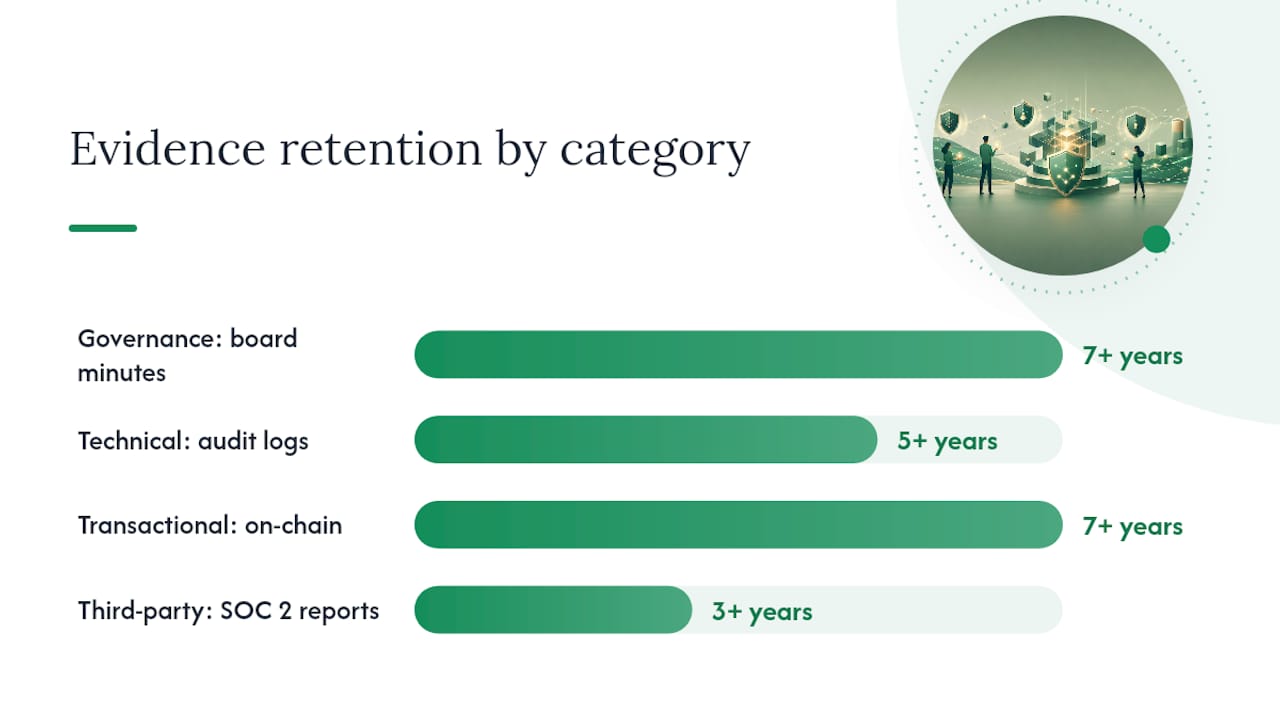
Regulators organize their review around four evidence categories. Present each category as a separately indexed binder or digital folder with an executive summary page.
| Evidence Category | Examples | Retention |
|---|---|---|
| Governance | Board minutes, policy approvals, risk appetite statements | 7+ years |
| Technical | Audit logs, key-management records, smart-contract audit reports | 5+ years |
| Transactional | On-chain snapshots, custodial statements, reconciliation reports | 7+ years |
| Third-party attestations | SOC 2 reports, vendor due-diligence sign-offs, DARE certification report | 3+ years (renew annually) |
The Basel Committee’s prudential standard requires banks to document governance, supervisory review, and disclosure under Pillars 1–3 for crypto exposures. Even non-bank enterprises benefit from adopting the same structure: it signals institutional maturity to any examiner. Regulators expect firms to document operational risk, liquidity, leverage, and disclosure approaches and to notify supervisors of crypto classification decisions proactively, not reactively.
Pro Tip: When producing evidence for an exam team, include a one-page index with document title, date, approver, and cross-reference to the relevant control. Examiners work faster when they can navigate your evidence package without asking for a guide.
How to test your response and maintain continuous assurance
Testing is where most enterprises fall short. A policy binder is not a control; a tested, exercised capability is.
- Tabletop exercises — Quarterly, scenario-based; involve Legal, Compliance, InfoSec, and Treasury; document outcomes and remediation items.
- Full forensics drills — Semi-annual; test the actual evidence-preservation and chain-of-custody workflow end to end.
- Red-team smart-contract tests — Annual; engage an independent firm to probe emergency-stop mechanisms and access controls.
- Vendor SLA audits — Annual; verify that custody and on-chain indexing providers can deliver evidence within contractually specified timeframes.
Key risk indicators to track continuously:
- Time-to-preserve-evidence (target: under four hours from trigger to hash-verified snapshot).
- KYC match rate on counterparty transactions (track weekly; flag drops below threshold).
- Custodian reconciliation delta (daily; any unexplained variance triggers an alert).
- Smart-contract audit currency (flag any contract running more than 12 months since last independent audit).
Exercise records, including objectives, scenario, participants, success criteria, and remediation tracking, become part of your certification evidence package.
Vendor and custody oversight: contractual and operational guardrails
Custody providers are your single largest third-party enforcement risk. Standard vendor onboarding is not enough.
Due-diligence checklist for custody and smart-contract providers:
- Private key management architecture and MPC implementation details.
- Smart-contract audit history (independent auditor, date, findings, remediation status).
- Disaster-recovery and business-continuity plans with tested recovery time objectives.
- Regulatory status and any prior enforcement history.
Required contract clauses:
- Right-to-audit (unrestricted, on reasonable notice).
- Evidence-delivery SLA: custodian must produce transaction records within 48 hours of a written request.
- Data portability: full export of transaction history in a machine-readable format on contract termination.
- Breach notification: 24-hour notification of any security incident affecting your assets.
- Indemnity and escrow arrangements for key-loss scenarios.
Map every vendor’s evidence outputs to a named field in your enterprise evidence repository. When an examiner asks for custodial records, you should be able to produce them in minutes, not days.
Pro Tip: Request a civil investigative demand response protocol from your custody provider before signing. If they cannot describe how they would respond to a regulatory subpoena for your transaction data, that is a red flag.

What does board engagement need to look like for regulators?
Senior management and the board must be demonstrably involved in digital asset activities and update new-product committee charters to include digital assets. “Demonstrably” is the operative word: regulators want to see evidence, not assertions.
Minimum board-level deliverables:
- Signed policy approvals with named board members and dates.
- A risk appetite statement that explicitly addresses digital-asset exposures.
- Materiality thresholds for escalation, documented in board minutes.
- A quarterly enforcement-readiness report on the board agenda.
Suggested board-report template fields:
- Current digital-asset exposures and classification.
- Open control gaps and remediation status.
- Regulatory developments (SEC, CFTC, FinCEN updates).
- Certification status (DARE renewal date, outstanding findings).
- Incident log and any near-miss events since last report.
Regulators reviewing board minutes look for evidence that the board asked hard questions, not just received updates. Document dissenting views and follow-up actions. For a detailed board-level oversight checklist, Wush’s DARE blog provides a 2026-updated template.
| Board Evidence Item | Why Regulators Care |
|---|---|
| Signed policy approvals | Proves governance was deliberate, not accidental |
| Risk appetite statement | Shows the board set limits, not just received reports |
| Quarterly readiness reports | Demonstrates ongoing oversight, not one-time review |
| Remediation approvals | Confirms the board closed known gaps |
Key Takeaways
An enterprise crypto enforcement response that survives regulatory scrutiny requires governance embedded in ERM, documented evidence produced before any trigger, and independent certification to prove readiness.
| Point | Details |
|---|---|
| ERM integration first | Map crypto controls into existing three Lines of Defence before any enforcement event occurs. |
| Evidence repository is non-negotiable | Stand up an immutable, indexed repository covering governance, technical, transactional, and third-party evidence. |
| Board engagement must be documented | Signed minutes, risk appetite statements, and quarterly readiness reports are the proof regulators expect. |
| Test before you need it | Tabletop exercises, forensics drills, and vendor SLA audits must be completed and logged annually. |
| DARE certification shortens scrutiny | Wush’s DARE credential provides a pre-built, independently attested evidence package that regulators can review in a single report. |
The gap most enterprises still haven’t closed
The conventional wisdom in crypto compliance is that having a policy is enough. It isn’t. The enterprises that navigate enforcement reviews with the least friction are the ones that treated their evidence repository as a live operational system, not a filing cabinet they open when someone asks.
What practitioners consistently underestimate is the time cost of reconstructing evidence after a trigger. Transaction logs, key-rotation records, and committee minutes that were never indexed become a weeks-long archaeology project under legal hold, and that delay reads to regulators as either disorganization or obstruction. Neither is a good look.
The smarter move is to build the evidence package as a byproduct of normal operations: every board approval goes into the repository, every vendor audit gets filed with a cross-reference, every tabletop exercise produces a dated remediation log. By the time an inquiry arrives, the package is already 80% complete. Certification through a program like DARE formalizes that discipline and gives you an independent attestation to hand an examiner on day one.
DARE gives your team a certified readiness path
Enterprises that have mapped their controls, documented their evidence, and run their exercises still face one gap: independent proof. That’s where Wush’s DARE certification closes the loop.
DARE is built specifically for compliance, legal, treasury, risk, and infosec teams at regulated institutions. The certification assessment evaluates your governance, custody, AML/KYC, smart-contract, and incident-response controls against a structured schema, produces a gap-remediation plan, and issues a verifiable, blockchain-anchored credential on completion. The resulting DARE report maps directly to the evidence categories regulators expect, so your team walks into any enforcement review with a pre-indexed, independently attested package rather than a stack of folders.
Annual renewal keeps the credential current and your controls retested. Start your DARE assessment and get a certified readiness path your board can sign off on and your regulators can rely on.
Useful sources for deeper reading
- Building Trust in a Digital Age: Essential Elements of a Digital Asset Policy | Deloitte UK
- Digital assets regulatory and compliance: PwC
- Digital Asset Risk Management: Managing Digital Asset Risk Using an Integrated, Composable Framework — Chartis Research
- SEC written proposal on digital asset infrastructure (Crypto Task Force)
- BIS FSI summary on banks’ crypto exposures
- Digital Asset Securities Control Principles (DASCP) — DTCC, Clearstream, Euroclear
- Digital Asset Risk Assessment | Deloitte US
For teams ready to move from reading to doing, the DARE certification program at Wush is the structured next step.