
What Finance Teams Should Budget for Digital Asset Certification Costs

Digital asset certification pricing varies widely, from low-cost self-study badges to high-end custom enterprise rollouts, with many professional-grade programs priced in the mid hundreds to low thousands per credential. Pricing depends on factors including the type of purchase—one-time credential, annual subscription, or enterprise licensing—as well as inclusion of continuing education credits, proctored assessments, or blockchain-based verification.
TL;DR:
- Certification costs range from $200 for basic badges to over $1,700 for CE-eligible credentials, with enterprise licenses often negotiated based on volume.
- Additional fees for proctoring, extensions, and blockchain verification can significantly increase the total price, especially when network congestion affects costs.
- CE credits linked to recognized credentials boost program value, often justifying higher prices since they support license renewal and employer reimbursement.
- Comparing quotes requires assessing inclusion of content, verification tech, renewal terms, and administrative support rather than focusing solely on sticker price.
- Verified blockchain credentials offer superior auditability for compliance purposes, with premiums justifiable when long-term proof of certification is critical.
Table of Contents
- Common Pricing Models and Representative Price Ranges
- Breakdown of Cost Components (What You Actually Pay For)
- How CE Credits, Accreditation, and Verification Tech Affect Price and ROI
- Practical Checklist: How to Evaluate and Compare Pricing Offers
- How DARE Maps Features to Pricing Line Items
- Comparison of Pricing Across Key Industry Providers
- Hidden Costs or Fees Commonly Overlooked by Buyers
- Cost-Benefit Analysis of Certification Pricing Relative to Career Advancement
- Trends in Pricing Changes Over Time: Inflation, Demand, and Market Competition
- When Paying More for Certification Actually Makes Sense
- DARE Pricing and Next Steps
- Sources
- FAQ
Common Pricing Models and Representative Price Ranges
Most digital asset certification providers price their programs one of three ways, and knowing which model you’re looking at changes how you should evaluate the quote.
Per-credential fees cover a single certification purchase, usually a fixed price for a defined content package, one assessment attempt, and issuance of the credential itself. Career-oriented certifications in this category typically run $400 to $1,700, depending on how much proctoring, CE accreditation, and support come bundled in. The Money Management Institute’s Certified in Blockchain and Digital Assets track is a useful benchmark here: it publishes a member price of $629 and a non-member price of $699, with CE hours built into that fee.
Individual annual subscriptions function more like an all-access pass. You pay once a year for ongoing access to modules, refreshed content, and sometimes a bundle of specializations rather than a single exam. This model suits professionals who expect to recertify annually or want to stack multiple credentials without paying for each one separately.
Enterprise and volume licensing is where pricing stops being a published number and starts being a conversation. Seat-based pricing typically drops as volume increases, often through tiered discounts at 25, 100, and 500+ learner thresholds, with implementation and onboarding fees layered on top.
Watch for these common add-ons across every model:
- Proctoring fees for identity-verified exam delivery
- Concierge services for compliance teams needing hands-on onboarding
- Printed materials or physical credential kits
- Custom reporting dashboards for enterprise procurement and audit teams
Breakdown of Cost Components (What You Actually Pay For)
A certification price is never one number. It’s a stack of line items, and unbundling them is the only way to compare two vendor quotes fairly.
- Learning content and access period. This covers the modules, labs, and practice exams, plus how long you can access them, ranging from 90 days to a full year.
- Credential issuance and verification method. A basic web badge costs little to issue. Blockchain anchoring or NFT-based credentials cost more per unit but create a tamper-resistant record that’s independently verifiable years later.
- Assessment delivery. Proctoring, exam retake fees, and scheduling surcharges for rush bookings all sit in this bucket.
- Support and onboarding. Some vendors bundle live onboarding and help-desk access; others sell it as a separate line item.
- Renewal and recertification. Annual or biennial renewal fees keep the credential current and usually cost less than the initial certification.
Verification technology deserves special attention because it swings the total cost more than most buyers expect. POK’s published pricing for digital credentials shows pay-per-credential blockchain verification starting around $0.30 per credential, or an annual license near $3,000 that covers tens of thousands of credentials. Other vendors price blockchain anchoring dynamically based on network congestion, which means your per-credential cost can fluctuate month to month rather than staying fixed.
Pro Tip: Ask every vendor for their fee table in writing before you compare quotes. Providers like the Institute of Business & Finance’s CDAS program publish exact retake fees and enrollment extension costs, which makes it far easier to catch hidden charges before you sign.
How CE Credits, Accreditation, and Verification Tech Affect Price and ROI
Continuing education eligibility is the single biggest lever on perceived value in this market. Programs that carry CE hours toward professional license maintenance consistently command higher prices, because the certification does double duty: it teaches the material and it satisfies a regulatory requirement your employer already has to fund. Yale School of Management’s executive education programs illustrate the pattern across finance education broadly: programs offering 18 or more CE hours get valued higher by employers and reimbursing entities than equivalent content without that accreditation attached.
That premium isn’t cosmetic. It changes the reimbursement math:
- CE-eligible programs are more likely to qualify for employer training budgets rather than coming out of an individual’s pocket
- Accreditation or endorsement from a recognized industry body shifts buyer willingness to pay upward, sometimes substantially
- Certified professionals show measurable hiring and promotion advantages in finance roles, which strengthens the case for paying more upfront
To convert this into a procurement decision, calculate cost per CE hour rather than cost per credential. A $699 program with 18 CE hours costs roughly $39 per hour of credited learning. A $300 program with no CE eligibility costs your team the same $300, but none of it counts toward license renewal, so the “cheaper” option can carry a higher effective cost once you factor in what your compliance team would otherwise pay separately for CE-qualifying training.
Practical Checklist: How to Evaluate and Compare Pricing Offers
Before requesting quotes, build a short list every vendor has to answer the same way. Inconsistent answers are usually where hidden costs live.
- Total cost per learner, inclusive of content, assessment, and issuance, not just the headline tuition figure.
- Verification type and its cost, whether that’s a web badge, blockchain anchoring, or NFT issuance, and whether that cost is fixed or variable.
- CE credit eligibility, including which bodies recognize the hours and whether documentation is provided automatically.
- Renewal terms, covering frequency, recertification fees, and whether pricing is locked for multi-year commitments.
- Administrative and onboarding fees, since these often get quoted separately from the “list price.”
- SLA for the verification API, especially for enterprise buyers who need credential status checks integrated into internal systems.
For budgeting purposes, three rough scenarios help frame the conversation:
- Single learner upskill: one per-credential fee, typically $400 to $1,700 all-in.
- Small team pilot (5 to 25 learners): per-seat pricing with modest volume discounts, often 10% to 20% off list price.
- Enterprise rollout (100+ learners): custom licensing where per-seat cost drops sharply but implementation and admin fees become the larger share of total spend.
Negotiation levers worth raising directly: multi-year discounts, volume tiers at specific headcount thresholds, and whether proctoring or CE paperwork can be bundled into the license rather than billed per learner.
How DARE Maps Features to Pricing Line Items
DARE structures its Digital Asset Readiness Evaluation around the same line items procurement teams already budget for: modular learning maps to platform subscription cost, blockchain-verified issuance maps to the verification line, and annual renewal maps to recurring recertification fees. The program is designed for professionals involved in finance, treasury, legal, risk, and information security functions and offers licensing options suitable for organizations scaling beyond pilot groups. Because the modules are structured rather than monolithic, moving from a small pilot to a full rollout adds incremental seats rather than rebuilding the governance framework from scratch.
Comparison of Pricing Across Key Industry Providers
Pricing across the digital asset certification market clusters into three visible tiers rather than a smooth continuum. At the low end, self-study badges and short-form courses run $200 to $400, usually without CE eligibility or proctored assessment. The mid tier, where most career-relevant credentials sit, runs $400 to $1,700, and this is where CE-linked programs like the Money Management Institute’s blockchain and digital assets track publish transparent member and non-member rates.
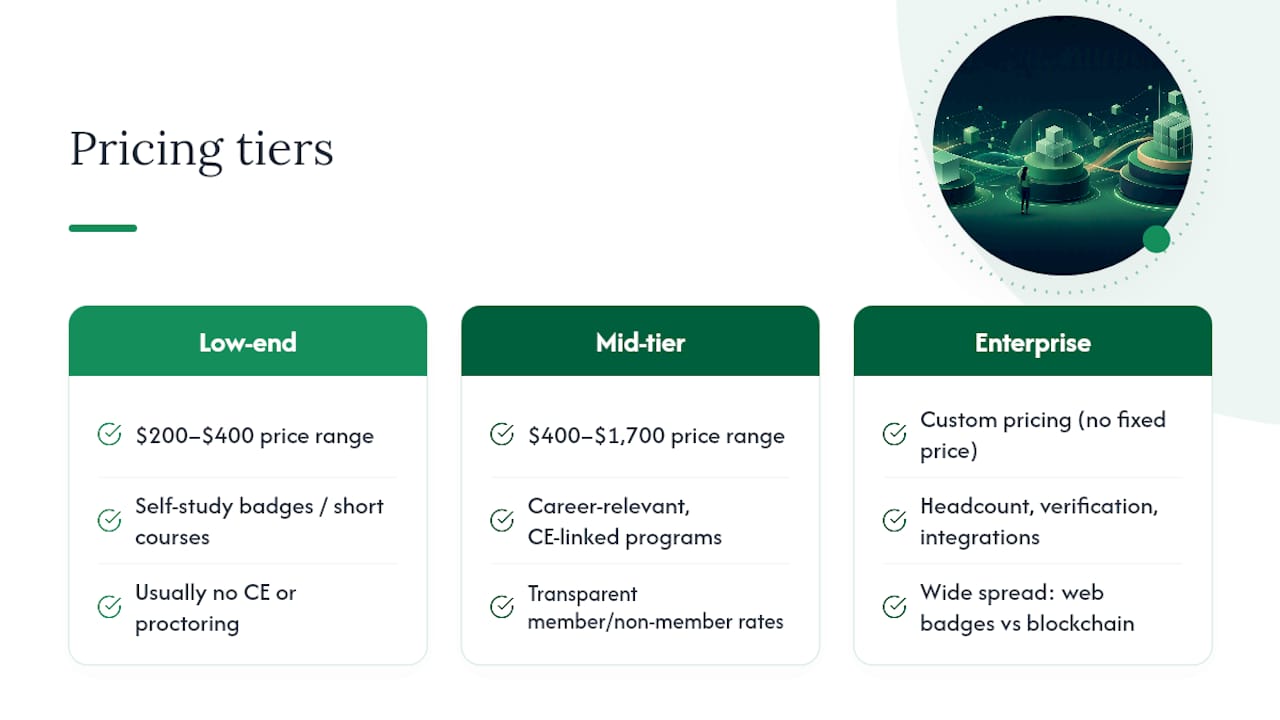
Enterprise and platform-based providers occupy a third tier entirely, quoting custom pricing that reflects headcount, verification method, and integration requirements rather than a fixed catalog price. Also, this is where verification technology choice creates the widest spread between providers: a vendor using simple web badges will quote lower per-credential costs than one anchoring every credential to a blockchain ledger, even when the underlying course content is comparable in depth.
The practical takeaway for buyers comparing providers side by side: don’t compare sticker price alone. Compare sticker price against what’s actually included, since a $699 CE-eligible credential with verified issuance can outperform a $300 credential on total value even though the invoice looks larger. Procurement teams that treat “cheapest quote” as the deciding factor routinely end up paying more later in retake fees, missing CE documentation, or unverifiable credentials that HR can’t validate during an audit.
Hidden Costs or Fees Commonly Overlooked by Buyers
The published tuition figure is rarely the final number on the invoice. Exam retake fees catch the most buyers off guard, since a failed first attempt can add $50 to $150 or more depending on the provider, and multi-attempt policies vary widely between vendors.
Enrollment extensions are another common surprise. If a learner needs more than the standard 90 or 180 day access window, providers often charge a separate extension fee rather than including it in the base price. Concierge or white-glove onboarding, frequently pitched as optional, becomes close to mandatory for larger teams that need help coordinating dozens of learners through the same assessment window, and that service typically carries its own price tag.
For blockchain-verified credentials specifically, the underlying network fee structure matters. A provider quoting dynamic, congestion-based anchoring costs can leave your budget exposed to fluctuations, unlike a flat per-credential or annual license model.
Administrative overhead is the quiet one. When scaling from a pilot to a full enterprise rollout, the biggest incremental cost usually isn’t more content access. It’s the reporting, CE paperwork, and learner administration that scales with headcount. Negotiating those administrative services into the enterprise package upfront, rather than paying for them piecemeal later, is often the single highest-leverage cost control available to procurement.
Cost-Benefit Analysis of Certification Pricing Relative to Career Advancement
The return on a digital asset certification depends less on the sticker price and more on what the credential unlocks organizationally. For an individual professional, a $699 credential that satisfies CE requirements and strengthens a promotion case pays for itself quickly if it replaces a separate CE course the employer would have funded anyway.
The calculation shifts for enterprise buyers. A $50,000 enterprise license covering 100 learners works out to $500 per seat, comparable to individual credential pricing, but the value proposition changes because the organization gains a documented, auditable governance capability across an entire team rather than one certified individual. That matters directly for compliance functions facing regulatory scrutiny on digital asset custody and controls, where having a verifiable, organization-wide competency record can shorten audit cycles and reduce the burden of demonstrating staff readiness to regulators.
The honest framing for procurement: treat certification spend as a governance investment with a career-development side benefit, not the other way around. Programs tied to recognized accreditation and verifiable issuance tend to hold their value longer because the credential remains checkable years after issuance, which matters when auditors or new employers ask for proof.
Trends in Pricing Changes Over Time: Inflation, Demand, and Market Competition
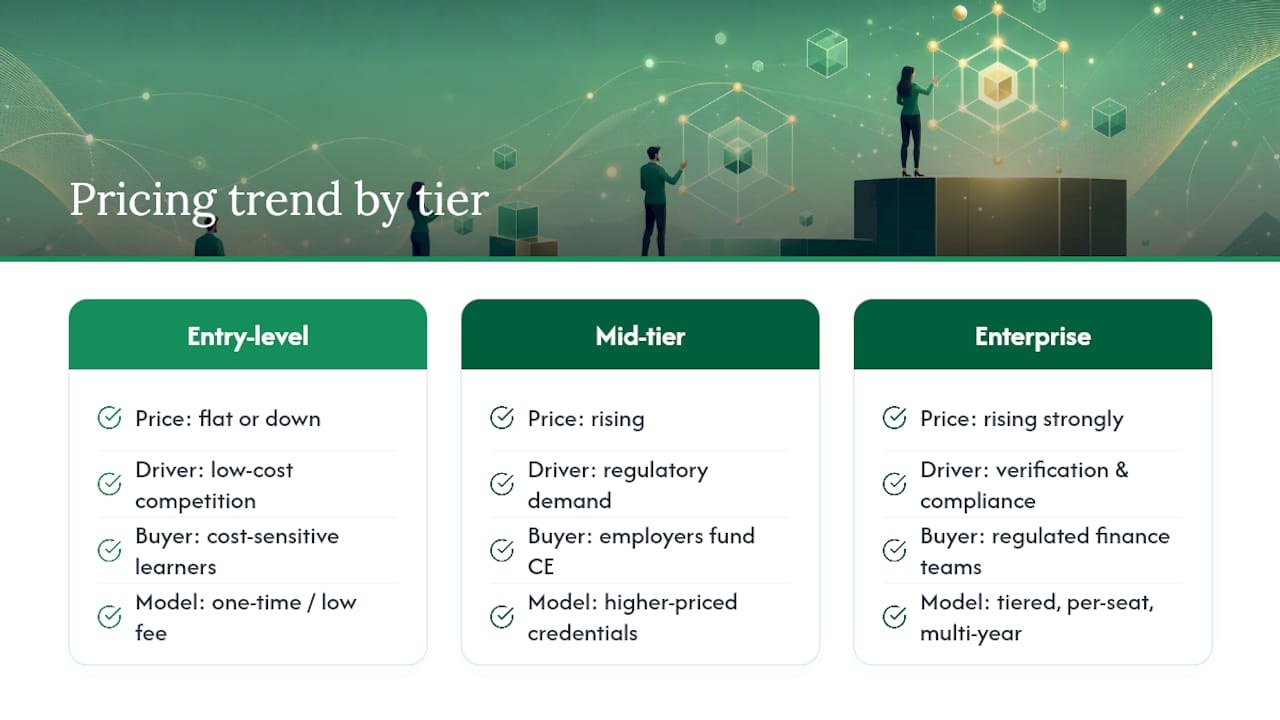
Digital asset certification pricing has moved upward over the past several years, but not uniformly. Entry-level and self-study offerings have stayed relatively flat or even dropped as competition among low-cost providers intensified. Mid-tier and enterprise-grade programs have moved the other direction, with CE-eligible and verification-backed credentials commanding higher prices as demand from regulated finance and compliance teams has grown.
Three forces are driving that split. General inflation in professional education pushes baseline course costs up across the board. Regulatory demand is the bigger factor specific to this market: as digital asset custody, treasury, and compliance functions face more scrutiny, employers are willing to fund higher-priced, CE-eligible, verifiable credentials rather than cheaper alternatives that don’t hold up under audit. Market competition among enterprise platforms is pushing toward more transparent, tiered pricing structures, since buyers increasingly expect the kind of published fee tables that make vendor comparison possible.
Expect that trend to continue. As more finance and compliance organizations build digital asset governance into formal risk frameworks, certification pricing at the top end will likely keep tracking toward enterprise software pricing norms: tiered licensing, per-seat discounts at scale, and multi-year contracts, rather than the flat one-time fees that dominated the market’s earlier years.
When Paying More for Certification Actually Makes Sense
Auditability is where I’d draw the line on spending more. If your compliance team needs to prove, years from now, that a specific person held a specific credential on a specific date, a web badge that disappears when a vendor shuts down its servers isn’t worth the discount. Blockchain-verified issuance earns its premium in exactly that scenario. If you just need a resume line for an individual contributor, a simpler badge is fine.
CE credits and recognized accreditation are the other multiplier worth paying for, since they turn a training expense into a license-maintenance expense your compliance budget already covers. For enterprise rollouts, predictable per-credential pricing and clear renewal terms matter more than shaving the last few dollars off list price.
— Gregg
DARE Pricing and Next Steps
DARE’s pricing is built around the same procurement logic this article just walked through: individual access for a single learner, team subscriptions for pilot groups, and enterprise licensing with custom quotes for organization-wide rollouts. Because DARE’s credential issuance is blockchain-verified, you get the auditability enterprise compliance teams need without piecing together separate verification and renewal vendors.
Before requesting a quote, gather three things: your expected learner count, the verification method your compliance team requires, and your CE documentation needs. That’s what shapes whether you land in individual, team, or enterprise pricing. From there, reach out to explore DARE’s certification program and request a pilot or enterprise quote directly.
Sources
Pricing and ROI claims in this article draw on published tuition and fee data from the Money Management Institute and verification pricing from POK. CE and employer reimbursement context comes from Yale SOM Executive Education, while hiring and career-impact evidence comes from the AFP. Vendor pricing examples illustrate market norms rather than universal benchmarks.
- Yale SOM Executive Education — Investment Management: Theory to Practice
- Money Management Institute — Certified in Blockchain and Digital Assets (Financial Professional Track)
- POK — Prices for digital credentials (Blockchain Verify and NFT ownership options)
FAQ
Is crypto certification worth it?
It’s worth it when the credential carries CE hours toward an existing license requirement or when your employer treats it as a governance investment rather than a personal expense; a $699 CE-eligible credential often delivers more value than a $200 badge with no accreditation.
How much does Chainalysis certification cost?
Chainalysis pricing isn’t publicly listed in a standard fee table and varies by program and access tier, so contact the provider directly for current quotes rather than relying on secondhand estimates.
How to become a certified digital asset advisor?
Most paths involve completing a structured program covering digital asset fundamentals, custody, and compliance, then passing a proctored assessment. Programs like DARE’s Digital Asset Readiness Evaluation are built specifically for finance, treasury, legal, and risk professionals moving into this role.
How much is a crypto license?
“Crypto license” usually refers to a regulatory license to operate a crypto business, which is a separate legal process from certification pricing and varies by jurisdiction and business type; it shouldn’t be confused with the $200 to $1,700 range typical of professional certification programs.
How long does crypto certification typically take to complete?
Most individual certification programs require a duration ranging from several days of self-paced study up to several weeks for programs that include proctored exams and continuing education documentation, depending on curriculum depth and delivery format.