
3 Step U.S. Crypto Regulation 2026 Readiness: 180 Day Plan for Counsel

The SEC’s March 17, 2026 interpretive release and its August 18 proposal for Regulation Crypto Assets together give crypto activity its clearest federal treatment yet. The proposal builds two offering exemptions and a conditional safe harbor called Form TR, and pairs them with active SEC–CFTC coordination. If your firm issues, custodies, or trades digital assets, the near-term task is concrete: map your tokens to the proposed categories and decide whether to file a comment before the October 20, 2026 deadline.
TL;DR:
- Firms must accurately classify tokens based on the SEC and CFTC’s taxonomy; digital commodities and utility tokens may remain outside regulation, while security-linked tokens do not.
- The proposed exemptions allow startups to raise up to five million dollars over four years with lighter disclosure, and larger offerings up to seventy-five million dollars with more extensive reporting requirements.
- Preparations should focus on building comprehensive governance, custody, and operational evidence early, as Form TR filings rely heavily on proof of network decentralization and ceased managerial efforts.
- Enforcement risks remain high, especially if certification claims about decentralization are inaccurate or if disclosures about governance and token economics do not match on-chain data.
- Cross-agency coordination between SEC and CFTC is increasing, but firms must also comply independently with existing Treasury, banking, and state regulations, emphasizing the need for integrated compliance processes.
Table of Contents
- What Crypto Regulation 2026 Actually Changes
- Who Regulates What Now: The Federal Agency Map
- Regulation Crypto Assets Explained: Exemptions and the Safe Harbor
- Practical Compliance Implications for Firms, Issuers, and Intermediaries
- Your Readiness Checklist: What To Do in the Next 180 Days
- How 2026 Rules Compare to Prior Years
- Impact Across Exchanges, DeFi Projects, and Investors
- Enforcement Risk Under the New Framework
- International Perspectives on U.S. Crypto Regulation
- DARE’s Take: Turning Disclosure Rules Into Governance Practice
- Key Primary Sources and Further Reading
- Sources
What Crypto Regulation 2026 Actually Changes
Two documents anchor crypto regulation 2026, and reading them out of order is where most legal teams get confused. The interpretive release came first. The proposed rule came five months later, and it depends on the taxonomy the release established.
On March 17, 2026, the SEC and CFTC issued a joint interpretive release clarifying how federal securities laws apply to crypto assets and the transactions built around them. The release sorted crypto activity into working categories rather than treating every token the same way:
- Digital commodities — assets functioning as a medium of exchange or store of value without an issuer’s ongoing managerial promise.
- Collectibles — non-fungible assets whose value derives from scarcity or provenance rather than an enterprise’s efforts.
- Digital tools — utility tokens tied to access rights within a network or protocol.
- Stablecoins — payment-focused tokens pegged to fiat or other reference assets, largely governed by the separate GENIUS Act statute enacted in 2025.
- Digital securities — tokens that still satisfy the Howey test because holders depend on a promoter’s ongoing managerial efforts.
That taxonomy matters because it tells you which assets even need the new exemptions. A digital commodity or a genuine utility token may never touch Regulation Crypto Assets at all. A token still tethered to founder promises almost certainly does.
The SEC proposed Regulation Crypto Assets on August 18, 2026, and it does three things at once: it creates two tailored offering exemptions, it builds a conditional safe harbor for tokens that mature into genuine decentralization, and it preempts state securities registration for issuers who qualify. This is the first time the agency has offered a structured, rules-based exit ramp from securities treatment rather than a case-by-case no-action letter.
Key dates to calendar right now:
The rule was published in the Federal Register on August 21, 2026 under File No. S7-2026-27, with public comments due October 20, 2026. It remains a proposal, not a final rule. Nothing in it is binding yet, but the comment window is the last real chance to shape the final text before it hardens into law.
Treat the gap between “proposed” and “final” carefully in your own compliance memos. Counsel who write “Regulation Crypto Assets requires X” without the qualifier “as proposed” are setting up a credibility problem the moment the SEC adopts amendments, which historically happens in nearly every rulemaking of this scale.
Who Regulates What Now: The Federal Agency Map
No single regulator owns crypto, and 2026 didn’t change that. What changed is how loudly the SEC and CFTC now admit they’re supposed to work together.
The SEC’s jurisdiction still runs through the Howey test: does a token represent an investment of money in a common enterprise with profits expected from a third party’s efforts? The March interpretive release didn’t rewrite that legal standard. It clarified how to apply it to modern token structures, particularly staking rewards and protocol mining, both of which had lived in gray areas for years. The release signals that staking rewards tied to network validation, absent a promoter’s managerial promise, generally sit outside securities treatment. Tokens still dependent on a founding team’s continued development do not.
The CFTC holds commodity jurisdiction, and 2026 saw it lean into that role more assertively. The agency issued guidance and approvals on products like perpetual futures, extending its market-structure oversight further into crypto derivatives than in prior years. Firms running leveraged or derivative crypto products now answer to the CFTC’s rulebook in ways that were murkier three years ago. A closer look at CFTC crypto regulation and what it means for legal and compliance teams is worth your time if derivatives touch any part of your product line.
The coordination piece is what’s genuinely new. The SEC and CFTC signed a Memorandum of Understanding in March 2026 as part of what’s been branded Project Crypto, aiming to harmonize oversight and cut down on the duplicative, contradictory requirements firms faced when the two agencies issued guidance independently. Policy trackers following the MOU describe it as a deliberate shift toward joint examinations and shared interpretive positions, rather than two agencies working from separate, sometimes conflicting, rulebooks.
Beyond the SEC and CFTC, three other regulatory layers still apply in full:
- Treasury and FinCEN continue to enforce anti-money-laundering rules and OFAC sanctions screening on crypto transactions, unchanged by either 2026 action.
- Banking regulators (the OCC, FDIC, and Federal Reserve) retain authority over bank-affiliated custody arrangements and stablecoin-related banking activity, largely under the framework the GENIUS Act established in 2025.
- State securities and banking regulators lose some ground under Regulation Crypto Assets specifically, since the proposal aims to preempt state registration for qualifying offerings, but state money-transmitter licensing and consumer-protection statutes remain fully in force.
If your compliance program still treats these as five separate checklists, 2026 is the year to consolidate them into one integrated review, because examiners increasingly are.
Regulation Crypto Assets Explained: Exemptions and the Safe Harbor
The proposed rule is built in subparts, and understanding the architecture matters more than memorizing every subsection number. Subpart A sets definitions and scope. Subparts B and C house the two offering exemptions. Subpart D contains the Form TR safe harbor. Subpart E addresses preemption and state law interaction. Rule 103(b), tucked into the disclosure requirements, is the section every general counsel should read twice, because it dictates what you’ll actually have to tell investors.
The two exemptions work at different scales and carry different obligations.
| Exemption | Offering cap | Time window | Disclosure burden |
|---|---|---|---|
| Startup exemption | $5 million | Rolling 4-year period | Lighter, principles-based narrative disclosure |
| Fundraising exemption, lower tier | Modeled on Regulation A tiers | 12-month period | Moderate narrative disclosure |
| Fundraising exemption, upper tier | Up to $75 million | 12-month period | Financial statements plus ongoing reporting |
The startup exemption caps at $5 million raised over four years, aimed squarely at early-stage protocol teams who need seed capital without triggering full registration. The fundraising exemption scales up from there, borrowing structural cues from the existing Regulation A framework, and tops out at $75 million raised in a rolling 12-month period for issuers willing to accept heavier disclosure and reporting duties. The tradeoff is explicit: raise more, disclose more.
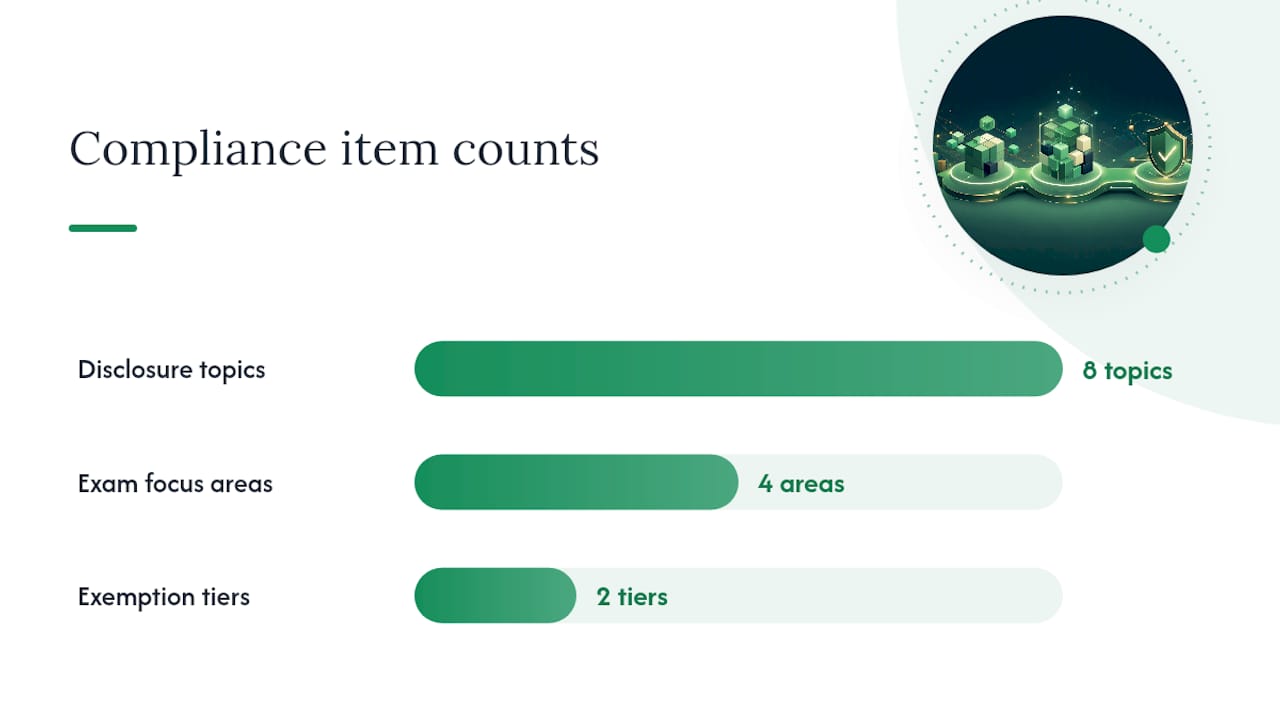
Rule 103(b) lists the disclosure topics that apply once you’re inside either exemption: a description of the covered investment contract, the mechanics of the offering itself, the nature of the underlying crypto asset, management structure and conflicts of interest, governance arrangements, risk factors specific to the protocol, notes on source code transparency, and token economics including supply schedules and vesting terms. None of this is boilerplate. A team that can’t articulate its own token economics clearly enough to satisfy Rule 103(b) has a problem that predates the SEC’s rule.
The safe harbor is the proposal’s most consequential piece, and also its most legally untested.
Rule 400 creates a mechanism built around a new filing called Form TR. Filing it certifies that a network has crossed into genuine decentralization and that the original promoter’s essential managerial efforts have permanently ceased. If the certification holds, the token exits securities treatment altogether. This is the exit ramp founders have wanted since the ICO boom of 2017 and 2018, formalized for the first time into an actual filing rather than a lawyer’s comfort letter.
The catch is the standard itself. “Permanently ceased essential managerial efforts” is a fact-intensive test, and the SEC’s own proposed release makes clear that a Form TR filing is only as strong as the evidence behind it. A network with an active foundation still publishing roadmaps, merging code, or influencing governance votes is going to struggle to certify anything close to “permanently ceased.” Expect Form TR filings to draw sustained scrutiny, and expect the earliest filers to become de facto test cases for how strictly the SEC reads its own standard.
The preemption piece is more straightforward. Where an issuer properly relies on either exemption, the proposal blocks state securities regulators from imposing separate registration requirements on the same offering. That doesn’t touch state money-transmitter licensing or consumer-protection law, which stay firmly in place regardless of federal exemption status.
Practical Compliance Implications for Firms, Issuers, and Intermediaries
Reading the rule is the easy part. Operationalizing it inside a real compliance function is where the actual work begins, and where most of the proposal’s cost will land.
Start with the disclosure obligations, because they touch every team from legal to engineering. If you’re relying on either exemption, Rule 103(b) requires you to produce and maintain accurate disclosure across eight topics simultaneously: the investment contract itself, offering mechanics, the underlying asset’s function, management and conflicts, governance, protocol-specific risk factors, source code transparency notes, and token economics. Firms that already publish clean documentation on strategic risk disclosure examples for boards have a real head start over teams starting from scratch.
Reporting obligations scale with exemption tier. The upper fundraising tier, capped at $75 million, requires financial statements and ongoing periodic reporting, not a single point-in-time disclosure. That’s a materially different operational lift than the startup exemption’s lighter narrative approach, and treasury teams need to budget for recurring reporting cycles the same way they would for any other periodic SEC filing. A structured reporting obligations guide for 2026 helps map which cadence applies to which tier before your first filing deadline arrives.
Enforcement posture is shifting too, even though the rule hasn’t been finalized. Antifraud and antimanipulation provisions apply regardless of exemption status, meaning a startup relying on the $5 million exemption gets zero relief from fraud liability just because its disclosure burden is lighter. Examiners are likely to focus on four areas once the rule takes effect:
- Whether disclosed token economics match on-chain reality, including supply schedules and vesting.
- Whether governance disclosures reflect who actually controls upgrade keys and treasury funds.
- Whether Form TR certifications rest on documented evidence rather than aspirational claims.
- Whether custody arrangements for investor funds meet existing broker-dealer and qualified custodian standards.
Custody, broker-dealer registration, staking, and derivatives products each carry their own regulatory touchpoints layered on top of the new exemptions. A platform that custodies client assets still needs to satisfy existing custody rules regardless of how its tokens are classified. A firm offering staking-as-a-service needs to revisit whether its staking product itself constitutes a separate securities offering, a question the March interpretive release addresses but doesn’t fully resolve for every business model. Derivatives desks answer to the CFTC’s expanding perpetual futures guidance on top of anything the SEC proposes.
Pro Tip: Don’t wait for the final rule to start your disclosure drafting. Build your Rule 103(b) narrative now using the proposed text as a template. If the SEC amends specific line items after the comment period, you’re editing an existing document instead of starting from a blank page under deadline pressure.
Your Readiness Checklist: What To Do in the Next 180 Days
Treat this as a compliance program rollout, not a legal memo you file away. The firms that move early on documentation will file cleaner Form TR submissions and draft sharper comment letters than the ones scrambling in September.
-
Days 1 to 30: Map and inventory. Assign counsel to classify every token your firm issues, holds, or facilitates trading in against the five categories from the March interpretive release. Simultaneously inventory every public statement your team has made about roadmap plans, governance changes, or managerial involvement. Those statements will matter enormously if you ever attempt a Form TR filing, so pull them together before memories fade or personnel turn over. Begin drafting Rule 103(b) disclosure templates in parallel, even for tokens you believe fall outside securities treatment.
-
Days 30 to 90: Build the evidence base. Treasury and finance teams should confirm financial statement readiness for any offering likely to hit the upper fundraising tier. Engineering and legal need to jointly document governance history: who held admin keys, when control transferred to the community, what the current upgrade process looks like. This is where a Form TR certification lives or dies. A useful evidence package includes governance meeting minutes, engineering change logs showing declining founder commits, on-chain data demonstrating distributed transaction activity, and third-party attestations where available. That package functions less like a legal opinion and more like an operational audit trail, and it needs to exist before regulators ask for it, not after.
-
Days 90 to 180: Finalize, test, and decide. Run a tabletop exercise simulating an SEC or CFTC examiner’s questions about your disclosures and your Form TR evidence, if you’re pursuing that path. Brief your board and key stakeholders on which exemption path the firm intends to rely on and why. Decide, as a firm, whether to submit a formal comment letter before October 20, 2026. If any provision in Rule 103(b) or the exemption caps creates a genuine operational problem for your business model, the comment period is your only structured opportunity to say so before the rule locks in.
Pro Tip: Assign a single owner for the Form TR evidence package from day one. Split across legal, engineering, and treasury, it will scatter across email threads and Slack channels. Consolidated under one owner, it becomes a defensible file you can hand to outside counsel or an examiner on short notice.
Read broader step-by-step planning frameworks in this compliance readiness guide for 2026 if you’re building this checklist into a formal internal audit process rather than an ad hoc project.
How 2026 Rules Compare to Prior Years
Crypto regulation before 2026 ran almost entirely on enforcement actions and no-action letters. The SEC brought cases, courts issued fact-specific rulings, and everyone else guessed at the boundaries from the sidelines. There was no structured exemption path and no formal mechanism to exit securities treatment once a token had been sold as an investment contract.
Regulation Crypto Assets changes the mechanism, not just the outcome. Instead of litigating decentralization case by case, the SEC now offers a filing, Form TR, that lets a project make its case proactively. Instead of a binary registered-or-not framework, issuers get two tiered exemptions calibrated to raise size. That’s a meaningfully different posture from the enforcement-first approach that defined the years following the 2017 to 2018 token boom.
The other shift is institutional tone. The interpretive release and the proposed rule both reflect what the SEC’s own Crypto Task Force has described as a fit-for-purpose approach: tailored disclosure obligations sized to the actual risk profile of an offering, rather than forcing every token issuer through registration requirements built for traditional public companies. Whether that approach survives the comment period intact, or whether the SEC has to build in the technical fixes counsel are almost certainly going to request over the next few months, is the open question heading into 2027.
Impact Across Exchanges, DeFi Projects, and Investors
The effects split unevenly across the market. Centralized exchanges get clearer listing standards, since they can now evaluate whether a token qualifies for an exemption or a Form TR safe harbor before deciding whether to list it. That clarity cuts legal risk on the listing side, but it also raises the bar: exchanges that once listed tokens on thin diligence now have a documented federal standard they’ll be expected to have checked against.
DeFi projects face the trickiest calculus. A protocol that genuinely has no controlling entity may find Form TR a natural fit, formalizing what founders have argued informally for years. A protocol where a foundation still holds upgrade keys or actively manages a treasury is going to find the certification standard difficult to satisfy honestly, and filing prematurely creates its own liability exposure.
Investors gain more consistent disclosure, at least from issuers who use the new exemptions rather than avoiding U.S. markets altogether. The upper fundraising tier’s financial statement requirement gives retail and institutional buyers something closer to the disclosure quality they’d expect from a traditional securities offering. The tradeoff is that smaller startup-exemption offerings, capped at $5 million, carry lighter disclosure by design, meaning investor protection there still leans heavily on antifraud enforcement rather than upfront transparency.
Enforcement Risk Under the New Framework
Antifraud and antimanipulation liability doesn’t shrink just because an offering fits inside an exemption. That’s the single most important thing risk and legal teams need to internalize about crypto regulation 2026. Exemptions relieve you of registration burden. They don’t relieve you of liability for misrepresenting your token, your roadmap, or your governance structure.
The likeliest enforcement flashpoint is Form TR itself. A certification claiming “permanently ceased essential managerial efforts” that later proves inaccurate, because a founding team quietly kept pushing protocol upgrades, creates exposure that’s arguably worse than never filing at all. It’s an affirmative representation to the SEC, and affirmative representations that don’t hold up invite exactly the kind of enforcement action the safe harbor was designed to help firms avoid.
Expect coordinated examinations to be the new normal rather than the exception. Because the SEC and CFTC now share findings under their MOU, a compliance gap flagged by one agency is increasingly likely to surface in the other’s review. Programs still organized around separate securities, commodity, and AML silos are the ones most likely to get caught flat when a joint examination arrives asking questions that cross all three domains at once.
International Perspectives on U.S. Crypto Regulation
The United States isn’t moving alone, but it isn’t fully aligned with other major markets either. The European Union’s Markets in Crypto-Assets framework took a more prescriptive, licensing-first approach years before the SEC’s 2026 proposals, requiring authorization before most crypto services can operate across the bloc. The U.S. approach, by contrast, leans on tailored exemptions and a decentralization-based exit mechanism, a structurally different philosophy even where the underlying investor-protection goals overlap.
Asian financial centers have generally moved toward calibrated licensing regimes of their own, distinguishing exchanges, custodians, and issuers as separate regulated activities rather than folding everything into one securities framework. The U.S. model’s emphasis on a single federal safe harbor for decentralization is, so far, a distinctly American experiment. No other major jurisdiction has proposed anything structurally identical to Form TR.
For compliance teams at firms operating across borders, the practical takeaway is that harmonization within the U.S. under the SEC–CFTC MOU doesn’t extend to harmonization with foreign regulators. A token that qualifies for a U.S. safe harbor still needs a separate compliance analysis for every other jurisdiction where it trades or where your users reside.
DARE’s Take: Turning Disclosure Rules Into Governance Practice
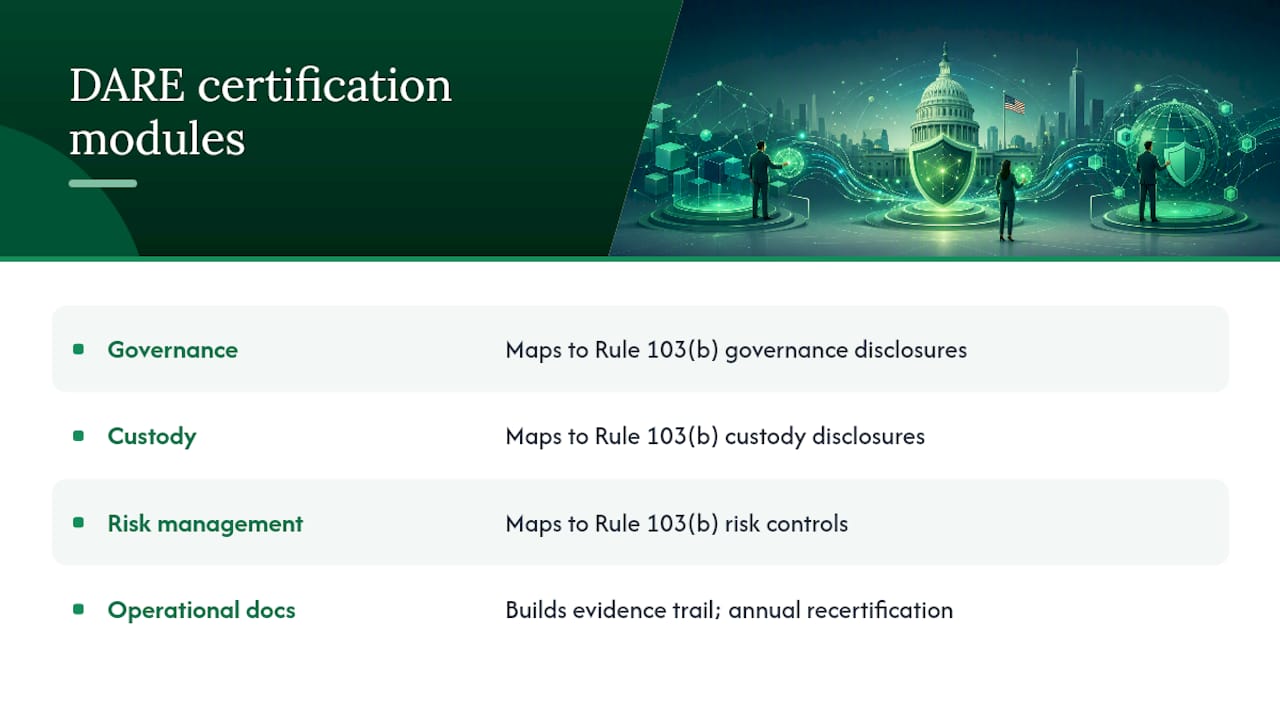
Reading a 100-plus page proposed rule and turning it into an operational compliance program are two very different skills, and most firms underestimate the gap between them. Rule 103(b)'s disclosure topics map almost directly onto the governance, custody, operational control, and risk management domains that any serious digital asset governance program already needs to cover. That’s not a coincidence. Regulators have effectively told the market what “good governance” looks like on paper, and now it needs to look that way in practice.
A Digital Asset Readiness Evaluation certification can be built around exactly that overlap, with modular assessments to walk finance, legal, risk, and technology teams through the same categories Rule 103(b) demands: governance structure, custody arrangements, risk management controls, and operational documentation. The value isn’t just passing a one-time exam. It’s building the continuous evidence trail that a Form TR filing, an ongoing reporting obligation, or a coordinated SEC–CFTC examination will eventually demand anyway.
That’s the part conventional legal memos tend to skip. A opinion letter tells you what the rule says. It doesn’t build the governance minutes, the documented control testing, or the annual renewal discipline that turns a legal conclusion into something an examiner can actually verify months or years later. Annual recertification built into the structure by design mirrors exactly the kind of ongoing reporting posture the SEC is now asking larger issuers to maintain under the fundraising exemption’s upper tier.
Firms that treat crypto regulation 2026 as a documentation exercise, something to file and forget, are going to find themselves exposed the first time an examiner asks for evidence rather than a legal opinion. Firms that treat it as a governance practice, built and maintained the way any other regulated financial activity is maintained, will be the ones still standing comfortably when the final rule lands.
— Gregg
Key Primary Sources and Further Reading
For direct verification, start with the SEC’s own materials rather than secondary summaries. The SEC’s press release on Regulation Crypto Assets lays out the proposal’s core structure, while the full Federal Register entry under File No. S7-2026-27 contains the actual rule text and the October 20, 2026 comment deadline.
The March 2026 interpretive release explains the asset taxonomy that underpins the later proposal, and the SEC’s Crypto Task Force page tracks ongoing agency statements as the rulemaking evolves. For cross-agency context, policy trackers covering the SEC–CFTC MOU offer regularly updated summaries of coordination developments worth bookmarking through the comment period and beyond.
Sources
- SEC Proposes New Regulation Crypto Assets
- Application of the Federal Securities Laws to Certain Types of Crypto Assets and Certain Transactions Involving Crypto Assets