
Enterprise Teams: Crypto Governance Certifications with Annual Renewal

Yes, crypto governance certification programs are worth pursuing if you work in compliance, risk, legal, or treasury and your organization touches digital assets, because the credential signals verifiable, structured competency that generic crypto literacy can’t. Executive short courses fit senior decision makers who need regulatory context fast; industry-body programs suit compliance and AML specialists; independent, enterprise-grade certifications like DARE fit teams that need ongoing, auditable governance capability rather than a one-time diploma.
TL;DR:
- Certification programs vary in depth, with enterprise-grade options like DARE focusing on operational controls, custody, and incident response for ongoing governance needs.
- Look for programs with transparent syllabi, proctored assessments, and credentials endorsed by regulators or industry bodies to ensure long-term credibility and relevance.
- Typical formats include self-paced courses for foundational knowledge, instructor-led cohorts for applied skills, and intensive executive courses for regulatory context, each with different time commitments.
- Regular curriculum updates and renewal policies are critical, as regulatory requirements in crypto evolve rapidly and outdated training quickly lose value.
- Verifiable credentials with renewal cycles are essential for demonstrating ongoing compliance readiness and trustworthiness to regulators and clients.
Table of Contents
- What Modern Crypto Governance Certification Programs Actually Teach
- How to Evaluate a Crypto Governance Certification Before You Commit
- Program Formats and How Much Time They Actually Take
- Who Actually Benefits From a Governance Credential, and How Employers Read It
- Where to Find Credible Crypto Governance Education
- How DARE Structures an Enterprise-Ready Governance Certification
- Credential Type and Continuing Education Recognition
- Cost and Typical Fee Ranges
- Do Certification Programs Keep Up With Crypto Regulation?
- Prioritizing Governance Training Heading Into 2026
- Get Your Team DARE Certified for Enterprise-Grade Governance
- Sources
- FAQ
What Modern Crypto Governance Certification Programs Actually Teach
Ask five different providers what “crypto governance training” covers and you’ll get five different answers. That’s partly because the field is young, and partly because programs split into two camps: ones built for concept literacy and ones built to produce someone who could walk into a boardroom and defend a custody policy.
The stronger programs converge on a similar core curriculum, even when the packaging differs. Expect modules on:
- Governance models, including how decision rights get distributed across centralized entities, consortiums, and decentralized autonomous organizations
- On-chain and off-chain voting mechanisms and how they interact with legal accountability structures
- Tokenomics and how incentive design intersects with governance risk
- Custody controls, including key management, multi-signature architecture, and third-party custodian due diligence
- AML/CFT frameworks specific to crypto, not adapted from traditional banking without modification
- Global regulatory frameworks and cross-border standards
- Risk management and incident response for digital asset operations
- Identity and access management for wallets, exchanges, and internal systems
Stanford Law School’s Blockchain Governance course is a useful reference point for academic depth. It covers DAO tooling, governance mechanisms, and privacy alongside the regulatory landscape, showing how a serious program treats governance as both a technical and a legal discipline. That dual framing matters. A program that teaches only policy without touching how custody or transaction structure actually works tends to produce governance frameworks that don’t survive contact with an actual audit.
The practical components separate a certificate that looks good on LinkedIn from one that changes how you work. Look for case studies drawn from real enforcement actions, forensic tracing exercises, policy template libraries you can adapt for your own organization, and tabletop simulations where you respond to a live incident scenario, like a compromised custody wallet or a sanctioned-address exposure. ACAMS builds proctored assessment into its cryptoasset and blockchain certificates, which pushes candidates past passive video watching into demonstrated skill.
The depth gap between a two-day executive briefing and a full certificate track is real, and it’s not just about hours. A short course gives you enough vocabulary and regulatory awareness to ask the right questions in a board meeting. A full track, often spanning modular assessments over several weeks, gives you enough depth to write the policy the board is asking about. Both have a place. Neither substitutes for the other.
How to Evaluate a Crypto Governance Certification Before You Commit
Most professionals compare programs by price and duration. That’s the wrong starting point. Price and duration tell you almost nothing about whether the certification will hold up when a regulator, auditor, or client asks you to prove competency.
Run any candidate program through this framework instead:
- Audience fit. Was this built for your role, or adapted from a general crypto course? A treasury analyst and a board director need different depth on the same topics.
- Syllabus transparency. Can you see the actual module list and learning objectives before paying, or does the provider hide the syllabus behind a sales call?
- Assessment rigor. Is there a proctored exam, a practical project, or a scored simulation, or does “certification” just mean you clicked through video modules?
- Accreditation or endorsement. Is the credential recognized by a regulator, industry body, or professional association, or is it self-declared?
- Instructor credentials. Do instructors have documented governance, compliance, or regulatory experience, or are they general blockchain educators?
- Enterprise features and renewal policy. Does the provider support group licensing, verifiable digital credentials, and an annual renewal or continuing education requirement to keep the certification current?
Red flags show up fast once you know where to look. A program with no visible syllabus, learning outcomes phrased as vague aspirations (“understand blockchain governance”), no assessment component beyond a completion certificate, or marketing copy heavier on buzzwords than curriculum detail should drop to the bottom of your list. So should any provider that can’t tell you how the credential gets renewed or updated.
Pro Tip: Ask the vendor rep to show you a sample module and a sample assessment question before you sign anything. A provider confident in its curriculum will show you the material; one that stalls or redirects to a demo call usually has less substance behind the marketing.
When you’re the one running procurement, or building the business case for your own enrollment, bring these questions to the conversation:
- What percentage of the program is assessed versus passively consumed?
- How is the credential verified? Is it a PDF certificate or a cryptographically verifiable credential?
- What happens after 12 months? Is there a renewal fee, a refresher module, or full recertification?
- Can the provider name specific regulatory changes it has incorporated into the curriculum in the last year?
- Does the program offer enterprise or group pricing, and does it track completion across a team?
If a provider can’t answer the renewal question clearly, treat that as a signal the certification wasn’t designed with long-term compliance use in mind.
Program Formats and How Much Time They Actually Take
Format determines almost everything else, from what you’ll retain to how much your employer will pay.
- Self-paced e-learning works best for foundational concepts. Expect 10 to 30 hours spread over a few weeks. Good for building vocabulary before a live cohort, weaker for developing judgment under pressure.
- Instructor-led cohorts run over several weeks with scheduled sessions and peer discussion. This format suits applied learning, especially when the curriculum includes group case work or live Q&A with practitioners who’ve handled real incidents.
- Executive short courses, often one week and delivered in-person or intensively online, focus on policy and regulatory context rather than hands-on technical skill. LSE’s international crypto asset and digital financial regulation course is a clear example: a concentrated week aimed at people who need to understand the regulatory matrix, not execute the operational controls themselves.
- Blended models combine self-paced foundations with an in-person or live applied component. FINRA’s Crypto and Blockchain Education Program, developed with Georgetown University, pairs e-learning with an applied learning course, and that hybrid structure is becoming the preferred model among practitioners who want both breadth and hands-on practice.
Format shapes price and perceived credibility as much as content does. A one-week executive course at a known university commands a premium partly for the credential and partly for the cohort network. A blended program with proctored assessment tends to carry more weight with employers than a purely self-paced track, because it proves the learner did the work rather than clicked through slides.
Employer support patterns follow the same logic. Companies sponsor blended and executive programs more readily than self-paced ones, because the completion signal is stronger and easier to defend in a budget review.
Who Actually Benefits From a Governance Credential, and How Employers Read It
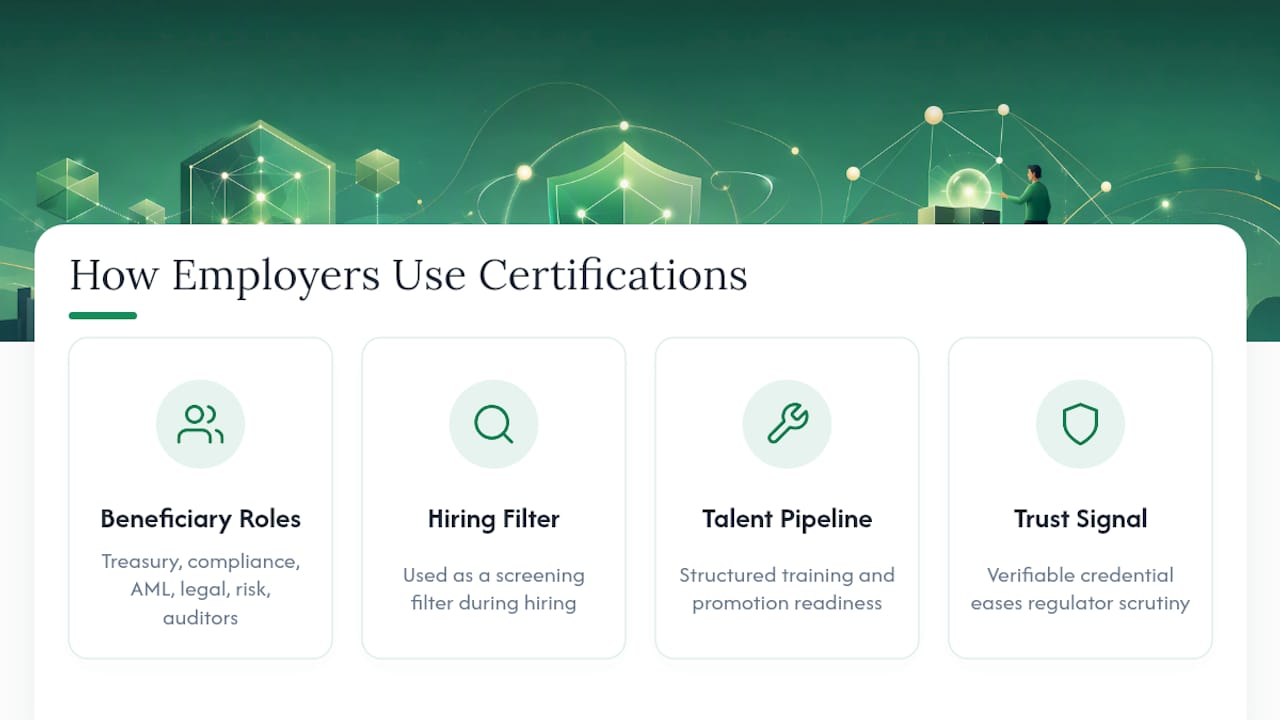
Treasury professionals, compliance officers, AML analysts, legal counsel, risk managers, governance leads, and auditors see the clearest return on a governance certification. These are roles where a credential functions as proof of competency to a client, a regulator, or an internal audit committee, not just a resume line.
Employers use certifications in three concrete ways: as a screening filter during hiring, as a structured pipeline for internal training and promotion readiness, and as a trust signal to clients or regulators who ask how the firm verifies staff competency on digital asset risk. That last use case matters more than most candidates realize. A regulated financial institution that can point to a documented, verifiable credential across its risk and compliance staff has an easier conversation with examiners than one relying on informal, undocumented expertise.
Demand for crypto governance expertise among financial professionals keeps building, and both regulators and universities are answering with targeted programs rather than generic crypto courses, based on how FINRA has invested in practitioner-focused training built with an academic partner.
Be realistic about salary impact. No credible source publishes a clean, verified figure for how much a single certification moves a paycheck, and any number claiming otherwise should be treated with suspicion. What employers actually look for is evidence of practical skill and a verifiable assessment behind the credential, not the name of the course on a resume. A certification with a proctored exam and a real case-based project carries more hiring weight than one with a completion badge and no test behind it.
Where to Find Credible Crypto Governance Education
Provider categories break down into four rough types, and each trades off differently on cost, depth, and recognition.
- University executive education offers strong regulatory and policy depth plus cohort networking with senior peers. Expect selective admission and higher fees, but also the strongest brand recognition on a resume.
- Industry and regulatory programs lean compliance-first, often with proctored exams and recognition inside specific sectors like anti-financial-crime. ACAMS’s crypto and blockchain certificates fall into this category, and they carry weight specifically because compliance teams already recognize the ACAMS name.
- Professional training vendors move faster to market with practical, modular content at lower price points, useful for teams that need quick upskilling without a semester-long commitment.
- Independent certification platforms, DARE among them, focus on enterprise features: modular assessments, verifiable credentials, group licensing, and structured renewal cycles built specifically for organizations managing ongoing governance risk rather than individuals collecting a one-time badge.
If you’re comparing aggregated listings across provider types, resources like GetVoucher’s certification directory can help you scan what’s available before narrowing your search to programs matched to your specific role.
How DARE Structures an Enterprise-Ready Governance Certification
DARE, short for Digital Asset Readiness Evaluation, was built specifically for the enterprise governance gap that generic crypto courses don’t close. The certification runs on modular learning paired with structured assessments, and the credential itself is blockchain-verifiable rather than a static PDF. Annual renewal keeps the certification tied to current regulatory and technical standards rather than freezing knowledge at enrollment date.
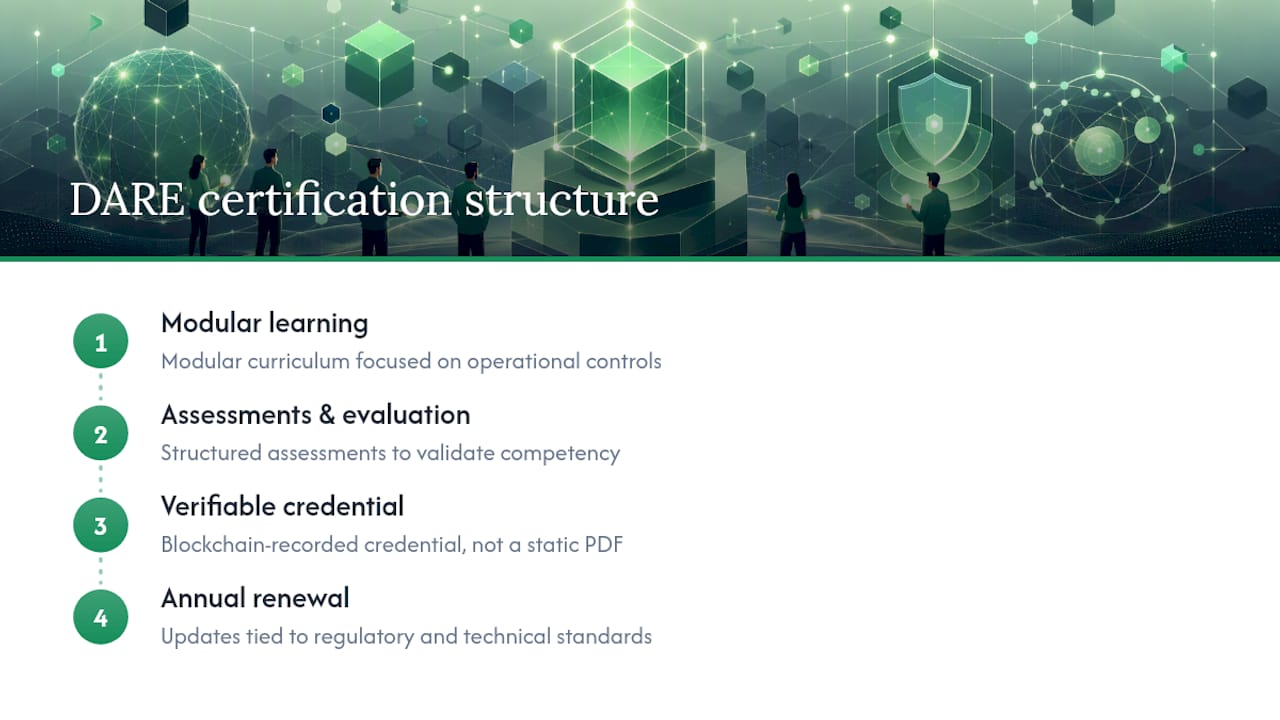
Treasury teams, legal advisors, risk managers, information security personnel, and executives overseeing digital asset operations make up the core user base. That focus shapes the curriculum toward operational controls: custody, compliance workflows, and incident response, not abstract blockchain theory. Enterprise risk teams get the most value from certifications that pair a governance framework with usable assets like policy templates and oversight checklists, and DARE’s structure reflects that priority directly.
Readers evaluating fit for their own organization can review platform details and program structure on the DARE site.
Credential Type and Continuing Education Recognition
Not every “certification” issues the same kind of credential, and the difference matters more than most buyers realize when they’re comparing programs.
Some programs issue a completion certificate: proof you finished the material, with no independent verification of what you actually retained. Others issue a proctored, assessed credential, which usually carries more weight in hiring and audit contexts because a third party can confirm the holder passed a scored evaluation. A smaller group issues cryptographically verifiable credentials, where an employer or regulator can confirm authenticity directly rather than trusting a claim on a resume.
Accreditation adds another layer. A credential endorsed by a recognized industry body, university, or regulator carries more external trust than a self-declared certification, even when the underlying content is comparable. This is where continuing professional development policy becomes a real differentiator. Renewal or CPD is common practice across credible programs, since certifications that lack a renewal or continuing education process tend to lose relevance fast in a field where regulatory guidance shifts every year. A credential that expires or requires periodic reassessment forces the holder to stay current, which is exactly the point of governance training in the first place.
When comparing programs, ask directly whether the credential requires annual renewal, what the renewal process involves, and whether continuing education hours count toward any external professional designation you already hold, like a CAMS or a legal bar requirement.
Cost and Typical Fee Ranges
Pricing varies more by format than by content depth, which surprises a lot of first-time buyers.
Self-paced foundational courses tend to sit at the low end, often free to a few hundred dollars, reflecting minimal instructor involvement and no proctored assessment. Industry-body certificates with proctored exams and specialist tracks cost more, since they carry assessment overhead and third-party recognition. University executive short courses sit at the premium end, reflecting instructor caliber, cohort size limits, and campus or live delivery costs, sometimes running into several thousand dollars for a single week.
Independent enterprise certification platforms generally price around subscription or license models rather than one-time course fees, since the credential requires annual renewal and ongoing access to updated modules. That structure shifts the cost conversation from “how much for the course” to “how much for a year of verified, current governance capability across the team,” which is a different budget line entirely, and usually a more defensible one to a finance committee that already understands subscription software costs.
Enterprises weighing group licensing should ask providers directly for volume pricing, since per-seat costs typically drop as team size increases, and some providers bundle enterprise features like centralized progress tracking into the group rate rather than charging separately.
Do Certification Programs Keep Up With Crypto Regulation?
Regulation in this space doesn’t sit still, and a certification built in 2023 without a serious update cycle is stale by 2026. The best programs treat curriculum revision as an operating requirement, not an afterthought.
FINRA’s own program illustrates the pace of institutional response: the applied learning component developed with Georgetown University has ongoing sessions, with the next round of registration open for June 2027, showing a regulator actively iterating on practitioner training rather than publishing a static course once and walking away.
Programs with annual renewal built in have a structural advantage here, since renewal forces a curriculum refresh cycle rather than leaving certified professionals working off outdated assumptions about custody rules, stablecoin treatment, or DAO liability. Ask any provider directly how often module content gets revised and what triggers a revision, a new regulation, an enforcement action, a technology shift. A vague answer here is as much a red flag as a missing syllabus. The programs worth your enrollment fee treat regulatory change as the reason the certification exists, not a problem to manage around.
Prioritizing Governance Training Heading Into 2026
Sequence matters more than most learners assume. Start with foundational literacy, custody mechanics, transaction structure, basic regulatory categories, then move into compliance frameworks, then governance design, and only then pursue a formal assessment or credential. Skipping straight to certification without the technical grounding produces professionals who can recite policy language without being able to operate it.
On funding: ask your employer to sponsor certification when the role explicitly touches digital asset risk, custody, or compliance reporting. Self-fund foundational courses if you’re building a case for a role shift. Either way, prioritize programs with real assessment over ones that just look impressive on a certificate.
— Gregg
Get Your Team DARE Certified for Enterprise-Grade Governance
If you’ve compared university executive courses, industry-body certificates, and vendor training and still need something built specifically for ongoing enterprise governance, Some enterprise-level certifications are structured around annual renewal and verifiable credentials to help compliance and risk teams stay current, rather than relying on static certificates that can become outdated.
Some certification programs offer modular assessments related to operational controls, custody, AML workflows, and incident response, along with group licensing features to help manage certification status across teams. That combination of verifiable credentialing and renewal-by-design is what separates DARE from a one-time course completion badge.
Review the full program structure and enterprise options on the DARE certification page, or reach out through the platform to request pricing for your team.
Sources
- FINRA Crypto and Blockchain Education Program
- International Crypto Asset and Digital Financial Regulation — LSE
- Cryptoasset and Blockchain | ACAMS
- Blockchain Governance | Stanford Law School
FAQ
Is a Crypto Governance Certification Worth It?
Yes, for professionals in compliance, risk, legal, or treasury roles at organizations handling digital assets, since a verifiable credential proves competency to regulators, auditors, and clients in a way general crypto knowledge can’t.
How Much Does Chainalysis Certification Cost?
Pricing details for third-party vendor certifications vary by course level and aren’t consistently published; contact the provider directly for current fee schedules rather than relying on secondhand figures.
Is Blockchain Still Relevant in 2026?
Yes. Regulators like FINRA continue expanding practitioner training programs, and enterprises keep building out formal governance functions around digital assets, both signs the underlying infrastructure and its compliance demands aren’t going away.
What Is the Average Salary for a Certified Cryptocurrency Expert?
No verified, consistent salary figure exists across roles and regions, so treat any specific number with skepticism. Employers weigh practical skill and verifiable assessment behind a credential more heavily than the certification’s name when setting compensation.
What Makes DARE Different From a Standard Crypto Course?
DARE is built for enterprise governance specifically, with modular assessments, blockchain-verifiable credentials, and annual renewal, rather than a one-time completion certificate aimed at individual learners.