
Audit Ready Continuing Education for Crypto Compliance Teams

For compliance and AML professionals, the most effective continuing-education route is a role-based modular certification that pairs hands-on assessment with an auditable digital credential. Programs segmented into Foundations, Compliance, and Investigations tracks let you match training to your actual job, and most credible options now carry CE eligibility with a defined recertification cycle. Pick the track that fits your role first, then confirm whether it qualifies for continuing education credits and understand its renewal terms before you enroll.
TL;DR:
- Most credible crypto compliance programs offer role-specific tracks in Foundations, Compliance, and Investigations, with durations from hours to months depending on complexity.
- Practical assessments like proctored exams, capstones, and casework are essential for verifying operational skills and should be included in certification programs.
- Verify that certifications are recognized by regulators or industry bodies such as FINRA or ACAMS before enrolling, and ensure they provide verifiable, exportable audit trails.
- Continuing education credits vary: check eligibility, recertification methods, and whether renewal involves a full retake or short update modules before committing.
- The best certification for teams builds ongoing, role-based credentials with annual renewal, verifiable digital badges, and a comprehensive audit trail, such as those offered by DARE.
Table of Contents
- What Are the Main Crypto Compliance Training Tracks?
- How Do Delivery Formats and Exams Actually Differ?
- How Do You Pick the Right Program for Your Role and Team?
- How Do CE Credits and Recertification Actually Work?
- Which Practitioner Skills Do Credible Programs Actually Teach?
- What Results Should You Expect From Certification?
- How Does DARE Fit the Continuing-Education Checklist?
- Why Role-Based Crypto Training Matters Now
- Get an Enterprise-Ready Crypto Compliance Credential
- Where to Learn More
- Sources
- FAQ
What Are the Main Crypto Compliance Training Tracks?
Most credible programs split into three functional tracks rather than one generic course. Each targets a different job, not a different skill level.
- Foundations covers blockchain mechanics, wallet types, and basic typologies. It’s built for anyone who touches digital assets peripherally: treasury staff, legal advisors, junior analysts who need context before they need depth.
- Compliance goes deeper into regulatory obligations, risk scoring, and control design. AML analysts, compliance officers, and risk managers use this track to build policies and monitor programs that actually hold up under examination.
- Investigations focuses on on-chain forensics and casework. Investigators and senior analysts who trace funds, build typology reports, and support law enforcement referrals need this level.
Time commitments vary widely. A Foundations badge might take a few hours over a week; a Compliance or Investigations track with applied casework can run several weeks to a few months, depending on whether it includes live exercises. Progression usually looks like badge, then certificate, then a specialist designation once you stack enough modules and pass a capstone assessment. ACAMS structures its AML Foundations for Cryptoasset and Blockchain certificate around a few hours of coursework within a flexible window, capped by a final assessment with multiple questions. That format is fairly typical of entry-tier badges: short, focused, and gated by a real test rather than a click-through quiz. Programs worth your time issue a digital badge tied to a verifiable record, not just a printable certificate nobody can check.
How Do Delivery Formats and Exams Actually Differ?
The delivery format matters as much as the content, because it determines what you can actually prove to an examiner or a hiring manager later.
- Self-paced e-learning works for keeping current on typologies and rule changes. It’s cheap, fast, and easy to schedule around a full caseload, but on its own it rarely proves operational skill.
- Instructor-led and applied learning adds live casework, guided exercises, and peer discussion. This is where investigators and senior analysts build the muscle memory that self-paced modules can’t deliver.
- In-person immersive courses go furthest, often multiday, with real transaction datasets and scenario-based problem sets. FINRA’s Crypto and Blockchain Education Program pairs self-paced e-learning with an in-person applied course developed alongside Georgetown University, covering blockchain operations, crypto markets, and fraud schemes.
- Proctored exams, capstones, and practical casework are what turn a course into a credential. A proctored exam proves knowledge retention; a capstone or practical casework assignment, like Chainalysis’s certification programs emphasize, proves you can actually do the work.
Pick applied learning when you’re training investigators or anyone who needs to defend findings in an audit. Short modules make more sense for staff who just need to stay current on shifting regulation and typologies. Firms managing several employees across tracks typically assign training through an LMS that tags each completion to a role and exports a timestamped record for compliance files.
How Do You Pick the Right Program for Your Role and Team?
Before you commit budget or hours to any provider, evaluate six criteria: role fit, hands-on assessment, eligibility for continuing education or industry recognition, availability of an exportable audit trail, acceptance by employers or regulators, and total cost compared to available time.
Ask vendors and internal L&D these questions before signing anything:
- Does the assessment include a proctored exam, capstone project, or practical casework, or is it a self-graded quiz?
- What’s the recertification cadence, and does it require a full retake or a shorter refresher module?
- Can the LMS export an audit log showing completion dates, scores, and credential IDs?
- Is the credential independently verifiable, or does it live only on a certificate the learner can edit?
- Does the provider offer group or enterprise pricing, and how does per-seat cost change at scale?
- Will your compliance department or regulator actually recognize this credential, or is it primarily a resume line?
Red flags are easy to spot once you know what to look for: no verifiable badge, a vague or missing assessment description, and no stated recertification policy. Walk away from any program that can’t answer those three points clearly.
A small compliance team of two or three analysts usually gets the most value from a single Compliance-track certification with group pricing and a shared renewal date, which simplifies tracking. A larger enterprise running dedicated investigators typically needs a mixed portfolio: Investigations-track certification for the forensics staff, Foundations for adjacent legal and treasury roles, and a centralized audit trail checklist to keep every completion record examiner-ready.
Pro Tip: Before comparing price across providers, normalize by cost per verified competency, not cost per course. A cheaper program with no practical assessment often costs more in rework once an examiner asks for proof of skill, not just proof of attendance.
How Do CE Credits and Recertification Actually Work?
CE credit rules differ by provider, and confirming eligibility before you enroll saves a lot of frustration at renewal time. Check three things up front: whether the program is listed with or accepted by a recognized body such as FINRA’s education program, whether ACAMS accepts the credits toward its own CCAS pathway, and whether your employer’s internal L&D policy recognizes the issuing organization at all.
Recertification windows tend to run annually, driven by how fast forensic tooling and regulatory frameworks shift in this space compared to traditional AML. Rather than forcing a full retake every cycle, many providers use short, bite-sized modules to refresh specific topics, which keeps the credential current without wasting a week of billable time.
- Verify CE eligibility and industry recognition before enrolling, not after.
- Confirm whether recertification means a full exam retake or a shorter update module.
- Keep a digital badge and its underlying LMS audit trail as your primary evidence for auditors and examiners.
- Export completion records into personnel files regularly. An AML compliance workflow that includes training documentation as a standing step avoids a scramble before an exam.
Which Practitioner Skills Do Credible Programs Actually Teach?
The credentials that hold weight internally are the ones tied to skills you can demonstrate on a real case, not just recite on a test.
- Wallet and address screening, matching addresses against sanctions and risk lists before onboarding or processing a transaction.
- Transaction tracing, following funds across hops, mixers, and bridges to build a defensible chain of custody.
- Typology recognition, spotting patterns tied to layering, peel chains, or ransomware payouts before they become losses.
- SAR evidence preparation, turning raw tracing output into a report a regulator or law enforcement contact can actually use.
These skills map directly onto daily casework, feeding case management systems and analytics platforms rather than sitting apart from them. Evidence of real competence looks like a completed tracing report or an investigation memo produced under supervision, the kind of practical deliverable Elliptic’s certification framework builds toward rather than a certificate that only confirms attendance.
What Results Should You Expect From Certification?
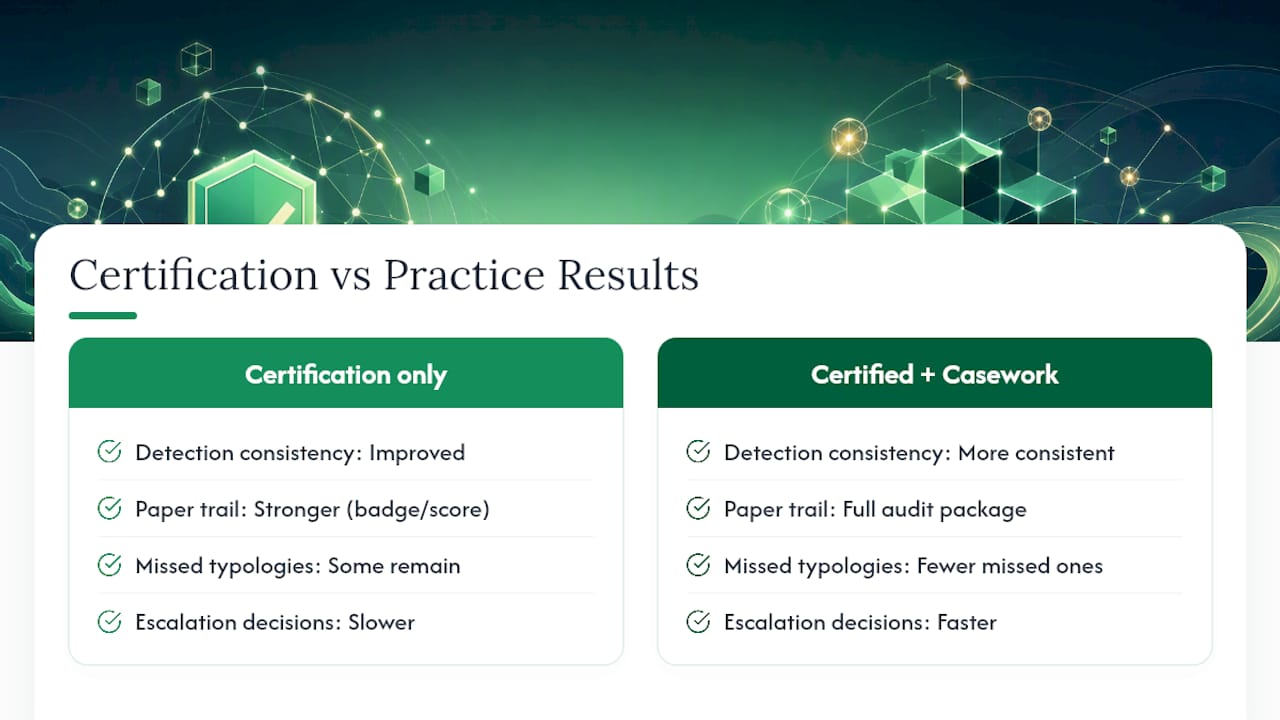
Certification improves detection consistency and gives you a stronger paper trail during an exam, but it isn’t a substitute for time spent on live cases. Teams that combine certified staff with ongoing casework tend to see fewer missed typologies and faster escalation decisions, because analysts recognize patterns they’ve already practiced in training.
For examiners and HR, present credential evidence as a package: the badge, the underlying assessment score, and a dated LMS export showing when the credential was earned and when it renews. That combination answers the two questions examiners actually ask: is this person qualified, and can you prove it stayed current. Many firms also fold completed certifications into internal promotion criteria, particularly for investigator and senior analyst roles. The limitation worth stating plainly: no certification replaces supervised, on-the-job practice. Training builds the framework; casework builds the judgment.
How Does DARE Fit the Continuing-Education Checklist?
DARE (Digital Asset Readiness Evaluation) is an independent certification platform built around governance and compliance for enterprise digital asset management, which puts it in a different lane than a single-topic AML course. It’s structured for the buyer problems this article keeps circling back to: governance gaps between teams, custody controls that nobody formally owns, and an audit trail that holds up when a regulator asks for it.
- Modular learning organized by function, so finance, legal, risk, and information security staff each get relevant content instead of one generic course.
- Assessments that produce a verifiable credential rather than a participation certificate.
- Annual renewal built into the program, matching how fast custody and regulatory expectations shift in digital assets.
- Blockchain-backed credentials that give an examiner or hiring manager something they can actually verify, not just take on faith.
…
Why Role-Based Crypto Training Matters Now
The mistake I keep seeing compliance leaders make is treating crypto training as a one-time checkbox instead of a recurring operational requirement. Regulatory frameworks and forensic tooling in this space move faster than traditional AML ever did, and a badge earned two years ago tells an examiner nothing about current capability. My practical recommendation: build auditable, role-based tracks directly into your team’s learning calendar with mandated completion windows, not optional deadlines. Treat recertification like a compliance control, because that’s exactly what it is.
— Gregg
Get an Enterprise-Ready Crypto Compliance Credential
DARE gives compliance teams the thing most single-course certifications skip: a credential built around governance, not just knowledge recall. It hits the checklist this article laid out, modular tracks by function, assessments that produce a verifiable badge, and annual renewal so the credential doesn’t quietly go stale while your custody obligations keep evolving.
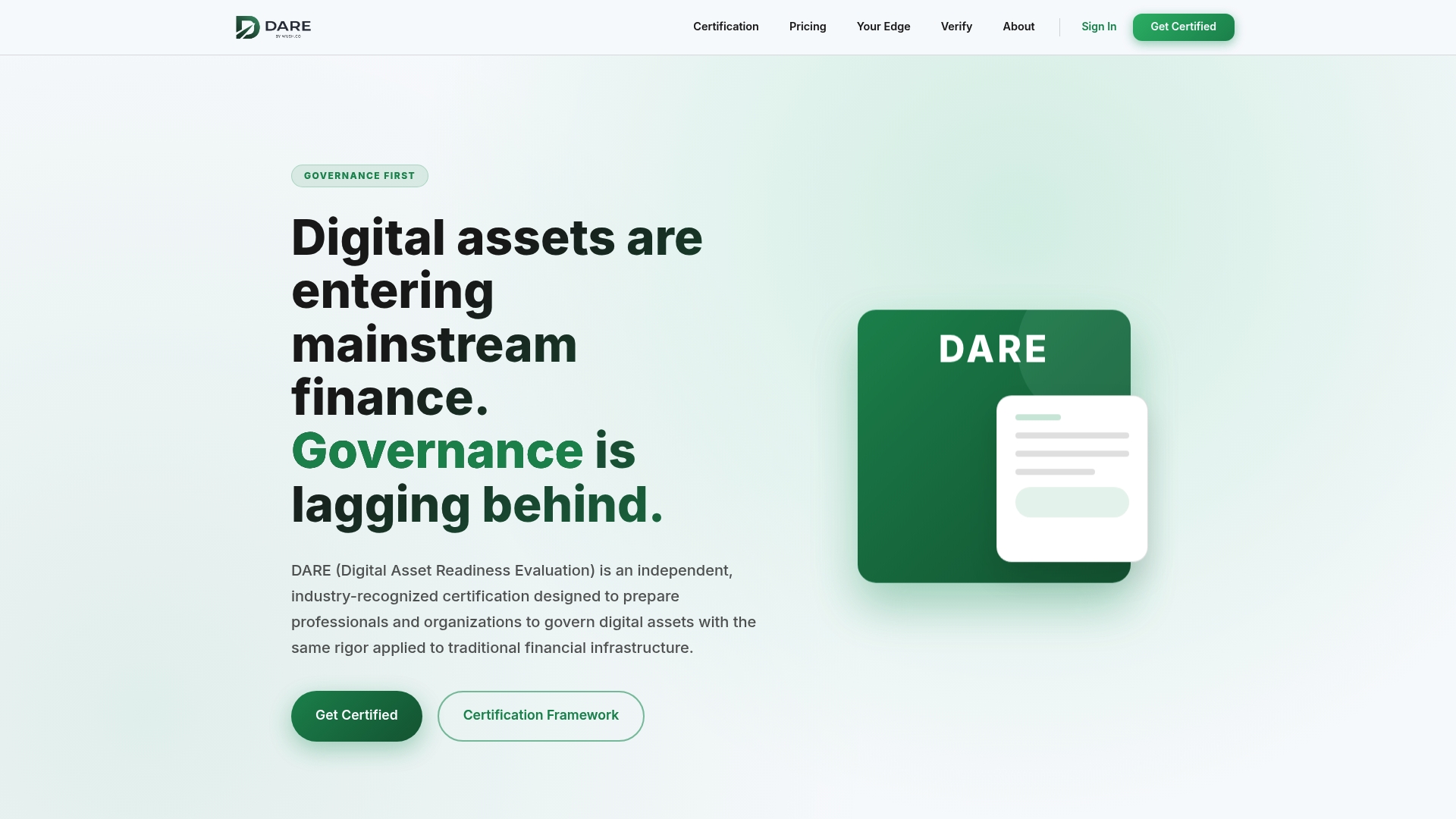
Instead of stitching together separate courses for legal, risk, and treasury staff, DARE lets an enterprise run one governance-focused certification across every role that touches digital assets, with records built to survive an audit rather than just a resume review. Review the DARE certification framework to see how the modular tracks map to your team’s roles, or check DARE’s competitive advantages if you’re building the business case internally. If you’re managing more than a handful of staff, request enterprise pricing directly through the DARE certification page to get a quote scoped to your team size.
Where to Learn More
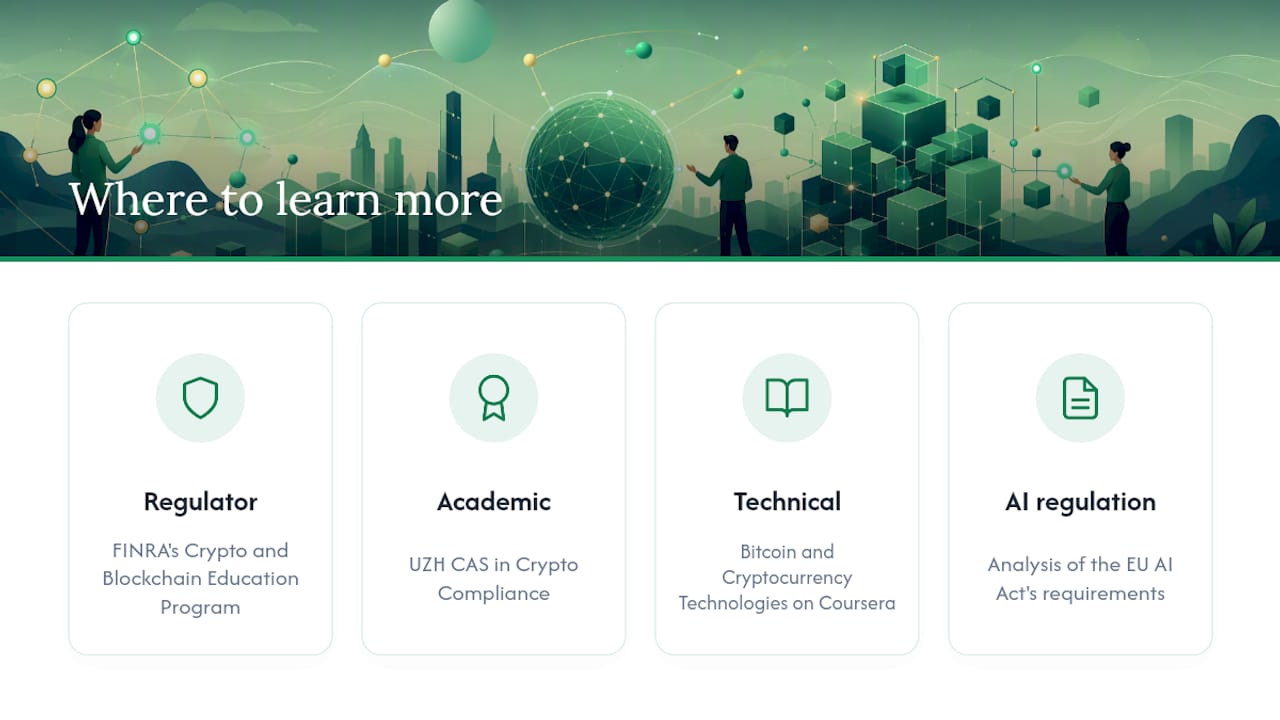
For regulator-backed applied learning, see FINRA’s Crypto and Blockchain Education Program. For an academic credential model, review the UZH CAS in Crypto Compliance. For technical foundations, start with Bitcoin and Cryptocurrency Technologies on Coursera, and for a broader look at how AI regulation is reshaping compliance obligations at financial institutions, see this analysis of the EU AI Act’s requirements.
Sources
- FINRA Crypto and Blockchain Education Program
- UZH CAS in Crypto Compliance
- Bitcoin and Cryptocurrency Technologies | Coursera
FAQ
What Is the Best Continuing Education Path for Crypto Compliance?
A role-based modular certification with hands-on assessment and a verifiable digital badge fits most compliance and AML professionals best, since it matches training depth to your actual job function.
Do Crypto Compliance Certifications Qualify for CE Credits?
Some do. Check whether the issuer is listed with a recognized body like FINRA or accepted toward a broader pathway such as ACAMS’s CCAS before you enroll.
How Often Do These Certifications Need Renewal?
Most credible programs use a regular recertification cycle, often through short refresher modules rather than requiring a full retake, because crypto typologies and tooling change quickly.
Which Track Should an AML Analyst Choose?
An AML analyst typically fits best in the Compliance track, which covers regulatory obligations and risk scoring, while investigators lean toward the Investigations track for on-chain forensics work.
Does DARE Offer Continuing Education for Compliance Teams?
DARE (Digital Asset Readiness Evaluation) offers modular, role-based certification with assessments, verifiable credentials, and annual renewal designed to support governance and compliance functions.