
U.S. Auditors: 3 Checks to Validate On Chain Audit Evidence with DARE

Yes. Blockchain can supply traceable, tamper-evident evidence for many audit assertions, but only after auditors verify three things: who actually controls the private keys, how the underlying protocol is governed, and whether the on-chain activity ties back to real-world events. Evidence-gathering methods range from block explorer exports to signed-message proof of control to running an independent node. None of them replace the auditor’s judgment. PCAOB and ISACA both make clear that specialized skills and third-party attestations are often required before an auditor can rely on a ledger alone.
TL;DR:
- Blockchain provides strong evidence for asset existence and transaction timestamps but requires supplementary proof for ownership, control, and valuation.
- Collecting reliable on-chain evidence involves using independent nodes, signed messages, and traceable microtransactions, with thorough documentation at each step.
- Auditors must verify private key custody, operational controls, protocol governance, and smart contract security to trust blockchain data fully.
- Regulatory bodies emphasize specialized skills, continuous monitoring, and independent attestations for trustworthy digital asset audits.
- Organizations should proactively document governance and control procedures through certifications like DARE to streamline audit readiness.
Table of Contents
- What Does Blockchain Actually Record, and How Does That Map to Audit Evidence?
- How Do Auditors Collect and Verify On-Chain Evidence?
- What Control Risks Should Auditors Test Before Trusting the Ledger?
- What Does a Blockchain Audit Procedure Checklist Look Like?
- What Do Regulators and Standards Bodies Expect From Blockchain Audits?
- What Auditors and Finance Leaders Need to Rethink Now
- Prove Your Governance Is Audit-Ready Before the Auditors Ask
- Sources
- FAQ
What Does Blockchain Actually Record, and How Does That Map to Audit Evidence?
A public ledger is a chronological, cryptographically linked record of transactions that, once confirmed, is extremely difficult to alter retroactively. That property is genuinely useful for an auditor, but it only answers some of the questions an audit is built to ask.
Where blockchain shines is existence and completeness. If an asset moved to a specific address at a specific block height, that transaction is permanently visible and time-stamped, and nobody can quietly delete it later. That’s a stronger existence assertion than most auditors get from a bank statement, which the client controls and, in theory, can alter or withhold.
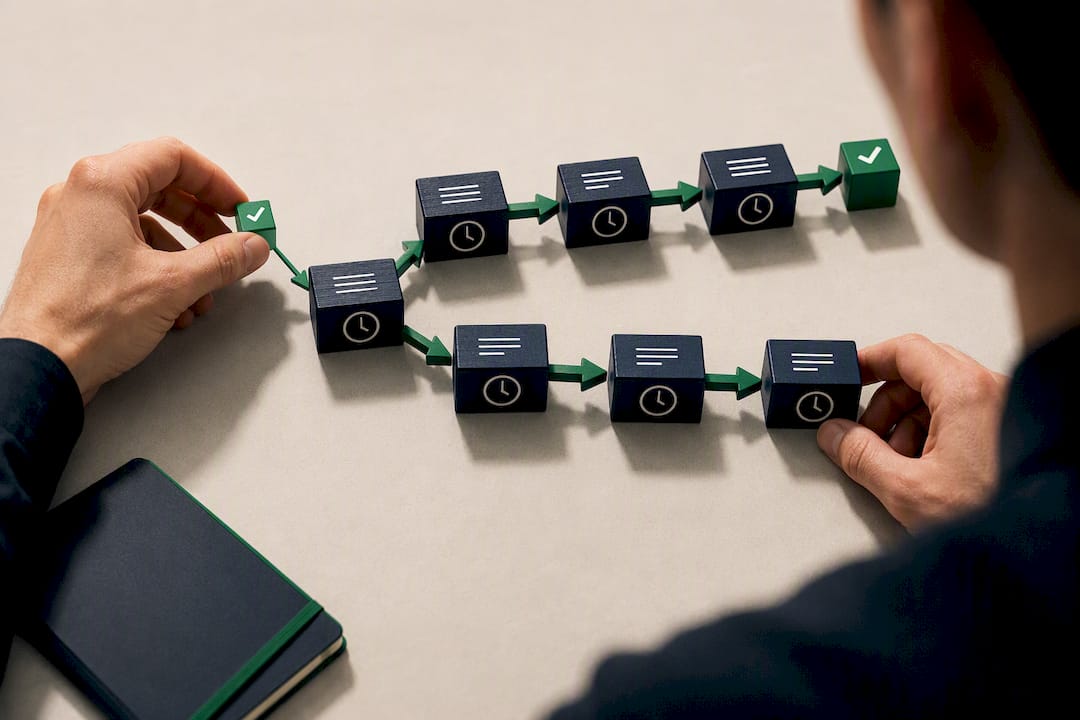
Where it falls apart is everything the chain doesn’t see. Addresses are pseudonymous, so an auditor can confirm that a wallet holds an asset without confirming who legally owns that wallet. Valuation depends on off-chain price feeds and market conventions the ledger knows nothing about. And smart contract logic can trigger transfers based on external inputs, oracles, corporate actions, that never appear in the transaction data itself.
Consider a simple case: a company claims to hold 500 units of a token in a self-custodied wallet.
- Existence: confirmed by a signed message or on-chain balance check tied to that address.
- Rights and obligations: requires proof the company, not a third party, controls the private key.
- Completeness: requires confirming no side wallets or omitted addresses exist.
- Valuation: requires an independent, corroborated price source, not just the last trade on one exchange.
ISACA’s assertion-based procedures walk through exactly this kind of mapping, and it’s worth reading before you design your first digital asset audit program. The ledger gives you a fact pattern. It doesn’t give you an opinion, and it doesn’t give you context.
How Do Auditors Collect and Verify On-Chain Evidence?
Auditors have four practical tools for gathering blockchain evidence, and each one carries a different reliability profile.
- Block explorers. Fast, free, and useful for a quick sanity check on balances and transaction history. The catch: you’re trusting a third-party interface to render the chain accurately, and explorer outages or indexing lags happen. Fine for preliminary analytics, weaker as sole support for a material balance.
- An independent auditor-run node. Downloading and syncing your own node lets you verify consensus rules directly and pull raw transaction and block data without an intermediary. Deloitte’s guidance recommends this route specifically because it produces reproducible evidence rather than a screenshot from someone else’s website.
- Signed-message proofs. Asking the client to sign a specific, auditor-provided message string with the private key tied to a wallet demonstrates control over that key at a point in time, without moving any funds.
- Microtransaction and proof-of-reserve tests. Sending a small, traceable amount to and from a wallet, or reviewing cryptographic proof-of-reserve attestations, adds a second layer of control evidence beyond a static balance check.
Whichever method you use, document the block height, timestamp, and export format at the moment of testing. A CSV pulled today won’t match a CSV pulled next month if the client has moved assets in between, so the workpaper needs to capture the exact state you tested, not a general description of it.
Pro Tip: Hash your exported evidence files (block data, signed messages, CSVs) and store the hash alongside the workpaper. If anyone questions the integrity of your evidence six months later, you can prove nothing was altered after the fact.
What Control Risks Should Auditors Test Before Trusting the Ledger?
On-chain data is only as reliable as the controls surrounding it. Four risk areas deserve specific testing, and skipping any one of them is how audits of digital assets go wrong.
- Private key custody. Request custody agreements, key-split or multisignature procedures, and logs from multi-party computation (MPC) or hardware security module (HSM) systems. A wallet address proves nothing about legal ownership without documentation showing who can actually authorize a transaction. A private key risk management guide breaks down what that documentation should look like in practice.
- Operational controls. Access management, change control procedures, personnel vetting for anyone with signing authority, and evidence of annual vulnerability testing all belong in your control-testing scope, the same way they would for any critical financial system.
- Protocol governance. Validator concentration and the underlying consensus mechanism matter more than most auditors initially assume. A chain with a handful of dominant validators carries real exposure to a 51% attack or a coordinated governance vote that changes the rules mid-stream, as ISACA’s governance research points out.
- Smart contract risk. Where a contract governs asset movement, obtain independent code-review reports and third-party security audit results rather than accepting the client’s internal assurance.
What Does a Blockchain Audit Procedure Checklist Look Like?
Blockchain evidence gathering follows the same logic as any other audit area: plan by assertion, collect appropriately, test rigorously, and document reproducibly, as outlined in comprehensive financial statement audit services.
- Plan by assertion. Identify which assertions (existence, rights and obligations, completeness, valuation, classification) digital assets affect, and flag where you’ll need cryptography or blockchain engineering expertise you don’t have in-house.
- Collect the evidence set. Pull on-chain exports, signed-message confirmations, custody contracts, SOC or service auditor reports, and any bank or fiat-conversion records tied to the digital asset activity.
- Run analytics for anomalies. Look specifically for timing patterns around period-end cutoffs, since a borrowed-balance scheme (moving assets in briefly to inflate a reported balance, then moving them out) tends to leave a visible footprint in transaction timing that a static balance check would miss entirely.
- Document methodology, not just conclusions. Record node logs, block heights, sync status, and exported file formats so a reviewer, or a regulator, could reproduce your testing a year later.
- Corroborate off-chain. Never let a clean on-chain balance substitute for confirming legal ownership, especially when assets sit in a pooled or omnibus custody arrangement.
That last point matters more than it sounds. When ownership is genuinely ambiguous, ISACA’s research on assertion-based procedures notes that auditors typically have to fall back on testing the custodian’s operating controls directly, rather than relying on substantive on-chain testing alone. For a fuller version of this checklist mapped to specific document types, see Wush’s digital asset audit trail checklist.
What Do Regulators and Standards Bodies Expect From Blockchain Audits?
Regulatory guidance in this space is still catching up to the technology, but the direction is consistent across every major body that’s weighed in.
- The PCAOB’s cryptoasset spotlight flags the need for specialized skills on the engagement team, heightened attention to custody arrangements, and careful risk assessment around pseudonymity, which raises real AML and KYC exposure that ordinary financial audits rarely encounter.
- ISACA and INTOSAI both push toward continuous monitoring as chains mature, but both also stress that the risk shifts from data manipulation toward protocol governance and validator behavior, meaning your control environment now includes people you may never meet.
- The CMTA Digital Assets Custody Standard (DACS) gives auditors a practical baseline: proof-of-reserve methods, personnel screening, access controls, and independent assessments that a custodian should already have in place.
- When custody or technology risk runs high, insist on an independent technology audit or a service auditor report (SOC-type) rather than accepting management’s self-assessment at face value.
What Auditors and Finance Leaders Need to Rethink Now
The biggest mistake audit teams make with digital assets isn’t technical, it’s organizational. They try to bolt blockchain testing onto an existing audit team without adding the skills that testing actually requires. A cross-functional team that pairs an audit lead with someone who understands node operation, cryptographic verification, and on-chain analytics will catch things a purely financial reviewer never will.
Continuous monitoring tools are worth adopting where feasible, but they should sharpen skepticism, not replace it. On-chain data still needs off-chain corroboration. Frameworks like ISO 27001 applied to crypto operations and structured certifications give teams a documented way to show they’ve actually built this capability, rather than assembling it ad hoc mid-engagement.
— Gregg
Prove Your Governance Is Audit-Ready Before the Auditors Ask
The Digital Asset Readiness Evaluation was created because most organizations can’t yet document, in writing, that their custody controls, key management, and governance processes would hold up under the kind of scrutiny outlined above.
The certification maps modular learning and assessments directly to the control areas auditors test: private-key custody, protocol governance awareness, and compliance documentation, so your team walks into an engagement with evidence already organized instead of scrambling to produce it on request. Annual renewal keeps that evidence current rather than letting it go stale the way a one-time policy document does. For finance, risk, and treasury teams operating regulated digital asset activity, that credential functions as a documented answer to the question every auditor eventually asks: how do you know your controls actually work? Explore the DARE certification and see what an enterprise assessment would look like for your organization at Dare.
This article is general information, not a substitute for advice from a qualified financial advisor. Consult a qualified financial professional about your own circumstances before acting on anything here.
Sources
- PCAOB — Audits Involving Cryptoassets (Spotlight)
- ISACA Journal — Assertion-based financial audit procedures related to crypto-assets (2024)
- ISACA — Blockchain auditing in practice (2026)
- CMTA — Digital Assets Custody Standard (DACS) (2025)
- Deloitte — Viewpoints: Applying auditing standards in the crypto-asset sector (node verification guidance)
FAQ
Is blockchain data alone sufficient audit evidence?
Rarely on its own. It’s strong for existence and completeness testing but usually needs off-chain corroboration for ownership, valuation, and control.
What’s the difference between using an explorer and running a node?
An explorer offers a fast, third-party view of chain data, while running an independent node lets the auditor verify consensus rules directly and produce reproducible evidence, which Deloitte recommends for higher-confidence testing.
How do auditors prove someone controls a private key?
Typically through a signed-message test, where the client signs an auditor-provided string with the wallet’s private key, sometimes paired with a small traceable microtransaction.
Do auditors need blockchain-specific skills?
Often, yes. The PCAOB specifically flags specialized skills as a requirement when cryptoassets are material, which is why many engagements bring in cryptography or blockchain engineering specialists.
Can a certification like DARE help with audit readiness?
Yes. DARE gives organizations a documented framework covering custody, private-key controls, and governance, giving auditors concrete evidence that controls exist and are maintained year over year.