
Digital Asset Dispute Resolution Types: What Counsel Must Know

Digital asset disputes fall into five primary resolution families: traditional U.S. court litigation, institutional arbitration (AAA, JAMS, ICC), mediation and hybrid med-arb, decentralized on-chain protocols (Kleros, Aragon Court), and embedded smart-contract escalation under frameworks like the Digital Dispute Resolution Rules (DDRR). According to Cardozo’s analysis of dispute resolution tailored for digital assets, these models divide along predictable lines of enforceability, confidentiality, and technical complexity. The core trade-off is simple: enforceability strengthens as you move toward institutional arbitration and litigation, while speed and automation increase as you move toward on-chain mechanisms.
Quick mapping by dispute category:
- Theft, asset recovery, or unknown wallet holders: Litigation with emergency injunctive relief and exchange disclosure orders
- Cross-border commercial contract disputes between platforms or counterparties: Institutional arbitration (AAA or JAMS) with a New York Convention seat
- Exchange-user disputes, relationship-sensitive or low-value claims: Mediation or med-arb, especially where flexible remedies matter
- Smart-contract execution failures in automated escrow or DAO governance: Embedded on-chain escalation with an institutional arbitration fallback
- Consumer complaints against platforms: Mediation, consumer forums, or carefully drafted arbitration clauses with consumer-law carve-outs
The enforcement trade-off in one line: institutional arbitration and litigation produce awards and orders that U.S. courts will recognize and enforce; decentralized and purely on-chain outcomes often do not.
Key Takeaways
Institutional arbitration under the FAA and New York Convention remains the most reliably enforceable path for commercial digital-asset disputes, but the right model depends on dispute type, enforcement target, and how the contract was drafted.
| Point | Details |
|---|---|
| Match model to dispute type | Litigation for unknown parties and asset recovery; institutional arbitration for commercial contracts; mediation for exchange-user and relationship disputes. |
| Enforceability requires design | Decentralized protocol outcomes are not FAA or New York Convention awards without an explicit institutional backstop clause. |
| Speed on evidence is decisive | Preserve chain state, issue exchange preservation letters, and retain forensic analysts within 24 hours of a dispute arising. |
| Clause drafting determines outcomes | Include seat, governing law, emergency relief carve-out, technical arbitrator requirement, and consumer carve-out in every digital-asset arbitration clause. |
| Wush DARE certification | The DARE framework maps governance controls, custody documentation, and dispute clause design to reduce dispute frequency and strengthen enforcement positions. |
Table of Contents
- What are the main digital asset dispute resolution types?
- When does U.S. court litigation make sense for digital-asset disputes?
- How does institutional arbitration work for digital-asset contracts?
- When should you use mediation or med-arb for crypto disputes?
- How do decentralized arbitration platforms like Kleros and Aragon Court work?
- How does embedded dispute resolution work in smart contracts?
- How do the five models compare across key decision factors?
- What should counsel do in the first 72 hours of a digital-asset dispute?
- How does U.S. enforcement actually work for digital-asset awards and orders?
- What actually matters most in practice
- Governance readiness reduces disputes before they start
- Sources
What are the main digital asset dispute resolution types?
The five models differ not just in procedure but in who decides, how quickly, and whether the outcome sticks in a U.S. court.
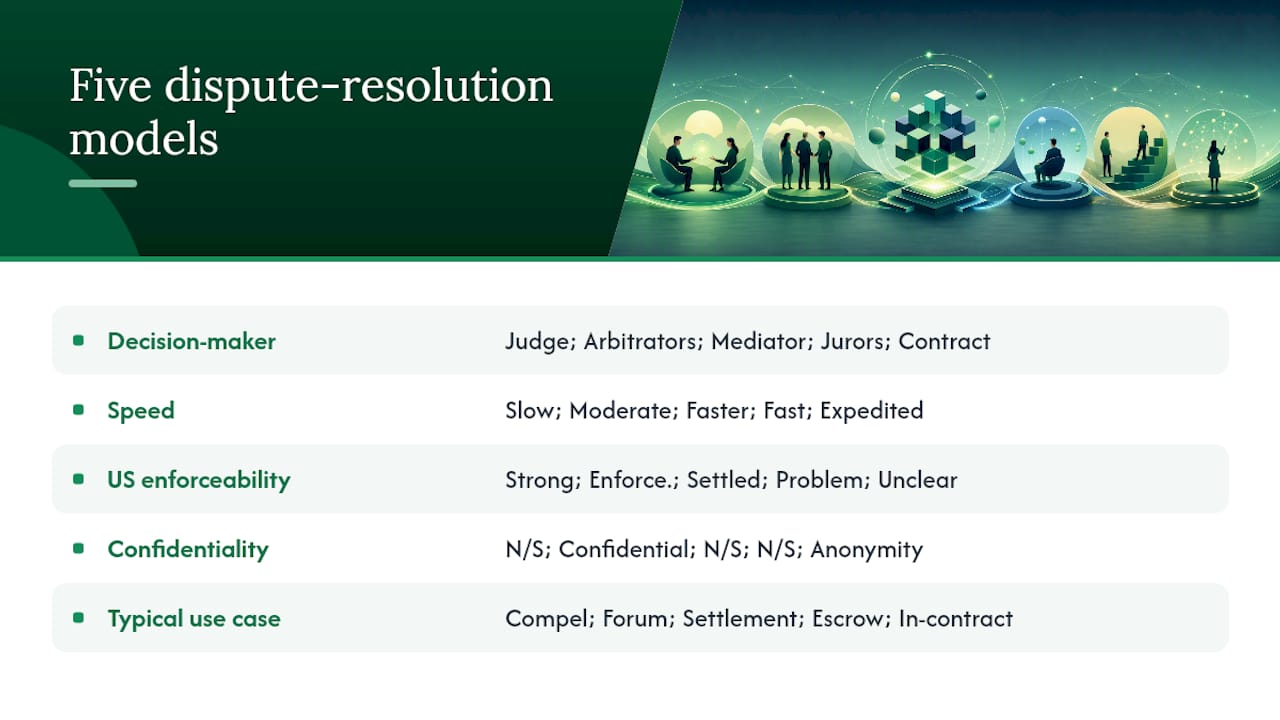
Litigation places the dispute before a federal or state judge. The court applies statutory and common law, issues binding orders, and can compel third parties (exchanges, custodians) to act. It is the slowest and most expensive path, but it carries the strongest coercive power.
Institutional arbitration delegates the decision to one or more appointed arbitrators under the rules of a recognized body: AAA, JAMS, or ICC. The parties choose their forum, seat, and often the arbitrators’ technical background. Awards are confidential and enforceable in most jurisdictions under the New York Convention.
Mediation and med-arb are non-adjudicative at the mediation stage. A neutral facilitates negotiation; no decision is imposed unless the parties settle. Med-arb adds an arbitration backstop: if mediation fails, the same neutral (or a new one) issues a binding award. Research on crypto exchange disputes shows mediation resolves many exchange-user conflicts faster and with more flexible remedies than either litigation or arbitration.
Decentralized on-chain protocols like Kleros and Aragon Court use token-staking juror pools to vote on outcomes. Execution is automated; no court order is needed to move funds in an escrow contract. Speed is the advantage. Enforceability in U.S. courts is the problem.
Embedded smart-contract escalation builds dispute handling directly into the contract code: timelocks, multisig governance gates, automated settlement triggers, and escalation paths to off-chain arbitration. The DDRR model, developed by the UK Jurisdiction Taskforce, formalizes this approach with anonymity protections and expedited timetables, and it informs how U.S. counsel can design similar clause structures.
The basic flow across all models follows the same skeleton: notice of dispute, evidence preservation (on-chain snapshot plus off-chain records), forum selection or trigger, hearing or protocol execution, and then remedy or enforcement.
When does U.S. court litigation make sense for digital-asset disputes?
Litigation is the right call when you need coercive power against a party who will not cooperate, or when the respondent is unknown. Three scenarios dominate:
- Asset recovery from unidentified wallet holders, where only a court can compel an exchange to disclose account information
- Enforcement against custodians or intermediaries that hold or control assets on behalf of others
- Complex insolvency, securities fraud, or regulatory claims that require statutory remedies a private arbitral tribunal cannot grant
The procedural toolkit for digital-asset litigation in U.S. courts includes preservation orders, subpoenas to exchanges for KYC records and transaction logs, and ex parte temporary restraining orders (TROs) to freeze assets before a respondent can move them. Courts have granted targeted interim relief and disclosure orders against intermediaries in tracing and recovery cases, treating digital assets as property subject to standard equitable remedies.
Evidence in digital-asset litigation has its own demands. Blockchain records are immutable and publicly verifiable, which cuts both ways: they provide a clear transaction trail, but they also require expert testimony to interpret. Counsel should retain a blockchain forensic analyst early, not after the pleadings are filed. Chain-of-custody documentation for any off-chain evidence (exchange logs, API records, custody provider statements) must be preserved from day one.
The public record is the main cost of litigation beyond time and expense. Every filing is visible. For a platform managing a dispute with a large user base, that exposure can be more damaging than the underlying claim. That calculus is why most commercial digital-asset contracts route disputes to arbitration first, with litigation reserved as an enforcement mechanism for awards or as the only viable path when parties are unknown.
Pro Tip: File for emergency injunctive relief and exchange disclosure simultaneously. Assets moved through mixers or bridged to another chain within 24–48 hours of a dispute becoming known are exponentially harder to trace. Speed on the first day matters more than the quality of the complaint.
A useful precedent frame: U.S. courts have consistently treated cryptocurrency as property for purposes of conversion, theft, and tracing claims, which means the full range of equitable remedies, including constructive trust and restitution, is available. Counsel can also reference enterprise digital asset enforcement strategies when mapping which intermediaries to target first.
How does institutional arbitration work for digital-asset contracts?
Institutional arbitration is the dominant choice in platform terms of service, token sale agreements, and exchange user agreements, and for good reason. It offers a neutral forum, confidential proceedings, arbitrator selection with technical competence, and enforcement in over 170 countries under the New York Convention.
The AAA’s smart-contract and blockchain dispute guidance includes technology-focused rules and the AAA ClauseBuilder tool, which helps parties draft enforceable arbitration clauses tailored to blockchain disputes. JAMS has developed smart-contract-specific rules that limit discovery to expert depositions on code interpretation, keeping proceedings focused and timelines short. ICC rules offer the most flexibility for multi-jurisdictional disputes involving parties in different regulatory regimes.
Clause drafting is where most digital-asset arbitration agreements fail. A clause that simply says “disputes shall be resolved by arbitration under AAA rules” is inadequate for a smart-contract context. Counsel must address:
- Seat of arbitration: Choose a seat in a New York Convention signatory state (New York and Delaware are common U.S. choices) to preserve enforcement options internationally
- Governing law: Specify the substantive law governing the contract, separate from the procedural law of the seat
- Scope: Expressly include tort and statutory claims, not just contract claims, to prevent a respondent from arguing that fraud or securities claims fall outside the clause
- Emergency arbitrator: Include an express carve-out for emergency arbitrator relief so interim measures are available without waiting for a full tribunal to be constituted
- Technical arbitrator: Specify that at least one arbitrator must have demonstrated technical expertise in blockchain systems or smart-contract code
- On-chain execution powers: If the parties intend the tribunal to have authority to direct on-chain actions (key transfers, multisig approvals), state that expressly
- Consumer carve-out: If any counterparty could be classified as a consumer under applicable state or federal law, include a carve-out or alternative process, because consumer-protection laws can override mandatory arbitration clauses where the process is inaccessible or one-sided
- Notice and clickwrap visibility: For online agreements, ensure the arbitration clause is conspicuous enough to satisfy enforceability standards in the governing jurisdiction
Pro Tip: Use AAA ClauseBuilder to generate a baseline clause, then layer in the digital-asset-specific elements above. The tool produces clauses that satisfy AAA’s own filing requirements, which reduces the risk of a respondent challenging the clause on procedural grounds before the merits are ever reached.
Despite the technology layer, many digital-asset disputes reduce to traditional contract, fiduciary, or insolvency issues. Institutional arbitration handles those well. The Transnational Matters analysis of digital asset arbitration notes that ICC, JAMS, and AAA appear most frequently in exchange and token-contract terms, reflecting practitioner confidence in their enforceability track record.
When should you use mediation or med-arb for crypto disputes?
Mediation is underused in digital-asset disputes, partly because the technology creates an illusion that disputes have clean technical solutions. They often do not. Governance failures and communication breakdowns are frequently the actual cause of a dispute, and those respond better to a facilitated negotiation than to an arbitral award.
The four main mediation styles each fit different dispute profiles:
- Facilitative mediation: The mediator helps parties identify interests and generate options; no evaluation of the merits. Best for ongoing relationships (exchange-platform partnerships, DAO contributor disputes)
- Evaluative mediation: The mediator offers a view on likely outcomes. Useful when parties are far apart on valuation or legal exposure and need a reality check
- Transformative mediation: Focuses on restoring communication and decision-making capacity. Rarely used in commercial digital-asset disputes but relevant for DAO governance breakdowns
- Online mediation (ODR): Conducted entirely remotely, often asynchronously. Practical for cross-border disputes where travel costs or time zones make in-person sessions impractical
For digital-asset disputes specifically, mediation’s advantages are confidentiality (no public record), flexible remedies (a token swap, a protocol upgrade, a revenue-share adjustment are all possible settlement terms that a court or arbitral tribunal cannot order), and speed. A mediated settlement can close in days; institutional arbitration typically runs months.
Med-arb is the right structure when the parties want to try mediation but need the certainty of a binding outcome if it fails. The mediator transitions to arbitrator (or a new arbitrator is appointed) and issues an award on unresolved issues. The risk is that parties may be less candid in mediation if they know the same neutral could later decide against them. Some practitioners address this by using separate mediator and arbitrator roles.
Pro Tip: *Before any mediation session involving volatile assets, agree in writing on a valuation mechanism: either a fixed fiat conversion rate as of a specified date, or a formula (e.g., 7-day volume-weighted average price from a named exchange) that applies to any settlement amount.
Practical preparation for digital-asset mediation includes a technical briefing document for the mediator (explaining the protocol, the transaction sequence, and the disputed code behavior), a preserved chain-state snapshot, and a clear statement of the remedies each party is actually willing to accept.
How do decentralized arbitration platforms like Kleros and Aragon Court work?
Kleros and Aragon Court operate on a token-staking juror model. Parties submit a dispute and deposit collateral; jurors stake platform tokens to signal their willingness to decide; a random selection of staked jurors reviews evidence and votes; the majority outcome executes automatically on-chain. Appeals are possible by escalating to larger juror pools, which increases the cost of gaming the outcome.
The use cases where this model genuinely fits are narrow: low-value automated escrow disputes, content moderation decisions in decentralized applications, and DAO governance votes where the parties have already agreed to on-chain execution. For those cases, the speed and automation are real advantages. Resolution can complete in hours or days, with no filing fees, no seat selection, and no arbitrator appointment process.
The enforcement problem is significant for anything beyond those narrow cases. A Kleros or Aragon Court outcome is not, in most circumstances, a conventional arbitral award under the Federal Arbitration Act or the New York Convention. Converting it into a court-ordered remedy requires additional steps that the protocols themselves do not provide.
Decentralized juror protocols offer genuine speed and automation for low-value, code-governed disputes. But for any dispute where a party might resist the outcome, the absence of a recognized enforcement pathway is not a drafting problem you can fix after the fact. It is a structural limitation of the model. Counsel advising enterprise clients should treat on-chain protocol outcomes as a first-step remedy, not a final one, and always pair them with an institutional arbitration or court backstop that can convert the outcome into an enforceable judgment.
Additional risks include procedural unpredictability (juror selection is pseudorandom and token-weighted, which can produce inconsistent outcomes on similar facts), limited discovery (no subpoena power, no document production), and the potential for juror bias in token-based systems where large holders can influence outcomes.
Practical mitigations for counsel who want to use decentralized protocols as part of a dispute design:
- Draft an explicit clause stating that the on-chain protocol outcome constitutes a binding first-tier determination, subject to appeal to an institutional arbitral tribunal
- Specify that the institutional tribunal has authority to review the on-chain outcome de novo or on a defined standard
- Include anonymity safeguards in the clause if party identity is sensitive
- Confirm that the on-chain execution mechanism (the smart contract holding funds) will honor the protocol’s output without requiring a separate court order for the first-tier remedy
The Mayer Brown analysis of on-chain and off-chain ADR makes the same point: distinguishing on-chain code-execution disputes from off-chain governance and custody disputes is the first design decision, and clause escalators must be built around that distinction so automated remedies do not foreclose human remedies.
How does embedded dispute resolution work in smart contracts?
Embedded dispute resolution means the contract itself contains the escalation logic. A typical structure includes a timelock (a waiting period before a disputed transaction executes), a multisig governance gate (requiring multiple keyholders to approve or reject a disputed action), an automated settlement trigger (releasing funds to one party if the other does not respond within a defined window), and an escalation path to off-chain arbitration if the automated steps fail to resolve the dispute.
The DDRR model, developed by the UK Jurisdiction Taskforce, formalizes this approach. DDRR permits tribunals to operate or modify digital assets directly, supports anonymous party filing, and targets expedited decisions. While the DDRR is a UK instrument, its design principles directly inform how U.S. counsel can structure embedded clauses: express on-chain execution powers for the tribunal, anonymity protections for parties who need them, and short timetables that match the pace of digital-asset markets.
The design principles for any embedded resolution clause are:
- Explicit fallback: State clearly that if the on-chain mechanism fails or is contested, the dispute escalates to a named institutional arbitral body under specified rules
- Notice mechanisms: Build notice requirements into the contract that satisfy FAA enforceability standards (written notice, reasonable time to respond, accessible process)
- Emergency relief carve-out: Preserve the right to seek emergency arbitrator relief or court injunctive relief notwithstanding any automated process
- Oracle trust: If the contract relies on an external data feed (price oracle, identity oracle) to trigger a resolution, specify the oracle source and a fallback if it fails
Before relying on embedded enforcement, counsel should run through this checklist:
- Who controls the private keys that would execute any on-chain remedy, and are those parties subject to the jurisdiction of the chosen seat?
- Is the asset custodied by a third party (exchange, custodian), and does the embedded mechanism actually reach that custodian’s systems?
- Does the oracle providing external data have a track record of reliability, and what happens if it is manipulated or goes offline?
- Has the smart contract been audited by an independent code reviewer, and is the audit report available as evidence if the contract behavior is disputed?
- Does the escalation clause satisfy the visibility and conspicuousness requirements for the governing jurisdiction?
For DeFi platforms and enterprise deployments, embedded resolution is increasingly standard. The key is ensuring the embedded mechanism is a first step, not the only step.
How do the five models compare across key decision factors?
Selecting a dispute-resolution model requires weighing enforceability, cost, timeline, technical demands, and confidentiality against the specific dispute type. The table below maps each model across those dimensions.
One-line recommendations for common scenarios:
- Exchange freeze or account suspension: Mediation first (faster, preserves relationship); litigation if the exchange refuses to engage or assets are at risk
- Smart-contract exploit or code failure: Embedded escalation for immediate asset preservation, then institutional arbitration for damages
- Token sale misrepresentation: Institutional arbitration (AAA or JAMS) with express statutory claim scope; litigation if securities fraud remedies are needed
- DAO governance dispute: Decentralized protocol for first-tier determination, with institutional arbitration backstop for contested outcomes
- Exchange insolvency: Litigation or structured out-of-court workout; asset resolution frameworks from mass-insolvency practice apply here
When selecting a primary forum, also identify the fallback. A contract that routes disputes to Kleros with no institutional backstop leaves a party with no enforcement path if the respondent ignores the protocol outcome. The right design pairs a fast first-tier mechanism with a slower, but enforceable, second-tier one.
What should counsel do in the first 72 hours of a digital-asset dispute?
The first three days determine whether assets are recoverable and whether the evidentiary record is intact. Here is the procedural sequence:
- Preserve private keys and wallet access. Secure all credentials, hardware wallets, and access logs. Do not transact from disputed wallets until the dispute is resolved.
- Snapshot the chain state. Record block height, transaction hashes, wallet balances, and smart-contract state at the moment the dispute is identified. This is your baseline evidence.
- Issue preservation letters to exchanges and custodians. Send written notice to any exchange or custodian that holds or has processed the disputed assets, demanding preservation of all account records, KYC data, transaction logs, and API records.
- Retain a blockchain forensic analyst. Engage a firm with on-chain tracing capability before assets move further. Tracing through mixers or cross-chain bridges becomes exponentially harder with each hop.
- Assess emergency relief options. Determine whether the facts support an ex parte TRO (theft, imminent dissipation), an emergency arbitrator application under the applicable institutional rules, or both. File the stronger option first.
- Trigger any contractual notice requirements. If the contract contains a dispute clause, send the required notice in the required form. Missing a contractual notice deadline can forfeit rights or delay the arbitral clock.
- Appoint technical experts. For smart-contract disputes, retain a protocol engineer or code auditor who can provide a written technical analysis of the contract’s intended versus actual behavior.
- Map enforcement targets. Identify which intermediaries (exchanges, custodians, banks, payment processors) hold or control the respondent’s assets and are subject to U.S. jurisdiction. Enforcement against those intermediaries is often faster than enforcing against the respondent directly.
- Assess cross-jurisdictional issues. If the respondent or the assets are in multiple states or jurisdictions, identify which court or arbitral seat has the strongest enforcement reach and whether federal or state law governs the claim.
- Draft remedies in dual terms. Specify relief in both asset-in-kind (return of X tokens) and fiat equivalent (USD value as of a specified date) to hedge against price volatility between filing and award.
Pro Tip: Draft every remedy request in both asset-in-kind and fiat terms from the first filing. A fiat floor protects against that outcome.
For future contracts, the drafting checklist mirrors this procedural list: visibility of the arbitration clause, emergency relief language, seat selection for enforcement, consumer carve-outs, explicit on-chain execution authority, and oracle trust provisions. Counsel can use the enterprise digital asset legal risks guide as a reference for the full range of legal exposure points that dispute clauses should address.
How does U.S. enforcement actually work for digital-asset awards and orders?
The Federal Arbitration Act (FAA) governs the enforcement of domestic arbitration awards in the U.S. A party with a valid arbitral award applies to a federal or state court to confirm the award as a judgment; once confirmed, it is enforceable like any other court judgment, including through asset seizure, garnishment, and contempt proceedings. The process is generally straightforward for awards issued under recognized institutional rules with a U.S. seat.
For international awards, the New York Convention (implemented in the U.S. under Chapter 2 of the FAA) provides enforcement in over 170 signatory countries. An award issued in a New York Convention seat is presumptively enforceable in any other signatory jurisdiction, subject to narrow defenses (public policy, procedural irregularity, non-arbitrability). This is why seat selection matters: an award with a New York or Delaware seat is easier to enforce against a respondent with assets in Europe or Asia than one with an ad hoc or non-Convention seat.
Practical enforcement in digital-asset disputes usually targets intermediaries, not the respondent directly. Exchanges, custodians, and payment processors that hold or process the respondent’s assets are subject to court orders and arbitral enforcement mechanisms. A confirmed award or court order served on a U.S.-registered exchange is typically effective; the exchange has regulatory obligations that make non-compliance costly.
Key enforcement pathways and their limits:
- Court injunctions and TROs: Available on an emergency basis; can freeze assets at a custodian before a respondent moves them. Require showing of irreparable harm and likelihood of success on the merits
- Confirmed arbitral awards (FAA): Enforceable as court judgments; can be used to garnish exchange accounts or compel custodian transfers
- New York Convention enforcement: Applies to international awards; allows enforcement in the respondent’s home jurisdiction if it is a signatory
- Disclosure orders against exchanges: Courts can compel exchanges to produce KYC records and transaction data identifying unknown wallet holders, as courts have demonstrated in digital asset tracing cases
- Decentralized protocol outcomes: Not enforceable under the FAA or New York Convention without a separate arbitration clause that incorporates the protocol outcome as a first-tier award subject to institutional review
The timing of enforcement applications matters as much as the legal theory. Assets in a self-custodied wallet can be moved in seconds; assets at a regulated exchange are subject to the exchange’s compliance obligations and can be frozen with a properly served order. Counsel should always identify the enforcement target before filing, not after obtaining the award.
For enterprise digital asset legal risks, understanding which intermediaries are subject to U.S. jurisdiction and which are not is a threshold question that should be answered at contract drafting, not at the enforcement stage.
What actually matters most in practice
The gap between a well-drafted dispute clause and an enforceable outcome is wider in digital-asset disputes than in almost any other commercial context. The technology creates a false sense of precision: because the blockchain records every transaction immutably, practitioners sometimes assume the facts will be clear and the remedy will follow. They often do not.
The disputes that are hardest to resolve are not the ones with unclear facts. They are the ones where the clause was drafted without considering where the respondent’s assets actually sit, or where the emergency relief mechanism was omitted because the parties assumed the smart contract would handle it. A Kleros outcome that no court will enforce, an arbitration clause that a consumer court strikes down, a mediation settlement that fails to specify a valuation date: these are drafting failures, not technology failures.
The practitioners who navigate digital-asset disputes most effectively share three habits. They map enforcement targets before drafting the dispute clause. They preserve evidence on day one, not after the first hearing. They treat technical experts as core members of the dispute team, not as witnesses to be retained at the last minute.
Governance readiness is the upstream variable. An enterprise that has documented its custody arrangements, mapped its contractual relationships, and tested its dispute clauses before a dispute arises will resolve that dispute faster and at lower cost than one that is reconstructing its records under pressure. The DARE certification framework addresses exactly that gap: structured governance documentation, custody mapping, and legal controls that reduce both dispute frequency and dispute severity.
Governance readiness reduces disputes before they start
The most expensive dispute is the one that was preventable. Enterprises that operate digital assets without documented governance frameworks, clear custody maps, and tested dispute clauses face two compounding risks: higher dispute frequency and weaker positions when disputes do arise.
The DARE certification from Wush is built around exactly the controls that reduce dispute risk: custody documentation, regulatory compliance mapping, risk management frameworks, and legal controls that include dispute clause templates and escalation path design. For legal advisors and in-house counsel, DARE provides a structured way to assess and close the governance gaps that generate disputes, and a verifiable credential that demonstrates that readiness to regulators, counterparties, and courts. Finance, treasury, risk, and legal teams at enterprises managing digital assets can evaluate their current readiness and access the full certification program at Dare.
Sources
- Dispute Resolution Tailored for Digital Assets
- Smart contracts and blockchain disputes — American Arbitration Association
- Digital Asset Arbitration: Resolving Crypto & NFT Disputes | Transnational Matters
- Digital Disputes — Courts and Tribunals Judiciary
This article is general information, not a substitute for advice from a qualified lawyer. Consult a qualified legal professional about your own circumstances before acting on anything here.