
Benefits of Regulatory Readiness Certification for Leaders

Regulatory readiness certification is the formal process by which an organization demonstrates it meets defined compliance standards before regulators, customers, or auditors require it. The benefits of regulatory readiness certification extend well beyond avoiding fines. Certified organizations report fewer security breaches and measurably faster time to market. Frameworks like ISO 27001, SOC 2, and the Digital Asset Readiness Evaluation (DARE) from Wush give compliance officers and business leaders a structured path to prove controls are working, not just documented. This article breaks down each major advantage with evidence and practical context.
1. What are the core benefits of regulatory readiness certification?
Regulatory readiness, also called compliance maturity, is the state in which an organization can demonstrate control effectiveness at any point, not just during scheduled audits. The distinction matters because regulators treat undocumented activities as activities that never happened. A certification framework forces documentation discipline from day one.
94% of certified organizations reported revenue growth and improved market share. That figure signals certification is a growth driver, not just a defensive cost. Certified firms also experience roughly 50% fewer security breaches than non-certified peers. Fewer breaches mean fewer crisis responses, lower insurance premiums, and preserved customer relationships.

The core advantages cluster into four areas: risk reduction, faster project deployment, market access, and operational efficiency. Each area compounds the others. An organization that reduces breach risk also shortens sales cycles because prospects trust its controls. That trust then opens procurement doors that were previously closed.
2. How certification reduces organizational risk and improves security posture
Certified organizations carry a measurably lower risk profile. The average cost of a data breach is $4.4 million. Certification substantially reduces that financial exposure by requiring organizations to identify gaps before attackers do.
The risk reduction works through three mechanisms:
- Structured gap analysis. Certification frameworks require a formal gap assessment before any controls are implemented. This surfaces vulnerabilities that informal reviews miss.
- Incident preparedness. Certified organizations maintain documented response plans. Regulators and courts treat documented plans as evidence of good-faith effort, which reduces enforcement severity.
- Continuous monitoring. Frameworks like ISO 27001 require periodic internal audits. That cadence keeps controls current as threats evolve.
Audit quality is the variable most organizations underestimate. About 12% of compliance reports are rejected due to audit quality issues. Each rejection costs roughly $70,000 and three months of remediation, with full costs approaching $100,000.
Pro Tip: Select audit providers who specialize in your specific framework. A generalist auditor producing a SOC 2 report for the first time introduces documentation gaps that a specialist would catch before submission.
3. How certification accelerates time to market for digital asset projects
Speed is a direct financial benefit of compliance readiness. Regulatory readiness reduces time to market by avoiding the 3 to 6 month delays typical of ad hoc compliance assessments. For a digital asset project with a defined launch window, that delay is not just inconvenient. It is a competitive loss.
The mechanism is straightforward. Certified organizations maintain pre-reviewed documentation, control evidence, and audit artifacts. When a new project requires regulatory sign-off, the team pulls existing materials rather than building from scratch. The compliance cycle shrinks from months to weeks.
Three scenarios where this advantage is most visible:
- New product launches. A treasury team launching a tokenized asset product can reference existing custody controls rather than commissioning a new audit.
- Vendor onboarding. Procurement teams at enterprise buyers increasingly require SOC 2 or ISO 27001 before onboarding. A certified vendor skips the questionnaire queue entirely.
- Geographic expansion. Entering a new jurisdiction often requires demonstrating compliance with local standards. Organizations with digital asset compliance readiness already documented can map existing controls to new requirements quickly.
The 2026 environment amplifies this advantage. AI governance standards, DORA, and NIS2 are all demanding documented control evidence. Organizations without a readiness foundation face compounding delays as each new regulation triggers a fresh assessment cycle.
4. Certification as a commercial signal that unlocks market access
ISO 27001 is frequently expected before enterprise buyers engage, especially in international procurement contexts. Certification is not just a compliance checkbox. It is a commercial gatekeeper.
The commercial advantages break into two categories. The first is direct market access. Many government contracts, financial institution partnerships, and enterprise software deals now list specific certifications as mandatory requirements. Without them, a vendor never reaches the evaluation stage. The second is reputational signaling. High-quality certification builds investor and partner confidence by proving controls are operational, not just documented. That proof reduces friction in vendor management and shortens sales cycles.
The table below shows how common certifications map to specific market outcomes:
| Certification | Primary market signal | Key audience |
|---|---|---|
| ISO 27001 | Information security controls are audited and current | Enterprise buyers, international partners |
| SOC 2 Type II | Controls were operational over a defined period | U.S. enterprise SaaS buyers, financial institutions |
| DARE (Wush) | Digital asset governance meets defined readiness standards | Finance teams, treasury, digital asset investors |
| NIS2 / DORA compliance | Operational resilience meets EU regulatory standards | European financial services, critical infrastructure |
Geographic expansion is where certification pays the clearest dividend. A firm certified to ISO 27001 entering the European market can map existing controls to NIS2 requirements rather than starting from zero. Certification frameworks improve repeatability, accountability, and transparency. Those qualities translate directly into faster vendor acceptance in new markets.
- Certified organizations skip lengthy security questionnaires in procurement processes.
- Certification reduces the legal review burden in contract negotiations.
- Investors treat certification as evidence of governance maturity, which affects valuation discussions.
5. Operational efficiencies and cost savings from compliance frameworks
Certification frameworks do not just reduce risk. They reduce the cost of managing compliance over time. Embedding compliance into daily workflows transitions organizations from reactive audits to sustained readiness. That shift eliminates the expensive sprint that typically precedes every audit cycle.
The operational gains are concrete:
- Reduced audit duplication. A single ISO 27001 audit produces evidence reusable across multiple regulatory requirements. Teams stop answering the same questions for different frameworks.
- Process standardization. Certification requires documented procedures. Documented procedures reduce variance, which reduces errors and the cost of fixing them.
- Supply chain reliability. Certified organizations can require certification from key vendors, which raises the baseline quality of the entire supply chain.
A structured 90-day readiness plan, starting with obligation identification and gap analysis, followed by controls strengthening and training, enables sustainable readiness. The first 30 days focus on gap analysis. The following 60 days focus on implementing improvements. That cadence is repeatable and measurable, which makes it manageable for compliance teams with limited headcount.
Pro Tip: Build a regulation-to-control traceability matrix. Map each regulatory obligation to the specific control and evidence that satisfies it. Regulators treat undocumented controls as non-existent, and a matrix makes gaps visible before an auditor finds them.
The benefits of digital asset risk frameworks for compliance teams extend to workforce capability as well. Structured certification programs include training components that build internal expertise. That expertise reduces dependence on external consultants for routine compliance tasks.
Key takeaways
Regulatory readiness certification delivers measurable business outcomes across risk reduction, market access, operational efficiency, and revenue growth for organizations managing digital assets.
| Point | Details |
|---|---|
| Risk reduction is quantifiable | Certified firms experience roughly 50% fewer security breaches and face lower financial exposure per incident. |
| Speed to market improves | Pre-reviewed documentation eliminates 3 to 6 month delays in launching new digital asset projects. |
| Certification opens procurement doors | ISO 27001 and SOC 2 are mandatory requirements in many enterprise and government contracts. |
| Operational costs decrease over time | Embedding compliance into workflows eliminates the expensive audit sprint and reduces duplication. |
| Audit quality determines outcomes | Poor audit quality causes report rejections costing up to $100,000 per incident. |
Why compliance culture matters more than the certificate itself
Most organizations treat certification as a destination. I have seen that framing cause real damage. A team earns the certificate, files it, and then coasts until the renewal date. By the time the next audit arrives, controls have drifted, documentation is stale, and the organization is back to the expensive sprint it was trying to avoid.
The organizations that extract the most value from certification treat it as a discipline, not a project. Inspection readiness is daily operational discipline, not a one-time mock audit. That mindset shift is harder than implementing any specific control, but it is the one that actually compounds over time.
The other mistake I see consistently is choosing audit providers based on price. Audit report rejections commonly stem from documentation gaps and inconsistent scoping, not technical complexity. A cheaper auditor who misses a scoping issue costs far more than the fee difference when the report comes back rejected. For digital asset operations specifically, where regulatory scrutiny is intensifying in 2026, the quality of your certification process is the quality of your market position. Treat it accordingly.
— Gregg
How Wush helps you achieve digital asset readiness
Compliance officers and business leaders managing digital assets face a governance gap that generic frameworks do not address. Wush built the DARE certification specifically for this environment. The Digital Asset Readiness Evaluation covers custody, regulatory compliance, risk management, legal controls, and operational governance in a single structured program.
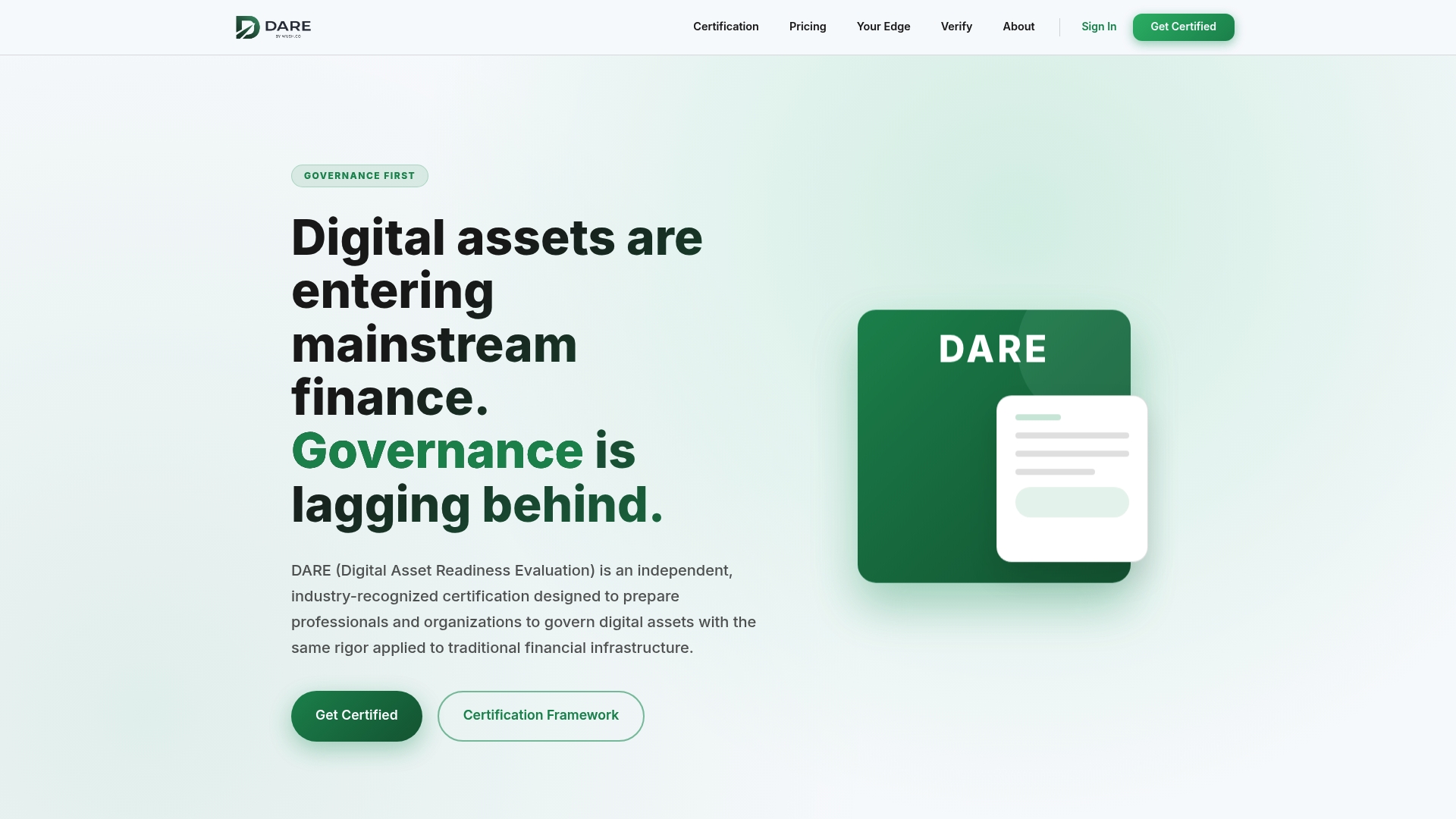
DARE includes modular learning, formal assessments, and annual renewal to keep credentials current as regulations evolve. Credentials are supported by blockchain technology, which means they are verifiable by any counterparty without a phone call. For finance professionals, treasury teams, and risk managers who need to demonstrate readiness to investors, regulators, and enterprise buyers, DARE provides the structured path that generic ISO frameworks do not. Explore the DARE platform to see how the certification maps to your current compliance obligations.
FAQ
What is regulatory readiness certification?
Regulatory readiness certification is a formal credential that proves an organization’s controls meet defined compliance standards before regulators or auditors require demonstration. Frameworks like ISO 27001, SOC 2, and DARE provide the structure for earning and maintaining this status.
How does certification reduce security breach risk?
Certified organizations experience roughly 50% fewer security breaches than non-certified peers. The reduction comes from structured gap analysis, documented incident response plans, and continuous internal audit requirements built into certification frameworks.
Why does certification matter for digital asset management?
Digital asset operations face intensifying regulatory scrutiny from frameworks including DORA, NIS2, and emerging AI governance standards. Certification demonstrates that governance controls are operational and documented, which satisfies both regulators and institutional counterparties.
How long does it take to achieve regulatory readiness?
A structured 90-day plan covering obligation identification, gap analysis, controls implementation, and training is a proven path to initial readiness. Ongoing readiness requires embedding compliance into daily workflows rather than treating it as a periodic project.
What does regulatory readiness mean in legal practice?
In legal practice, regulatory readiness means maintaining documented evidence that controls are active and current, so the organization can respond to regulatory inquiries or enforcement actions without delay. Undocumented controls are treated by regulators as controls that do not exist.