
AML Compliance Digital Assets Workflow: 2026 Guide

An AML compliance digital assets workflow is a structured process that manages anti-money laundering obligations across digital asset transactions, custody, and reporting to meet full regulatory requirements. Compliance officers working in crypto and digital finance face a distinct challenge: traditional AML frameworks were not built for blockchain-native activity. The FATF Travel Rule, the Sixth Anti-Money Laundering Directive (6AMLD), and record retention mandates all apply directly to digital asset operations. Getting the workflow right means fewer audit failures, lower regulatory risk, and a defensible compliance posture. This guide breaks down every layer of that workflow, from prerequisites to automation, for compliance professionals who need practical answers.
What are the essential components of an AML compliance digital assets workflow?
An effective AML workflow for digital assets rests on four pillars: regulatory alignment, process design, technology integration, and organizational roles. Miss any one of them and the entire program becomes fragile under examination.
85 out of 117 jurisdictions have implemented the Travel Rule, requiring originator and beneficiary data for crypto transfers above €1,000. That near-universal adoption means compliance officers cannot treat Travel Rule obligations as optional or regional. The workflow must capture and transmit counterparty data at the point of transaction, not after the fact.

The core process components every program needs are Know Your Customer and Customer Due Diligence (KYC/CDD), sanctions screening, transaction monitoring, and Suspicious Activity Report (SAR) filing. Each component feeds the next. A weak KYC stage creates blind spots that transaction monitoring cannot compensate for later.
Technology requirements include blockchain analytics tools for on-chain tracing, a case management system for investigation tracking, and data retention infrastructure. AML programs must retain KYC files and investigation notes for at least five years to meet global regulatory standards. That five-year floor is the minimum. Many jurisdictions require longer retention for high-risk cases.
Organizational structure matters as much as technology. Segregation of duties using role matrices with investigator, reviewer, and approver levels prevents bias and ensures legal responsibility sits with the right compliance officer at each decision point.
| Component | Regulatory alignment |
|---|---|
| KYC/CDD onboarding | FATF Recommendations, 6AMLD Article 3 |
| Sanctions and PEP screening | OFAC, UN Security Council lists |
| Transaction monitoring | FATF Travel Rule, national VASP regulations |
| SAR filing | FinCEN, national FIU requirements |
| Record retention | 5-year minimum, global standard |
| Segregation of duties | 6AMLD, internal audit standards |
How to design a step-by-step AML workflow for digital assets
A well-designed workflow moves in a clear sequence. Each stage has defined inputs, outputs, and responsible roles.
Step 1: Customer onboarding and risk tiering. Collect identity documents, verify wallet ownership, and assign a risk tier based on jurisdiction, transaction volume, and asset type. Digital asset customers require an additional layer: wallet attribution. Knowing whether a customer uses a custodial exchange or a self-hosted wallet changes the risk profile immediately.
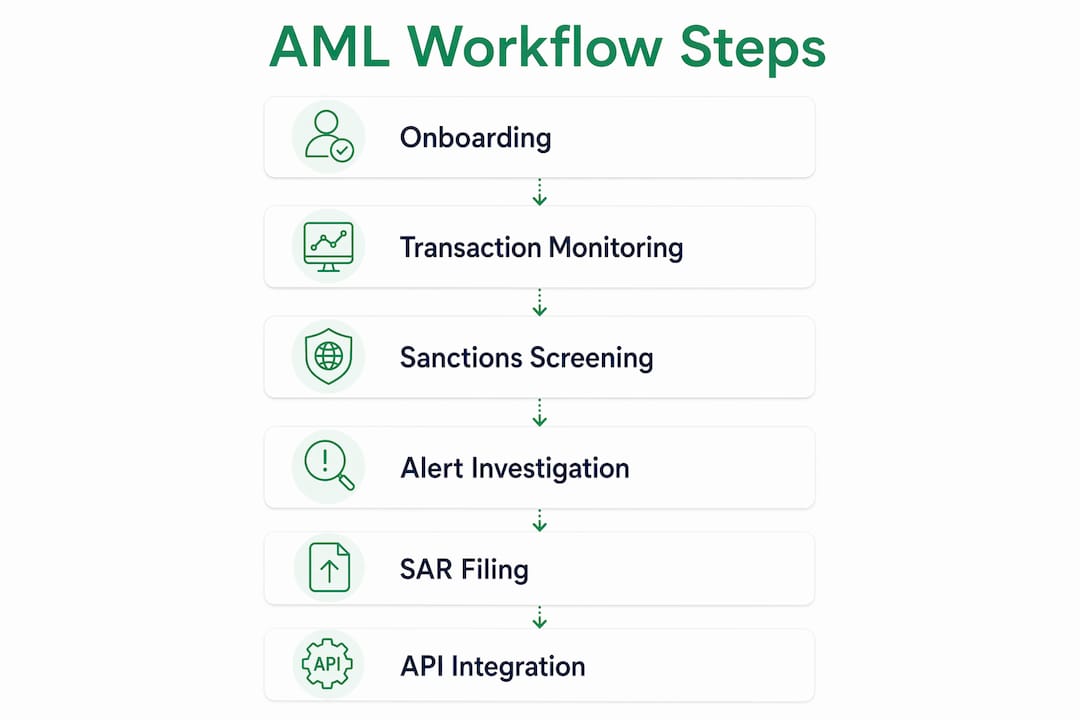
Step 2: Continuous transaction monitoring. Monitor on-chain activity in real time, not on a weekly batch cycle. Flag transactions that exceed thresholds, interact with high-risk smart contracts, or show structuring patterns. Aggregate activity across wallets linked to the same customer before applying rules.
Step 3: Automated sanctions and PEP screening. Connect real-time data feeds from OFAC, the UN Consolidated List, and regional watchlists directly into the workflow. Every new transaction and every customer profile update should trigger a fresh screening pass.
Step 4: Alert generation and tiered investigation. Tiered investigation playbooks improve efficiency by assigning Level 1 analysts to routine cases and reserving Level 2 and Level 3 investigators for complex blockchain tracing. This structure prevents alert backlogs from overwhelming the team and keeps SAR quality high.
Step 5: Documentation, escalation, and SAR filing. Every investigation must produce a documented decision, whether the outcome is a filed SAR or a cleared alert. Escalation paths must be written into the workflow, not left to individual judgment. The compliance officer approving a SAR must be different from the analyst who investigated it.
Step 6: API integration across systems. AML case management platforms require API integration with KYC systems, sanctions screening tools, workflow escalation logic, role-based access control, audit trails, and evidence management. Without this integration, analysts manually re-key data between systems, which creates errors and audit trail gaps.
Pro Tip: Build your escalation thresholds into the case management system as hard rules, not informal guidelines. Documented, system-enforced escalation paths are far easier to defend during a regulatory examination than verbal protocols.
| Feature | Manual workflow | Automated workflow |
|---|---|---|
| Transaction monitoring | Periodic batch review | Real-time event-driven alerts |
| Sanctions screening | Manual list checks | API-connected live feeds |
| Case documentation | Spreadsheets, email threads | Centralized case management |
| Audit trail | Fragmented, reconstructed | Continuous, system-generated |
| SAR filing | Analyst-drafted, slow | Template-driven, faster cycle |
What common challenges arise in digital asset AML workflows?
The most persistent operational failure in crypto AML compliance is the data gap between blockchain analytics tools and case management systems. Manual re-keying of wallet addresses leads to audit trail fragmentation during regulatory examinations. When an examiner asks for a complete investigation record, a fragmented trail is nearly as damaging as having no record at all.
Self-hosted wallet verification is the second major challenge. Proof-of-control techniques like signature challenges or micro-deposits go beyond simple address attribution and are required under the Travel Rule. Many compliance teams skip this step because it is operationally difficult. Skipping it creates a material gap in Travel Rule compliance that regulators will find.
Alert backlog management is a volume problem that becomes a quality problem. When analysts are overwhelmed, they clear alerts too quickly without adequate investigation. The tiered playbook model described in Step 4 above directly addresses this, but it only works if role assignments are enforced in the case management system, not just on paper.
GDPR and data protection rules add another layer of complexity. Compliance teams must balance the five-year retention requirement against data minimization obligations. The practical solution is to retain only the data necessary for the AML record and document the legal basis for retention in the case file.
- Connect blockchain analytics directly to the case management system via API to eliminate manual data transfer.
- Implement signature challenge protocols for all self-hosted wallet verifications above the Travel Rule threshold.
- Set hard alert aging limits in the case management system to force timely disposition.
- Document the legal basis for data retention in every case file to satisfy both AML and GDPR requirements.
Pro Tip: Run a quarterly internal audit specifically on audit trail completeness. Pull ten closed cases at random and verify that every investigative step, every data source, and every approval is documented in the case management system. Gaps found internally are far less costly than gaps found by an examiner.
Compliance programs that treat documentation as an afterthought consistently fail regulatory examinations. The investigation is only as defensible as the record it leaves behind.
How can automation improve AML workflow management for digital assets?
Automation in AML workflow management is not about replacing analyst judgment. It is about removing the manual steps that slow down good judgment and create errors. The unified platform approach that integrates blockchain tracing, sanctions screening, and case documentation into a single governed workspace produces audit-ready reports without manual assembly.
Event-driven monitoring is the clearest example of automation delivering real compliance value. Enterprise AML programs benefit from event-driven monitoring that triggers enhanced due diligence when material changes occur in customer profiles, such as a sudden shift in transaction volume or interaction with a flagged smart contract. Periodic batch reviews miss these signals entirely.
Robotic Process Automation (RPA) handles evidence collection and bulk case processing tasks that would otherwise consume analyst hours. RPA pulls blockchain transaction records, formats them for the case file, and routes the case to the correct analyst tier based on predefined rules. The analyst receives a pre-populated case, not a blank form.
Role-based access control (RBAC) is the governance layer that makes automation trustworthy. Every action in the workflow must be tied to a named user with a defined role. This creates the audit trail that regulators expect and prevents unauthorized access to sensitive investigation data.
- Integrate blockchain analytics via API to eliminate manual data transfer between systems.
- Deploy event-driven monitoring rules that trigger enhanced due diligence on profile changes.
- Use RPA for evidence collection, case routing, and bulk alert processing.
- Enforce RBAC across all workflow stages to maintain a clean, attributable audit trail.
- Schedule automated regulatory reporting outputs from the case management system to reduce manual report preparation.
Pro Tip: Before selecting any automation tool, map your current workflow on paper first. Automation applied to a broken process produces faster errors. Fix the process logic, then automate it.
What are best practices for ongoing monitoring and regulatory updates in AML workflows?
Ongoing monitoring is not a set-and-forget function. Digital asset compliance readiness requires continuous risk assessment and dynamic updates to customer risk profiles as transaction behavior and regulatory requirements evolve.
Regulatory change management must be built into the workflow as a formal process. Assign a named owner to monitor FATF guidance updates, 6AMLD implementation changes, and national VASP regulatory amendments. When a change occurs, that owner updates the relevant workflow rules and documents the change in the compliance program record.
- Review and update customer risk profiles at least annually, and immediately upon triggering events such as large transactions or new product use.
- Subscribe to FATF, FinCEN, and relevant national FIU update channels and assign a team member to review each release.
- Conduct independent testing of AML controls at least once per year, using a reviewer who did not design the controls being tested.
- Train all analysts on digital asset typologies and red flags specific to crypto, including mixer usage, chain-hopping, and layering through DeFi protocols.
- Maintain a living AML compliance checklist that reflects current regulatory requirements and is reviewed quarterly.
The penalty exposure for failing these obligations is severe. 6AMLD enforces fines up to 10% of annual turnover and minimum four-year prison sentences for serious AML failures. Those numbers make the cost of a strong ongoing monitoring program look very small by comparison.
Key takeaways
A structured AML compliance digital assets workflow, built on integrated technology, clear role definitions, and event-driven monitoring, is the only defensible approach to regulatory compliance in digital asset operations.
| Point | Details |
|---|---|
| Regulatory mandates are global | The Travel Rule applies in 85 of 117 jurisdictions; compliance is not optional for any digital asset firm. |
| Integration eliminates audit gaps | Connect blockchain analytics and case management via API to prevent the manual data gaps that fail examinations. |
| Tiered investigations protect quality | Assign L1 analysts to routine cases and L2/L3 to complex tracing to manage backlogs without sacrificing SAR quality. |
| Automation requires process clarity | Map and fix workflow logic before automating; automation applied to a broken process accelerates errors. |
| Ongoing monitoring is active work | Update risk profiles dynamically, track regulatory changes formally, and test controls independently at least once per year. |
What I’ve learned about AML workflows that most guides won’t tell you
After working through AML program design for digital asset operations, the pattern I see most often is not a technology failure. It is a role clarity failure. Teams invest in blockchain analytics tools and case management platforms, then undermine both by leaving escalation decisions to informal consensus. When a SAR decision requires three people to agree over email, the audit trail is already broken.
The second thing I have learned is that automation creates a false sense of security if it is not governed. An automated alert that routes to the wrong analyst tier, or a sanctions screening feed that goes stale for 48 hours, can produce a compliance gap that looks worse than a manual process during an examination. Governance of the automated workflow matters as much as the automation itself.
The benefits of a structured risk framework become most visible not during normal operations but during a regulatory examination or an internal audit. That is when the difference between a documented, system-enforced workflow and an informal one becomes very clear, very fast.
My honest recommendation: treat your AML workflow as a living document, not a project deliverable. Assign ownership, schedule reviews, and test it against real cases regularly. The compliance officers who do this consistently are the ones whose programs hold up under scrutiny.
— Gregg
Wush DARE certification for digital asset AML readiness
Compliance officers who want an independent benchmark for their AML program can use the Wush Digital Asset Readiness Evaluation (DARE) certification to assess where their workflows stand against current regulatory standards.
DARE covers custody, regulatory compliance, risk management, and operational controls through modular assessments with annual renewal. It is designed for finance professionals, treasury teams, and risk managers who need a credentialed, audit-ready record of their compliance posture. The certification is supported by blockchain technology, which means the credential itself is verifiable. For teams building or refining their digital asset AML program, DARE provides the structured framework and independent validation that internal reviews alone cannot deliver.
FAQ
What is an AML compliance digital assets workflow?
An AML compliance digital assets workflow is a structured sequence of processes covering KYC, transaction monitoring, sanctions screening, investigation, and SAR filing, designed to meet anti-money laundering obligations for digital asset operations.
What does the FATF Travel Rule require for crypto transfers?
The Travel Rule requires virtual asset service providers to collect and transmit originator and beneficiary data for transfers above €1,000. It is now implemented in 85 of 117 jurisdictions globally.
How do tiered investigation playbooks help manage AML alert backlogs?
Tiered playbooks assign Level 1 analysts to routine alerts and Level 2 or Level 3 investigators to complex cases. This structure prevents backlogs from forcing rushed dispositions and keeps SAR quality consistent.
What is the minimum record retention period for AML files?
Global regulatory standards require a minimum of five years for KYC files and investigation notes. Some jurisdictions and high-risk case categories require longer retention periods.
How does self-hosted wallet verification affect Travel Rule compliance?
Self-hosted wallet verification requires proof-of-control techniques such as signature challenges or micro-deposits, not just address attribution. Skipping this step creates a material gap in Travel Rule compliance that regulators actively examine.