
Digital Asset Penetration Testing Process: 2026 Guide

The digital asset penetration testing process is a structured, multi-phase security evaluation designed to identify and exploit vulnerabilities in blockchain systems, smart contracts, wallets, and related infrastructure before real-world attackers can. Unlike conventional IT security testing, this process must account for financially motivated attack vectors, smart contract logic flaws, and the regulatory expectations of frameworks like Singapore’s MAS TRM Guidelines and Dubai’s VARA Rulebook. The five-phase testing lifecycle covering goal definition, reconnaissance, active exploitation, reporting, and retesting has become the industry standard for digital asset security testing. A full platform assessment can exceed $50,000 depending on stack complexity. That cost reflects the depth of expertise and coverage these environments demand.
What are the essential preparatory steps before penetration testing digital assets?
Preparation determines whether a penetration test produces audit-ready findings or a report that fails regulatory review. The first task is building a complete asset and trust-boundary map. This map identifies every component in scope: smart contracts, node infrastructure, APIs, wallets, key management systems, and cloud services. Scope blind spots are a leading cause of audit failures, and they almost always trace back to incomplete asset inventories.
Once the asset map exists, the team defines clear objectives. Are you testing for MAS TRM compliance? Preparing for a VARA licensing submission? Validating a post-incident remediation? Each goal shapes which attack scenarios get prioritized. Regulatory requirements add a non-negotiable layer: MAS TRM Guidelines mandate annual testing for all internet-accessible systems, plus retesting after major changes. That schedule must be built into your security calendar, not treated as a one-time event.
Threat intelligence feeds into scoping decisions directly. Threat-led penetration testing (TLPT) requires that scope be derived from live attacker TTPs relevant to your specific digital asset environment, not from a static checklist. This means reviewing recent incidents in the DeFi and crypto custody space before finalizing what gets tested.
Key preparation deliverables include:
- A signed rules of engagement document covering authorized test windows and emergency contacts
- A complete asset register with trust boundaries and data flow diagrams
- Defined attacker profiles based on threat intelligence (e.g., financially motivated external actor, malicious insider)
- Environment decisions: testnet for smart contract logic, live staging for infrastructure
- Regulatory alignment confirmation with your compliance or legal team
Pro Tip: Map your trust boundaries before you finalize scope. Any component that touches a privileged workflow, a wallet signing key, or an external API is a candidate for inclusion, even if it sits outside your primary system boundary.
How is reconnaissance and threat modeling conducted in digital asset penetration testing?
Reconnaissance in digital asset security testing splits into passive and active phases. Passive reconnaissance collects publicly available information without touching target systems. This includes reviewing on-chain transaction histories, published smart contract code on block explorers, GitHub repositories, API documentation, and DNS records. Active reconnaissance involves direct interaction with endpoints, nodes, and interfaces to map live attack surfaces.
Threat modeling for blockchain environments goes well beyond conventional vulnerability scanning. Blockchain penetration testing focuses on simulating financially motivated abuse and economic attack vectors that have no equivalent in traditional IT systems. Flash loan exploits, oracle manipulation, governance token abuse, and reentrancy attacks are all incentive-driven scenarios that a standard IT tester will not model without blockchain-specific expertise.
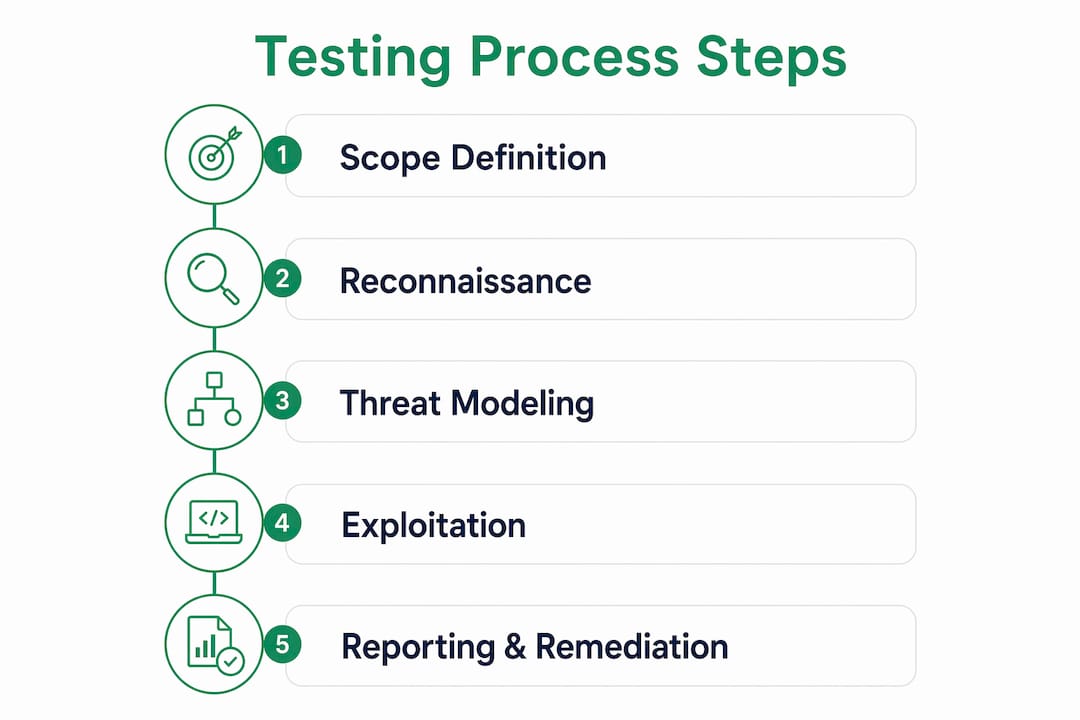
The threat modeling phase produces an attack tree: a structured map of how an adversary could move from initial access to a high-value outcome like draining a liquidity pool or compromising a custody wallet. Each branch of the tree gets assigned a likelihood and impact score. That scoring directly informs which test scenarios get executed in the active phase.
Effective reconnaissance for digital asset environments covers:
- Smart contract bytecode analysis and decompilation where source is unavailable
- Node and RPC endpoint enumeration to identify exposed interfaces
- API surface mapping including authentication mechanisms and rate-limit controls
- Review of privileged workflow documentation for insider threat modeling
- Cross-chain bridge and oracle dependency mapping
The output of this phase is not just a list of targets. It is a prioritized attack narrative that guides every decision in the active testing phase.
What processes and methods are used during active penetration testing and exploitation?
Active penetration testing combines automated scanning with manual, strategy-driven exploitation. Automated tools identify known vulnerability patterns quickly across large attack surfaces. Manual testing handles the logic-layer vulnerabilities that scanners miss entirely, including business logic flaws in smart contracts and multi-step privilege escalation paths.

Manual review alongside automated tools is essential because blockchain systems have unique incentive structures that automated scanners cannot model. A scanner can flag an unchecked external call. Only a skilled tester can determine whether that call is exploitable in a way that drains funds under specific market conditions.
The active phase follows a structured sequence:
- Smart contract testing: Reentrancy, integer overflow, access control bypass, and flash loan attack simulations on testnet before any live environment work.
- Wallet and key management testing: Privilege escalation attempts, signing key exposure paths, and multi-signature bypass scenarios.
- API and infrastructure testing: Authentication bypass, injection attacks, and lateral movement across cloud-hosted node infrastructure.
- Scenario-based testing: Advanced persistent threat simulations aligned with MAS TRM requirements, modeling a sophisticated external attacker with sustained access.
- Economic abuse modeling: Testing incentive-driven attack paths including oracle price manipulation and governance voting exploits.
Pro Tip: Run smart contract exploitation scenarios on a testnet fork of mainnet state. This gives you realistic conditions without risking live funds and satisfies most regulatory documentation requirements for evidence of testing.
| Testing area | Primary method | Key risk category |
|---|---|---|
| Smart contracts | Manual review + testnet exploitation | Logic flaws, reentrancy, access control |
| Wallets and key management | Privilege escalation testing | Key exposure, signing bypass |
| APIs and RPC endpoints | Automated scan + manual bypass | Authentication, injection, data exposure |
| Cloud infrastructure | Configuration review + lateral movement | Misconfiguration, privilege escalation |
| Economic attack vectors | Scenario modeling | Oracle manipulation, flash loan abuse |
Every finding gets documented with a proof-of-concept, reproduction steps, and a severity rating. Regulators expect this level of evidence. A finding without a reproducible exploit path carries little weight in a compliance submission.
What are best practices for reporting, remediation guidance, and retesting?
A penetration test report serves two audiences simultaneously: the technical team that must fix the findings and the compliance officer or regulator who must verify that fixing happened. These audiences need different things from the same document. Structure your report with an executive summary covering business risk, a technical findings section with full exploit details, and a remediation roadmap with prioritized timelines.
VARA regulations require comprehensive coverage of APIs, wallets, privileged workflows, and cloud infrastructure with audit-ready documentation. That means your report must map each finding to the specific regulatory control it affects. A finding labeled “high severity” with no regulatory mapping is harder to act on and harder to defend in a licensing review.
Remediation guidance must be specific. “Patch the library” is not guidance. The report should specify the exact version, the configuration change required, and the expected behavior after remediation. Prioritize findings by exploitability and business impact, not just CVSS score. A medium-severity finding in a wallet signing workflow carries more real-world risk than a high-severity finding in a read-only analytics endpoint.
Retesting is where many organizations cut corners. Retesting must verify the specific exploit path, not just confirm that a patch was applied. If the original finding demonstrated fund drainage through a reentrancy attack, the retest must attempt that exact attack sequence again. Patch confirmation alone does not satisfy regulatory audit standards.
Best practices for the reporting and remediation cycle:
- Assign a named owner and deadline to every finding before the report is finalized
- Use a risk register to track remediation status across testing cycles
- Retain all evidence artifacts, including screenshots, logs, and proof-of-concept code, for at least the period required by your regulatory framework
- Schedule retesting within a defined window, typically 30–90 days after remediation, not open-ended
Pro Tip: Build your digital asset risk framework before the first test. A pre-existing risk register makes it far easier to slot findings into existing controls and demonstrate continuous improvement to regulators.
Change control integration prevents scope drift between testing cycles. Any significant system change, a new smart contract deployment, a custody provider switch, or a major API version update, should trigger a targeted retest of affected components. This keeps your security posture current without waiting for the next annual cycle.
What are common challenges and pitfalls in the digital asset penetration testing process?
The most expensive mistake in digital asset security testing is hiring a firm with strong IT credentials but no blockchain expertise. Legacy IT firms lacking blockchain expertise routinely produce reports that miss Web3-specific attack vectors entirely. The result is a document that delays licensing and increases regulatory scrutiny rather than resolving it.
Scope definition errors are the second most common failure. Omitting a single privileged API or an external oracle dependency can leave a critical attack path untested. Overreach creates the opposite problem: a test so broad it runs over budget and timeline without producing actionable depth on the highest-risk components.
TLPT requires independent, qualified assessors with blockchain-specific expertise, distinct from standard IT security certifications. This is a regulatory requirement in several jurisdictions, not a preference. Submitting a report from an unqualified firm can invalidate the entire testing cycle.
Common pitfalls to avoid:
- Treating a smart contract audit as a substitute for a full penetration test. Audits focus on code logic while pentests simulate integrated system attacks across the full stack.
- Skipping retesting due to time or budget pressure, which leaves unverified fixes in production
- Failing to document test evidence in a format that satisfies your specific regulatory framework
- Relying on a single automated scanning tool without manual validation of findings
“Failure to align pentesting scope with threat intelligence and regulatory requirements risks non-compliance and an ineffective security posture.” This is not a theoretical risk. It shows up directly in licensing delays and regulatory findings.
For a deeper look at how third-party security assessments fit into your overall security program, the independence and qualification requirements deserve careful attention before you select a testing firm.
Key takeaways
A structured digital asset penetration testing process requires threat-led scoping, blockchain-specific expertise, and exploit-path retesting to satisfy both security and regulatory requirements.
| Point | Details |
|---|---|
| Scope from threat intelligence | Base your test scope on live attacker TTPs, not static asset lists, to meet TLPT requirements. |
| Use blockchain-specialist testers | Standard IT certifications do not qualify a firm to test smart contracts, wallets, or DeFi protocols. |
| Retest exploit paths, not just patches | Regulators require proof the specific attack vector no longer works, not just that a fix was deployed. |
| Map assets and trust boundaries first | Incomplete asset maps cause scope blind spots that produce audit failures and licensing delays. |
| Integrate testing into change control | Major system changes should trigger targeted retesting, not just the annual scheduled cycle. |
Why I think most digital asset pentests fail before they start
The organizations I see struggle most with digital asset security testing share one pattern: they treat penetration testing as a compliance checkbox rather than a security exercise. They scope it narrowly, hire the cheapest qualified firm, and file the report. When the regulator asks follow-up questions, the evidence trail falls apart.
The shift to threat-led penetration testing changes this dynamic. TLPT forces you to think like an attacker before you define scope. That discipline alone catches more real risk than any scanning tool. The firms that do this well spend as much time on scoping and threat modeling as they do on active exploitation. That ratio feels wrong to teams used to traditional IT testing. For digital assets, it is exactly right.
The other pattern I keep seeing is the audit-versus-pentest confusion. A smart contract audit is a code review. A penetration test is a full-stack attack simulation. You need both, and they answer different questions. Conflating them leaves entire attack surfaces untested, particularly the infrastructure and API layers that connect your smart contracts to the real world.
My honest recommendation: build your access control practices and asset inventory before you engage a testing firm. The quality of your preparation directly determines the quality of the findings. A tester can only find what they can reach. Make sure they can reach everything that matters.
— Gregg
How DARE supports penetration testing readiness and compliance
Wush’s Digital Asset Readiness Evaluation (DARE) gives compliance officers and security teams a structured framework for assessing and documenting digital asset security posture, including penetration testing readiness. DARE aligns with regulatory frameworks like MAS TRM and VARA, covering custody controls, risk management, and operational security in a single certification program. The platform tracks remediation progress, supports evidence retention for audits, and provides credentials recognized across the digital finance industry. For organizations preparing for licensing submissions or annual compliance cycles, DARE offers a clear path from security assessment to verified compliance. Learn more about DARE’s full certification program and how it fits your organization’s security workflow.
FAQ
What is the digital asset penetration testing process?
The digital asset penetration testing process is a five-phase security evaluation covering scope definition, reconnaissance, active exploitation, reporting, and retesting. It targets blockchain systems, smart contracts, wallets, APIs, and related infrastructure to identify vulnerabilities before attackers do.
How often should digital asset penetration testing be performed?
MAS TRM Guidelines require penetration testing at least annually for internet-accessible systems, plus additional testing after major system changes. Regulatory frameworks like VARA may impose similar or stricter schedules depending on your jurisdiction.
What is the difference between a smart contract audit and a penetration test?
A smart contract audit reviews code logic for flaws in isolation. A penetration test simulates integrated attacks across the full stack, including infrastructure, APIs, and wallets, making both necessary for complete security coverage.
What qualifications should a digital asset penetration tester have?
TLPT requirements in regulated jurisdictions mandate independent assessors with blockchain-specific expertise. Standard IT security certifications alone do not qualify a firm to test DeFi protocols, custody systems, or smart contract interactions.
What does retesting involve in a digital asset security assessment?
Retesting must attempt the original exploit path again after remediation, not just confirm that a patch was applied. Regulators require proof that the specific attack vector no longer works before closing a finding.