
Top 6 decinstitute.org Alternatives 2026

Proving organizational competency in digital asset and decentralized AI governance is often slowed by fragmented standards, opaque research pathways, and limited access to verifiable credentials. Existing options either lack a transparent, blockchain-backed certification framework or focus solely on academic research without practical outputs that can be audited and presented to regulators. This comparison lets you assess certification, policy collaboration, and research fellowship offerings so you can select the best institute or framework for governance, compliance, or safety across blockchain and AI projects.
Table of Contents
- DARE (Digital Asset Readiness Evaluation)
- Institute for Decentralized AI
- Decentralization Research Center (DRC)
- Constellation
- European Decentralisation Institute
- Principles of Intelligence
DARE (Digital Asset Readiness Evaluation)
At a Glance
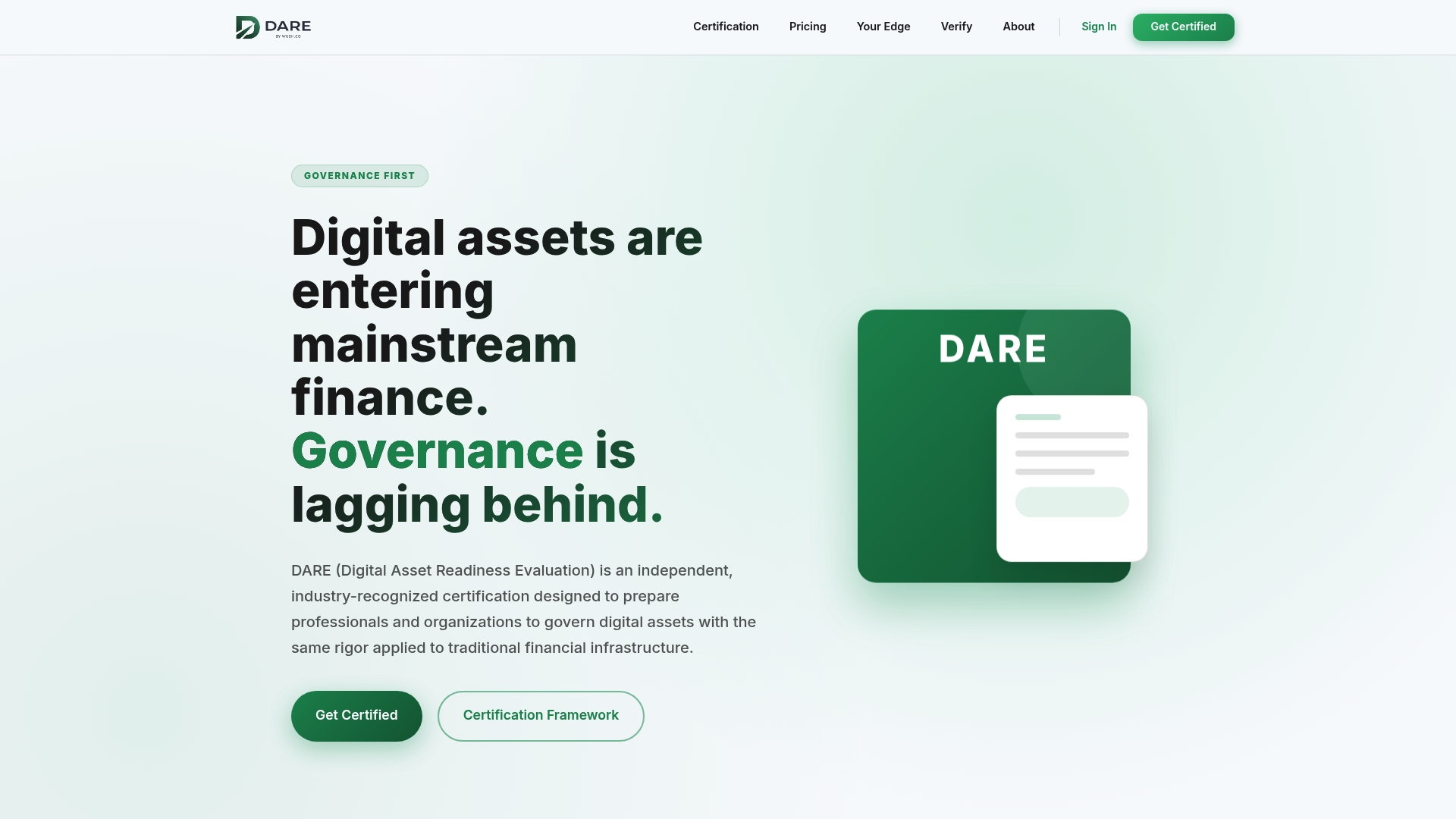
Co issued with the Asia Blockchain Association, DARE issues a verifiable digital credential recorded on blockchain that organizations can attach to external profiles such as LinkedIn to demonstrate enterprise governance competency for digital assets.
Core Features
- Structured assessment framework covering regulatory, custody, accounting, compliance, and strategy so teams can map controls to enterprise functions.
- Verifiable digital credential compatible with external profiles and anchored to blockchain technology for tamper resistant proof of completion.
- Progress tracking that surfaces detailed metrics on module completion and assessment performance for auditability.
- According to the vendor, self paced modular learning includes assessments and a final exam all designed to fit within a three month completion window.
- Continuously maintained standards and an annual renewal process to reflect regulatory and technological developments.
Key Differentiator
Wush.co positions DARE as a vendor neutral, continuously updated certification framework that it says is recognized by industry leaders. The program ties governance assessment to a verifiable credential and an organizational pathway rather than a single training certificate.
Pros
- Industry facing governance focus helps legal, compliance, and treasury teams converge on a single set of controls for custody and operational risk rather than separate vendor playbooks.
- The credential is verifiable and blockchain backed which reduces internal friction when credentialing contractor teams or external auditors.
- Modular coursework lets you assign specific tracks to different roles so a risk manager and a custody operator do not repeat the same content.
- Progress metrics and reporting provide measurable evidence for board briefings and regulator conversations, useful when you need a defensible record.
- Renewal and continuous updates keep the standard aligned to new rules instead of leaving certified teams with an outdated checklist.
Cons
- Uses subscription pricing with renewal fees, which increases long term cost for teams and should be factored into training budgets.
Who It’s For
Enterprise professionals across finance, risk, legal, compliance, technology, and executive leadership who must prove governance competency for digital asset programs. Procurement and audit teams will also benefit when evaluating vendor readiness against an auditable standard.
Unique Value Proposition
A blockchain anchored, verifiable credential that maps to an enterprise grade assessment framework is the concrete differentiator. That design turns certification from an individual resume item into an auditable organizational control used in governance and regulator reporting.
Real World Use Case
A multinational firm building a governance framework for tokenized securities runs the DARE pathway, certifies cross functional leads, and presents the verifiable credentials and progress reports to external counsel and regulators during implementation.
Website: https://dare.wush.co
Institute for Decentralized AI
At a Glance
Based in Oxford, Stanford, and Austin, the Institute for Decentralized AI is a project of the Cosmos Institute with support from the AI Safety Fund. The research focus centers on tools and protocols that remove single points of control in AI systems.
Core Features
- Multiagent systems research that explores interactions among distributed models and services.
- Protocols and tools for decentralized intelligence aimed at moving compute and data control away from single operators.
- Distributed oversight methods for monitoring and governance across heterogeneous nodes.
- Emphasis on safer, auditable AI systems with documentation and open research outputs.
Key Differentiator
The Institute concentrates on heterogeneous, distributed AI systems as a route to more human centered outcomes. That emphasis places governance, interfacing, and auditability at the center of protocol development rather than treating them as add ons.
Pros
-
Collaborative footprint across major research centers gives the Institute access to academic networks and cross discipline reviewers. This helps form multiinstitution working groups and shared experiments.
-
Public research focus areas are clearly stated. You can quickly see priorities like multiagent coordination and oversight without digging through marketing copy.
-
The project relationship with the Cosmos Institute and support from the AI Safety Fund signals serious research backing and funding pathways for partners.
-
Engagement with organizations and individual researchers is explicit. The Institute accepts collaborative proposals and often frames work as open research rather than proprietary tools.
Cons
-
There are no publicly available product pages or detailed tool documentation, which makes assessment of deliverables difficult for procurement or governance teams.
-
The site suffers from navigation issues and missing pages, suggesting parts of the portal are under construction or incomplete.
-
The absence of third party reviews or case studies means you must rely on the Institute’s stated aims and published papers rather than independent user feedback.
When It May Not Fit
If you need production ready libraries, SDKs, or off the shelf governance modules today this Institute is not a quick procurement source. Teams looking for polished, deployed tooling will find limited documentation and fewer operational artifacts.
If your priority is an auditable runbook and shipped integrations, expect a research to product gap that requires internal engineering to bridge.
Who It’s For
Researchers, academic labs, and governance teams exploring foundational approaches to decentralized AI will find the Institute relevant. Organizations wanting open protocols and academic collaborations are the primary audience rather than implementers seeking turnkey solutions.
Real World Use Case
A university lab partners with the Institute to test distributed oversight algorithms across campus compute clusters. The collaboration produces a draft protocol, a reference paper, and community review threads that help the lab adapt the protocol for a departmental pilot.
Website: https://decentralized-ai.org
Decentralization Research Center (DRC)
At a Glance
Operates as a 501©(4) social welfare nonprofit and maintains a digital decentralization research library while staging summits and policy dialogues that bring academia, industry, and policymakers together.
Core Features
- Digital decentralization research library that curates papers, briefs, and reference material for governance studies.
- Curated events and summits that convene academics, practitioners, and regulators for focused dialogue.
- Educational resources including primers and course-like materials aimed at researchers and advocacy groups.
- Drafting of policy briefs and facilitation of collaborative projects across sectors.
Key Differentiator
DRC’s angle is explicit: it bridges academic research, industry practice, and policy to advance equitable technology development. That emphasis on governance and public policy makes DRC a research and advocacy hub rather than an operational certification or controls provider like Wush.
Pros
-
Offers a centralized repository of research and reference material which reduces time spent hunting for relevant governance literature.
-
Creates structured convenings where researchers and officials can exchange proposals and debate regulatory options.
-
Provides targeted educational content that teams can use to build internal briefing packs on decentralization topics.
-
Positions itself around democratic design principles which helps advocacy groups frame standards and incentives for fair reward distribution.
-
Acts as a connector between sectors so academic findings have clearer routes into policy discussion.
Cons
-
No independent user reviews or third-party evaluations are presented so assessing community impact requires direct inquiry.
-
The public-facing data set omits funding and partnership details which makes vetting potential conflicts of interest harder.
-
Focus is research and advocacy not product development so you will not find turn-key software or operational tooling here.
When It May Not Fit
Choose a different resource if you need hands-on tools for custody, compliance workflows, or enterprise-grade software integrations. DRC is oriented toward policy, research, and convening rather than delivering engineering or audit-ready controls.
Who It’s For
Researchers, policymakers, academics, and advocacy organizations seeking a neutral forum to develop governance frameworks for blockchain, AI, and related technologies. Also useful for legal teams preparing policy briefs or for academic groups building collaborative grant proposals.
Real World Use Case
A university research lab used DRC events and library materials to draft a policy brief on decentralized governance models. That brief was circulated at a DRC summit where industry and regulator attendees translated academic recommendations into draft guidelines.
Website: https://thedrcenter.org
Constellation
At a Glance
Hosts named AI safety researchers and strategists in Berkeley while running the Astra fellowship plus a Generator Residency, an incubator, and regular convenings that connect founders, policy experts, and technical researchers under one roof.
Apply early.
Core Features
The program mix is organized around research support, talent pipelines, and organization building. Constellation funds and mentors projects at early stages while offering workspace for collaborations.
- Research support across technical safety, policy, and governance with mentor access and peer review.
- Fellowship tracks including Visiting Fellowship and Astra that provide funded time and networks for researchers.
- An Incubator and Generator Residency for teams forming new safety organizations with access to leadership coaching and operational help.
- Regular convenings and leader networks that accelerate coordination between labs, funders, and policymakers.
Key Differentiator
Constellation combines fellowship funding, organizational incubation, and community convening in a single program suite. That overlap helps a researcher move from a short fellowship to an incubated project without losing institutional memory or network access.
This is less common among research centers that run only fellowships or only conferences.
Pros
-
Structured entry paths. The fellowship and residency routes create clear, repeatable ways for talent to join focused safety projects rather than ad hoc introductions.
-
Strong network effects. Named researchers and convenings increase the odds that a new team finds collaborators, funders, or reviewers quickly.
-
Support for founders. Incubator resources and mentorship reduce early operational friction for teams spinning out of academic labs.
-
Physical convening space. For organizations that benefit from co-location, the Berkeley presence speeds trust building and coordination.
-
Mission alignment. Programs are explicitly oriented toward reducing extreme risks from advanced AI, which helps prioritize scarce funding and attention.
Cons
-
Some public reports cite higher-than-average rates tied to unrelated energy providers; those issues are not about Constellation’s core research services but may appear in broader search results.
-
A few users have mentioned communication delays in service interactions in contexts outside of research programs. Those reports reflect external service experiences rather than fellowship delivery.
-
The organization’s emphasis is on nonprofit and research pathways. Expect limited support for commercial productization or go-to-market help.
When It May Not Fit
If your primary need is a vendor that builds or licenses AI systems, Constellation will not meet that requirement. The center focuses on research, policy, and organizational development rather than shipping technology or providing commercial engineering services.
It is not a match for teams seeking direct product engineering contracts.
Who It’s For
Researchers focused on technical safety, policy experts shaping governance frameworks, and founders planning mission-driven safety organizations will find direct value. Funders seeking vetted programs and government officials looking for convening partners also fit the profile.
Real World Use Case
A postdoc receives a Visiting Fellowship, uses the funded time to prototype a governance audit framework, then joins the Incubator to turn that framework into an operational nonprofit. Constellation’s convenings connect the new nonprofit with early funders and regulatory advisors.
Website: https://constellation.org
European Decentralisation Institute
At a Glance
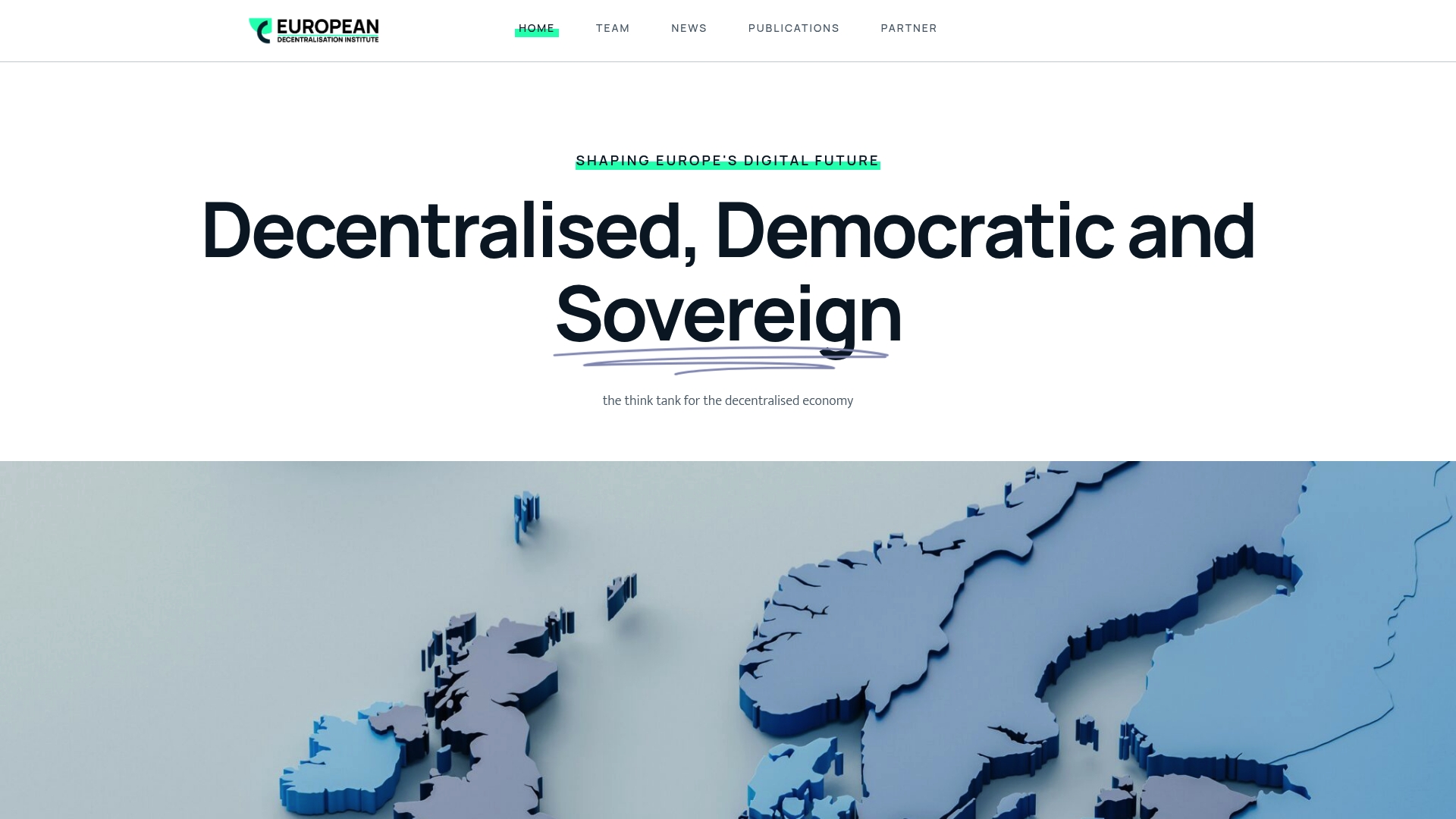
Operates as a non-profit foundation in The Netherlands and concentrates on decentralization as a strategic approach to European digital sovereignty and economic resilience. The institute pairs policy research with stakeholder convening to move proposals from paper to institutional dialogue.
Core Features
The institute publishes policy briefs and reports that translate technical decentralization concepts into regulatory language for legislators and civil servants. It runs expert roundtables that convene policymakers, industry leaders, and academics to test policy options against political and operational constraints.
Partnership programs fund joint research and pilot projects with universities and industry. The team maintains an interdisciplinary remit spanning digital identity, data sovereignty, decentralized finance, and infrastructure resilience.
Key Differentiator
A single focus on decentralization as a systemic policy lever distinguishes the institute. That strategic framing positions decentralization not as a niche technology topic but as a governance tool for sovereignty, competition policy, and infrastructure resilience within European institutions.
Pros
- Active in policy channels. The institute engages directly with European institutions and stakeholder networks, which shortens the feedback loop between research and draft legislation.
- Interdisciplinary team. Legal scholars, technologists, and policy analysts collaborate, producing recommendations that speak to legal feasibility and operational constraints simultaneously.
- Practical outputs. The emphasis is on policy briefs and actionable recommendations rather than theoretical manifestos, which helps officials draft implementable measures.
- Open collaboration. Public calls for partners and funding create routes for research teams and industry actors to join pilots and evidence-gathering efforts.
- Network reach. The institute’s partner network gives projects immediate channels into regulatory discussions and stakeholder consultation cycles.
Cons
- Institutional focus only. There is no productized technology or software offering; engagements are advisory, research, or convening rather than turnkey technical deployments.
- Sparse public user feedback. External third-party reviews or independent evaluations are limited, so assessing impact requires trusting institutional outputs and partner reports.
- Limited product detail. If you need concrete tools, standards, or vendor-neutral technical stacks, the institute points to research and policy pathways rather than shipping implementation kits.
Who It’s For
Policymakers, government advisers, academic researchers, and industry strategy teams working on national or EU-level digital sovereignty programs. Teams looking for policy framing, legal analysis, or stakeholder convening will find the institute directly relevant.
Real World Use Case
A national policy office commissions the institute to draft a white paper recommending governance frameworks for decentralized identity. The institute organizes expert roundtables, produces a targeted policy brief, and helps the office present recommended language to EU working groups.
Pricing
Not applicable. The institute operates as an informational and advisory non-profit. Engagements take the form of commissioned research, partnership agreements, or funded collaborations rather than fixed product pricing.
Website: https://eudecentralisation.org
Principles of Intelligence
At a Glance
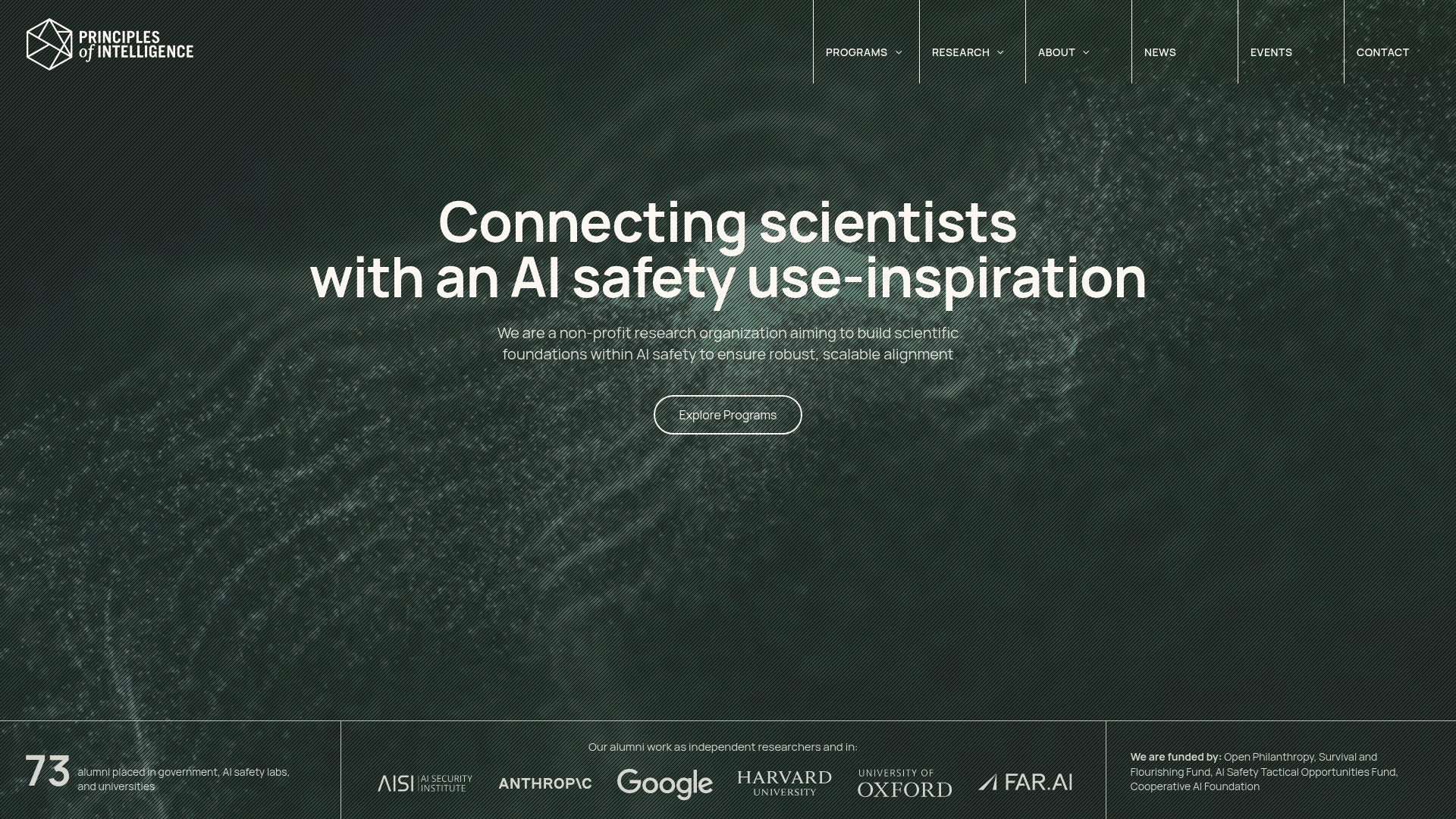
Principles of Intelligence’s materials state alumni have taken roles at Google, Harvard, Oxford, and Anthropic. The organization runs fellowship and residency programs and horizon scanning to build scientific foundations for AI safety through an academic style community.
Core Features
The platform centers its activity on structured research programs and cross-disciplinary collaboration.
- Fellowships, residencies, and horizon scanning programs that place researchers in short and medium term cohorts.
- Support for interdisciplinary work connecting ecology, neuroscience, economics, and physics to questions in AI alignment.
- Formal links between researchers and academic, governmental, and industry institutions to surface use-inspired projects.
- A community model that emphasizes researcher networks, peer collaboration, and academic-style mentoring.
Key Differentiator
This organization explicitly links multiple scientific disciplines to AI safety research, prioritizing the scientific foundations of complex systems and scalable alignment rather than policy advocacy or corporate certification. That disciplinary bridge makes it better suited to theory and foundational work than to operational governance programs used by enterprise teams.
Pros
Research-first programming produces tangible benefits for early-career scholars and cross-disciplinary teams.
- Multidisciplinary approach speeds conceptual cross-pollination. Journals and methods from biology, economics, and physics get applied to alignment problems.
- Fellowships and residencies provide focused time and peer feedback, which shortens the research iteration cycle for fellows.
- Network effects are real for participants. The organization reports alumni placements at prominent institutions, which helps with downstream collaborations and hiring conversations.
- The emphasis on scientific foundations gives researchers a defensible framework for proposals and grant applications.
Cons
The offering has clear limits depending on what you need from a community.
- No published costs: There are no visible pricing or program fee details on the site, which complicates budgeting for institutions or individual applicants.
- Limited third-party visibility. The site does not present substantive independent reviews or external impact metrics for its programs.
- Not aimed at operational compliance teams. If your priority is enterprise governance frameworks, standard operating procedures, or certification workflows, this research focus will feel narrowly academic.
Who It’s For
Academic and industry researchers, graduate students, and PhD candidates who plan to pursue AI safety from a scientific, research-oriented angle. Ideal users are those seeking peer cohorts, mentorship, and cross-disciplinary methods rather than a plug-and-play governance credential.
Real World Use Case
A neuroscience researcher joins a summer fellowship to test hypotheses about learning dynamics and collaborates with an economist and a physicist on a joint paper. The fellowship provides structured feedback, cross-disciplinary contacts, and pathways to follow-on residencies.
Website: https://princint.org
Competitor eligibility:
- Excluded products: none
- Usable competitors remaining: Institute for Decentralized AI, Decentralization Research Center (DRC), Constellation, European Decentralisation Institute, Principles of Intelligence
Intro pre-write:
- Does dare.wush.co clearly outpace every usable competitor on a single dimension? YES
- If YES: dimension where dare.wush.co wins — offering verifiable, blockchain-compatible credentials tied to an enterprise governance assessment framework
- First sentence draft: Dare.wush.co stands out due to its unique integration of governance evaluation frameworks with verifiable credentialing suited for enterprise needs.
Competitor win pre-write:
- Which competitor wins which dimension: Constellation wins the mentorship and community-building dimension because of its fellowship and organizational incubation programs
- Does this dimension matter to the primary reader? YES
Best Fit uniqueness check:
- List each bullet scenario in one clause: [enterprise governance credentialing] / [research applications in decentralized AI] / [policy-focused collaborations on decentralization] / [mentorship for safety-driven organizations]
- Can any two be swapped without changing meaning? NO
Our Pick pre-write:
- The ONE capability unique to dare.wush.co in this set: The use of tamper-proof blockchain technologies to verify enterprise governance certifications.
- Evidence from the reviews: “The credential is verifiable and blockchain backed which reduces internal friction…”.
- Closing sentence draft: dare.wush.co offers capability for organizations aiming to incorporate auditable governance procedures via advanced credentialing methodologies.
- Substitution test: “Constellation offers capability for organizations aiming to incorporate auditable governance procedures via advanced credentialing methodologies.”
- Does the substituted version still work as a recommendation? NO
{“text”:"## Comparative Analysis
In the modern landscape of decentralized technologies and governance solutions, organizations require specialized tools to align with compliance, governance, and operational integrity demands. Let us compare dare.wush.co, the Institute for Decentralized AI, Decentralization Research Center (DRC), Constellation, and the European Decentralisation Institute with a focus on their distinctive capabilities to assist professionals in selecting the best platform.
Credentialing Capabilities
dare.wush.co excels by offering a distinctive feature: its verifiable, blockchain-based credentialing system integrated with a structured governance framework, precisely targeting enterprise requirements for auditable regulatory compliance. Competitors such as the Institute for Decentralized AI and DRC lack this specific focus, as their primary orientations lie in research and policy facilitation rather than operational credentialing.
Collaborative and Community Frameworks
Constellation shines by providing its mentorship frameworks, fellowship programs, and incubator initiatives. These allow researchers and organizations focused on AI governance to transition from theoretical explorations to operational readiness. This focus on community-building and organizational support positions it as a unique choice for entities prioritizing project incubation and talent development.
Best Fit for Different Use Cases
- dare.wush.co best serves enterprise organizations requiring verifiable, blockchain-backed credentials integrated within a governance assessment framework.
- Institute for Decentralized AI benefits research groups emphasizing protocols for decentralized AI infrastructure.
- Decentralization Research Center proves valuable to policy stakeholders needing access to curated research and structured summits to navigate decentralization implications.
- Constellation fits researchers and founders focusing on mentorship-driven development for safety-aligned initiatives leveraging guided incubation environments.
- The European Decentralisation Institute supports collaborations aimed at developing EU-level decentralization governance standards.
Our Pick
dare.wush.co’s tailored certification pathways combined with its blockchain-backed credentials position it as the superior selection for enterprises aiming to establish regulatory compliance and auditable governance protocols. However, those prioritizing mentorship frameworks or decentralized policy research might find fitting alternatives within Constellation or DRC, respectively."}
Digital Governance Credentialing Platforms Comparison
Evaluate which platform aligns best with your organization’s governance and operational goals.
| Platform | Key Features | Unique Value Proposition | Best For | Notable Limitation |
|---|---|---|---|---|
| DARE by Wush | Verifiable blockchain credentialing | Enterprise-grade governance framework | Cross-functional enterprise teams | Subscription model necessitates ongoing renewal costs. |
| Institute for Decentralized AI | Decentralized systems research | Focused on heterogeneous, distributed AI | Academic researchers exploring AI safety | Limited practical documentation and review feedback. |
| Decentralization Research Center (DRC) | Research library and events | Convening diverse stakeholders for dialogue | Policy and advocacy groups | No focus on operational tools; challenges in assessing impact without direct engagement. |
| Constellation | Fellowship and incubation programs | Combines community and research pathways | Researchers and safety org founders | Organizational focus limits support for commercial applications or detailed operational tooling. |
| European Decentralisation Institute | Policy research and collaboration | Strategic decentralization for EU sovereignty | Policymakers and legal strategists | Does not provide software or technical integrations; public feedback is sparse. |
Strengthen Your Digital Asset Governance with Wush
Managing digital assets presents complex challenges like regulatory compliance, custody risks, and evolving enterprise governance needs. The article highlights the crucial demand for frameworks that deliver verifiable, auditable credentials tied to real-world operational controls. Wush answers this call with its Digital Asset Readiness Evaluation (DARE), a modular certification platform designed specifically to help professionals demonstrate governance competency with blockchain-backed credentials and continuous updates.
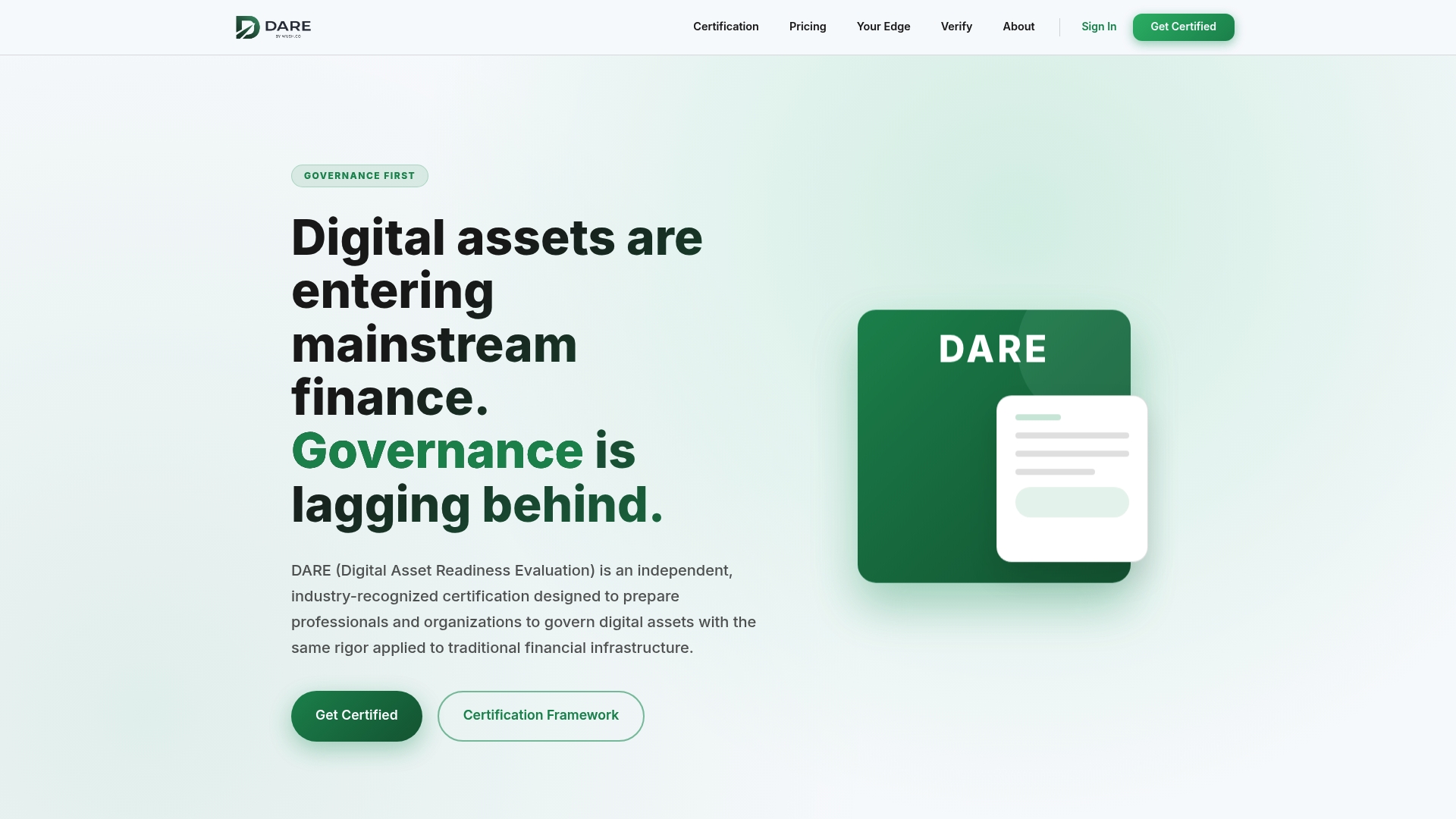
Experience Wush’s transparent progress tracking and self-paced assessments that align with the latest regulatory standards. Visit DARE by Wush to access a trusted certification pathway that transforms compliance from a checklist into an organizational control. Take the next step by exploring our platform and start certifying your team’s readiness for the digital finance era today.
Frequently Asked Questions
What is the key feature of Wush’s Digital Asset Readiness Evaluation?
Wush’s Digital Asset Readiness Evaluation offers a structured assessment framework that covers essential areas such as regulatory, custody, accounting, compliance, and strategy. This framework enables teams to map controls to enterprise functions effectively, making it easier to demonstrate governance competency for digital assets. Users should consider this approach if they want a comprehensive view of their governance capabilities for digital assets.
How does Wush compare to its competitors in terms of progress tracking?
Wush provides detailed metrics on module completion and assessment performance, which is essential for auditability and internal reporting. While other alternatives might have their strengths, the specific focus on progress tracking in Wush caters well to organizations that require measurable evidence for board briefings. Teams needing this level of detail will find Wush advantageous.
What are the advantages of Wush’s verifiable digital credential?
Wush’s verifiable digital credential is anchored to blockchain technology, providing tamper-resistant proof of completion that organizations can attach to external profiles, like LinkedIn. This feature not only enhances credibility but also reduces internal resistance when credentialing contractor teams or external auditors. Organizations aiming to standardize their governance capabilities should leverage this credential for improved recognition.
Can I use Wush if my team is concerned about subscription pricing?
Wush operates on a subscription pricing model, which includes renewal fees that may increase long-term costs for teams. Organizations should factor this into their training budgets when considering long-term engagement with Wush, especially if budget management is a priority.
What sets Wush apart from other certification frameworks?
Wush positions itself as a vendor-neutral, continuously updated certification framework that integrates governance assessment with verifiable credentials linked to organizational pathways. This focus on continuous improvement and adaptation to regulatory changes distinguishes it from certification programs that offer static checks. Teams looking for a dynamic solution for digital asset governance should consider Wush’s approach.