
Top 3 certifieddigital.org Alternatives 2026

Finding a digital asset governance certification that issues verifiable credentials, stays current on regulation, and adapts to different teams is difficult. Many options lack modular training, do not provide blockchain-backed certificates, or have confusing or enterprise-only pricing. This comparison details features, costs, and integration support across top alternatives so compliance teams and organizations can choose the right certification for their needs.
Table of Contents
DARE - Digital Asset Readiness Evaluation
At a Glance
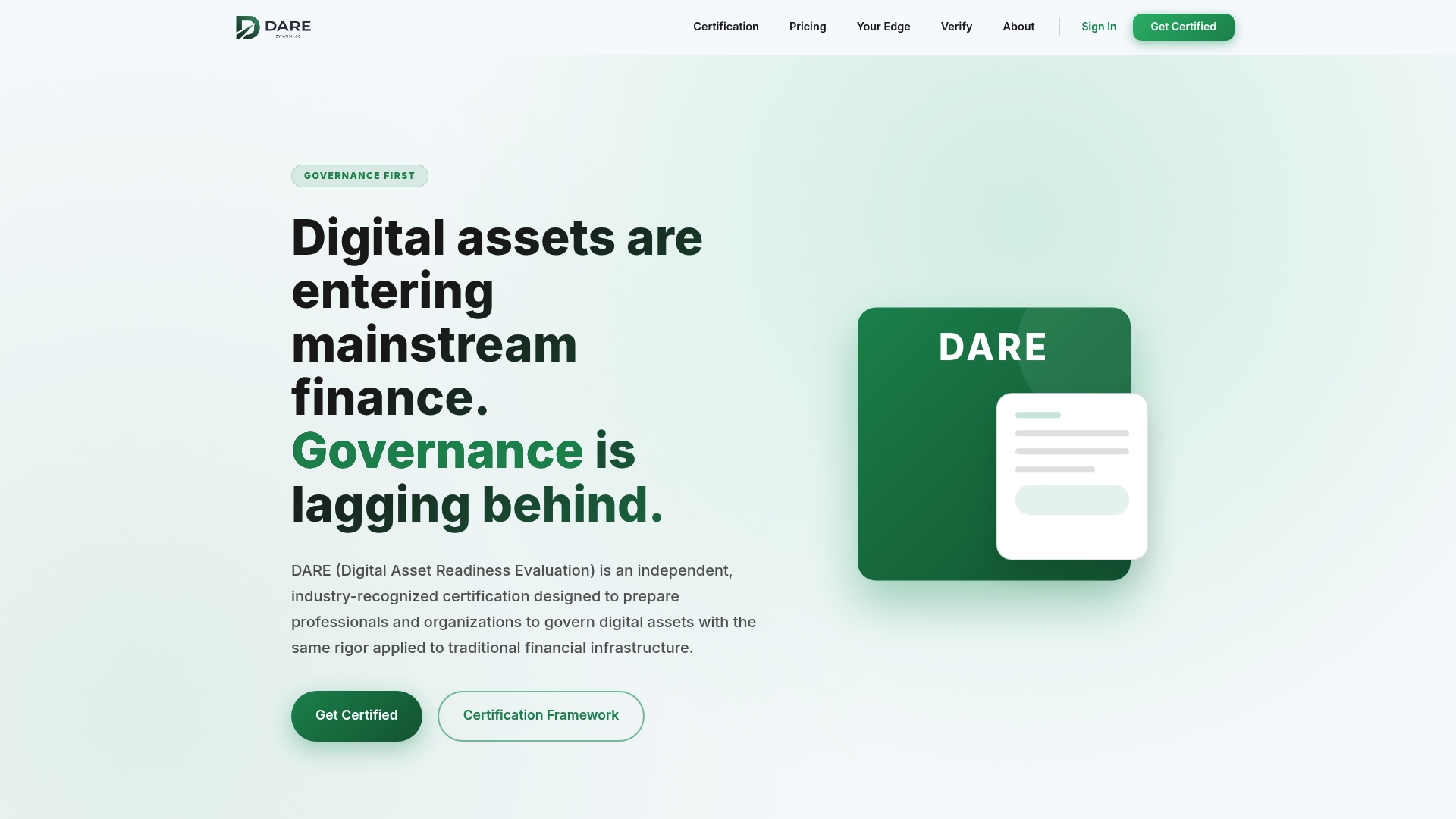
$399 first year with a $199 annual renewal is required for the certification. The program was developed by Wush.co in collaboration with the Asia Blockchain Association. DARE target governance gaps across finance, legal, compliance, technology, and executive functions. The credential is issued as a verifiable digital record supported by blockchain technology.
Core Features
DARE use a structured assessment framework that covers regulation, custody, accounting, compliance, and strategy, and it tracks progress through modular, self paced learning with assessments and a final certification. The program includes continuous standard updates to reflect regulatory and technological changes and offers a verifiable digital credential suited to professional profiles. International collaboration and vendor neutrality inform the syllabus and assessment scope.
Key Differentiator
The standout element is the industry-recognized, vendor-neutral certification model combined with a continuous update cadence tied to evolving regulatory standards and modular training. That design keeps the credential aligned with compliance expectations while letting organizations train cross-functional teams on specific governance controls.
Pros
The certification enhances credibility for professionals and organizations by producing a verifiable digital credential that can be linked to public professional profiles. The assessment framework applies across multiple enterprise functions, so finance, legal, compliance, and technology teams share a common governance baseline. Ongoing updates mean the curriculum and standards evolve with regulation and operational practice, which helps maintain relevance for internal audits and external reviews.
Cons
- The $399 first year cost, followed by a $199 annual renewal, may be a barrier for some individuals or small firms.
Who It’s For
DARE fits enterprises and professionals responsible for digital asset governance, including treasury, risk, legal, compliance, and information security roles. It also suits executives who must certify governance controls for regulators or clients. The program is governance focused and does not cover investment strategies or asset management.
Unique Value Proposition
A verifiable credential recorded via blockchain plus an annual renewal model creates an auditable lifecycle for digital asset governance qualifications. That combination reduces the administrative friction of proving governance readiness to regulators and clients while creating a clear renewal cadence for compliance teams.
Real World Use Case
A financial institution completes DARE to document governance readiness for digital asset custody and to show that cross functional staff completed standardized training. The certification then becomes part of vendor selection materials and regulator submissions. Staff training records and the verifiable credential help coordinate internal controls across departments.
Pricing
$399 for the first year, then $199 per year to renew. Enterprise pricing is customizable for organizational deployments and bulk enrollment.
Website: https://dare.wush.co
Sygna
At a Glance
According to the company, Sygna was the first Travel Rule solution to receive ISO/IEC 27001 certification. The vendor also states GDPR compliance for data privacy. Sygna packages modular components such as Sygna Bridge, Hub, and Gate to move transaction information and compliance checks between VASPs.
Core Features
Sygna combines modular crypto AML compliance components with Travel Rule protocol integration and protocol interoperability. It integrates with protocols like TRISA and Veriscope while feeding blockchain analytics and sanctions screening from providers such as Chainalysis and Elliptic. The platform emphasizes enterprise information security and data privacy controls tied to the certification claim.
Key Differentiator
The platform’s standout claim is that its Travel Rule tooling carries the ISO certification noted above, paired with broad protocol interoperability and many third party analytics integrations. That combination aims to reduce custom integration work for exchanges and custody providers. For teams that must connect to multiple analytics vendors or protocols, this is the distinct operational angle.
Pros
The security posture centers on the vendor reported ISO/IEC 27001 certification, which signals a formal information security management approach. Modular architecture lets VASPs deploy only the components they need, for example using Sygna Bridge to share travel rule messages while leaving other controls to existing tooling. Wide integration options for blockchain analytics and sanctions screening reduce the effort of adding third party monitoring.
Cons
- Market feedback or third party reviews are not provided, which limits independent assessment of real world performance.
- Publicly available, detailed feature comparisons and user reviews are limited, making side by side evaluation harder for buyers.
- The platform targets VASPs and crypto enterprises, so it may not fit individual practitioners or noncrypto organizations.
When It May Not Fit
Smaller startups without engineering teams may find implementation and maintenance burdensome. Organizations that need out of the box, low touch compliance tools may prefer simpler hosted services. Noncrypto businesses with unrelated compliance needs will likely find the offering misaligned with their workflows.
Notable Integrations
- Chainalysis
- Elliptic
- Merkle Science
- Coinfirm
- Dow Jones
- GDPR compliance tools
Who It’s For
Crypto exchanges, wallet providers, and other VASPs that must comply with global AML rules and the Travel Rule will find the product relevant. Teams that operate across jurisdictions and need multiple analytics providers will benefit most. Organizations that can invest in integration and operations will see the platform’s architecture pay off.
Real World Use Case
A crypto exchange integrates Sygna Bridge to automate Travel Rule reporting across multiple jurisdictions. The exchange routes transaction metadata through the Bridge and uses Chainalysis and Dow Jones screening before completing settlements. That flow reduces manual handoffs and centralizes audit trails for compliance teams.
Pricing
Pricing is not explicitly specified. The vendor lists customized pricing and typically scopes costs to customer size and integration needs. Prospective buyers should plan for licensing and implementation estimates during vendor discussions.
Website: https://sygna.io
Certifier
At a Glance
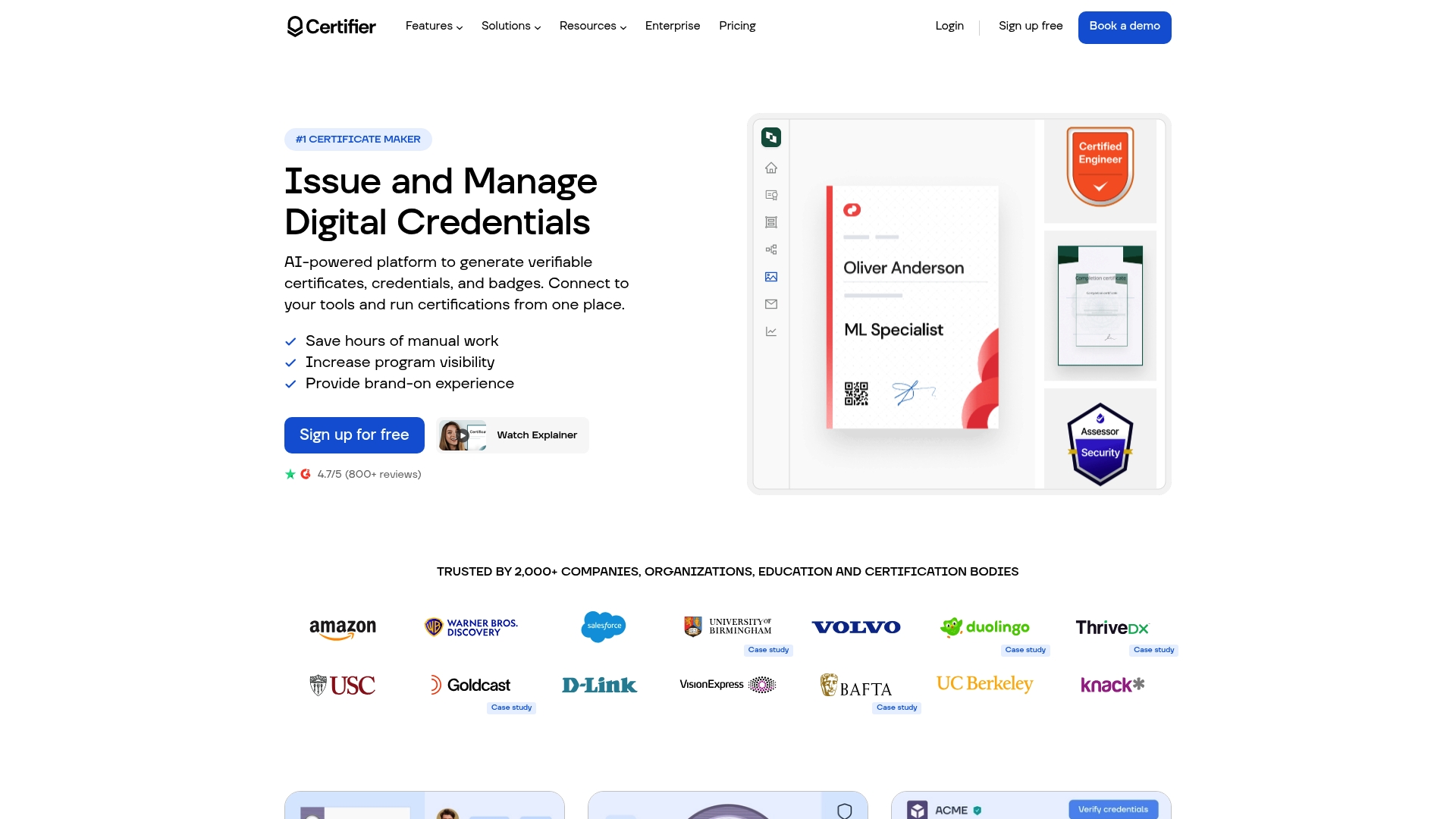
Certifier reports being trusted by over 2,000 organizations. The platform combines automated credential issuance with branded portals and recipient wallets. It targets institutions and enterprises that need verifiable certificates, bulk generation, and social sharing tools.
Core Features
The platform issues verifiable digital certificates, badges, and credentials while supporting bulk certificate generation and PDF or CSV exports. It includes a drag-and-drop template editor, white-label domains, automated email distribution, dynamic QR codes, credential lifecycle controls, and analytics for engagement tracking. The vendor advertises security and compliance claims including GDPR, ISO 27001, and SSL hosting.
Key Differentiator
Certifier pairs AI-powered design and automation with broad connectivity to external tools. That mix reduces manual certificate workflows and lets teams push events into credential workflows through APIs, webhooks, or automation platforms. The combination fits organizations that need both templated design and high integration reach.
Pros
High automation reduces manual workload and errors by handling design templates, bulk exports, and scheduled distribution. Extensive customization and white-label branding let organizations match certificates to corporate identity and publish them on custom domains. Strong connectivity via Zapier, Make, and Pipedream plus direct API and webhooks supports common workflows, and built-in analytics tracks sharing and recipient engagement.
Cons
- Some users report the interface feels complex at first and requires time to learn.
- Advanced customization features may need technical knowledge or support to implement fully.
- Pricing appears tailored to enterprise customers and may feel costly for small organizations.
When It May Not Fit
Certifier may not fit teams that need an ultra-simple, out-of-the-box certificate flow for occasional events. Small organizations with tight budgets could find enterprise pricing difficult to justify. Teams lacking technical resources may struggle with the initial setup and deeper API integrations.
Notable Integrations
Certifier lists direct connections and automation platforms that extend workflows. Notable integrations include:
- Zapier
- Make
- Pipedream
- Google Forms
- Kajabi
- Circle
- HubSpot
- Zoom
Who It’s For
Organizations seeking automated, customizable, and verifiable digital credential solutions will get the most value. Typical buyers include educational institutions, corporate training departments, event organizers, and online learning platforms. Teams that plan to use APIs or automation platforms will benefit from the integration options.
Real World Use Case
A university automates diploma issuance and manages ongoing credential updates through API and Zapier workflows. Recipients receive branded certificates via email and can share them on social channels. The institution then uses analytics to measure engagement and verify credentials instantly with QR codes.
Pricing
Pricing is not publicly listed in detail. The product data indicates enterprise-focused pricing and suggests custom quotes for larger deployments. Smaller organizations should request a tailored proposal and compare expected volume costs.
Website: https://certifier.io
Comparison of alternatives
In this comparison, the options presented address specific needs in digital asset certification and governance, sharing unique strengths suited to different requirements.
Strength in integration
Certifier demonstrates a distinct edge in integration and workflow automation. Its array of features, including webhooks, APIs, and third-party app integration, allows organizations to embed credential issuance into existing systems. This capability provides Certifier a significant advantage for teams seeking highly automated and connected solutions, especially those handling large-scale credential management.
Specialization in compliance
Sygna excels in compliance-driven solutions to support cryptocurrency ecosystems. Through its highly modular design and interoperability with tools like TRISA and Veriscope, it accommodates extensive travel rule compliance needs. Teams requiring transaction monitoring across multiple jurisdictions will value Sygna’s dedicated capabilities in this domain.
Best fit
- Ideal for enterprises in need of ongoing governance-focused certifications to maintain compliance, DARE offers structured accreditation with continual updates aligned with regulatory developments.
- Cryptocurrency service providers focusing on travel rule compliance benefit significantly from Sygna’s interoperability features and protocol integrations.
- Educational and professional organizations valuing custom-branded, verifiable credentials will find Certifier’s advanced integration tools ideal for creating cohesive lifecycle workflows.
Our pick
For entities focusing on governance quality and digital asset compliance with a mechanism that continuously reflects evolving standards, DARE ranks as the superior option. However, for institutions that prioritize large-scale automation or extensive compliance integration, alternatives like Certifier or Sygna may prove advantageous in specific scenarios.
Digital asset governance certifications vary in approach, features, and pricing. Below is a comparison to help choose the right option for professional needs.
| Product Name | Core Feature | Key Differentiator | Pricing | Notable Limitation |
|---|---|---|---|---|
| DARE | Structured modular learning with certification | Vendor-neutral with ongoing updates | $399 first year, $199 renewal per year | Certification cost may be a barrier for small firms |
| Sygna | Modular AML compliance tools | ISO certification and wide protocol integration | Price not published | Limited feedback on real-world performance |
| Certifier | Automated credential issuance and branding | AI-powered design with extensive integrations | Price not published | Initial complexity and advanced features need technical knowledge |
Challenges of Finding Certifieddigital.org Alternatives for Digital Asset Governance
Many finance professionals, legal advisors, and compliance teams face the challenge of filling governance gaps in digital asset management while keeping up with regulatory changes. The Digital Asset Readiness Evaluation (DARE) by Wush offers a clear solution for these concerns. Its modular, vendor-neutral certification covers custody, risk, compliance, and legal controls, all supported by blockchain-backed credentials.
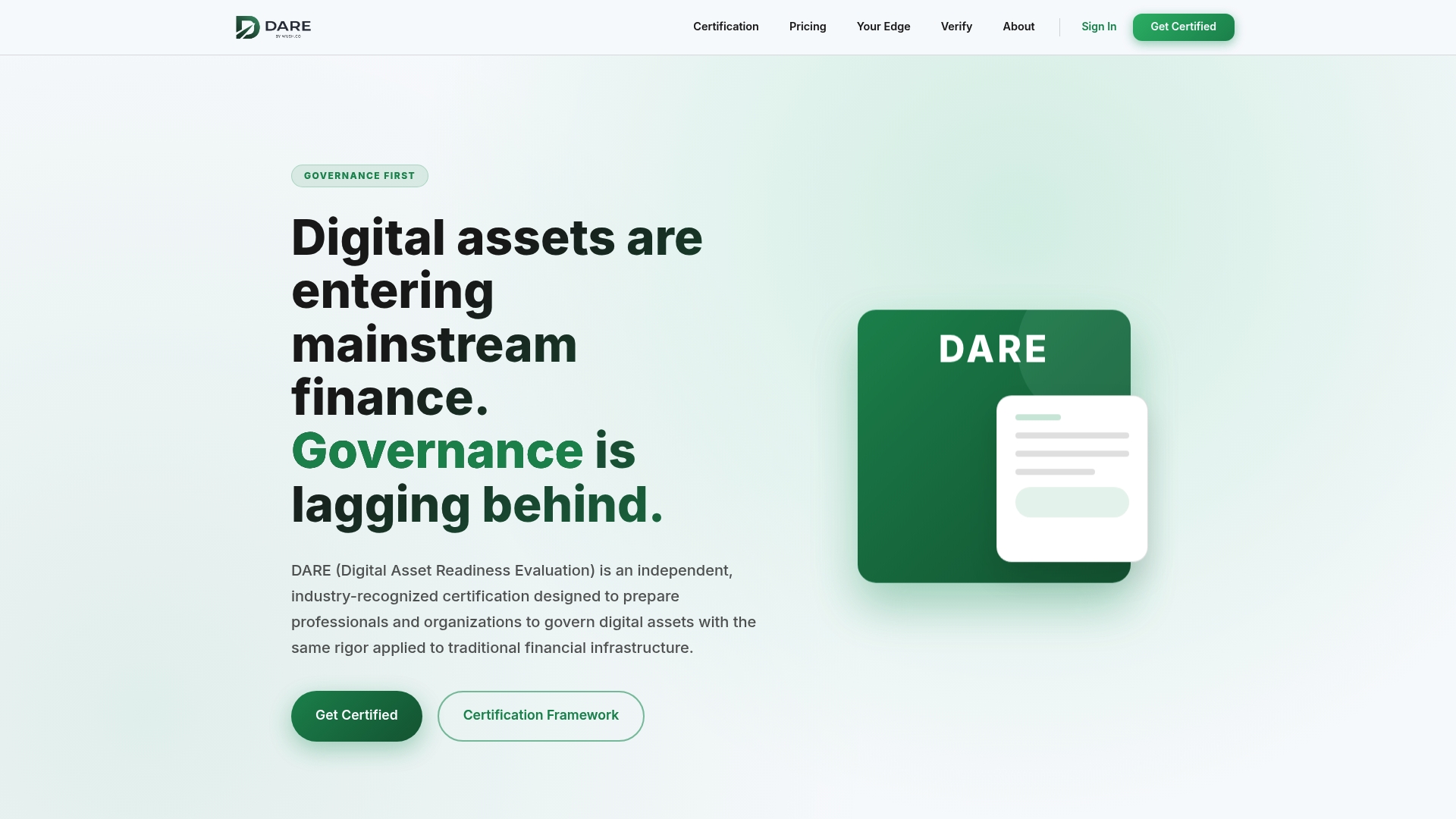
For professionals and enterprises seeking a trusted certification platform that stays current through annual renewals, Wush simplifies managing governance readiness. Visit DARE by Wush to review the structured assessments and gain a verifiable credential that supports internal audits and regulator submissions with confidence.
FAQ
How does Wush support digital asset governance certification?
Wush provides a structured assessment framework that covers regulation, custody, accounting, compliance, and strategy. This framework includes modular, self-paced learning, assessments, and a final certification, making it ideal for cross-functional teams. Users can expect a comprehensive approach to digital asset governance education.
What is the difference between Sygna and Wush?
Sygna claims to be the first Travel Rule solution to receive ISO/IEC 27001 certification, showcasing its focus on information security management. Wush, on the other hand, emphasizes a vendor-neutral certification model with continuous updates for regulatory compliance, making it more suitable for organizations needing a broader governance curriculum.
Which platform offers annual pricing for digital asset governance certification?
Wush charges $399 for the first year, followed by a $199 annual renewal fee. This pricing structure allows organizations to maintain compliance and keep staff updated on evolving regulations effectively.
Can I expect customizable training options with Wush?
Yes, Wush provides modular training suited for various enterprise functions, allowing organizations to adapt the training to their specific governance needs. This flexibility helps ensure that all relevant teams receive appropriate education without overwhelming them with unnecessary content.
How does Wush’s credentialing support regulatory needs?
Wush issues a verifiable digital credential recorded via blockchain, creating an auditable record of compliance readiness for regulators. This feature helps streamline communication with regulatory bodies while maintaining transparent governance practices.